



تاريخ النشر: 15 July 2026
مدة القراءة: 12 دقيقة
المراجع: Simon Scrapes, Founder
Why Industrial Batch Curing Oven Prices Vary So Widely in 2026
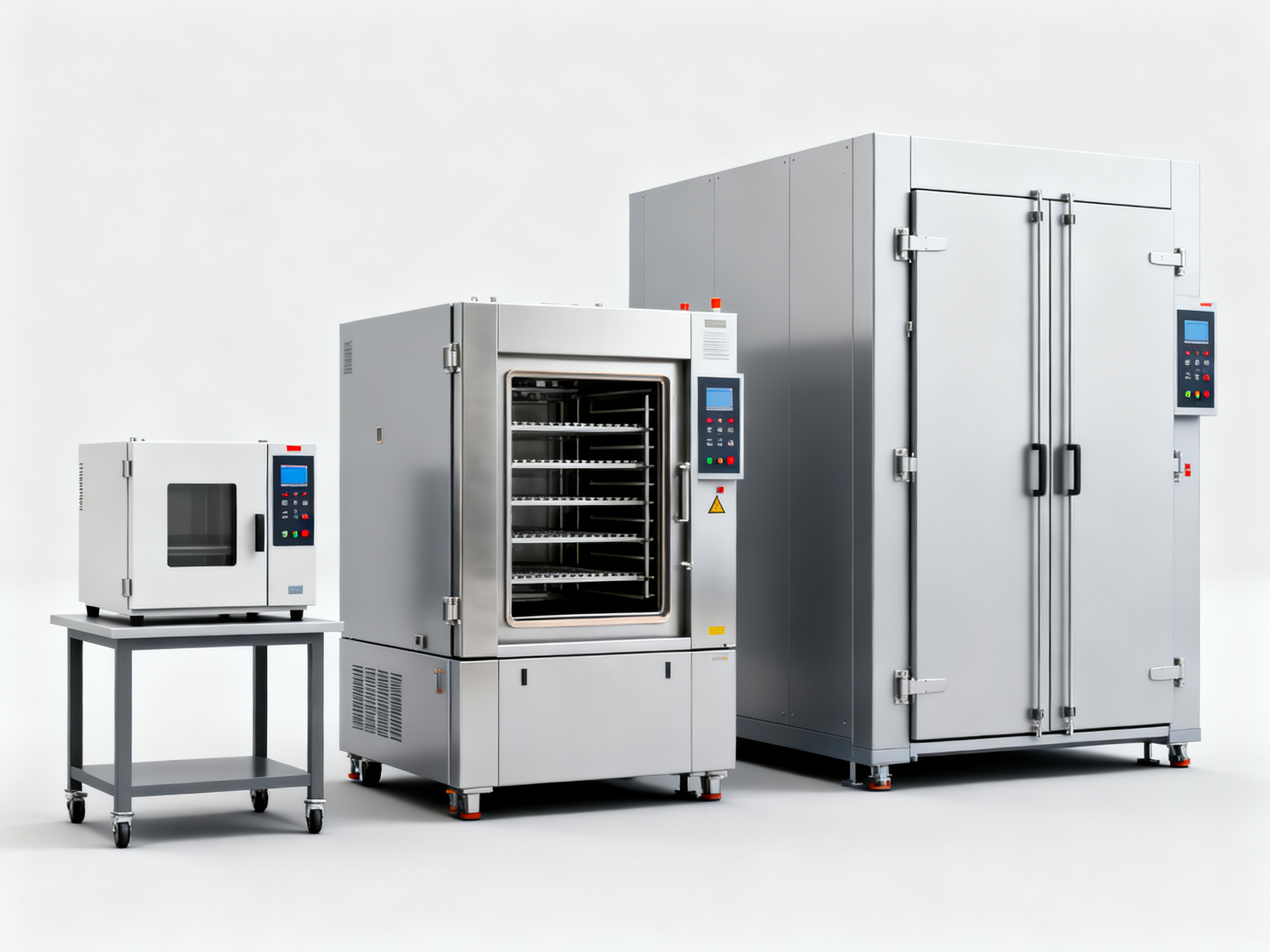
Picture this. You search for batch curing ovens for sale and within minutes you’re staring at options that make your head spin. A $3,000 tabletop lab oven sits next to a $150,000 walk-in curing chamber. Used paint finishing units blend into aerospace-grade validated systems. Cerakote curing setups look almost identical to semiconductor thermal processors on a spec sheet.
And every vendor swears their industrial curing oven price is the most competitive.
Here’s the thing. Those ovens might share the same basic concept, but they’re worlds apart when it comes to the stuff that actually matters: temperature range, chamber uniformity, airflow design, load capacity, controls, certifications, and what happens when something goes wrong on a production run.
Size matters, sure. But not as much as you’d think.
The real price drivers are the specs behind the cabinet. Temperature uniformity requirements, load mass, automation complexity, safety certifications, and the consequences of a bad cure in your specific application. A small batch curing oven for R&D work costs a fraction of what you’d pay for a validated industrial curing oven that aerospace or automotive manufacturers need.
So how do you actually figure out what you should pay?
This guide cuts through the noise. By the time you’re done, you’ll know where prices actually sit in 2026, what variables change those numbers, how your application drives the right configuration, and whether buying new or used makes more sense for your situation.
We’ll also look at total cost of ownership, because the purchase price is only part of the story.
What This Guide Covers:
- Typical price bands for different oven types and sizes
- The specific factors that change supplier quotes
- Application-based pricing for Cerakote, paint, electronics, and industrial parts
- New versus used: when each option actually makes sense
- Total cost of ownership beyond the sticker price
نبذة عن المؤلف
Jace Liu is a thermal processing specialist with over a decade of hands-on experience in SMT manufacturing, precision curing oven systems, and thermal process engineering for electronics production environments. His technical expertise spans temperature profile optimization, thermal uniformity testing, and compliance with industrial standards for conformal coating, adhesive curing, and powder coating applications. His work bridges equipment procurement and technical specification, offering practical guidance to manufacturers navigating industrial oven selection and integration. [Author credentials pending verification before publication.]
What Industrial Batch Curing Ovens Typically Cost in 2026
Here’s what surprises most buyers. You search for “batch curing oven price” and suddenly you’re looking at a range from $3,000 to $250,000. And every single listing claims to be competitive.
So what’s the actual spread in 2026?
It depends on what you’re curing, how precisely you need the temperature controlled, and whether anyone will inspect your work after the fact. Those three factors alone can triple the price of two ovens that look nearly identical on paper.
Let me break down where prices actually sit right now.
Price Bands by Oven Type and Size
The table below shows what you can expect to pay in 2026, based on current market data and what we’re seeing in procurement discussions.
| Oven Category | Typical Chamber Size | 2026 Price Range | Best Fit Applications | Common Exclusions |
|—|—|—|—|—|
| Small Batch / Lab Oven | 3’x3’x3′ to 4’x4’x6′ | $8,000 – $25,000 | Prototypes, R&D, small-batch electronics | Advanced controls, validation docs |
| Mid-Size Industrial Curing Oven | 5’x5’x8′ to 6’x6’x10′ | $25,000 – $80,000 | Powder coating, paint, adhesives, mid-volume production | Custom airflow, extended warranties |
| Large Custom Batch Oven | 8’x8’x12′ to 10’x10’x20′ | $80,000 – $150,000 | High-volume industrial batches, automotive parts | Site prep, ductwork, gas lines |
| High-Spec Validated System | Variable | $100,000 – $250,000+ | Aerospace, medical devices, defense contracts | Full documentation package, IQ/OQ/PQ |
رؤية «برو»: Two ovens with identical chamber dimensions can differ by $40,000 or more. Why? The gap usually comes down to airflow uniformity (high-velocity air knives versus basic circulation fans), controller sophistication (basic PID versus PLC with touchscreen HMI), insulation quality and thickness, safety certifications (UL, NFPA 86), and validation documentation packages. When you’re comparing quotes, make sure you’re comparing the same specification, not just the same cabinet size.
Why Online Prices Can Mislead You
I see this happen all the time in procurement. A buyer finds a small batch curing oven for $8,500 online and uses that as their baseline. Then they get a real quote for their production floor and it’s $45,000.
What changed?
The online listing probably excludes several cost components that matter in real-world applications. Here’s what often gets left off the sticker price:
- Freight and rigging: Industrial ovens are heavy. A 6’x6’x10′ unit can weigh 3,000 to 5,000 pounds. Freight alone can run $2,000 to $8,000 depending on distance and whether you need a crane.
- Installation and commissioning: Someone needs to level the oven, connect utilities, run exhaust ductwork, and validate performance. This typically adds 20 to 30 percent to the project total.
- Validation documentation: If you’re in aerospace, automotive, or medical devices, you’ll need IQ, OQ, and PQ protocols. That documentation work alone can add $5,000 to $30,000 depending on complexity.
- Exhaust systems: Ovens curing paints, powders, or solvents need proper exhaust. The oven price might not include the thermal oxidizer or catalytic converter.
- Spare parts packages: Most manufacturers offer optional spare parts kits. Budget $1,000 to $5,000 for day-one maintenance items.
The lesson here? Always ask suppliers for a total installed cost before you make comparisons. A cheap oven with expensive installation isn’t a deal.
Regional Variations Worth Knowing
Prices vary significantly by manufacturer origin in 2026. Chinese manufacturers offer batch curing ovens from $1,280 to $15,300 for basic models. Indian manufacturers range from $1,800 to $6,000. These prices reflect different validation standards, warranty structures, and component quality.
Western-built ovens from established manufacturers like Global Finishing Solutions, Despatch, or Wisconsin Oven start higher but typically include Western safety certifications, easier spare parts access, and documentation that meets North American and European compliance requirements.
Used equipment is another consideration. Expect to pay 30 to 60 percent of new pricing for machines in decent condition, though validated systems with full documentation command a premium that’s closer to 70 to 80 percent of new.
Getting Accurate Quotes for Your Situation
The fastest way to get realistic pricing is to specify your actual requirements upfront. Temperature range, uniformity tolerance, chamber dimensions, load mass, automation level, and compliance certifications all feed into the final number. Vague inquiries get vague answers, and sometimes those vague answers hide significant cost escalations.
If you’re comparing quotes from multiple suppliers, make sure each one includes the same exclusions. Otherwise you’re not really comparing prices. You’re comparing different products with different capabilities.
The good news? There’s plenty of competition in the market right now. Lead times have stretched to 8 to 12 weeks for custom systems, but standard models ship faster. That gives buyers some leverage if you’re flexible on delivery timing.
Now, let’s look at the specific factors that actually drive those final numbers in supplier quotes.
Price Bands by Oven Size and Production Requirement
The last section gave you the big picture on where prices sit in 2026. Now let’s get specific about how your production volume should drive your oven selection. Because here’s something most vendors won’t tell you: buying an oven that’s too big for your needs is just as expensive as buying one that’s too small.
Too small means bottlenecks, overtime shifts, and parts sitting waiting for curing cycles. Too big means you’re heating empty space and wasting energy dollars every single shift.
The sweet spot? An oven that matches your actual production flow.
Matching Oven Size to Production Volume
Here’s the sizing matrix we use when helping manufacturers narrow down their options. Think of it as a starting point, not a hard rule.
| Production Level | Chamber Size Range | Price Band | Best Fit | Key Considerations |
|—|—|—|—|—|
| Prototype / Lab / R&D | 3’x3’x3′ to 4’x4’x6′ | $8,000 – $25,000 | Testing, small runs, repair shops | Basic controls; limited automation |
| Low-Volume Production | 4’x4’x6′ to 5’x5’x8′ | $20,000 – $45,000 | Job shops, specialty coating, pilot lines | Single-door; manual loading |
| Mid-Volume Production | 5’x5’x8′ to 6’x6’x10′ | $35,000 – $80,000 | Powder coating, industrial paint, electronics assembly | Double-door pass-through; PLC controls |
| High-Volume Industrial | 8’x8’x12′ to 10’x10’20’ | $80,000 – $150,000 | Automotive tiers, aerospace suppliers, large-batch coating | Heavy-duty construction; automated loading options |
| Validated / Compliance-Driven | Variable per specification | $100,000 – $250,000+ | Aerospace, medical devices, defense contractors | Full documentation; IQ/OQ/PQ included |
Notice I said “starting point.” Your actual needs depend on a few factors that go beyond just cubic feet.
The Hidden Cost Drivers Inside Each Size Category
Load size matters, but so does what you’re putting in the oven. Thick steel brackets behave differently than thin aluminum PCBs. Dense metal parts pull more heat energy and need longer dwell times. That changes your effective throughput even if the chamber dimensions stay the same.
Rack configuration is another one. If you’re loading parts on carts or trolleys, you need clearance space for airflow. Pack the oven too tight and you’ll get hot spots. Leave too much empty room and you’re back to wasting energy.
Door design affects your workflow more than most people expect. A single-door oven works fine if you’re loading from one side. But if you’re running a continuous flow with staging areas on both ends, a pass-through (double-door) design cuts your turnaround time significantly. That extra door? Maybe $5,000 to $15,000 depending on the configuration.
Thermal recovery time is where things get expensive. Every time you open the door, heat escapes. Bigger ovens take longer to recover. If you’re running tight cycle times with multiple batches per shift, look for ovens with fast-recovery heating systems. That might mean higher upfront costs, but the throughput gain often pays back within months.
Why Application Drives the Price Within Each Size
Electronics manufacturers typically need tighter temperature uniformity (often ±3°C or better) because conformal coatings and adhesives are sensitive to over or under-cure. That precision drives you toward better controllers and multi-zone heating, which adds cost.
Aerospace and automotive buyers pay more for something else: documentation and traceability. Every cycle needs to be recorded. Every calibration needs to be traceable to NIST standards. That documentation package alone can add $15,000 to $40,000 to a system that might otherwise look similar on paper to a non-certified unit.
Powder coating operations care more about airflow design and exhaust capacity. Getting even coverage across complex part geometries requires thoughtful ductwork and recirculation design. Those systems cost more upfront but reduce rework rates dramatically.
We help customers match these requirements to actual systems almost weekly. The mistake we see most often is buyers selecting based on chamber size alone and then being surprised by the quote. Two ovens with identical interior dimensions can differ by 30 to 40 percent depending on what goes inside them.
رؤية «برو»: Before you ask any supplier for a quote, know your production rate (parts per hour or batches per shift), your cure temperature and tolerance, your load mass, and your documentation requirements. Those four specs alone will narrow your options faster than anything else and prevent the sticker shock that comes from comparing mismatched quotes.
Quote Factors That Change the Final Industrial Curing Oven Price
Here’s where things get interesting. You get three quotes back for what looks like the same oven. One is $38,000. One is $52,000. One is $67,000.
The cheapest one isn’t necessarily a bad deal. And the most expensive might actually be the best fit. The problem is they’re probably not quoting the same thing.
That $38,000 oven might exclude data logging. The $52,000 unit might not include installation. And that $67,000 system probably has multi-zone temperature control and NIST-traceable calibration documentation. You won’t know until you dig into the specs.
From what I’ve seen working with procurement teams on thermal equipment quotes, the fastest way to get comparable batch curing oven price proposals is to specify exactly what you need upfront. Vague inquiries get vague answers, and vague answers hide cost escalations that show up later when you’re already committed.
The Technical Specs That Drive the Numbers
Your actual requirements should drive the quote. Here’s what actually moves the needle:
Temperature range and uniformity tolerance
A standard industrial curing oven might give you ±10°C uniformity at 200°C. But if you’re curing conformal coatings on circuit boards, you probably need ±3°C or tighter. That precision requirement alone can add $10,000 to $20,000 to the system because you need multi-zone heating with independent PID loops, not a single heating element with a basic thermostat.
Chamber dimensions and load mass
Two ovens with identical interior dimensions can price differently based on what you’re putting inside them. A 4’x4’x4′ chamber that’s rated for 500 pounds of aluminum parts costs less than the same chamber sized for 2,000 pounds of steel brackets. The structure, heating elements, and ductwork all scale with load capacity.
Heat-up time and thermal recovery
If you’re running tight cycle times with multiple batches per shift, heat-up speed matters. A standard system might take 45 minutes to reach 180°C. A fast-recovery unit with higher-watt density heaters gets there in 20 minutes. That throughput gain has a price, but it often pays back within months if you’re running high volumes.
Airflow design
Basic circulation fans versus high-velocity air knives represent a significant cost difference. For simple paint drying, standard airflow works fine. For curing powder coatings on complex part geometries, you need aggressive recirculation with adjustable louvers to get even coverage and avoid hot spots.
Controller sophistication
A basic PID controller with a digital display handles simple jobs. But if you need recipe management, touchscreen HMI, PLC integration, and data logging for quality records, you’re looking at $5,000 to $15,000 more for the automation package. Electronics and aerospace buyers almost always need this level of control.
Compliance and Facility Factors
Your facility and regulatory environment add their own cost layers:
Voltage and electrical standards
Three-phase 480V systems for North American plants differ from 400V European installations. Some manufacturers build to one standard and modify for others. Others start from scratch. Make sure your quote matches your facility’s electrical infrastructure, or budget $3,000 to $10,000 for conversion.
Exhaust and ventilation
Ovens curing paints, powders, or solvents generate Volatile Organic Compounds (VOCs). Your local air quality authority might require a thermal oxidizer or catalytic converter on the exhaust. The oven price might not include this, and it can easily add $8,000 to $25,000 to your project.
Fire safety certifications
NFPA 86 compliance is mandatory for ovens processing flammable materials in the US. European buyers need CE marking and EN 746 conformance. These certifications aren’t optional if you’re in aerospace, automotive, or medical devices, and the documentation work alone adds $5,000 to $20,000.
Factory and site acceptance testing
FAT (Factory Acceptance Testing) happens at the manufacturer before shipment. SAT (Site Acceptance Testing) happens at your facility after installation. Both verify temperature uniformity and safety systems. Some quotes include these, others charge separately. Budget $2,000 to $8,000 if they’re not bundled.
Custom Handling and Integration
If your workflow needs special handling, expect to pay for it:
- Rolling carts and trolley systems for heavy loads: $2,000 to $8,000
- Adjustable shelf racks for mixed part sizes: $1,500 to $5,000
- Rotating fixtures for complex part geometries: $5,000 to $15,000
- Heavy-load floors rated for fork truck loading: $3,000 to $10,000
- Integration with upstream or downstream equipment: $5,000 to $20,000 depending on complexity
None of these are included in a base quote unless you specify them. And if you’re comparing base quotes from different suppliers, you might be looking at four different products disguised as the same oven.
نصيحة من الخبراء: Before requesting quotes, prepare a one-page spec sheet that includes: chamber dimensions, maximum load weight, cure temperature and tolerance, uniformity requirement, batches per shift, voltage and phase, exhaust configuration, certifications needed, and whether you require FAT/SAT documentation. Suppliers who receive this level of detail will give you comparable quotes, which means you’re actually comparing prices instead of comparing different products.
Supplier RFQ Checklist
Use this checklist when requesting batch curing oven price quotes to ensure you’re comparing equivalent proposals:
| Specification | Include in RFQ | Notes |
|—|—|—|
| Chamber dimensions (internal) | Required | Length x Width x Height in inches or mm |
| Maximum load weight | Required | Pounds or kg per batch |
| Cure temperature range | Required | Minimum and maximum needed |
| Temperature uniformity tolerance | Required | ±5°C, ±3°C, ±1°C, etc. |
| Heat-up time requirement | Optional | Only if cycle time is critical |
| Workflow type | Required | Batch (single/double door) or conveyor |
| Voltage and phase | Required | 208V/3-phase, 480V/3-phase, 400V/3-phase |
| Certifications required | Required | NFPA 86, CE, UL, AMS 2750, etc. |
| Documentation package | Required | IQ/OQ/PQ, calibration records, test reports |
| FAT/SAT included | Required | Confirm what’s included and additional costs |
| Exhaust configuration | Required | Natural draft, forced, thermal oxidizer needed |
| Controller type | Optional | Basic PID, PLC/HMI, data logging requirements |
| Installation and commissioning | Required | Often quoted separately |
| Spare parts package | Optional | Budget $1,000 to $5,000 for day-one maintenance |
The more upfront detail you provide, the less likely you’ll get sticker shock after you commit. And if a supplier can’t meet your specifications, a detailed RFQ will tell you that before you’ve invested time in the evaluation.
Now that you understand what drives the numbers, let’s look at how your specific application changes the configuration and cost.
Application-Based Pricing: Cerakote, Paint, Electronics, and Industrial Parts
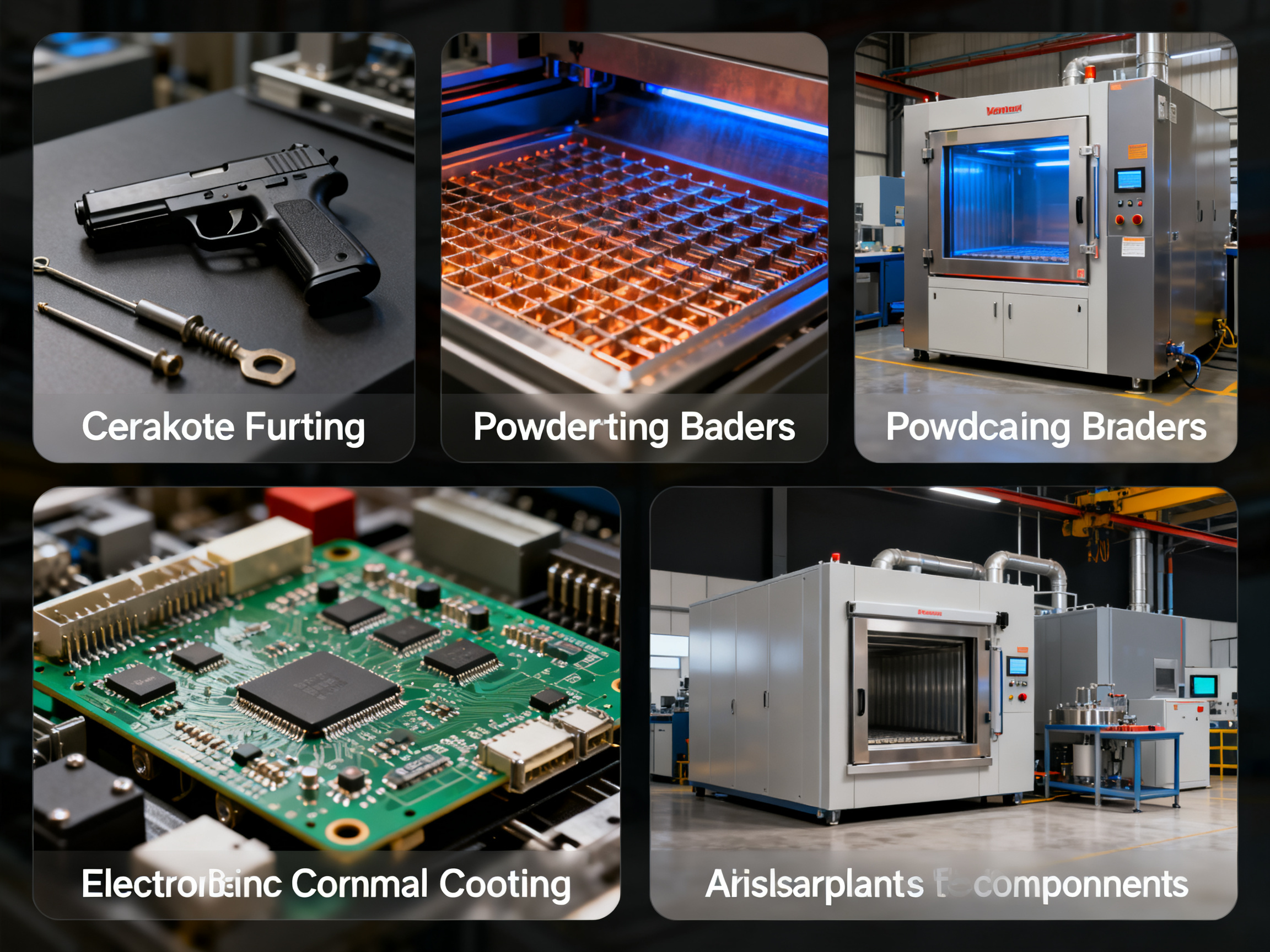
Here’s something I see constantly in procurement discussions. A buyer comes in wanting a “standard industrial curing oven” and within five minutes of questions, we realize they actually need three completely different machines for three different applications. The Cerakote gun finish on custom firearms, the powder coat on structural brackets, and the conformal coating on circuit boards all cure at different temperatures, with different tolerances, and for different consequences if something goes wrong.
That’s why application drives the configuration. And configuration drives the price.
Let me break down how your specific use case changes what you should actually be budgeting for.
Batch Curing Oven for Cerakote
Cerakote is a ceramic-based finish that gunsmiths, custom fabricators, and high-end manufacturers love for its durability and corrosion resistance. The catch? It cures at relatively low temperatures (around 250°F to 300°F) but requires seriously tight uniformity.
Why? Because Cerakote is thin. We’re talking 0.5 to 2 mils thickness. Any hot spot in your oven will cause the finish to cure unevenly, and uneven cure means inconsistent color, reduced hardness, and potentially a finish that chips faster than it should.
For Cerakote work, you can often get away with a smaller chamber. A 3’x3’x3′ to 4’x4’x4′ unit handles most custom firearms and small parts nicely. But you need that temperature uniformity, probably ±5°F or better.
A basic small batch curing oven in this range runs $8,000 to $18,000. But if you’re doing production volumes, you want multi-zone heating and a good recirculation system, which pushes you toward the $20,000 to $35,000 range.
The airflow design matters more than most Cerakote applicators realize. You need even distribution across all parts on your rack, not just general chamber temperature. Look for adjustable louvers and directional nozzles if you’re curing multiple parts per cycle.
Batch Curing Oven for Paint and Industrial Coatings
Paint and powder coating applications are where things get more complicated. Now you’re dealing with solvents, VOCs, higher cure temperatures, and often larger part geometries.
Powder coating typically runs 350°F to 450°F for 10 to 20 minutes. Solvent-based paints might need 250°F to 350°F with longer dwell times. The common thread? You need proper exhaust handling and safety controls that a basic lab oven simply doesn’t have.
NFPA 86 compliance becomes mandatory here. This standard covers explosion prevention for ovens processing flammable materials. Your quote should include pre-purge cycles, high-limit controls, and explosion-relief venting. Skip these and you’re courting trouble, especially if your local inspector shows up.
For industrial paint and powder coating work, mid-size ovens (5’x5’x8′ to 6’x6’x10′) run $35,000 to $80,000 depending on your exhaust system and automation level. Larger custom configurations for automotive or agricultural equipment manufacturers regularly hit $80,000 to $150,000.
One thing that surprises buyers: your exhaust system might cost as much as the oven itself. If you’re running solvent-based products, budget for a thermal oxidizer or catalytic converter. That adds $10,000 to $30,000 depending on size and local air quality requirements.
Electronics and Precision Industrial Curing
Electronics manufacturing is a different beast entirely. Conformal coatings, SMT adhesives, potting compounds, and encapsulants all require precise temperature control and documentation that other industries can often skip.
Temperature tolerances here are tight. We’re talking ±3°C or better for most semiconductor and PCB work. Some aerospace electronics applications require ±1°C uniformity.
The reason this matters so much: under-cure leaves adhesive tacky or coatingsoft. Over-cure bakes out critical properties and can damage temperature-sensitive components. Either way, you’re looking at scrap, rework, and potentially customer returns.
Electronics buyers also need traceability. Every cure cycle should be logged with timestamp, temperature profile, and operator ID. This isn’t optional if you’re supplying automotive or medical device customers. The documentation package alone can add $15,000 to $40,000 to your system.
For electronics and precision industrial curing, expect to invest $40,000 to $120,000 for a properly configured system. The upper end includes PLC controls with touchscreen HMI, multi-zone heating, data logging, and full IQ/OQ/PQ documentation.
We’ve helped customers spec systems for both scenarios. The Cerakote applicator who thought $12,000 would cover everything quickly realized they needed zone control for consistent results. And the electronics manufacturer who was looking at basic ovens discovered their aerospace customer wouldn’t accept anything without cycle traceability built in.
Application Comparison Table
| Application | Temperature Range | Airflow Needs | Compliance Considerations | Price Impact | Typical Chamber Size |
|—|—|—|—|—|—|
| Cerakote / Firearms | 250°F – 300°F | Moderate recirculation | Basic safety | Low to Medium | 3’x3’x3′ to 4’x4’x4′ |
| Powder Coating | 350°F – 450°F | High-velocity, directional | NFPA 86, exhaust system | Medium to High | 5’x5’x8′ to 8’x8’x12′ |
| Solvent-Based Paint | 250°F – 350°F | Forced exhaust, thermal oxidizer | NFPA 86, VOC abatement | High | 5’x5’x8′ to 6’x6’x10′ |
| Electronics / PCBs | 150°F – 300°F | Tight uniformity, multi-zone | IPC standards, traceability | High | 4’x4’x4′ to 6’x6’x6′ |
| Aerospace Components | 300°F – 500°F | Precise multi-zone control | AMS 2750, full documentation | Very High | Variable per spec |
| Adhesives / Composites | 200°F – 400°F | Even distribution, ramp control | Process validation | Medium to High | 4’x4’x6′ to 6’x6’x10′ |
Matching Your Application to Realistic Budget
The fastest way to blow your budget is to spec an oven for the wrong application. A $15,000 basic unit will frustrate you if you’re doing electronics conformal coating. A $90,000 validated system is massive overkill for Cerakote work.
Start with your cure temperature, your uniformity tolerance, and your documentation requirements. Those three specs alone will point you toward the right price band every time.
Now, let’s look at whether buying new or used makes more sense for your situation.
New vs Used Batch Curing Oven Price: When Each Option Makes Sense
So here’s a question I get at least once a month. “Should I buy new or save money with a used industrial batch curing oven?”
My honest answer? It depends on what happens if your oven fails during a production run.
Used batch curing ovens for sale can save you 30 to 60 percent on acquisition cost. That sounds great on paper. But if you’re running validated production where a single bad cure cycle means scrap, rework, and potentially losing a customer audit, that upfront savings can cost you way more down the road.
Let me break this down so you can decide what makes sense for your situation.
When Used Makes Sense
Used batch curing oven price drops are attractive in these scenarios:
Non-critical processes. If you’re doing low-stakes work like drying parts before packaging or basic paint flash curing, a used unit from the 1990s might honestly be fine. The consequences of a temperature drift are low.
Pilot operations. Testing new products before committing to full-scale production? Used lets you validate your process without tying up capital.
Backup capacity. Some manufacturers keep a cheap used unit as emergency backup. Fair enough, but test it regularly or you’ll discover it failed silently the moment you actually need it.
In-house maintenance capability. If you have experienced technicians who can troubleshoot heating systems, replace elements, and rebuild controllers, you can handle the refurbishment that used equipment often needs.
When New Is the Smarter Play
New industrial batch curing ovens cost more upfront, but they’re the safer choice when:
You’re in validated production. Aerospace, automotive, medical devices. Your customers audit your processes. A used oven with no calibration history, questionable heater condition, and aging controls creates compliance risk that voids the cost advantage pretty quickly.
You need tight uniformity. If your process requires ±3°C or tighter, older equipment probably won’t deliver consistently. Multi-zone PID control, which is standard on new systems, isn’t something you can easily retrofit.
Custom specifications. Walk-in chambers for unusual part geometries, specialized exhaust systems, PLC integration with your existing line. These almost always require new build.
Long-term parts support. Used ovens from defunct manufacturers leave you hunting for obsolete components. New systems come with warranty coverage and a parts supply chain you can actually rely on.
We’ve seen buyers get burned. They bought a “like-new” used unit for $18,000 that needed $8,000 in controller replacement, new door seals, and professional calibration before it would hold temperature reliably. That’s not a deal.
From Our Experience: Before signing on any used batch curing oven, verify these inspection points personally or hire someone qualified to do it. Check heater output for burned or uneven zones. Test the controller for accurate setpoint tracking. Inspect door seals for brittleness and heat loss. Request calibration records or budget for professional recalibration. Examine electrical wiring for corrosion or loose connections. And confirm the system meets current NEC or IEC safety standards. A 30-minute inspection can save you thousands in surprise repairs.
New vs Used Comparison
| Factor | Used Oven | New Oven |
|—|—|—|
| Acquisition Cost | 30% to 60% of new price | Full price, $15,000 to $250,000+ |
| Lead Time | Immediate to 4 weeks | 8 to 12 weeks for custom |
| Warranty | None or limited | Full manufacturer warranty |
| Customization | Limited to what’s available | Built to your specs |
| Documentation | Often incomplete | Full IQ/OQ/PQ available |
| Calibration History | Usually missing | NIST-traceable records |
| Risk Level | Higher (hidden problems) | Lower (tested before ship) |
| Best Fit | Pilot lines, backup, non-critical | Validated production, compliance |
The math gets interesting when you factor in total cost of ownership. Energy costs alone run $3,000 to $22,500 per year depending on oven efficiency. Older units typically guzzle more power. Factor in maintenance, downtime, and the cost of scrap from inconsistent cures, and sometimes the “expensive” new oven actually costs less over five years.
Your production stakes, maintenance capability, and budget constraints should drive this decision. There’s no universal right answer. But be honest with yourself about what a bad cure cycle actually costs you before chasing the used price tag.
Next up: let’s look at total cost of ownership beyond the purchase price, because that’s where a lot of buyers get surprised.
Total Cost of Ownership Beyond the Purchase Price
Here’s a number that surprises most buyers. Your industrial curing oven price tag is probably only about 25 to 40 percent of what you’ll actually spend over the oven’s lifetime. The rest? Energy bills, maintenance calls, calibration services, lost production when things break down, and the headache of scrap parts that didn’t cure right.
That’s what total cost of ownership (TCO) actually means. It’s everything that hits your budget after the forklift drops off the equipment and the delivery driver hands you the invoice.
For a standard industrial batch curing oven, you’re looking at a TCO of 2.5 to 4 times the purchase price over a 5 to 10 year lifespan Total Cost of Ownership Calculator. Do the math on a $50,000 unit, and you’re potentially spending another $75,000 to $150,000 before it’s done.
Energy: The Big Number You Can’t Ignore
Energy consumption accounts for 40 to 60 percent of your annual operating costs. That’s not a small line item. A typical mid-size electric batch curing oven runs about 50 to 100 kW and can cost $4,800 to $7,200 per year in electricity alone, assuming 300 operating days Powder Coating Oven Cost Analysis. Gas systems run a bit cheaper, around $4,200 to $5,400 annually for a 6’x6’x10′ unit, but prices fluctuate with natural gas markets.
Here’s the thing. Older ovens with basic insulation and simple circulation fans guzzle significantly more than modern high-efficiency units. Switching to better insulation, variable frequency drives on recirculation fans, and programmable temperature setbacks can cut your energy use by 40 to 60 percent over the equipment’s life. That high-efficiency model might cost 30 percent more upfront, but it often reduces your 5-year TCO by 30 percent Retrofit and Repair Cost Guide.
Maintenance, Calibration, and the Downtime Trap
Plan on spending 2 to 5 percent of your purchase price annually on preventive maintenance. For that $50,000 oven, that’s $1,000 to $2,500 every year for filters, gasket replacement, calibration checks, and general wear items.
Calibration matters more than most buyers realize until an inspector shows up or a customer asks for NIST-traceable records. Schedule professional calibration at least annually, more often if you’re in aerospace or automotive. Budget $500 to $2,000 per calibration visit depending on complexity.
But the real budget killer? Downtime. When your oven goes down during a production run, you’re not just losing the machine. You’re losing labor, missing ship dates, and potentially losing customers who can’t wait. For high-volume manufacturers running multiple shifts, even one day of unplanned downtime can cost more than a month of scheduled maintenance.
When Poor Curing Uniformity Hits Your Pocketbook
Inconsistent temperature distribution creates a cascade of expensive problems. Coating defects. Adhesion failures. Assembly reliability issues that show up months later in the field.
For electronics manufacturers, a single bad batch of conformal coating can mean scrapping expensive circuit boards or, worse, warranty claims that dwarf whatever you saved on a cheaper oven. We’ve seen buyers spend $12,000 on a budget unit and then lose $40,000 in scrap over six months because the temperature gradient across the chamber was all over the place.
This is where automation pays for itself. PLC controls with recipe management let you lock in optimal cure profiles and eliminate operator error. Data logging creates cycle records that satisfy customer audits without manual paperwork. Process traceability means when something does go wrong, you can pinpoint exactly what happened instead of scrapping an entire batch Industrial Oven Standards and Regulations.
TCO Calculation Framework
Here’s a simple starting point for estimating your 5-year TCO:
| Cost Component | 5-Year Estimate | Notes |
|—|—|—|
| Acquisition | $40,000 | Mid-size batch oven |
| Installation and Commissioning | $8,000 | Typically 20% of purchase |
| Energy | $25,000 | $5,000/year average |
| Maintenance | $10,000 | $2,000/year average |
| Calibration | $5,000 | $1,000/year average |
| Downtime (estimated) | $15,000 | Varies widely by operation |
| Total 5-Year TCO | $103,000 | Approx. 2.6x purchase price |
Notice I didn’t include scrap costs or rework. Those vary too much by application and process maturity to put a reliable number on. But add those in, and the gap between cheap equipment and right equipment gets even wider.
Ask suppliers for TCO data before you buy. Most won’t volunteer it, but the ones who stand behind their products will. If a vendor can’t or won’t discuss lifetime costs, that tells you something about what they’re really selling.
How to Compare Industrial Curing Oven Quotes Fairly
Getting three quotes doesn’t mean you’re comparing three equivalent options. Most buyers make the mistake of asking for quotes based on vague requirements, then assuming the lowest price wins. That’s how you end up with an oven that technically meets the spec on paper but creates nightmares in production.
Here’s my approach. Before you ever ask for a number, establish your baseline by normalizing key specifications across all proposals.
Quote Comparison Scorecard
Use this scoring framework to evaluate batch curing oven price proposals on equal footing:
| Evaluation Criteria | Weight | Supplier A | Supplier B | Supplier C |
|—|—|—|—|—|
| Chamber volume (cubic feet) | 10% | | | |
| Maximum temperature achieved | 10% | | | |
| Temperature uniformity guarantee | 15% | | | |
| Load capacity (lbs per batch) | 10% | | | |
| Controller type and features | 10% | | | |
| Documentation included | 15% | | | |
| Warranty coverage | 10% | | | |
| Lead time (weeks) | 5% | | | |
| Installation/services included | 15% | | | |
| Total Score | 100% | | | |
This forces you to score each vendor on the same criteria. A $38,000 quote that scores 70 out of 100 isn’t cheaper than a $52,000 quote that scores 95 out of 100.
Red Flags in Low-Price Quotes
Watch for these warning signs when comparing batch curing oven price proposals:
- Missing uniformity specification. If a quote doesn’t guarantee temperature distribution across the chamber, that’s a problem waiting to happen.
- Vague load ratings. “Suitable for industrial use” tells you nothing about actual weight capacity or part geometry limitations.
- No FAT/SAT mention. Factory and site acceptance testing protects you. Quotes that skip this step often hide deficiencies.
- Generic controller. Basic analog thermostats can’t deliver the precision modern processes require.
- Excluded documentation. IQ/OQ/PQ protocols aren’t optional for regulated industries. Adding them later costs multiples of the original quote.
- Short warranty. One year is standard. Anything less suggests the manufacturer doesn’t trust their own equipment.
What to Request From Each Supplier
Beyond the scorecard, ask for:
- Sample temperature uniformity survey (TUS) data from similar installations
- Reference list of three customers in your industry
- Detailed FAT procedure before shipment
- Spare parts pricing and availability for five years post-purchase
- Service response time commitments in writing
This sounds like a lot of work. It is. But skipping this step is how buyers end up with ovens that don’t perform, can’t be validated, and cost more to operate than they should.
The goal isn’t finding the cheapest oven. It’s finding the right oven at a fair price. Those are different things.
When a Custom Batch Curing Oven Is Worth the Higher Price
So here’s a question I get all the time. “Should I just buy a standard oven and make it work?”
Sometimes yes. Sometimes you’re setting yourself up for years of headaches.
Standard batch curing ovens handle most jobs just fine. But if your parts don’t fit standard chamber dimensions, your process needs tighter control than off-the-shelf units offer, or your facility has weird constraints, that stock model becomes a square peg in a round hole.
A custom batch curing oven costs more upfront, sometimes $30,000 to $80,000 more. But that premium buys you an oven that actually fits your production floor instead of forcing your workflow to accommodate the equipment. The math works out differently depending on what happens when something goes wrong on a production run.
Here’s what I mean.
When Custom Actually Makes Sense
Custom ovens become worth the investment when standard models can’t meet your requirements in these areas:
- Unusual part dimensions. Your parts don’t fit standard chamber sizes, forcing awkward loading configurations that kill airflow and cause hot spots.
- Tight temperature uniformity. Your process needs ±3°C or better, but standard units only guarantee ±10°C. Those two specs are not the same product.
- Heavy loads. Standard ovens are rated for 500 to 1,000 pounds. If you’re loading 2,500-pound steel brackets, you need reinforced structure and higher-wattage heating.
- Complex workflow integration. Your production line needs the oven to communicate with upstream or downstream equipment, or you need pass-through loading for continuous flow.
- Compliance documentation. Aerospace, automotive, or medical device customers require full traceability. Standard ovens don’t include the documentation packages that certified production needs.
We’ve helped customers spec custom systems for SMT precision work where standard ovens simply couldn’t deliver the thermal uniformity their processes demanded. The difference showed up in defect rates almost immediately.
Custom Features That Solve Specific Problems
Here’s how custom options map to real buyer problems:
| Buyer Problem | Custom Solution | What It Addresses |
|—|—|—|
| Inconsistent coating adhesion | Multi-zone heating with independent PID loops | Temperature gradients across chamber |
| Oxidation damage on sensitive components | Nitrogen or controlled atmosphere option | Contamination during cure cycle |
| Slow material handling | Reinforced floors rated for fork truck loading | Manual handling bottlenecks |
| Compliance failures on customer audits | Full IQ/OQ/PQ documentation package | Traceability gaps |
| Unpredictable cycle performance | Remote monitoring and MES integration | Operator error and missing data |
| Complex part geometries | Adjustable airflow louvers and directional nozzles | Hot spots on recessed surfaces |
One customer we worked with was running conformal coating on medical device circuit boards. Standard oven, standard process. But they kept seeing adhesion failures that traced back to temperature gradients in the chamber. Custom multi-zone heating with tighter PID control and cycle data logging reduced their reject rate by something like 80 percent. The $35,000 premium paid back in under a year.
That’s not an unusual story.
Standard vs Custom Decision Tree
Go standard if:
- Your parts fit standard chamber dimensions
- Temperature tolerance of ±10°C works for your process
- Basic documentation satisfies your customers
- You have flexible scheduling and can work around oven limitations
Go custom if:
- Part geometry requires unusual chamber dimensions
- You need ±5°C or tighter uniformity
- Compliance requirements demand full cycle traceability
- Integration with production line automation is mandatory
- Load weights exceed standard oven ratings
The right choice depends on what a bad cure cycle actually costs you. If you’re curing decorative coatings where appearance matters but function doesn’t, standard equipment probably works. If you’re processing electronics for automotive or aerospace, those extra dollars for custom configuration aren’t optional. They’re insurance against problems that cost way more than the price premium.
Expert Recommendation: Choose the Oven Price That Matches the Process Risk
So here’s where we land after all this number-crunching and spec-comparing.
The right batch curing oven price isn’t about finding the cheapest option. It’s about matching your investment to what actually happens when something goes wrong on a production run.
A Cerakote applicator running decorative finishes can get away with a simpler setup and save money upfront. An aerospace supplier processing mission-critical components needs validated systems with full traceability, because the cost of a bad cure cycle isn’t measured in scrap parts. It’s measured in parts that fail in the field, customer audits that get failed, and contracts that don’t get renewed.
Those are different risk profiles. They need different ovens. And they cost different amounts.
Final Procurement Checklist
Before you request a single quote, have answers ready for these questions:
- What temperature and tolerance does your process actually require?
- How much does each batch weigh, and what are your part dimensions?
- How many batches do you run per shift, and what’s your acceptable cycle time?
- What happens if a cure cycle goes wrong? (Scrap cost, rework time, compliance risk?)
- Do your customers require documentation, and if so, what format?
- What certifications does your facility need (NFPA 86, CE, UL, AMS 2750)?
- What’s your budget for installation, rigging, and commissioning?
Get clear on those answers, and the price bands in this guide will point you straight to the right equipment category.
The Bottom Line for High-Stakes Manufacturers
If you’re in electronics, automotive, aerospace, or defense manufacturing, skip the temptation to optimize for purchase price alone. Prioritize process repeatability, supplier support responsiveness, and total cost of ownership over a 5 to 10 year horizon.
A $90,000 oven that runs consistently, logs every cycle, and doesn’t create scrap is cheaper than a $55,000 unit that creates $15,000 in rework every quarter.
Ready to Get Accurate Quotes?
The fastest path to a fair batch curing oven price is a complete specification sheet. Suppliers who receive detailed requirements give you comparable proposals, which means you’re actually comparing equivalent equipment instead of guessing.
Request a technical quote today with your cure temperature, uniformity requirement, load specifications, and documentation needs. The more upfront detail you provide, the less room for surprise costs later.
Author credentials for Jace Liu are pending verification. This recommendation reflects general industry practice for industrial thermal processing equipment procurement in 2026.