



If you’re buying a new wave (or selective) soldering system—or validating a supplier’s process claims—the hardest part isn’t finding a temperature number. It’s defining a temperature window that’s tight enough to control defects, wide enough to run your board mix, and measurable in a way QA can audit.
This guide gives you a practical starting window for SAC305, explains how to specify topside preheat temperature wave soldering in measurable terms, and turns the window into a decision-stage equipment/vendor checklist.
Key takeaways
A widely published baseline for SAC305 wave solder pot temperature 255–265°C a selective soldering pot temperature 280–320°C comes from alloy vendor guidance such as Kapp Alloy’s SAC305 recommended solder pot temperatures.
Your process window is not just the pot setpoint. For reliability, you must control pot setpoint + measured topside preheat + contact/dwell time.
For preheat, focus on the measured laminate/topside temperature at preheat exit. Practitioner guidance spans different ranges depending on flux chemistry and drying needs; see the discussion in Circuitnet’s lead-free wave soldering preheat Q&A.
When you move from SAC305 to other lead-free families (SnCu / SN100C-class / low-Ag SACX), the settings you’ll most often adjust are pot temperature headroom a flux / atmosphere (N2) strategy to protect wetting and hole fill.
For equipment selection, the differentiator is the machine’s ability to hold the window under load (stability, profiling/logging, preheat uniformity, pot management, and support)—not just reaching a maximum setpoint.
What “temperature window” really means in wave vs selective
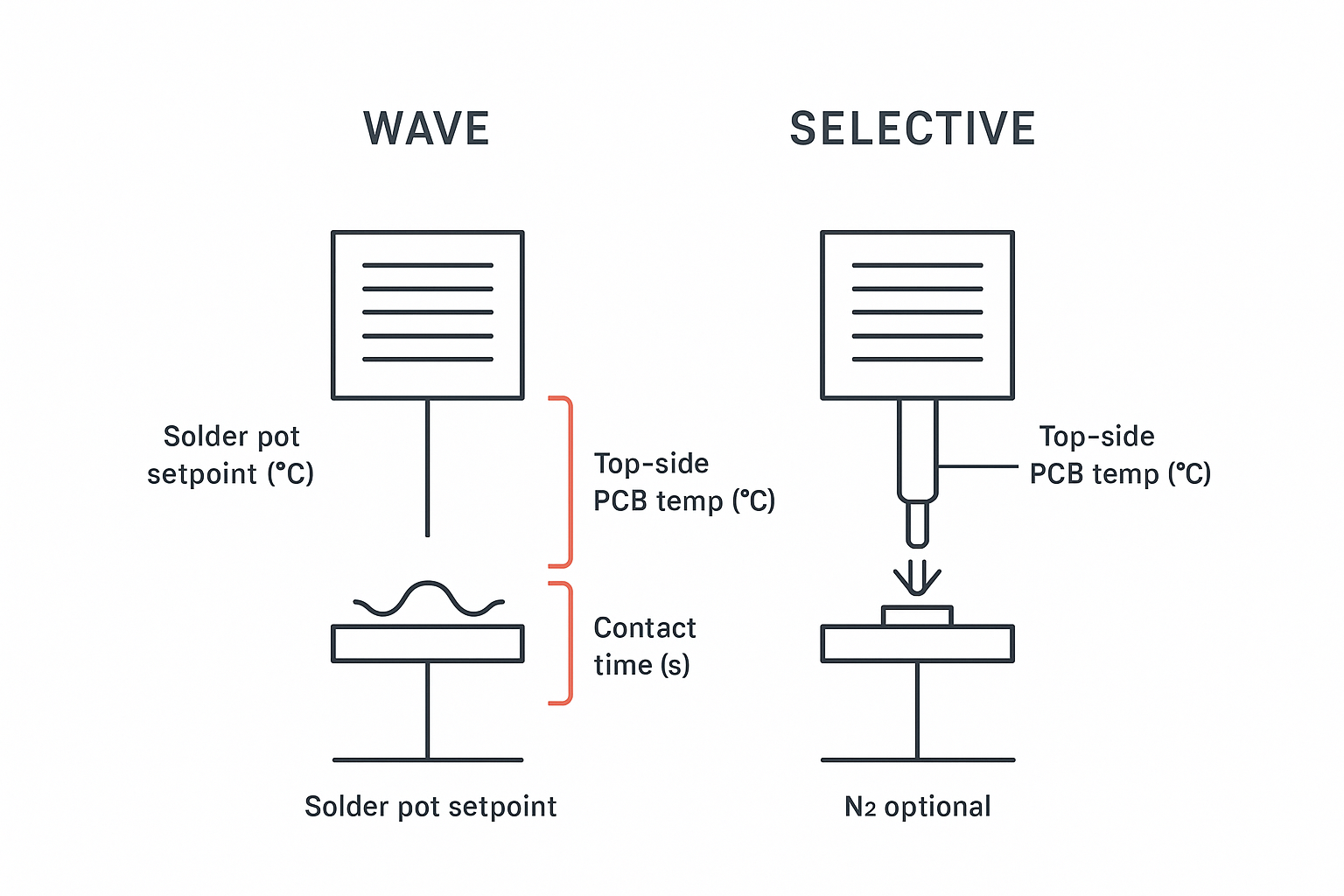
A temperature window is the set of controlled variables that determine whether solder can wet, fill holes, and drain consistently across your board family.
In practical terms, a usable window has three layers:
Solder pot setpoint (°C) — thermal headroom that drives solder fluidity and wetting.
Measured board temperature (topside and/or laminate at preheat exit) — what determines flux activation, solvent evaporation, and thermal shock risk.
Contact/dwell time (seconds) — exposure to the wave/miniwave that controls hole fill vs bridging and thermal stress.
Selective soldering compresses time and localizes heat. That’s why selective processes commonly run higher pot temperatures: you need enough heat input during a short, targeted interaction.
Wave soldering temperature window SAC305: starting point for RFQs
This section anchors the wave soldering temperature window SAC305 in citable baseline ranges, then shows what you should require a vendor to prove on your boards.
SAC305 (Sn96.5/Ag3.0/Cu0.5) melts around 217–220°C, per AIM Solder’s SAC305 melting range (217–220°C). Wave and selective operations run well above liquidus to achieve stable wetting.
Baseline SAC305 numbers you can ask vendors to support
Use this as a starting requirement set—then validate on your boards and your flux.
Parametr | Conventional wave (SAC305) | Selective miniwave (SAC305) | Why this differs |
|---|---|---|---|
Solder pot setpoint | 255–265°C | 280–320°C | Selective has shorter localized dwell and often needs more headroom for hole fill |
Topside preheat (measured) | flux-dependent (spec it as measured °C) | flux-dependent (spec it as measured °C) | Board mass + flux chemistry drive the target more than the alloy |
Contact/dwell time | set by conveyor speed + wave geometry | set by program/nozzle + travel | The “same setpoint” can deliver very different heat input |
Pro Tip: In vendor FAT/SAT, require the supplier to state whether “pot temperature” is a controller setpoint, a measured solder temperature, or a measured nozzle temperature. The number is only comparable when measurement method is comparable.
Topside preheat: how to specify it so it’s measurable (and auditable)
Topside preheat is where many lead-free lines win or lose yield—not because the setpoint is wrong, but because the board never reaches the intended temperature uniformly.
A better spec than “set preheat to X”
In buyer documents, specify outputs you can verify:
Measured laminate/topside temperature at preheat exit under a defined conveyor speed and board mass.
Uniformity requirement across the panel (especially for wide boards).
Ramp constraints (to reduce thermal shock), when your products/components require it.
Practitioner guidance also shows why a single universal number is misleading. For example, the lead-free wave soldering discussion in Circuitnet includes both:
a broader ~140–160°C topside guidelinea
a more conservative ~85–130°C window (flux- and product-dependent), with ~100°C cited as a practical starting point.
Those aren’t contradictions—they’re signals that your correct target is constrained by flux chemistry a assembly thermal limits.
⚠️ Warning: If a vendor quotes a preheat setpoint but can’t show a repeatable profiling method (thermocouples + recorded traces), you don’t have a controlled window—you have a guess.
Other lead-free alloys: what changes vs SAC305 (and why buyers should care)
When manufacturers evaluate alternatives to SAC305, the decision is usually about cost, wetting behavior, and pot-management stability.
A practical “what changes” view:
Alloy family | Typical thermal implication | What to validate during trials |
|---|---|---|
Low-Ag SAC variants (SACX family) | Often requires slightly higher heat input and/or tighter atmosphere control to maintain wetting | Hole fill on heavy connectors; bridging on fine pitch; oxidation/dross behavior |
SnCu / SN100C-class (Sn-Cu-Ni/Ge) | Often managed via flux + pot temp + pot chemistry control; sometimes positioned for stable bath behavior | Wetting on OSP/ENIG mixes; copper dissolution; residue behavior |
Higher-Ag SAC variants | Tradeoffs vary by reliability requirements and cost | Mechanical/reliability requirements; supply chain availability |
For selective soldering specifically, some suppliers position SN100C variants as better aligned to selective operation and bath management. Balver Zinn describes SN100C-SEL as developed for selective soldering and higher process temperatures, with emphasis on stabilizing Ni/Cu behavior in certain board-finish mixes.
How to validate a window on your own boards (the part procurement needs)
A credible vendor doesn’t just tell you “run 265°C.” They give you a method to prove the process stays inside a controlled window.
1) Instrument representative boards
Pick 2–3 board types that represent your extremes:
highest thermal mass through-hole connector board
densest mixed-tech board (SMT nearby)
widest panel / worst-case uniformity risk
Measure where it matters:
topside laminate near the heaviest joints
near heat-sensitive components you must protect
2) Map acceptance criteria to defects
Use defect-mapping rather than “looks good”:
Insufficient hole fill → increase heat input (pot temp or dwell) or correct flux/preheat pairing
Bridging/icicles → often points to drainage/peel-off dynamics, excess heat input, or flux imbalance
Dewetting/non-wetting → surface finish/oxidation/flux activity; pot temperature alone is a blunt instrument
3) Validate stability over time
Drift matters:
temperature recovery after idle
temperature drop during heavy board loads
repeatability over a full shift
If the system can’t hold a stable window, the “ideal” number is irrelevant.
Buyer checklist: what to ask wave/selective soldering machine vendors
If you’re evaluating equipment, your RFQ should focus on what makes the lead-free wave solder pot temperature (and preheat) controllable and repeatable.
Must-have questions
Temperature stability & monitoring
What is pot temperature stability under load?
What sensors are used, where are they placed, and how is calibration handled?
Are alarms and data logs available when parameters drift?
Preheat zoning and uniformity
How many independent preheat zones?
How do you control cross-board temperature differences on large panels?
Selective solder programmability (for selective scope)
How do you set dwell/contact time and travel speed?
How do you prevent overheating near adjacent SMT?
Nitrogen capability (when required)
Can the system run with nitrogen blanket/enclosure?
What purity/flow assumptions are required for stable operation?
Pot management
How do you manage dross and oxidation?
What’s the maintenance routine for pot cleanliness, pumps, and nozzles?
How do you monitor alloy contamination over time?
For a wave-focused checklist you can adapt into an RFI, see S&M’s guide on critical specifications to check when sourcing wave soldering machines.
Common defects when the window is off (and what to adjust first)
Insufficient hole fill
First check: preheat/flux pairing + dwell
Next: pot temperature headroom (especially in selective)
Bridging and icicles
First check: exit/peel-off dynamics (conveyor speed, contact time, drainage)
Next: reduce excess heat input or correct flux volume/activation
Dewetting/non-wetting
First check: surface finish + oxidation + flux activity
Next: consider nitrogen or flux change before pushing temperatures high
For a structured troubleshooting map, use S&M’s wave soldering process setup and defect troubleshooting guide.
Next steps
If you’re sourcing a new wave/selective system—or standardizing lead-free windows across sites—the fastest path to a defensible spec is a short, instrumented trial:
confirm SAC305 baseline windows on your board family
verify the machine holds stability under load
document profiling evidence and parameter-control capabilities
Request a quote/demo: If you want to evaluate a lead-free wave/selective soldering configuration and the controls needed to hold a stable window, contact S&M (chuxin-smt.com) for a proposal and process review.