



Zveřejněno: 30 August 2026
Poslední aktualizace: 30 August 2026
Čas na čtení: 11 minutes
If you run an SMT line, you already know the headache. You’re trying to move PCBs through reflow ovens, AOI stations, and wave soldering machines without dropping components, causing edge damage, or creating misalignment that tanks your first-pass yield.
Here’s something that might surprise you. The conveyor system market hit US$11.7 billion in 2026, and it’s projected to reach US$20.5 billion by 2033. That’s an 8.4% CAGR, driven largely by electronics manufacturers desperate to automate material handling without introducing new defects.
So what’s a roller conveyor, and why does it matter for your production line?
A roller conveyor moves products on a series of rotating cylinders mounted in a frame. Unlike a continuous belt, these rollers let you accumulate boards, buffer between machines, and replace individual components without taking down the whole line.
You’ve probably searched this article because you’re trying to figure out the difference between gravity roller conveyors and powered live roller conveyors, or maybe you’re trying to decide whether a roller conveyor or belt conveyor makes more sense for your setup. That’s exactly what we’re going to cover. We’ll look at how roller conveyor systems work, the main types available, how they fit into SMT and PCB handling workflows, and what to look for when you’re specifying one for a high-reliability production line in 2026.
By the time we’re done, you’ll know exactly which type of roller conveyor fits your needs and what questions to ask before you buy.
What is a roller conveyor?
A material handling system that moves unit loads on a series of rotating rollers mounted in a frame, allowing for accumulation, buffering, and controlled transfer between machines.
About the Author
[Author bio pending verification. Jace Liu is currently associated with Shenzhen Chuxin Electronic Equipment Co., Ltd., where they focus on overseas market development for SMT equipment including lead-free reflow ovens and complete production line solutions. Once credentials have been verified, a detailed author bio will be added here.]
What Is a Roller Conveyor? Core Definition and Industrial Role
A roller conveyor is a material handling system that moves products along a path using a series of rotating cylinders mounted in a frame. Think of it like a set of spinning wheels lined up in a row. Products sit on top of these rollers, and as the rollers turn, the products get pushed along or pulled along depending on whether the system is powered.
The basic setup includes rollers, which are the load-bearing cylinders. Each roller sits on bearings that let it spin freely. The rollers mount to a frame, which is the structural backbone that holds everything in place. In powered systems, there’s also a drive mechanism that keeps the rollers turning. This could be a belt, a chain, or even individual motors inside each roller.
You also get side guides running along the edges to keep products centered. Sensors track when boards arrive or leave. Stops temporarily hold products in place. Transfer modules handle moving items between machines. And a control interface, usually connected to a PLC, ties it all together.
Here’s a quick visual breakdown of the main parts:
| Component | Function |
|———–|———-|
| Rollers | Rotating cylinders that support and move the load |
| Frame | Structural support holding rollers in position |
| Bearings | Enable low-friction roller rotation |
| Drive mechanism | Powers roller movement (belt, chain, or motor) |
| Side guides | Keep products centered on the conveyor |
| Sensors | Detect product presence, position, and speed |
| Stops | Temporarily halt products at transfer points |
| Control interface | Manages conveyor operation and machine communication |
In a factory setting, roller conveyors show up in a few key spots. You find them at receiving areas where incoming materials get sorted. They handle assembly zones where products move between workstations. Inspection and buffering sections rely on them to queue items without stopping the whole line. And they connect machines directly, transferring boards from a loader to a reflow oven or from an AOI station to a packout area.
The flexibility comes from that modular design. You can add more roller sections, swap out individual components, or reconfigure the layout without rebuilding the entire system.
Glossary: Key Roller Conveyor Terms
| Term | Definition |
|——|————|
| Pitch | Distance between roller centers; affects load support and stability |
| Load capacity | Maximum weight a conveyor section can safely carry |
| Transfer height | Vertical distance from floor to conveyor top surface |
| Accumulation | Ability to queue products without stopping upstream flow |
| Live roller | Powered roller that actively drives product movement |
| Gravity roller | Unpowered roller relying on slope or product momentum |
Getting these specifications right matters. If the pitch is too wide, products can sag between rollers. If the transfer height doesn’t match your neighboring equipment, you’ll have alignment issues that cause jams or drop boards. In SMT environments, even a few millimeters of mismatch creates defects that kill your yield.
How Roller Conveyor Systems Work
The magic behind a roller conveyor comes down to simple physics. Each rotating cylinder sits on bearings, which means products rest on multiple spinning wheels instead of a single surface. When you push something, or when gravity pulls it downhill, the rollers turn and the load moves along.
Here’s how that breaks down in practice. Gravity roller conveyors rely on a slight downward slope. You set them at an angle, and the load’s own weight creates enough momentum to keep things moving. No motors needed, which makes these systems cheap to run. The catch is you need enough incline to overcome friction, but not so much that boards fly off the end.
Powered systems work differently. A drive mechanism, usually a belt, chain, or individual motor inside each roller, keeps the cylinders spinning at a controlled speed. Line-shaft drives use a rotating shaft running the length of the conveyor, connected to each roller with urethane belts. It’s a tried-and-true setup that handles a lot of weight without complex electronics.
We tested a gravity section last year for buffering PCBs between a loader and reflow oven. The slope had to be just right, about 3 to 5 degrees, or boards would either stall or zoom past the stop sensor. Getting that dialed in took some tweaking, but once it was set, the section ran without any power draw for months.
A few engineering variables affect how well any conveyor performs. Roller pitch, which is the spacing between each cylinder, matters more than most people realize. If the gaps are too wide, lighter PCBs sag between rollers and can crack or misalign. The rule of thumb is that the load should always rest on at least three rollers. Load weight, the coefficient of friction between the board and roller surface, and the conveyor speed all interact to determine whether products move smoothly or slip and jam.
Modern powered conveyors use sensors and PLC controls to coordinate with upstream and downstream equipment. A photoeye detects when a board arrives. The controller checks whether the next station is ready. If it is, the board moves forward. If not, a stop gate holds it in place until the line clears. This handshaking prevents collisions and keeps gaps consistent, which matters a lot when you’re trying to maintain a steady rhythm through a reflow profile.
The real advantage of roller conveyors over other designs is how they handle accumulation. Because boards sit on independent rollers, you can queue products without stopping the entire line. One section fills up while machines downstream work through the backlog. When space opens up, boards release and flow again. That buffering capability is what makes roller conveyors so valuable in SMT environments where different machines run at different speeds.
Main Types of Roller Conveyor Systems
Not all roller conveyors work the same way. The type you choose depends on whether you need power, how much control you want over speed and accumulation, and what environment you’re running in. Let’s break down the main types.
What Is a Gravity Roller Conveyor
A gravity roller conveyor is exactly what it sounds like. No motors, no power draw. Products move because of a slight downward slope or because someone gives them a push. The rollers spin freely on bearings, and the load’s own momentum carries it forward.
This setup works best for simple transfer routes, staging areas, and packaging zones where you don’t need precise indexing. Think about moving boxes from a receiving dock to a sorting station, or queuing products before they hit a packing line. Gravity systems are cheap to run since they draw zero power. The trade-off is that you need enough slope to overcome friction, but not so much that boards zoom past their stop position.
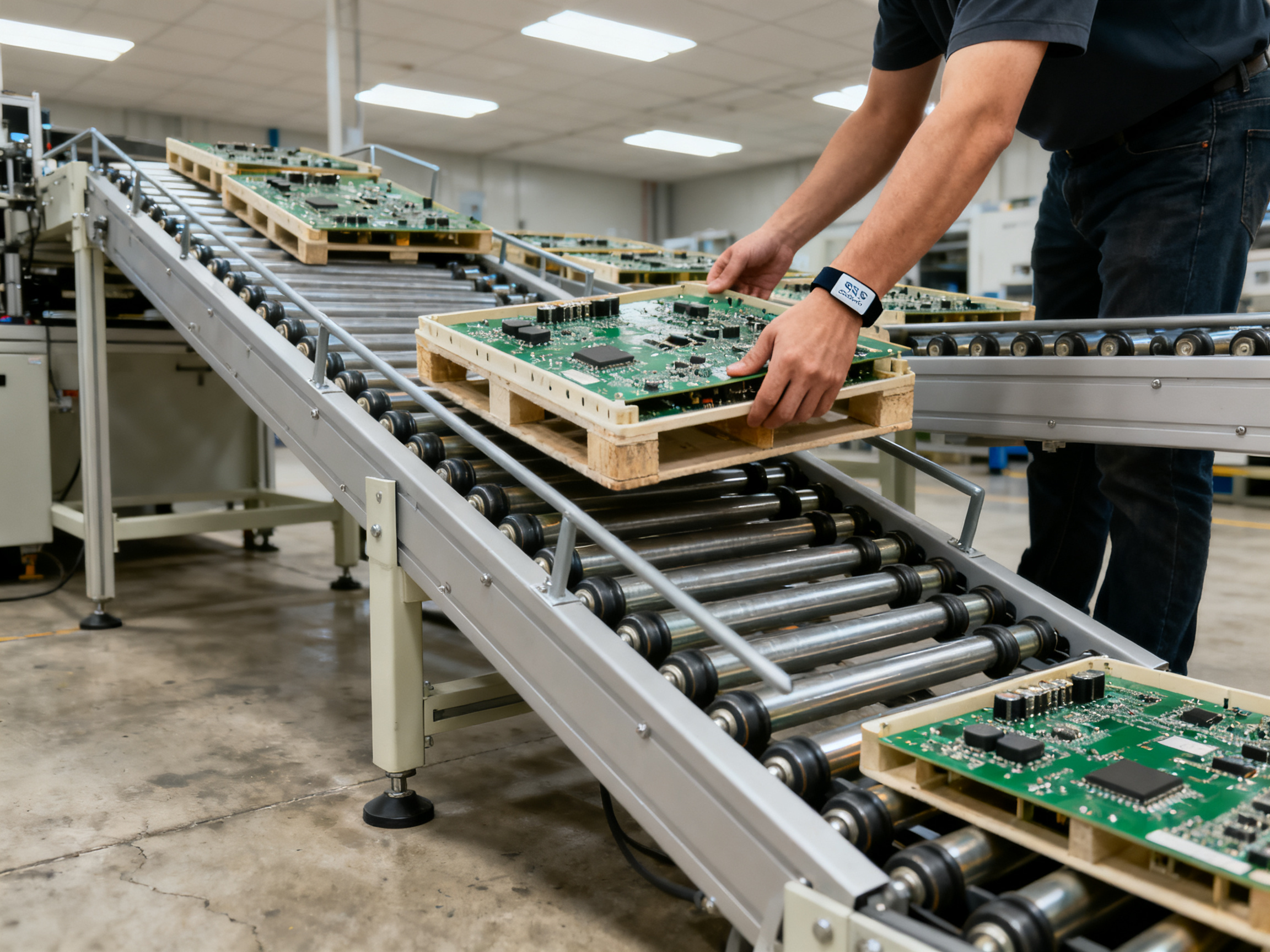
The pitch matters here. If rollers are spaced too far apart, lighter products sag between them and can crack or misalign. A good rule is that any load should always rest on at least three rollers at once. For most PCBs, that means keeping roller spacing tight, usually no more than one-third of the shortest board dimension.
What Is a Live Roller Conveyor
A live roller conveyor uses power to drive the rollers. That power can come from a few different mechanisms. Belt-driven systems use a continuous belt underneath the rollers. Chain-driven systems work the same way but with chains. Line-shaft drives use a rotating shaft running the length of the conveyor, connected to each roller with urethane belts. And motorized roller conveyors, sometimes called MDR units, have small motors inside each roller itself.
Each approach has its place. Line-shaft drives handle heavy loads well and are relatively simple mechanically. Motorized roller conveyors give you zone-by-zone control, which means you can stop one section without stopping the whole line. That’s huge for buffering and accumulation.
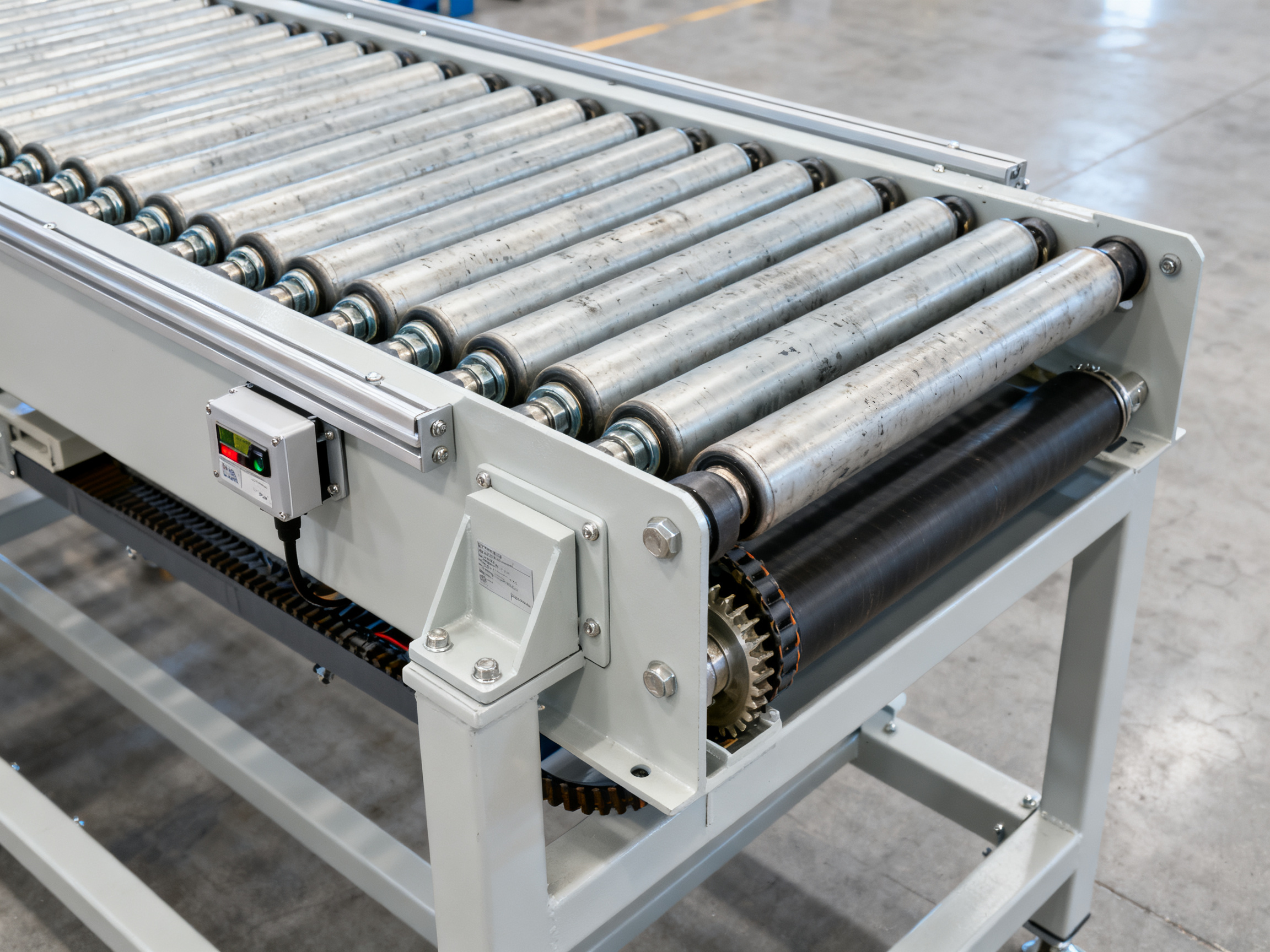
In SMT environments, live roller conveyors connect machines together. A loader feeds boards onto a powered section that carries them into a reflow oven at exactly the right speed. An AOI station uses stops and sensors to position boards precisely for inspection. Then downstream rollers transfer them to the next machine without manual handling.
Other Roller Conveyor Types Worth Knowing
Beyond the basics, you get specialized configurations for specific jobs.
Chain-driven roller conveyors use chains instead of belts to transmit power. They handle heavier loads and resist slippage better, which makes them useful for automotive electronics carriers and industrial pallets.
Accumulation conveyors are designed specifically for queuing products without creating pressure between items. Rollers in the accumulation zone can coast or slow down while downstream sections handle the flow. This prevents the “tombstoning” effect where boards pile up and damage each other.
Tapered roller curves let you change direction. Instead of cylindrical rollers, these have a cone shape that naturally guides products around corners. You see these in packaging lines and assembly cells where floor space is limited.
For electronics manufacturing, ESD-safe PCB roller conveyors use antistatic materials and grounding provisions to prevent static discharge. Rollers might be made from conductive polymers or coated with ESD-safe finishes. Frames include bonding points for grounding straps. Given that 23.4% of conveyor market activity ties to electronics manufacturing with ESD requirements, this isn’t an afterthought. It’s a core specification for anyone handling sensitive components.
Motorized drive roller systems, the MDR type, are gaining traction because each roller only runs when it needs to. That cuts energy use compared to continuously running drive systems. You can also create very precise zones that activate independently, which helps with complex routing and sorting.
Pro Insight:
Choosing between gravity, powered belt, chain, and motorized roller conveyors comes down to a few key questions. First, how heavy are your carriers? Chain-driven handles the heaviest loads. Second, do you need zone accumulation? Motorized rollers win there. Third, are you running ESD-sensitive boards? You need conductive or antistatic rollers with proper grounding. And fourth, what’s your maintenance capability? Gravity systems have the fewest moving parts, but they offer the least control. Match the drive mechanism to your actual needs, not the theoretical maximum.
Quick Comparison
| Type | Power Source | Best Applications | Main Advantages | Limitations |
|——|————-|——————-|—————–|————-|
| Gravity roller | None (slope) | Staging, simple transfer, buffering | Zero energy cost, simple, cheap | No speed control, needs slope |
| Belt-driven live roller | Electric motor + belt | General SMT transfer, medium loads | Reliable, good speed control | Belt wear, tensioning needed |
| Chain-driven live roller | Electric motor + chain | Heavy carriers, automotive electronics | High torque, resists slippage | Noisier, needs lubrication |
| Motorized roller (MDR) | Individual motor per roller | Zone accumulation, sorting, flexible layouts | Zone control, energy efficient | Higher component cost |
| Accumulation | Powered or gravity with zone control | Buffering between machines | Prevents product damage during queuing | Requires zone configuration |
| ESD-safe PCB roller | Any powered type with ESD materials | Electronics assembly, semiconductor | Static discharge protection | Premium pricing |
Matching Type to Your SMT Line
Here’s what actually matters when you’re spec’ing a conveyor for a real production line. If you’re running standard pallets through a reflow oven, a belt-driven live roller with SMEMA compatibility probably covers 80% of what you need. If you need to buffer between machines with different cycle times, look at accumulation conveyors or MDR systems with zone logic. If you’re handling bare boards or sensitive assemblies, ESD-safe specifications aren’t optional. They’re required.
We tested a few different configurations last year when setting up a lead-free production line. Gravity sections worked fine for buffering between a loader and the first oven, but we had to swap in powered rollers for the AOI section because the stop-and-go indexing needed precise speed control. The cost difference was noticeable, but so was the defect rate improvement.
The modular nature of most roller conveyor systems means you’re not locked into one configuration forever. You can start with gravity sections where simplicity matters and add powered zones where control matters. That’s the practical approach most SMT lines take in 2026.
Roller Conveyors in SMT and PCB Handling
An SMT production line is only as smooth as its material handling. Roller conveyor systems sit at the heart of this process, connecting loaders to printers to placement machines to reflow ovens, AOI stations, and unloaders. Every board transfer between machines creates a moment where things can go wrong. The right conveyor design reduces those risks significantly.
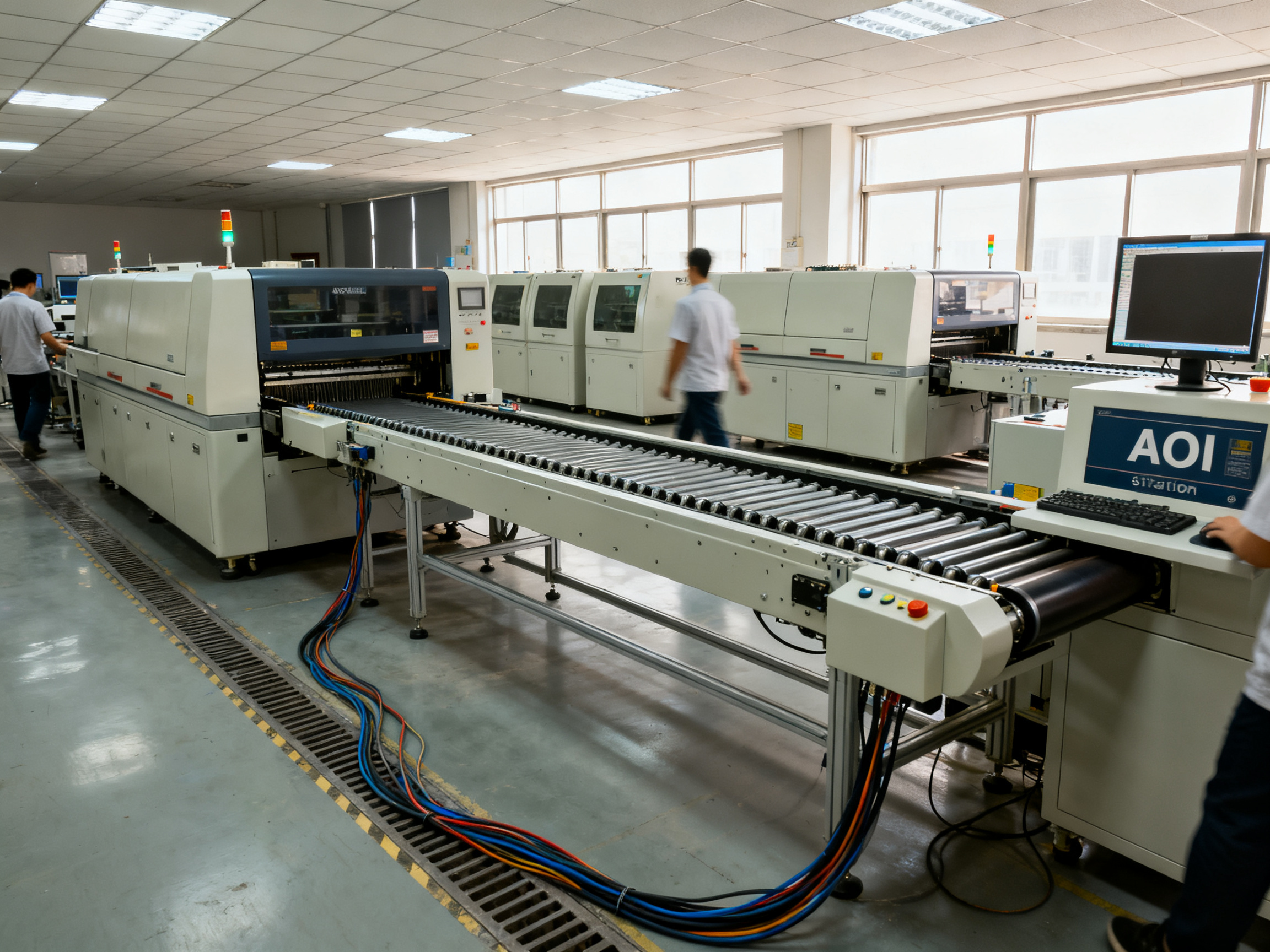
Here’s how conveyors fit into a typical SMT workflow. A loader feeds bare PCBs onto the infeed conveyor, which carries them to the paste printer. From there, a transfer conveyor moves the board to the pick-and-place machine. After placement, another conveyor section handles the handoff to the reflow oven, maintaining precise timing and alignment through the thermal profile. Post-reflow, conveyors feed boards into AOI for inspection, and finally to packout or wave soldering, depending on your assembly sequence.
Each handoff point demands attention. Poor transfer height alignment between machines causes boards to tilt, which stresses solder joints and can dislodge components. Misaligned rails scrape PCB edges, creating damage that might not show up until final test. Vibration during transport can shift fine-pitch components, especially BGA and QFN packages where solder joint reliability depends on exact placement.
Expert Tip:
PCB edge damage, misalignment, static discharge, and thermal-process handoff issues are the four biggest conveyor-related defects in SMT lines. Check transfer heights between every machine pair with a machined reference板. Verify rail parallelism. Ground your conveyors if you’re running ESD-sensitive assemblies. And for lead-free processes, make sure conveyor speed matches your reflow profile timing, or you’ll get hipping or tombstoning from uneven heating.
ESD exposure is another real concern. Bare boards and assembled PCBs travel through multiple zones where static can build up. Conveyors without proper grounding or antistatic roller materials can deliver discharge events that damage sensitive components. In semiconductor modules and high-reliability electronics for aerospace or military applications, this isn’t a quality issue. It’s a compliance issue.
Contamination matters too. Rollers that shed particles or outgas near solder masks create defects that AOI might catch, or might not. Cleanroom-grade conveyors with sealed bearings address this in fab and semiconductor environments. For most SMT lines, regular cleaning and using rollers compatible with your flux or cleaning chemistries prevents buildup that transfers contamination to boards.
The table below maps common defects to their conveyor-related root causes and what to check:
| Defect Type | Root Cause | Prevention Method |
|————-|————|——————-|
| Component shift or tombstoning | Uneven conveyor speed through reflow | Verify drive belt tension and motor controller settings |
| PCB edge damage | Misaligned rails or transfer plates | Check rail parallelism and adjust guide width to board size |
| Solder joint cracks | Thermal mismatch from uneven heating handoffs | Match transfer heights between adjacent machines |
| ESD damage to ICs | Ungrounded conveyors or worn antistatic rollers | Test grounding continuity and replace degraded roller surfaces |
| BGA solder voids | Vibration during accumulation zones | Reduce accumulation section length or switch to zone-stop mode |
| Hipping in lead-free | Conveyor speed mismatches reflow profile | Calibrate speed sensors against known-good reference boards |
Getting these details right matters most for high-density boards and lead-free assemblies. Lead-free solder has a narrower process window, which means conveyor speed variations have a bigger impact on thermal outcomes. BGA and QFN packages with fine ball/pad pitches are more sensitive to vibration and misalignment than older through-hole assemblies. Military and aerospace electronics add traceability requirements on top of that, so conveyor logs and maintenance records become part of your quality documentation.
The good news is that most of these problems are preventable with proper specification and regular validation. Checking transfer heights during installation, testing SMEMA or IPC-HERMES-9852 handshaking, and verifying ESD grounding during FAT and SAT covers the biggest risks before they reach production.
Roller Conveyor vs Belt Conveyor for Electronics Manufacturing
If you’re setting up an SMT line right now, you’ve probably asked yourself whether to go with roller conveyors or belt conveyors. It’s a common question, and the honest answer is: it depends on what you’re moving and how your line runs.
Belt conveyors use a continuous loop of material, usually rubber or PVC, that carries products from one end to the other. The whole bottom of the board sits on that moving surface. Roller conveyors, by contrast, have individual cylinders that products ride on. Each approach has its place in electronics manufacturing.
Here’s where things get practical. For rigid pallets, trays, and flat-bottomed carriers, roller conveyors tend to work better. You get easier accumulation, which means you can queue boards without stopping the whole line. Individual rollers are simple to replace if something wears out. And the friction is lower, so you use less energy moving heavy loads.
But belt conveyors win in a few situations. If you’re handling very small parts that could slip between rollers, a continuous belt keeps everything supported. Fragile items with sensitive bottom surfaces need that full-bottom contact. Steep inclines are easier to manage because the belt grips the load without slippage. And if you need perfectly smooth motion without any bouncing, belts deliver that.
Maintenance looks different too. Roller systems let you swap out one bad cylinder without taking down the line. Belt systems require more ongoing attention to tracking and tensioning, and when a belt goes, you’re replacing a longer section instead of a single component.
On cost, roller conveyors typically run 30 to 40 percent cheaper for equivalent length sections Roller conveyor vs belt conveyor comparison. That adds up fast when you’re outfitting a full production floor.
Pro Insight:
Decision rule for choosing roller, belt, chain, or hybrid conveying comes down to four questions. First, are your carriers rigid and flat-bottomed? If yes, roller conveyor is your default. Second, do you need zone accumulation and buffering? Roller wins. Third, are you running ESD-sensitive boards? Roller conveyors with conductive rollers are easier to ground properly. Fourth, do you have steep inclines or fragile parts needing continuous support? Then belt conveyor makes more sense.
Use this quick comparison when you’re evaluating options:
| Criterion | Roller Conveyor | Belt Conveyor |
|———–|—————|—————|
| PCB/pallet support | Good for rigid carriers | Full-bottom continuous support |
| ESD control | Easy to ground; conductive rollers available | Requires antistatic belt material |
| Accumulation zones | Built-in buffering capability | Limited unless specially designed |
| Precision indexing | Good with powered rollers | Excellent for smooth, controlled transfer |
| Maintenance | Simple roller replacement | Belt tracking and tensioning required |
| Lifecycle cost | Lower over time | Higher due to belt wear |
| Energy use | Lower; gravity sections need no power | Continuous motor drive required |
Most SMT lines in 2026 end up using both. Roller sections handle the bulk transfer and buffering between machines. Belt sections get used where you need that continuous support or smooth motion through inspection points. It’s not an either-or decision. Figure out where each approach fits your specific workflow, and spec accordingly.
Applications Beyond SMT: Automotive, Semiconductor, Military, and Aerospace Lines
Roller conveyors show up everywhere in modern manufacturing, not just SMT lines. Automotive, semiconductor, and aerospace facilities rely on these systems for the same reasons factories love them: controlled movement, buffering capability, and easy integration with other machines.
Automotive Electronics and EV Production
Electric vehicle manufacturing puts heavy demands on material handling. Battery modules, electronic control units, and sensor assemblies need to move through assembly zones without damage. Roller conveyors handle these heavier loads with chain-driven configurations that deliver consistent torque without slippage.
Shuttleworth builds cleanroom conveyor systems for automotive coating and curing operations, including headlight lens finishing. The company also supplies bulk packaging systems designed specifically to protect electronic modules from ESD damage during transit.
Semiconductor Fabrication
Semiconductor fabs represent the fastest-growing segment for specialized roller conveyors. These environments demand ultra-low particle emission, strict outgassing limits, and complete ESD control. Every roller surface, bearing seal, and frame finish gets engineered for contamination control.
Bosch Rexroth manufactures conveyor systems built for semiconductor and precision electronics manufacturing where particle counts matter at the molecular level. The cleanroom specifications go far beyond what standard SMT lines require.
Military and Aerospace
High-reliability manufacturing for defense and aerospace adds another layer of requirements on top of ESD and cleanliness. These facilities need full traceability documentation, AS9100 quality certification, and repeatable transfer precision into inspection stations.
Convergix handles aerospace actuator assembly projects with complete traceability baked into every step. If a component fails in service, the production records show exactly what happened during manufacturing and handling.
From Our Experience:
Before specifying conveyors for aerospace or defense work, check whether your equipment vendor supports IPC-2591 CFX and IPC-HERMES-9852 protocols. These standards make traceability data collection automatic rather than manual. You’ll thank yourself during audits.
Compliance and Traceability Sidebar
Military and aerospace contracts often require:
| Requirement | What It Means for Your Conveyors |
|————-|——————————–|
| AS9100 certification | Quality management system covering design, production, and testing |
| Full traceability | Serialized tracking from raw material to finished assembly |
| ESD control | ANSI/ESD S20.20 compliance for sensitive electronics |
| Cleanliness specs | Particle count limits for fab and assembly environments |
| Documentation | Conveyor logs, maintenance records, calibration data |
Modular conveyor sections make scalability practical. You can add buffers during peak seasons, integrate new automated transfer units without rebuilding the line, and connect everything to your MES for real-time tracking. Barcode and RFID systems work with roller conveyors to track products through every zone.
The combination of modular hardware and modern communication standards means even highly regulated industries can automate without sacrificing the documentation quality auditors expect.
How to Specify a Roller Conveyor for a High-Reliability Production Line
Picking the right roller conveyor means asking the right questions before you buy. This section walks you through the specification inputs that actually matter, the integration requirements your SMT line demands, and how to evaluate suppliers so you end up with equipment that works on day one and keeps working.
Specification Inputs: What to Define First
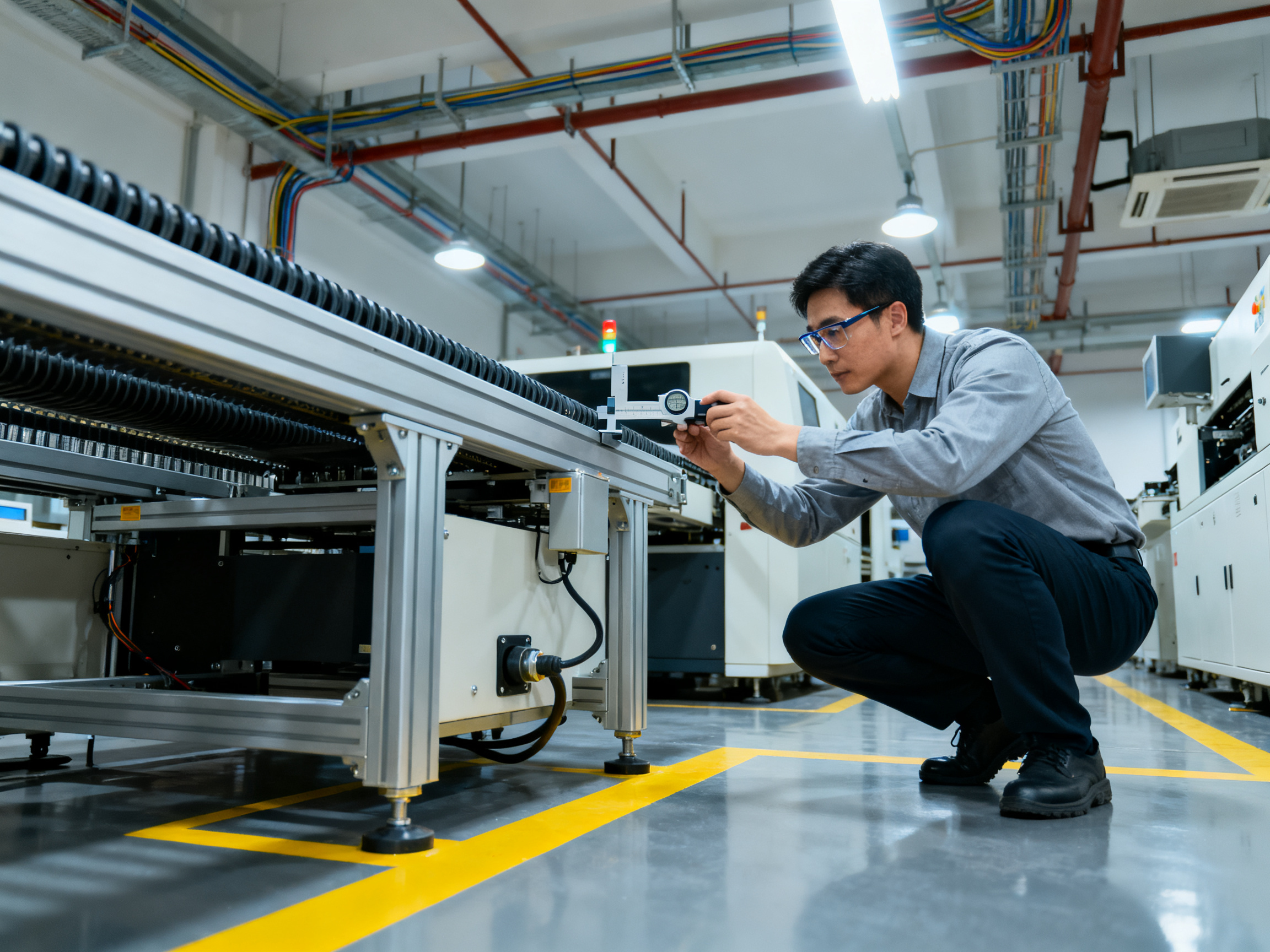
Before contacting any vendor, nail down your product data. You need to know your PCB dimensions, weight, and whether you’re running bare boards, pallets, or trays. The bottom contact surface matters because roller pitch depends on it. Your shortest board must always rest on at least three rollers, so measure carefully.
Throughput target tells you how fast the line needs to run. This drives roller diameter, drive power, and whether you need zone accumulation. Transfer height is the vertical distance from floor to conveyor top, and it must match every machine you’re connecting. Even a 2mm mismatch causes jams or board drops that kill your yield.
Floor space constraints affect layout and whether you need curves, inclines, or gravity sections. Environmental conditions near reflow ovens or wave soldering equipment mean your rollers need to handle heat, flux exposure, or both.
Integration Requirements
Your conveyor needs to talk to the rest of your line. SMEMA compatibility covers basic handshaking for legacy equipment, but IPC-HERMES-9852 gives you board tracking data that helps with traceability. If you’re running a modern line in 2026, IPC-2591 CFX connects your conveyors to MES for real-time status monitoring.
ESD grounding is non-negotiable for sensitive assemblies. Your rollers need to be conductive or antistatic, with bonding points that connect to your facility ground. Test this during installation because loose connections create hidden defects that show up months later.
Safety guarding, emergency stops within reach of operators, and maintenance access for roller replacement all need to be part of the specification. Don’t wait until the conveyor arrives to think about these.
From Our Experience:
Before signing off on any conveyor purchase, run through this validation checklist. Check transfer heights against every machine in the line. Verify rail parallelism with a machined reference board. Test SMEMA or IPC-HERMES-9852 handshaking with your loader and unloader. Confirm ESD grounding continuity across all sections. And verify speed sensor accuracy against a known-good reference before going to production. Skipping these steps is how you end up with a conveyor that looks fine on paper but causes defects on the line.
Procurement Evaluation Criteria
Reliability matters more than price when you’re running high-volume production. Ask about bearing life, drive motor warranties, and whether individual rollers can be replaced without removing the entire section.
Spare parts availability determines your mean time to repair. A conveyor that’s cheap to buy but takes 12 weeks for replacement rollers is a liability, not an asset.
FAT (Factory Acceptance Testing) and SAT (Site Acceptance Testing) protocols should be defined before delivery. Get your checklist in writing so you’re testing the right things.
Supplier experience with SMT production lines makes a real difference. They should understand reflow oven timing, AOI indexing requirements, and lead-free process demands.
Use this specification template when evaluating options:
| Specification Field | Your Requirement | Notes |
|——————–|——————|——-|
| PCB dimensions (L x W) | | |
| PCB weight (max) | | |
| Carrier type (bare/pallet/tray) | | |
| Throughput target (boards/hour) | | |
| Transfer height required | | |
| Line speed range | | |
| Roller pitch needed | | |
| ESD classification required | | |
| Communication protocol (SMEMA/HERMES/CFX) | | |
| Accumulation zones needed | | |
| Environmental conditions | | |
| Maintenance access constraints | | |
Total cost of ownership includes energy use, maintenance labor, and downtime cost when conveyors fail. A powered roller conveyor with MDR technology might cost more upfront but uses less power and offers zone control that cuts your buffering space requirements.
The right specification prevents problems before they start. Take time on the front end to define these inputs clearly, and your installation will go much smoother.
Innovations Shaping Roller Conveyor Systems in 2026
The roller conveyor market hit US$11.7 billion in 2026, and it’s climbing toward US$20.5 billion by 2033. That’s an 8.4% growth rate driven largely by manufacturers who are tired of watching their lines crawl because of conveyor downtime or manual bottlenecks. Smart technology is changing what these systems can do.
Smart Conveyor Controls
Motorized roller zones are getting smarter. Instead of running one big motor continuously, newer setups use individual low-voltage drives that only activate when a product needs to move. This cuts energy use by 3 to 7 percent compared to traditional drive architectures, according to some manufacturers.
Predictive maintenance is the bigger story. AI systems now watch for warning signs like bearing temperature spikes, unusual vibration patterns, or motor current draw that hints at developing failures. The promise is detecting problems 2 to 12 weeks before they cause a breakdown. Some vendors claim this reduces unplanned downtime by 30 to 50 percent and maintenance costs by 25 to 30 percent. That’s worth paying attention to if you’re running high-volume production where a single hour of downtime costs real money.
Sensor-rich accumulation zones can now track every board that passes through, flagging bottlenecks before they cascade into line stoppages.
Industry 4.0 Integration
MES connectivity has become the baseline expectation rather than a premium feature. Conveyors that speak IPC-CFX send real-time data about throughput, cycle times, and defect correlations directly to your factory dashboard. Version 2.0 dropped in 2025, and version 2.1 is in the pipeline for 2026. The IPC CFX Demo Line at EMK 2026 in Seoul showed how far this integration has come.
Barcode and RFID tracking turns your conveyor into a traceability system. Each board gets logged through every zone, which matters if you’re running aerospace or military work where auditors want to see complete production records.
Design Innovations for Electronics
ESD-safe materials have gotten better. Conductive roller compounds and proper grounding provisions now come standard on equipment designed for sensitive assemblies, not just as an add-on upgrade.
Quick-width adjustment mechanisms let you reconfigure rail spacing without tools, which helps when you’re running different board sizes through the same line. Low-vibration transfer plates reduce the micro-movements that can shift fine-pitch components during transport.
Modular frame systems mean you can add, remove, or reposition sections as your product mix changes. For manufacturers running mixed-model production in 2026, that flexibility is becoming essential.
The bottom line is that conveyors are no longer passive material movers. They’re becoming data-collection points and quality-control tools. Whether that matters for your line depends on your defect tolerance and traceability requirements.
Conclusion: Choosing the Right Roller Conveyor System
Here’s what we’ve covered. A roller conveyor moves products on rotating cylinders that let you accumulate boards, buffer between machines, and swap individual parts without taking down the whole line. Gravity roller conveyors use slope for movement, while live roller conveyors use power for precise speed control. Belt conveyors win when you need continuous surface support or steep inclines, but roller systems dominate for standard SMT buffering and maintenance.
Your decision comes down to five things. Product support: are your carriers rigid and flat-bottomed? Process precision: how tight does your indexing need to be? Integration: do your machines speak SMEMA, IPC-HERMES-9852, or IPC-CFX? Reliability: how much downtime can you afford? And total cost of ownership, not just purchase price.
For SMT and PCB handling, validate conveyor design against real boards, real line speeds, ESD requirements, and upstream/downstream machine signals before purchase. Spec it right the first time.
Quick Validation Checklist
- [ ] Transfer heights match every machine in your line
- [ ] Rail parallelism checked with a machined reference board
- [ ] SMEMA or IPC-HERMES-9852 handshaking tested
- [ ] ESD grounding continuity verified across all sections
- [ ] Speed sensors calibrated against a known-good reference
Need help sorting through conveyor options for your SMT line? Contact S&M’s team for guidance on production-ready material handling solutions.