



Veröffentlicht: 09 July 2026
Lesezeit: 10 minutes
Author: Jace Liu
You know that feeling. The line stops. Costs climb. Your delivery dates slip. It’s 2026, and the pressure to deliver flawless PCBs at scale has never been higher.
The global SMT equipment market is projected to hit USD 6.1 billion this year, climbing to USD 14.2 billion by 2033. Consumer electronics still drive the bus, accounting for roughly 28.5% of market revenue. But here’s what matters for you: smarter factories are now the norm. AI-powered inspection systems are growing at 15.2% annually, and lead-free manufacturing compliance is non-negotiable in most sectors.
Thing is, finding the best SMT machine for PCB assembly isn’t a one-size-fits-all equation. Your product mix, throughput targets, defect rate goals, and component types all shape which equipment actually works for your operation. Upstream and downstream integration matters too. A machine that looks great on paper can still become a bottleneck if it doesn’t play nice with your existing line.
That buyer regret? It happens when teams chase specs without matching them to their real production needs.
So let’s fix that. This guide breaks down the SMT equipment categories that actually matter in 2026: pick and place machines, reflow soldering systems, wave soldering equipment, selective and automatic SMD soldering solutions, pricing benchmarks, and the evaluation criteria that separate smart buys from expensive mistakes.
Whether you’re a production head, procurement manager, or CTO upgrading from legacy SMT lines, you’ll get the practical breakdown you need to make confident decisions.
Author Credentials: Why This Guide Is Qualified
Written by Jace Liu. [Author bio placeholder: add Jace Liu’s relevant experience with SMT equipment, PCB assembly, electronics manufacturing, lead-free soldering, or production-line optimization. Do not publish without replacing this placeholder with verified author credentials.]
A note for readers: Every production floor is different. Board designs vary. Throughput targets differ. Before applying any recommendation from this guide, validate it against your specific component mix, defect rate goals, and process requirements.
How to Evaluate an SMT Machine for PCB Assembly in 2026
Here’s what nobody tells you upfront: those CPH numbers on spec sheets? They’re lies. Well, not lies exactly, but definitely optimistic.
Manufacturers test machines under perfect conditions with ideal components. Real production floors? Different story. We typically de-rate manufacturer CPH claims by 20-30% to get a realistic number.
What Actually Matters When Comparing SMT Machines
Placement accuracy matters more than pure speed. Modern high-end pick and place machines achieve ±20-25 μm accuracy with Cpk ≥ 1.0, which is a massive leap from legacy ±50 μm systems. If you’re working with 0201 or finer components, accuracy beats speed every time.
Feeder capacity? Huge deal. Entry-level machines support 80-112 feeder positions. Mid-range hits 140-192. High-end models? 224-312+ dual cart feeders. More feeders means fewer changeovers, and fewer changeovers means your line keeps running.
For soldering equipment, look beyond the headline specs. Thermal uniformity, nitrogen capability for lead-free processes, flux management, profiling control, energy consumption, and maintenance access all affect your total cost of ownership.
Compatibility matters too. Does the machine support Hermes and CFX protocols for MES integration? Can it talk to your existing AOI and SPI systems? A machine that looks incredible on paper becomes a bottleneck real fast if it won’t play nice with your line.
Pro Insight: Before signing any purchase order, verify the machine works with your existing line. Quote CPH means nothing if the feeder cart won’t fit, the conveyor height is wrong, or the communication protocol doesn’t handshake with your MES. Ask for a test run with your actual board designs.
Evaluation Checklist for SMT Equipment Buyers
| Criteria | Entry-Level | Mid-Range | High-Speed |
|———-|————-|———–|————|
| Real-World CPH | 12,000-22,000 | 22,000-35,000 | 35,000-75,000+ |
| Placement Accuracy | ±30-40 μm | ±25-30 μm | ±20-25 μm |
| Feeder Capacity | 80-112 positions | 140-192 positions | 224-312+ positions |
| Component Range | 0402-15mm | 03015-55mm | 03015-100mm |
| Nitrogen Support | Optional | Recommended | Standard |
| Line Protocol | Basic | Advanced | Full Integration |
The real question isn’t whether the SMT machine for PCB assembly meets spec sheet requirements. It’s whether the equipment actually performs on your production floor, with your components, at your target throughput.
1. High-Speed SMT Pick and Place Machine for Large-Scale Consumer Electronics
If you’re running a factory that builds smartphones, wearables, or IoT devices, you already know the drill. Millions of units. Tight margins. Zero patience for line downtime.
High-speed pick and place machines are the workhorses here. We’re talking about systems that hit 50,000 to 100,000+ CPH on paper. Real world? More like 35,000 to 75,000 once you factor in vision cycles and component complexity.
Here’s what separates the winners from the expensive doorstops in this category:
Throughput and accuracy go hand in hand. Modern high-end systems achieve ±20-25 μm accuracy (Cpk ≥ 1.0), which matters big time when you’re placing 0201 components or finer. Accuracy beats raw speed when your defect rates define your margins.
Feeder capacity is a silent productivity killer. High-volume lines need 224-312+ dual cart feeders. More positions means fewer changeovers, and fewer changeovers means your line actually keeps running.
Dual-gantry architecture changes the game. Two placement heads working simultaneously can push throughput up by 40-65% compared to single-gantry setups.
Vision alignment matters more than most buyers realize. On-the-fly vision systems have driven placement defects from 85 ppm down to under 20 ppm for fine-pitch components. That’s the difference between hitting quality targets and eating rework costs.
| Machine Class | Rated CPH | Real CPH | Accuracy | Feeder Capacity |
|————–|———–|———-|———-|—————–|
| Entry-Level | 16,000-30,000 | 12,000-22,000 | ±30-40 μm | 80-112 |
| Mid-Range | 30,000-50,000 | 22,000-35,000 | ±25-30 μm | 140-192 |
| High-Speed | 50,000-100,000+ | 35,000-75,000 | ±20-25 μm | 224-312+ |
The real question when evaluating SMT pick and place machine manufacturers isn’t just about speed specs. You need to know about service network coverage, spare parts availability, and whether they’ll still support that model in three years. A machine that costs 30% less upfront becomes a nightmare if the vendor disappears when you need them most. Consider total cost of ownership and the supplier ecosystem before committing to any purchase.
2. Flexible SMT Pick and Place Machine for High-Mix, Mid-Volume Production
High-speed machines? Great for smartphones. But what if your production floor builds 200 different board SKUs in a month? That’s where flexible placement systems earn their keep.
Thing is, raw CPH matters less when you’re constantly swapping recipes. High-mix operations need quick-change feeder carts, digital recipe management, and software-guided changeovers that cut setup from 25 minutes down to under 8 minutes. That’s the real metric here.
Automotive electronics manufacturers, industrial controls, aerospace subassemblies, and semiconductor test boards? They’re the ones who live in this world. Small batches, frequent changeovers, tight quality specs.
Integration becomes everything. SPI and AOI systems need to handshake with your placement machine, feeding data into your MES for full traceability. One bad batch? You need to know exactly which feeder, which nozzle, which shift.
Flexible machines handle a wide range of components from 0201 up to large modules and odd-shaped parts, with accuracy around ±25-35 μm. You won’t match the raw speed of dedicated high-volume lines, but you get production agility that pure speed can’t provide. For mixed-technology boards with changing market demands, that flexibility often proves more valuable than chasing maximum throughput numbers.
Decision Matrix: High-Speed vs. Flexible Placement Machines
| Factor | High-Speed | Flexible |
|——–|————|———-|
| Best For | 1-5 SKUs, massive volume | 50+ SKUs, mixed batches |
| Changeover Time | 15-25 minutes | <8 minutes |
| Component Range | Optimized for standard parts | Supports odd-form, large modules |
| Accuracy | ±20-25 μm | ±25-35 μm |
| Feeder Capacity | 224-312+ | 140-192 |
| Integration | MES, AOI required | MES, AOI, full traceability |
| Typical Cost | $150K+ | $80K-150K |
The real question isn’t which machine ranks higher on spec sheets. It’s which one actually fits your production reality.
3. Lead-Free Reflow Oven for BGA, QFN, and High-Density PCB Assemblies
If you’re building anything with BGA, QFN, CSP, or fine-pitch components, your reflow oven isn’t just another piece of equipment. It’s the heart of your line. Get the profile wrong and you’re looking at voiding, tombstoning, head-in-pillow defects, or worse, thermal damage that shows up six months down the road.
Here’s what actually matters in 2026:
Zone count and thermal uniformity drive quality. Eight to twelve zones give you the control needed for complex boards. The critical spec is PWI (Process Window Index), and you want it under 80%. Anything higher means some areas of your board are running too hot or too cold compared to others.
Nitrogen capability isn’t optional anymore. Running lead-free? Oxygen levels below 50 ppm make a noticeable difference in wetting and void rates. Without nitrogen, you’re fighting oxidation at peak temperatures and your solder joints suffer for it.
Cooling rate control is where most shops drop the ball. Keep it at 2-3 degrees Celsius per second. Too fast and you get micro-cracking in ceramic caps and QFN packages. Too slow and you’re looking at intermetallic layer problems.
For BGA assemblies specifically, X-ray inspection becomes mandatory. Visual AOI can’t see voids or misregistration under those packages. Budget for it if it’s not already in your line.
Expert Tip: Before running production, always validate your reflow profile with thermocouples placed at high thermal mass locations, sensitive components, and board corners. The output is board temperature, not oven settings. A trial run of 5-10 boards with cross-section analysis tells you more than any datasheet.
S&M Co. Ltd. builds lead-free reflow ovens targeting smartphone, semiconductor, and military electronics manufacturers who can’t afford profile excursions on dense assemblies. Their systems support nitrogen atmospheres and closed-loop profiling for process repeatability across high-volume runs.
The biggest mistake I see? Borrowing a generic reflow profile from the internet and hoping it works on your board. It won’t. Every board design needs its own validated profile, especially as component density keeps climbing in 2026.## 4. Compact Reflow Soldering Machine for Prototyping and Pilot Runs
Not every board needs a full production line. Sometimes you need to validate a design before dumping capital into high-volume equipment.
That’s where compact reflow systems earn their keep. We’re talking about machines built for engineering validation, pilot runs, NPI (New Product Introduction), and small-batch manufacturing where changeovers happen constantly.
Here’s the breakdown: benchtop reflow ovens work for tiny batches and hobby projects. Think T962 units around $250. They’re fine for learning how to smd solder at home or running 10-20 boards for design verification.
Batch reflow ovens step it up. The Rehm VisionXC handles small-to-medium batches with better thermal control than any toaster-oven hack. These fit engineering labs and prototype cells nicely.
Inline compact systems? Those bridge the gap. You start seeing real closed-loop profiling and nitrogen capability, which matters once your boards contain BGA or QFN packages.
Thing is, a good SMD soldering iron helps with repairs and touch-ups, but it won’t replace proper reflow profiling for production joints. Temperature-controlled stations with fine tips work great for rework. They don’t cut it for scale.
| Tool Type | Best For | Thermal Control | Throughput |
|———–|———-|—————–|————-|
| Benchtop/Toaster | Prototypes, learning | Poor | <20 boards/run |
| Batch Reflow Oven | Pilot runs, NPI | Good | 50-200 boards/run |
| Inline Compact | Small production | Excellent | 100-500 boards/hr |
| Full Inline SMT Reflow | Volume production | Superior | 500+ boards/hr |
The rule? Use compact systems to prove your design. Scale to full lines when the product survives the prototype phase.
5. SMT Wave Soldering Machine for Through-Hole and Mixed-Technology Boards
Here’s where wave soldering still earns its floor space in 2026. Despite the SMT push, through-hole components aren’t going anywhere. We’re talking connectors with high pin counts, power electronics, automotive modules, and industrial equipment where mechanical strength matters more than miniaturization.
The global wave soldering equipment market keeps humming along because some joints just need that bulk solder reliability. If you’re building ruggedized boards for aerospace or military applications, wave soldering delivers the thermal and mechanical resilience that surface-mount reflow can’t match on certain component types.
Essential Machine Features
The spray fluxer is where quality starts. Consistent flux application means fewer rejects downstream. Look for machines with programmable spray patterns and density control.
Preheat control is equally critical. Boards need gradual thermal ramp-up to avoid cracking ceramic components and ensure flux activates properly before hitting the solder wave.
Solder pot stability matters too. Temperature fluctuation leads to inconsistent joint formation. Nitrogen tunnel options reduce oxidation and dross buildup, extending pot life while improving wetting.
Conveyor angle, wave geometry, and dross reduction systems round out the features that separate solid machines from problem generators.
Common Defects and How to Avoid Them
Bridging between pins, insufficient fill, and icicles point to process window problems. Too much flux or incorrect preheat causes bridging. Fill issues typically stem from contaminated solder or inadequate hole fill time. Icicles form when cooling rates are misaligned with conveyor speed.
Flux residue and thermal shock round out the trouble list. Proper cleaning schedules and controlled cooling rates address most of these.
From Our Experience: Wave soldering makes sense for full through-hole assemblies with high volumes. But mixed-technology boards? That’s where selective soldering pulls ahead. When we ran a mixed board through both processes, selective delivered better results for the few through-hole components alongside dense SMT placement.
| Process | Best For | Throughput | Component Range |
|———|———-|————|——————|
| Wave Soldering | Full THT assemblies | High | Large connectors, power components |
| Selective Soldering | Mixed SMT + THT | Medium | Complex boards, tight keep-out zones |
| Reflow | SMT only | Highest | Fine-pitch, BGA, QFN |
The decision hinges on your board mix. Full through-hole boards at volume? Wave soldering stays the cost-effective choice.## 6. Selective Soldering Machine for Complex Mixed Assemblies
Here’s the thing about mixed-technology boards in 2026: they keep getting more complex. Automotive ECUs, aerospace sensor modules, industrial control systems. These boards pack dense SMT placement alongside through-hole connectors, and throwing them into a wave solderer risks cooking your nearby BGA components.
That’s where selective soldering earns its keep.
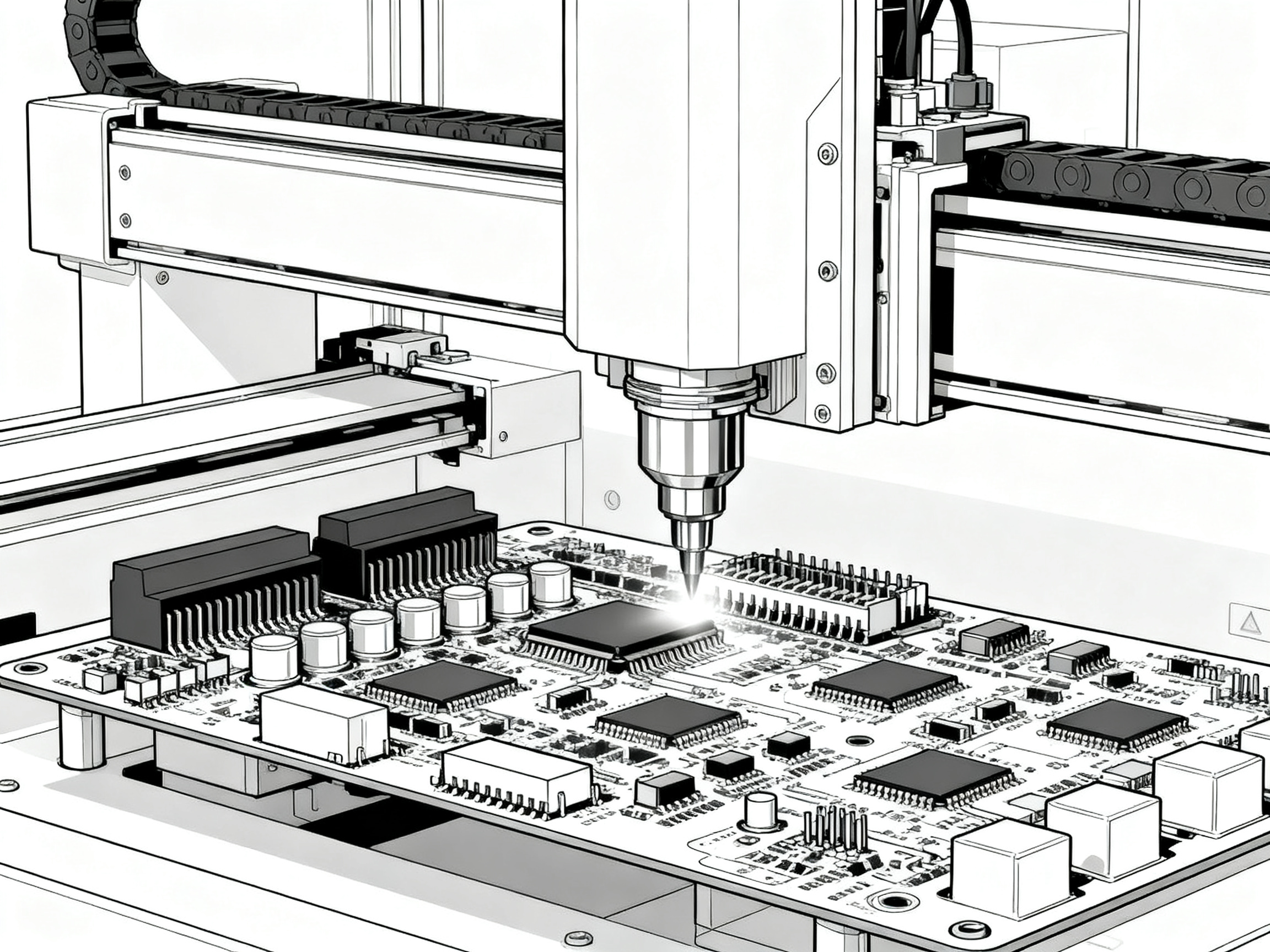
Instead of flooding the entire board with molten solder, selective systems solder one joint, or one small group of joints, at a time. You program the solder path, set the nozzle diameter, and the machine applies heat exactly where needed.
Key Specs to Evaluate
Nozzle size range matters. Mini nozzles down to 2-3mm handle fine-pitch connectors. Larger nozzles for power components. Some systems offer quick-change nozzle cartridges that cut changeover to under 5 minutes.
Flux precision is make-or-break. Micro-spray or micro-drop fluxers give you control over flux volume and placement. Too much flux and you get residue problems downstream. Too little and you get insufficient wetting.
Preheat control prevents thermal shock to surrounding components. Look for localized bottom-side preheat that brings the board up gradually without baking your SMT joints.
Board clearance and fixturing. Complex boards need custom pallets with precise keep-out zones. Verify the machine handles your board’s maximum dimensions and that fixturing costs aren’t hidden surprises.
Repeatability matters more than raw speed. You want ±0.5°C solder temperature stability and ±0.1mm positioning accuracy across thousands of boards.
The Speed vs. Precision Tradeoff
Selective soldering is slower than wave per joint, no question. But for boards where wave would damage $50 worth of components per board? The math changes fast. Cycle times of 8-15 seconds per joint seem slow until you compare them to the cost of rework or scrap from thermal damage.
Decision Tree: Wave vs. Selective Soldering
| Condition | Choose Wave | Choose Selective |
|———–|————-|——————|
| Board type | Full through-hole | Mixed SMT + THT |
| Component density | Low, no nearby SMT | High density, tight keep-outs |
| Production volume | High (>10K units) | Medium to high |
| Changeover frequency | Low SKU count | High SKU mix |
| Thermal sensitivity | Standard components | BGA, QFN, nearby |
The real question: is your board complex enough that selective soldering’s precision beats wave soldering’s speed? If you’re building anything with thermal-sensitive components near through-hole joints, the answer is usually yes.## 7. Complete SMT Production Line for Automated PCB Assembly
A single machine can’t do everything. That’s why large manufacturers think in lines, not boxes.
A modern SMT production line chains together automated systems that pass boards from station to station without manual handling. Here’s the typical flow:
Loader feeds blank boards onto the conveyor. A stencil printer applies solder paste with precision. SPI (Solder Paste Inspection) catches paste volume problems before they become expensive defects. High-speed pick and place drops components onto pads. Pre-reflow AOI verifies placement accuracy. The reflow oven solders everything together. Post-reflow AOI and X-ray inspection catch any soldering issues. Barcode tracking links every board to its process data. Finally, the unloader stacks finished assemblies.
| Station | Purpose | Key Buying Criteria |
|———|———|———————|
| Loader | Board input | Magazine capacity, changeover speed |
| Stencil Printer | Solder paste application | Print repeatability, vision alignment |
| SPI | Paste inspection | Detection sensitivity, false call rate |
| Pick and Place | Component placement | Accuracy, feeder capacity |
| Pre-reflow AOI | Placement verification | Defect detection, programming time |
| Reflow Oven | Soldering | Thermal uniformity, nitrogen capability |
| Post-reflow AOI/X-ray | Final inspection | Detection capability for hidden joints |
| MES/Traceability | Data management | Protocol support, reporting depth |
The real question isn’t whether each machine looks good on paper. It’s whether they work together as a system.
Line balance matters more than any individual machine spec. When one station runs faster than the next, the faster one waits. You want every machine sized to your actual bottleneck, not just the one with the best spec sheet.
Legacy factories upgrading toward automated, lead-free, traceable production face real friction. Old equipment may lack modern protocols like Hermes or CFX, making it hard to integrate with newer inspection and traceability systems. The choice becomes: rip and replace everything, or phase upgrades over time. For large manufacturers, this decision shapes production efficiency for years to come.
S&M Co. Ltd. builds complete SMT lines targeting high-volume manufacturers who need every station optimized for throughput, quality, and data capture. Their systems emphasize process control from first paste print to final inspection, supporting the compliance and traceability requirements that automotive and military customers demand.## 8. Automatic SMD Soldering Machine or Selective Soldering Cell for Mixed Assemblies
When buyers ask about automatic SMD soldering machines, they’re usually pointing at one of four things: inline selective wave soldering for high-volume production, standalone selective soldering units for low-to-medium batches, robotic soldering arms for complex geometries, or automated rework stations for defect repair.
Thing is, each solves a different problem.
Automated soldering wins hard on repeatability. A programmed selective soldering cell applies the same heat, the same flux volume, the same dwell time, every single cycle. Your defect rate drops. Operator fatigue stops being a variable. And once you’ve dialed in the recipe, scaling from 100 boards to 100,000 becomes predictable instead of chaotic.
Labor cost math shifts too. One operator supervising two selective soldering cells handles what used to require four hands on hot plates. That assumes you’ve got the volume to justify the equipment investment, which brings us to the practical boundary.
Manual SMD soldering still earns its place in three scenarios: repair benches dealing with field returns, engineering labs validating new designs before NPI, and low-volume work where programming a $120,000 selective soldering cell for 20 boards doesn’t pencil out.
For those situations, a solid temperature-controlled soldering station with fine tips and a hot air rework unit gets the job done. You won’t match production quality at scale, but you also won’t tie up capital in equipment running below capacity.
From Our Experience: We ran mixed boards through both automated and manual processes. When production volume exceeded 500 units per SKU, the automated cell paid for itself in under eight months through reduced rework and consistent first-pass yields. Below that threshold, manual techniques with skilled operators delivered comparable quality at lower cost.
| Use Case | Best Equipment | Why It Works |
|———-|—————-|—————|
| High-volume THT assemblies | Inline selective wave soldering | Continuous throughput, minimal changeover |
| Mixed SMT + THT boards | Standalone selective soldering cell | Programmable nozzle, localized heat |
| Complex geometries, odd-form parts | Robotic soldering arm | Multi-axis flexibility, jigit positioning |
| Defect repair, rework | Automated rework station | Controlled preheat, reflow, cooling stages |
| Prototyping, engineering labs | Manual station + hot air | Fast setup, low cost, skilled operator dependent |
| Low-volume repair | Temperature-controlled iron | Precise tip control, quick changeover |
The real question: does your production mix justify the automation investment? If you’re running the same board for years at scale, the math usually says yes. If you’re chasing rapid design changes, keep manual techniques in your toolkit until volume stabilizes.## Budget Planning: SMT Pick and Place Machine Price and Total Line Cost in 2026
Here’s the uncomfortable truth about SMT equipment pricing: the machine on the quote is rarely what you actually pay.
Buyers fixate on the sticker price. That’s a mistake. Total cost of ownership over five years typically runs 2.5 to 4 times the purchase price when you factor in everything else.
So what actually drives SMT pick and place machine price in 2026?
Capacity and speed tier sets your baseline. Entry-level desktop units start around $4,500 to $13,500 for basic prototyping machines. Mid-range production systems run $29,000 to $80,000. High-speed lines for volume manufacturing? Expect $150,000 to $400,000 and up.
Brand and support ecosystem matter more than most buyers realize. Fuji, Panasonic, Yamaha, and ASM lead the market, but you’re also paying for their global service networks. Smaller manufacturers may offer lower prices but watch out for disappearing support when you need it most.
Feeder packages catch people off guard. A machine that ships with 20 feeders sounds great until your production mix needs 80. Additional feeders run $200 to $800 each, and high-volume lines often need 50 to 100+.
Software, installation, and training add 10 to 20% to your equipment cost. Factory layout changes, conveyor modifications, and utility upgrades sometimes dwarf the machine price itself.
Energy and nitrogen consumption for lead-free reflow ovens can run $15,000 to $30,000 annually. Factor that into your operating cost model.
Annual maintenance typically runs 8 to 12% of purchase price. Budget for it from day one.
Pro Insight: Before comparing quotes, calculate your five-year total cost of ownership. A machine that costs 20% less upfront might cost 40% more over its lifespan if service response times lag and spare parts availability is poor.
SMT Equipment Price Ranges (2026)
| Equipment Type | Entry-Level | Mid-Range | High-Speed/High-Volume |
|—————-|————-|———–|————————|
| Pick and Place | $4,500-$13,500 | $29,000-$80,000 | $150,000-$400,000+ |
| Reflow Oven | $8,000-$15,000 | $25,000-$60,000 | $70,000-$150,000+ |
| Wave Soldering | $15,000-$30,000 | $30,000-$50,000 | $50,000+ |
| Selective Soldering | $40,000-$70,000 | $70,000-$120,000 | $120,000+ |
| Complete SMT Line | $25,000-$50,000 | $100,000-$250,000 | $300,000-$750,000+ |
These ranges vary based on configuration, brand, and included options. Request updated quotes from SMT pick and place machine manufacturers and soldering equipment suppliers before committing.
Quick ROI Worksheet
Before approving any purchase, run these numbers:
- Throughput gain: How many extra boards per hour? At $0.50 margin per board, 100 extra boards/hour equals $200,000 annually
- Defect reduction: Dropping from 2% to 0.5% defect rate on 500,000 units saves expensive rework or scrap
- Labor savings: One operator managing automated cells instead of four hands on hot plates
- Downtime reduction: Every hour of line stop costs your throughput multiplied by your margin
The payback math usually works out to 12 to 24 months for high-volume operations and 24 to 36 months for mid-volume. If your numbers don’t pencil out, reconsider the equipment tier or whether automation makes sense for your production mix right now.## Comparison Table: Best SMT Machine Categories by Use Case
Use this table to quickly match your production profile with the right SMT equipment. Whether you’re running high-volume consumer electronics, mixed-technology boards, or low-volume prototypes, there’s a machine category built for your workflow.
| Machine Category | Ideal Buyer | Primary Function | Core Advantage | Limitation | Key Spec to Verify |
|——————|————-|—————–|—————-|————|——————–|
| High-Speed Pick and Place | Large-scale manufacturers, consumer electronics | High-volume component placement | Raw throughput up to 75,000 real CPH | High cost, best for stable SKUs | Placement accuracy (±20-25 μm), feeder capacity (224-312+) |
| Flexible Pick and Place | High-mix producers, automotive, industrial | Mixed batch placement | Changeover under 8 minutes | Lower raw speed than dedicated high-speed | Component range, recipe management software |
| Lead-Free Reflow Oven | BGA/QFN assemblers, dense PCB builders | Solder joint formation | Precise thermal profiling, nitrogen capability | Profile validation required per board | PWI <80%, oxygen <50 ppm, zone count (8-12) |
| Compact Reflow System | NPI teams, engineering labs, pilot runs | Small-batch soldering | Low cost, quick setup | Limited throughput, thermal uniformity | Temperature repeatability, max board size |
| Wave Soldering Machine | Full through-hole producers, power electronics | Bulk THT solder joint formation | High throughput for THT assemblies | Not for mixed SMT+THT boards | Preheat control, flux application consistency |
| Selective Soldering Machine | Mixed-technology manufacturers | Localized THT soldering | Protects nearby SMT components | Slower per joint than wave | Nozzle range, flux precision, repeatability (±0.1mm) |
| Complete SMT Production Line | OEMs, contract manufacturers | End-to-end automated assembly | Full traceability, minimized manual handling | Significant capital investment | Line balance, MES protocol support (Hermes/CFX) |
Quick match guide:
Running millions of identical boards? Start with high-speed pick and place and a multi-zone reflow oven.
Juggling 50+ board variants monthly? Flexible placement plus selective soldering handles the mix.
Building prototypes before production commitments? A compact reflow system validates designs without major spend.
Got through-hole connectors near thermal-sensitive BGA packages? That’s selective soldering territory.
The table gives you a starting point. Your specific component mix, defect rate targets, and throughput goals should shape the final call.## Procurement Checklist: Questions to Ask SMT Machine Manufacturers
Before signing any purchase order, get straight answers to these questions. The conversations you have before buying prevent the nightmares you deal with after.
Your Board, Your Numbers
- What board sizes and thicknesses does this machine actually handle?
- What’s the real-world CPH on components similar to ours? (De-rate quoted specs by 20-30% to be safe.)
- What’s the placement accuracy for 0201 and finer components?
- How many feeder positions come standard, and what does each additional feeder cost?
Support and Service
- What’s your SLA for remote triage? For on-site response?
- Do you have local service engineers, or are we waiting on overseas support?
- Are spare parts stocked regionally or shipped from overseas?
- Can you share reference installations in our industry?
Testing and Validation
- Will you run a sample board trial before we commit?
- Can we witness FAT at your facility with our actual components?
- What’s the installation and commissioning timeline?
Documentation and Training
- What manuals and maintenance schedules come with the machine?
- Is operator training included, or does it cost extra?
- What’s your software update policy and how long do you support each model?
Integration Check
- Does the machine support Hermes and CFX protocols for MES connectivity?
- Will it handshake with our existing AOI and SPI systems?
Ready to talk specifics? Request machine specs, schedule a sample board trial, or discuss your line design with our team. We will help you compare options without the sales pressure.
—## Conclusion: Choosing the Right SMT Machine for PCB Assembly
Here’s what I want you to take away from all this: there is no single best SMT machine for PCB assembly that works for everyone.
Your ideal equipment depends on factors nobody else can answer for you. What’s your production volume? How complex are your boards? What’s your defect tolerance? Are you running lead-free processes that demand tighter thermal control? What factory systems do you already have in place?
These questions matter more than any spec sheet number.
The practical recommendations from this guide stay consistent regardless of who you are:
- High-speed pick and place machines deliver for massive volume runs with stable SKUs
- Flexible placement systems handle high-mix production without killing changeover time
- Lead-free reflow ovens with nitrogen capability protect BGA and QFN components on dense boards
- Wave and selective soldering equipment tackle through-hole joints, with selective protecting nearby SMT parts
- Full-line automation makes sense when you need scalable quality and traceability at volume
Now, here’s your next step: define your production requirements clearly before looking at any machine quotes. Run the total cost of ownership math over five years, not just the sticker price. Request equipment trials with your actual board designs. And validate supplier support before you sign anything.
Smart buying separates profitable factories from expensive regrets.