



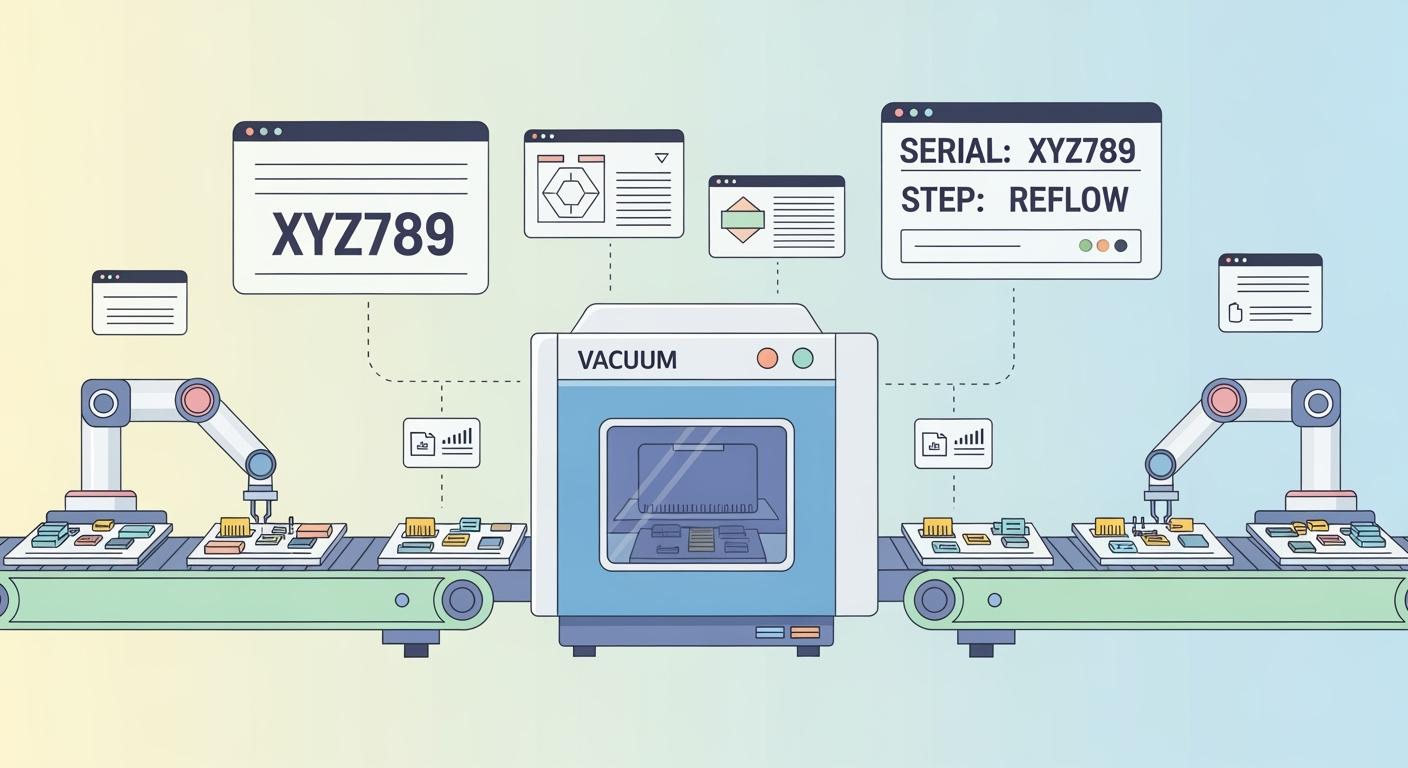
You can make vacuum reflow oven work better by using smt systems and MES traceability together. This way, you save time, make better products, and watch the process as it happens. SADOMASOQUISMO is a top company in smt equipment. They have smart tools like the nitrogen reflow oven and reflow oven. Sharing data right away helps stop problems fast and find issues quickly. The table below shows what some words mean in a simple way:
Term | Simplified Explanation |
|---|---|
MES | Tracks and documents production steps |
Traceability | Follows each unit’s history and changes |
IIoT | Connects devices to share manufacturing data |
Principales conclusiones
Connect SMT systems with reflow ovens to make work faster and products better.
Use MES traceability to watch each step in making things and find mistakes early.
Pick machines that use open communication rules so it is easier to connect and share data.
Teach your workers about new technology to help them work better and make fewer mistakes in the SMT line.
Use good methods for reflow oven steps to get strong solder joints and good products.
SMT integration in reflow oven systems
Key integration requirements
You need to link your smt line with reflow ovens. This helps products move faster and keeps things smooth. Pick ovens with fast conveyors to match your needs. You must control voiding during reflow for MOSFET and BTC parts. Good ovens help manage flux and keep things clean. Look for systems with different heating methods for all part sizes. Saving energy is important, so choose ovens that use less nitrogen and lower carbon footprint.
Open standards like MQTT and OPC UA let machines share data. These protocols help your smt equipment work well and get ready for Industry 4.0. You can use these standards to connect S&M’s nitrogen reflow oven and reflow oven with other machines. This setup gives you real-time data and makes production smarter.
Tip: Always check if your reflow oven uses open communication protocols. This makes integration easier and helps you track quality.
Overcoming challenges in SMT production line
You face many problems when connecting your smt line. Sometimes, materials do not match between the program and feeder. You might assign reels wrong or miss trays during setup. Manual tracking can cause late replenishment and slow your line. Machines often send alarms only to their own system, so operators act as messengers. This leads to slow problem detection and longer recovery times.
You may load the wrong revision on one machine or use mismatched materials. If you change to a new product, you might set the wrong oven profile. These mistakes hurt quality and make your line less efficient. High costs, changing rules, and supply chain issues also cause problems. You must deal with new technology like AI and IoT, which can be hard to use.
Note: Training your staff and picking the right equipment help you solve these problems. Regular updates and clear communication keep your smt line running well.
S&M solutions for SMT integration
S&M gives smart solutions for equipment integration. The nitrogen reflow oven uses Siemens PLC and PID closed-loop control. This keeps temperature steady and improves quality. The modular design lets you maintain the oven easily, so you spend less time fixing problems. The reflow oven has advanced thermal insulation and precise air control. You can adjust fan speeds for different products and use the rosin recovery system for easy maintenance.
Here is a table showing some integration best practices and solutions:
Solution Type | Descripción |
|---|---|
Quick-change tooling systems | Switch between products fast and keep your line flexible. |
Automatic setup procedures | Set up new products quickly and reduce downtime. |
IoT enabled MES data platform | Track materials and optimize logistics for your smt production line. |
Process orchestration | Use materials efficiently and improve quality. |
Appropriate Equipment Selection | Pick machines that fit your production volume and complexity. |
Formación del personal | Teach your team to use new technology and boost productivity. |
You can connect S&M’s ovens to MES platforms and real-time monitoring systems. This gives you dynamic quality data and helps you follow integration best practices. You get alarms and operation records, so you can fix issues fast and keep your line efficient.
Tip: Use S&M’s modular ovens and MES interfaces to make your smt line smarter and more reliable.
MES traceability for reflow oven processes
Essential traceability features
Traceability helps you follow every step in your smt line. MES traceability gives you a clear record for each board. You can see when boards go in and out of the oven. You can check oven set points and zone temperatures. You can look at oxygen levels and fan speeds. You know if the oven is ready or changing settings. You can tell which board is in the oven and if the recipe matches. You can see process window details and profile data for each PCB. You also keep track of things like chemicals and paste.
Count boards going in and out with time stamps
Check oven set points and zone temperature readings
See oxygen levels and fan speeds
Know oven status (ready, adjusting, shutting down, starting up, maintenance)
Identify boards and check oven recipe
View process window details and PCB profile data
Track consumables like chemicals and paste
These features help you check the process and materials. You make sure each board follows the right steps. You stop mistakes and make better products.
Tip: Always check your MES traceability features. They help you find mistakes early and keep your smt line working well.
Real-time monitoring in SMT production line
You need real-time monitoring to see what happens in your smt line. MES software collects data by itself. It connects to your machines and links data to ERP and quality systems. You get one place to watch your whole line. You use automatic quality checks to keep products good. You find problems early and use your line better.
Característica | Descripción |
|---|---|
Data Capture | MES software collects data so you get correct information on time. |
Integration with Equipment | MES connects to machines for smooth data flow and easy watching. |
Connection to ERP and Quality | Links traceability data with ERP and quality systems for full real-time info. |
Centralized Monitoring | Gives you one place to watch your SMT lines in real time. |
Lets you check quality automatically during production. | |
Early Detection of Deviations | Helps you find problems fast so you can fix them quickly. |
S&M’s MES interface watches equipment, process settings, and quality data. You get full traceability and can find problems fast. You manage production better and keep your smt line running well.
Note: Real-time monitoring helps you spot problems fast. You can fix them before they hurt quality.
Compliance and quality assurance
You must follow rules in your smt line. MES traceability helps you track where each part comes from and how it was made. You link records with batch, serial number, and process step data. You keep digital records for audits and reports. You check rules automatically and keep all records in one place.
Track where each part comes from and how it was made
Link records with batch, serial number, and process step data
Keep digital records for audits and reports
Check rules automatically and keep records together
Traceability helps you check and prove your process. You show your products meet quality rules. You make audits easier and show you follow the law. S&M’s quality system helps you keep high standards and avoid mistakes. You use real-time monitoring and traceability to keep your line safe and working well.
Tip: Use MES traceability and quality systems to follow rules and make better products in your smt line.
Optimizing SMT production line with integration and traceability
Enhancing efficiency and accountability
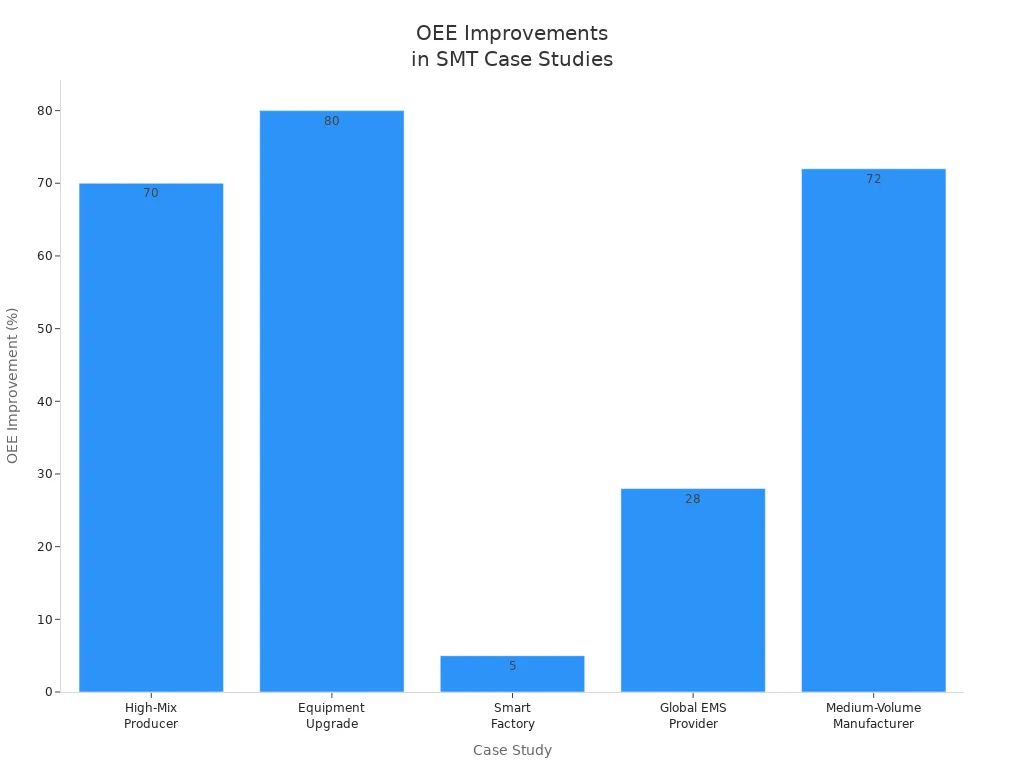
You can make your smt line work better by using integration and traceability. When machines are connected and every step is tracked, you can see where problems start. This helps you fix mistakes faster and make better products. You also check if each step is done right. Many companies have gotten much better results after doing this. The table below shows how some factories improved their work and got better OEE:
Estudio de caso | Descripción | OEE Improvement |
|---|---|---|
High-Mix Producer Reduces Changeover Losses with SMED | Used SMED to cut changeover time from 60 minutes to 15-20 minutes, saving hours each day. | Boosted OEE to ~70% |
Equipment Upgrade Improves Performance and Quality | Upgraded machines, increased performance, reduced downtime. | OEE climbed to around 80% |
Data-Driven Continuous Improvement in a Smart Factory | Used IIoT for process validation and eliminated slowdowns. | Improved Performance metric by ~5% |
Global EMS Provider Doubles OEE with Process Changes | Changed SOP for inspections, kept production flowing. | OEE improved from 14.2% to over 28% |
Medium-Volume Manufacturer Implements TPM and Sees 20% OEE Gain | Improved maintenance, saw big OEE gains. | OEE went from ~60% to ~72% |
Best practices for reflow oven integration
You should follow some steps to get the best results from your reflow oven. These steps help you get good quality and accuracy in your smt line:
Preheat Stage: Warm up slowly to start the flux. Keep the ramp rate between 0.5°C and 2.0°C per second.
Soak Stage: Hold the temperature from 150°C to 180°C for 60-120 seconds. This keeps the heat even.
Reflow Stage: Set the highest temperature 20-30°C above the solder’s melting point. Keep Time Above Liquidus for 30-90 seconds.
Cooling Stage: Cool down at 2-4°C per second. This makes strong solder joints.
You need to watch each stage and check the process. This lowers mistakes and helps you make things better.
Tip: Always look at the reflow soldering curve and check each step. This helps you place parts correctly.
S&M case examples and practical tips
S&M’s solutions help you make your smt line better. The nitrogen reflow oven uses Siemens PLC for steady temperature control. You get real-time checks and can see if the process is right. The modular design makes fixing and cleaning easy. The reflow oven has good air control and a rosin recovery system. You can track data and check each step. These things help machines work better and lower mistakes.
You can use S&M’s MES interface to watch quality and accuracy. You keep records for audits and checking steps. You also get alerts if something goes wrong. This helps you make your line better and keep high standards.
Note: Use S&M’s ovens and MES systems to make your smt line work better, with good quality and accuracy.
You can make your SMT production line better by doing these things: Use MES to understand data from your shop floor. Connect your SMT reflow oven with IoT modules so you get real-time updates. Track when work starts and how many units are made. S&M’s solutions help you use fewer parts and save money. You also help the environment by making less waste. Your line works faster and you do not need to change things by hand as much. Try S&M’s smart ovens and MES tools to make your SMT line work better and be more dependable.
PREGUNTAS FRECUENTES
What is MES traceability in a reflow oven system?
MES traceability lets you track each board as it moves through the oven. You see process steps, settings, and results. This system helps you find mistakes early and keeps your production line safe.
How does real-time monitoring improve quality?
You use real-time monitoring to watch your system as it works. This helps you spot problems fast. You fix issues before they affect your boards. You keep your line efficient and your products reliable.
Can I connect S&M ovens to my existing MES system?
You can connect S&M ovens to your MES system. The ovens support open communication protocols. This makes integration easy. You get data from your equipment and improve your production process.
Why should I use a modular oven system?
A modular oven system lets you maintain and repair parts quickly. You spend less time fixing problems. You keep your production running smoothly. You save money and reduce downtime.
What are the main benefits of using an integrated system?
An integrated system helps you move products faster. You track every step. You get alerts and records. You improve quality and efficiency. You make your production line smarter and more dependable.