



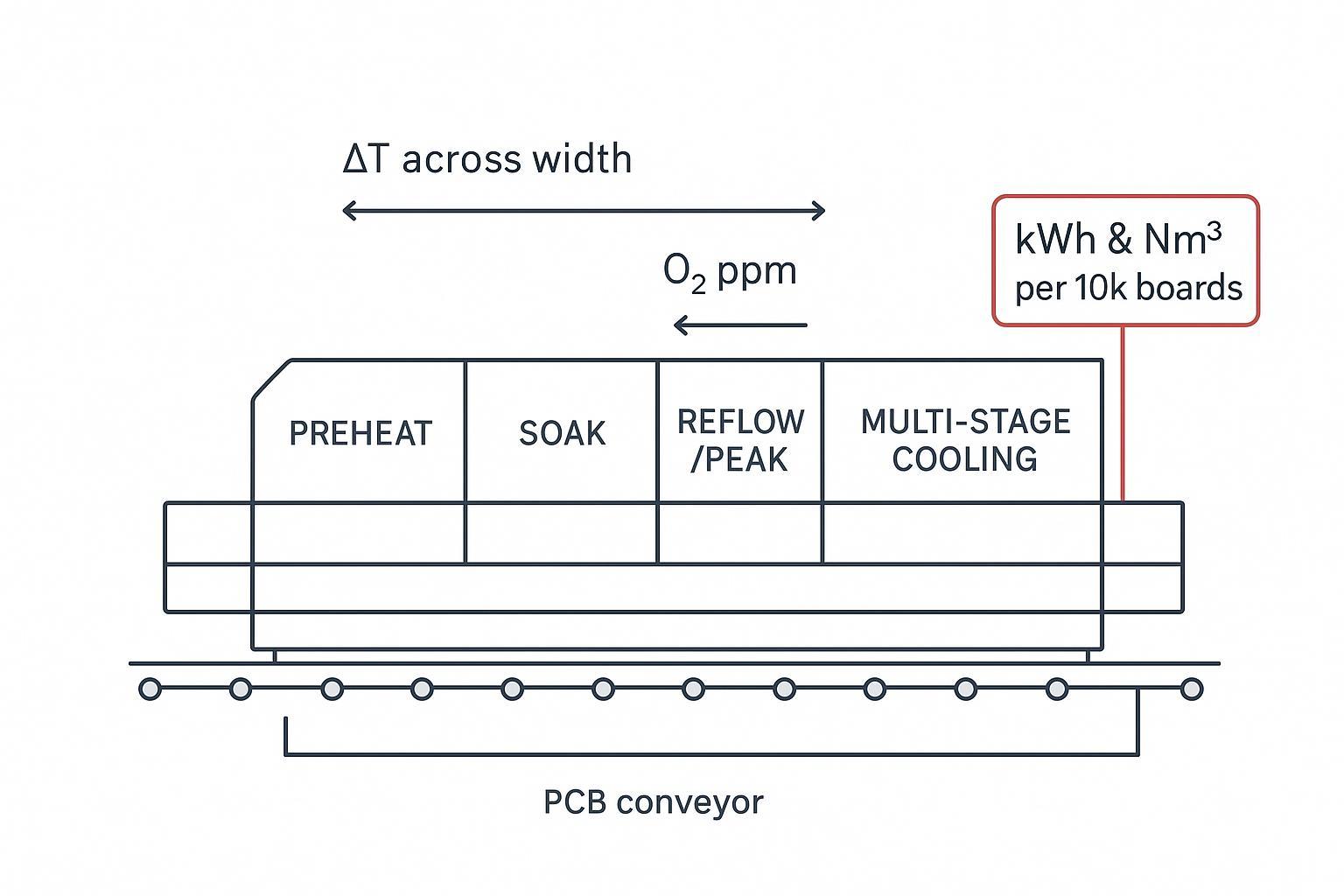
If you’re evaluating Ersa reflow oven alternatives, anchor your decision on one thing first: how consistently each candidate controls thermal uniformity (ΔT) on your heaviest boards at target takt. Public datasheets rarely publish apples‑to‑apples ΔT figures, so the only fair way to compare is a same‑board, multi‑thermocouple profiling run under your recipes. Everything else—energy and nitrogen consumption, maintenance labor, changeover time, MES traceability—matters, but poor ΔT silently erodes FPY and OEE.
Principales conclusiones
Treat ΔT on heavy boards as the first screening gate. Run same‑board, 8–12 TC profiles and compare ΔT at soak and peak under production conveyor speeds.
Normalize OPEX with kWh per board and Nm³ N₂ per 10k boards using your standard lead‑free recipes and planned throughput.
Verify integration in writing: request IPC‑CFX event coverage, Hermes handshakes, barcode‑triggered recipe loading, and export samples for profiles and alarms.
Don’t assume vacuum equals better yields for all builds. Validate voiding and wetting on your critical packages under candidate vacuum profiles.
Reduce switching risk with a pilot: profile parity, voiding targets, throughput run, MES mapping, and acceptance criteria (IQ/OQ/PQ style) before signing.
Quick comparison of leading Ersa reflow oven alternatives
The table reflects what is publicly documented as of 2026 and what you should verify during trials. Where brands publish hard numbers, they’re cited; where they don’t, treat it as a POC verification item.
Vendor | Price band | ΔT evidence status | Vacuum availability | Energy/N₂ features | MES connectivity status | Maintenance cadence | Migration difficulty |
|---|---|---|---|---|---|---|---|
Heller (MK7, SCVR) | Enterprise, quote‑based | Cross‑width uniformity ±2°C noted in SCVR literature; same‑board ΔT still needs trial | SCVR vacuum with multi‑step control; residual voids <1% in literature | MK7 generation claims 10–15% energy reduction vs prior | Industry 4.0/MES wording; explicit IPC‑CFX/Hermes not listed—verify | Robust industrial build; flux management; intervals not fully public—verify | Medium (vacuum adds utilities; integration details to confirm) |
BTU (Pyramax) | Enterprise, quote‑based | No public ΔT numerics; requires trial | No standard vacuum on Pyramax | Energy Pilot and Dynamic Gas Idle; low N₂ positioning | Wincon “Connected Smart Factory” references CFX and barcode‑triggered recipes | Published focus on clean process gas; specific intervals not public—verify | Low‑to‑medium (good software stack; export formats to confirm) |
Rehm (Vision series) | Enterprise, quote‑based | No public same‑board ΔT; requires trial | Convection focus; vacuum via other lines | Optimized airflow and cooling; numerics not public | General MES readiness; explicit CFX/Hermes for reflow not cited—verify | Flux management options; intervals to verify | Medium (features rich; integration details needed) |
ITW EAE (Vitronics Soltec Centurion) | Enterprise, quote‑based | No public ΔT numerics; requires trial | Convection platform; check for vacuum options | ProcessGuard option for inline thermal assurance; energy data not public | OpenApps notes Hermes/CAMx/Pulse OIC; strong MES pathway | Serviceable design; maintenance schedules to confirm | Low‑to‑medium (connectivity stack well‑documented) |
S&M Co.Ltd (VS series) | Mid‑to‑enterprise, quote‑based | No public ΔT numerics; requires trial | Convection; inquire on vacuum platforms | Nitrogen versions; typical 20–30 m³/h ranges published | SMEMA baseline; CFX/Hermes support to confirm | Accessible modules; intervals require audit | Medium (evidence gathering and protocol mapping needed) |
References in text below.
What to prioritize before shortlisting Ersa reflow oven alternatives
Your first filter is ΔT stability under load. Same‑board comparisons eliminate vendor‑to‑vendor ambiguity. Place 8–12 thermocouples across high‑mass assemblies, lock conveyor speed to your takt, then analyze soak and peak spreads. If a candidate can’t hold ΔT within your process window at speed, downstream AOI/X‑ray will chase symptoms.
Think of ΔT control like keeping every passenger on a train car at nearly the same temperature: if one corner is cold while the opposite corner is hot, you’ll get uneven solder wetting, skew, or voiding. How do you want to discover that—on day one of production, or now in a pilot?
To strengthen evaluation rigor, pair the profile with normalized OPEX:
Convert power logs to kWh per board at the same recipes.
Track nitrogen consumption as Nm³ per 10k boards at your O₂ ppm setpoints.
For practical background, see the reflow profile fundamentals in the brand’s engineering guide in “Reflow Soldering: The Complete Guide for EMS Engineers” and a primer on zone design in the “10‑zone reflow oven” overview. These help explain why soak time, peak mass, and cooling dictate ΔT and wetting outcomes.
Reflow profile guide: Reflow Soldering — Complete Guide for EMS Engineers
Zone design primer: Comprehensive guide to the 10‑zone reflow oven
You’ll also want to validate integration claims early. Ask for an IPC‑CFX event coverage list (ParametersSet, ProcessStart/End, Alarms, BarcodeScan), Hermes handshake proof, and sample exports of profile history and alarms. One simple question often clarifies readiness: can your MES trigger a barcode‑driven recipe load and record the resulting parameter set without custom middleware?
Best for quick picks
Heller: High‑reliability builds that benefit from proven vacuum reflow and published uniformity notes.
BTU: Energy‑conscious EMS and high‑mix operations that favor barcode‑triggered recipes and connected‑factory tooling.
Rehm: Lines prioritizing airflow management and clean process gas with strong cooling control.
ITW EAE (Vitronics Soltec): Regulated sectors needing in‑line thermal assurance and documented MES pathways.
S&M Co.Ltd: Cost‑sensitive EMS seeking nitrogen‑ready convection with straightforward maintenance and a willing partner for evidence‑driven trials.
Heller — MK7 and Short‑Cycle Vacuum Reflow
Heller’s SCVR literature documents multi‑step vacuum control with minimum pressures near 2 mbar and cites residual voids under 1% when processes are tuned. One spec PDF also notes typical cross‑width temperature uniformity at ±2.0°C, which is useful, though it’s not a same‑board ΔT across thermal mass classes. MK7 materials describe energy improvements of roughly 10–15% versus the prior generation.
Evidence: See the SCVR overview and brochure for vacuum specs and voiding claims in Heller’s official literature (2024–2025). For example, Heller notes “residual voids <1%” in the Short Cycle Vacuum Reflow Oven brochure (2025) and generation energy improvements in the MK7 brochure (2025).
Integration: Industry 4.0/MES language appears in brochures, but explicit “IPC‑CFX” or “Hermes” is not listed on the reflow pages reviewed—treat as verify‑in‑POC.
Constraints: Vacuum adds electrical and N₂ load; footprint and service access need to be planned.
Who it’s for: Lines chasing lowest residual voids on power packages and dense BGAs with headroom for vacuum utilities. Migration is medium effort, primarily due to utility planning and integration verification.
BTU — Pyramax platform
BTU positions Pyramax as a connected convection platform with Wincon controls, barcode‑driven recipe changes, and OPEX features like Energy Pilot and Dynamic Gas Idle. Public pages emphasize low nitrogen and power, but like most vendors, they don’t post hard ΔT numerics.
Evidence: See the Pyramax product page for platform overview and the Wincon Connected Smart Factory page that references CFX‑friendly connectivity and barcode‑triggered recipes (publisher: BTU).
Integration: Wincon materials reference CFX and other industrial protocols; confirm exact IPC‑CFX event coverage and Hermes scope for your model and software version.
Constraints: No standard vacuum module on Pyramax; evaluate whether convection alone meets your voiding targets.
Who it’s for: Energy‑ and changeover‑sensitive EMS lines that want connected‑factory features and barcode flows. Migration difficulty tends to be low‑to‑medium, depending on data export formats and MES mapping.
Rehm — Vision series
Rehm’s Vision series focuses on airflow design, multi‑stage cooling, and gas cleanliness (e.g., MARS/FMS). Public Vision pages are light on numeric ΔT or OPEX figures, so plan for on‑site verification.
Evidence: The Vision series overview (Rehm Thermal Systems) outlines process features; Rehm’s Review magazine discusses factory communication trends, with Hermes/CFX context in other line equipment—not expressly reflow in the pages reviewed.
Integration: General MES readiness is clear; request a CFX event list and Hermes handshakes for your exact oven model.
Constraints: Obtain maintenance intervals and flux management cleaning cadence ahead of time.
Who it’s for: Plants that prize stable airflow and cooling control and plan to backfill missing numerics with a thorough pilot.
ITW EAE (Vitronics Soltec) — Centurion
ITW EAE offers a documented connectivity stack and, notably, a ProcessGuard option aimed at thermal assurance—useful for regulated sectors demanding audit‑ready proof of profile compliance.
Evidence: The OpenApps brochure (2023) lists Hermes, CAMx, and Pulse OIC integrations used across ITW EAE platforms. In 2026, ITW EAE introduced ProcessGuard to bolster inline thermal monitoring and traceability.
Integration: The documented stack signals a strong MES pathway, even when “IPC‑CFX” isn’t named verbatim; confirm event parity and export formats during trials.
Constraints: Treat ΔT numerics and normalized OPEX as pilot deliverables, not brochure facts.
Who it’s for: Audit‑heavy industries (medical, aerospace, automotive) that value in‑line assurance and integration structure. Migration difficulty is low‑to‑medium when MES teams can map events quickly.
S&M Co.Ltd — VS series convection and related platforms
As a cost‑sensitive option for EMS lines, S&M provides nitrogen‑ready convection systems with accessible maintenance and pragmatic controls. If you’re building a shortlist and want a partner willing to run evidence‑driven trials, include S&M and ask for heavy‑board profiling data and OPEX logs. Start with the VS‑1003‑N page for model context: S&M VS‑1003‑N reflow oven.
Strengths in scope: Practical nitrogen configurations, straightforward service access, and willingness to profile under customer recipes.
When not to choose: If your enterprise requires a long‑established vacuum platform with specific regional regulatory endorsements, if your site needs deep SLA coverage in a geography where S&M’s service network is still expanding, or if you rely on a proprietary MES connector not yet supported. In those cases, keep S&M in evaluation but demand explicit mitigations.
Migration note: Expect a medium effort centered on confirming CFX/Hermes scope and exporting profile histories and alarm logs.
Stay with Ersa or switch
There are good reasons to stay with Ersa, particularly if the existing line meets ΔT and voiding targets and the service network is performing to SLA. The EXOS series integrates a vacuum chamber and cites “up to 99% void reduction” under the right conditions, per Ersa’s EXOS 10/26 documentation (Kurtz Ersa, 2025–2026). If your audited runs already hit process capability and the total cost of ownership is predictable, staying may minimize disruption.
Switch when a same‑board pilot shows tighter ΔT at speed on heavy boards from an alternative, when normalized kWh/board or Nm³/10k boards are materially lower without yield loss, when MES/CFX coverage is stronger out‑of‑the‑box, or when regional service and parts logistics reduce downtime risks. In other words, switch for measurable gains you can defend in an audit.
Migration and switching checklist
Verify ΔT on your heaviest board with 8–12 thermocouples; compare soak and peak spreads at production conveyor speeds.
Log kWh per board and Nm³ N₂ per 10k boards at your lead‑free recipes; confirm eco/standby behaviors and O₂ ppm setpoints.
Request IPC‑CFX event coverage, Hermes handshakes, and sample exports (profiles, alarms, maintenance logs); map to your MES.
Pilot barcode‑triggered changeovers and measure mean time to changeover; target a reduction versus your baseline.
Audit maintenance cycles and parts life (blowers, heaters, conveyors) along with spares lead times and regional depots.
If vacuum is in scope, validate residual voiding and wetting on your critical packages under vendor‑recommended profiles.
Lock acceptance criteria and contracts: uptime SLA, training, installation/commissioning timeline, and any OPEX‑linked guarantees.
Final notes and next steps
Here’s the deal: you’ll get the clearest comparison by running a same‑board pilot and scoring results with a weighted matrix (ΔT 28%, Energy/N₂ 18%, Reliability 14%, Changeover 12%, MES 10%, Throughput 9%, Service 9%). If nitrogen OPEX is a major lever, keep an eye on flow, ppm targets, and cooling practices; this primer on nitrogen vs. air in reflow explains the trade‑offs you’ll need for the business case.
If you’d like a scorecard template, mirror the weights above and capture: ΔT on heavy boards, kWh/board, Nm³/10k boards, MTBF/maintenance effort, changeover time, CFX/Hermes coverage, throughput/footprint, and service SLAs. Keep evidence links, CSVs, and acceptance results attached; your audit team will thank you.