



Publicado: 08 August 2026
Tiempo de lectura: 18 minutes
Introduction: Finding the Best Small Batch Reflow Oven for Your Needs
You’ve got a prototype PCB that needs soldering, and sending it out to a contract manufacturer feels like sending your kid to college: expensive, slow, and you lose control over the whole process. Plus, waiting weeks for a handful of boards to come back just doesn’t work when you’re iterating on a design.
This is exactly why more engineers, labs, and small shops are bringing reflow soldering in-house with a small batch reflow oven. Whether you’re working in a university lab running student projects, a startup pumping out prototypes, or a small business doing low-volume production, having your own reflow capability changes everything. You get faster turnaround, more control over quality, and the ability to iterate quickly without external dependencies.
But here’s the thing: not all small batch reflow ovens are created equal. A lab doing component validation has very different needs than a prototype shop running 50 boards a day, and both differ from a low-volume production line pushing a few hundred assemblies weekly. The price tags reflect this too. You can find basic desktop units around $1,000, mid-range benchtop systems from $5,000 to $17,500, and professional-grade units climbing past $50,000 [1]. Understanding where your operation fits on this spectrum matters more than chasing brand names.
In this guide, we’ll break down what actually matters when choosing the best lab reflow oven, prototype reflow oven, or low-volume production oven for your specific situation. We’ll look at temperature control, heating methods, maintenance requirements, and real-world value so you can make a smart investment without overspending on features you’ll never use.
[Author Bio for Jace Liu – 2-3 sentences establishing relevant expertise in SMT equipment and reflow oven technology to be added]## 1. T200N Benchtop Lead-Free Reflow Oven – Best Overall for Labs and Prototyping
If you’re looking for the sweet spot between professional-grade performance and something that won’t require a second mortgage, the T200N Benchtop Lead-Free Reflow Oven deserves your attention. This unit consistently shows up in conversations about the best lab reflow ovens for small shops and universities, and after digging into the specs, I can see why.
The T200N hits a really nice balance. It offers precise thermal control without the complexity and price tag of production-line equipment. For labs doing component validation or prototype work, this matters a lot. You don’t need industrial-scale throughput, but you absolutely need reliable, repeatable profiles that won’t toast your boards.
What’s under the hood: The T200N features a 270×230 mm work area, which handles most prototype-sized boards without issues. Its temperature range goes from room temperature up to 360°C, giving you plenty of headroom for lead-free solders that peak around 240–250°C. The rated power sits around 3.8–4.0 kW, and temperature accuracy claims ±2°C, which is solid for this class of equipment.
The controller supports multiple profile segments, so you can dial in proper ramp rates, soak zones, and cooling slopes. This is critical for lead-free work where thermal profiling directly affects joint quality and reliability. Most standard solder pastes work well with this oven, including the common SAC305 alloys you’ll encounter with most components.
One thing I appreciate about benchtop units like this is the footprint. You’re not dedicating an entire room to the equipment. It sits on your workbench, plugs into standard 220V circuits in most cases, and doesn’t require the infrastructure investment that larger conveyor systems demand.
T200N Specifications
| Specification | Details |
|————–|———-|
| Work Area | 270 × 230 mm |
| Temperature Range | Room temp to 360°C |
| Temperature Accuracy | ±2°C |
| Rated Power | 3.8–4.0 kW |
| Heating Method | Convection (forced air) |
| Profile Segments | Multi-stage programmable |
| Compatible Solders | Standard lead-free (SAC305), leaded |
Where it shines: Universities running student projects, startups doing prototype runs, and small shops that need reliable results without full production capacity. The learning curve is gentler than industrial systems, and maintenance stays straightforward with basic cleaning and periodic calibration checks.
Is it the right choice for everyone? Probably not. If you’re pushing 50+ boards daily with zero tolerance for variation, you’ll want to look at higher-end systems. But for the vast majority of labs and prototype operations, the T200N delivers professional results at a price point that makes sense.
You can find the T200N through distributors like Torch and other SMT equipment suppliers, with typical costs falling in that entry-level to mid-range bracket we mentioned earlier 1.
2. PDR H636 Lead-Free Convection Reflow Oven – Best for Semiconductor and Precision Assembly
When your work involves sensitive semiconductor components, the stakes jump way higher. BGA packages, QFN assemblies, and advanced ICs demand tighter thermal control than your basic prototype work. One bad profile can mean cracked die, compromised solder joints, or components that pass initial testing but fail in the field months later. Not ideal.
This is where precision convection reflow ovens like the PDR H636 earn their keep. The “H” designation typically signals a higher tier, and in this case it means business. We’re talking about equipment built for assembly where temperature uniformity across the entire work surface isn’t just nice to have, it’s everything.
Why convection heating matters for sensitive work:
Look, infrared ovens have their place. They’re fast, they heat quickly, and for simple single-sided boards with uniform component heights, IR can work fine. But here’s the problem: infrared heating behaves differently depending on what it’s hitting. Dark components absorb heat faster than light ones. Large ground planes pull heat differently than sparse traces. Shadowed components under taller parts miss out entirely.
Convection reflow ovens solve this by heating the air in the chamber, which then surrounds every component equally regardless of color, shape, or position. The result? Temperature readings at different points on your board stay within a few degrees of each other throughout the entire profile. For lead-free solders that peak around 240-250°C, this consistency directly translates to reliable joints across your entire assembly.
Heating Technology Comparison
| Feature | Convection | Infrared | Hybrid (IR + Convection) |
|———|———–|———-|—————————|
| Temperature Uniformity | Excellent | Good (varies by board) | Very Good |
| Heating Speed | Moderate | Fast | Fast |
| Color/Geometry Sensitivity | None | High | Low |
| Best For | Dense boards, BGAs, QFNs | Simple, stable designs | Mixed requirements |
| Maintenance | Moderate (fans/filters) | Low | Moderate |
The PDR H636 uses closed-loop temperature control, which means the system continuously monitors actual chamber temperature and adjusts heating output in real-time. This closed-loop approach keeps your profile on target even when you’re running boards with varying thermal mass, a common challenge in semiconductor assembly where you might have massive BGA heat spreaders sitting next to tiny passives.
Who needs this level of precision?
If you’re assembling anything with advanced packaging, working with moisture-sensitive components that need controlled ramp rates, or doing any work where field failures carry real cost, the extra investment in a precision convection system pays for itself quickly. We’re talking about the difference between boards that work in the lab and boards that work reliably for years.
Pro Insight: For labs and low-volume operations, features like multi-zone closed-loop control and advanced profiling software provide real ROI. But here’s the catch: if you’re mostly running the same simple board over and over, you probably don’t need all those bells and whistles. Save your budget for the features you’ll actually use daily, and skip the complexity that just adds learning curve without adding value.
For semiconductor validation work, prototype testing, and any assembly where repeatability matters more than raw throughput, the PDR H636 delivers the thermal performance that sensitive components demand. It sits in that mid-to-upper tier where you’re paying for precision, but you’re not crossing into full production-line pricing yet.
The question is whether your operation actually needs that level of control, or whether a well-tuned benchtop unit would serve you just as well for what you’re actually building.## 3. Reflow Technologies Flow solder Pro – Best Value for Low-Volume Production
Let’s talk about getting the most bang for your buck. If you’re running a small shop or a startup’s production line, you probably don’t have the budget of a major electronics manufacturer, but you still need equipment that won’t let you down when it matters.
The Flow solder Pro from Reflow Technologies sits in that interesting middle ground. It’s built for shops that have outgrown basic benchtop units but aren’t ready to drop $50,000 on a production-line system. We’re talking about the sweet spot where capability meets affordability, and that’s a space more vendors are targeting in 2026.
What makes it good value:
For low-volume production, you’re usually looking at runs of anywhere from a few boards to a couple hundred assemblies per week. The Flow solder Pro handles this workload without the overhead of bigger systems. You get programmable profiles, decent throughput, and the reliability needed for repeatability. All without needing a dedicated facility or industrial electrical service.
One thing budget-conscious operations appreciate is the automation features. Once you dial in your profile, the system handles the temperature曲线 without constant babysitting. This frees up your technicians to focus on board prep, inspection, and other value-added work instead of standing over an oven watching numbers.
Value Comparison for Low-Volume Production
| Feature | Entry-Level | Mid-Range (Flow solder Pro class) | Premium Systems |
|———|————-|———————————-|——————|
| Typical Price | $5,000-$8,000 | $10,000-$20,000 | $25,000-$60,000+ |
| Profile Control | Basic | Advanced | Industrial-grade |
| Throughput | Low (1-2 boards/cycle) | Moderate (3-5 boards/cycle) | High volume |
| Automation | Manual | Semi-auto | Full auto |
| Lead-Free Support | Limited | Full | Full |
| Best Fit | Prototyping | Low-volume production | Small-batch production |
The real ROI shows up when you calculate labor savings. If you’re running 20 boards a week with a manual process, you’re probably spending 15-20 minutes per cycle actively managing the oven. With automation handling the profile, that drops to maybe 5 minutes of load and go work. Over a year, that’s significant.
Pro Insight: For labs and low-volume operations, features like multi-zone closed-loop control and advanced profiling software provide real ROI. But here’s the catch: if you’re mostly running the same simple board over and over, you probably don’t need all those bells and whistles. Save your budget for the features you’ll actually use daily, and skip the complexity that just adds learning curve without adding value.
Is it the cheapest option out there? No. But when you factor in reliability, repeatability, and the ability to actually grow into the equipment, the Flow solder Pro type units deliver genuine value for operations that need professional results without professional-grade pricing.
For small businesses, university labs pushing into small-batch work, or startups that need assembly capability without the assembly-line overhead, this class of equipment makes a lot of sense.## 4. Shenzhen Chuxin Electronic E-Series – Best for Military and Aerospace Applications
When failure isn’t an option, you need equipment built to a different standard. Military and aerospace electronics operate in environments where a single bad solder joint can mean mission failure, safety issues, or costly field failures that erode trust. We’re talking about avionics, defense systems, satellite components, and other high-reliability assemblies where the stakes are orders of magnitude higher than consumer products.
The Shenzhen Chuxin Electronic E-Series targets exactly this world. S&M Co. Ltd., operating under the Shenzhen Chuxin Electronic Equipment brand, has positioned this line for manufacturers who need traceable, documented, and repeatable soldering processes that meet stringent industry requirements 1.
Why compliance matters in defense electronics:
Look, you can build a solid board on a basic benchtop oven. But can you prove it? Can you show documentation that your thermal profile was within spec, that every board went through the same process, and that your equipment was calibrated at the time of assembly? For military contracts, the answer needs to be yes, and that changes everything about how you select equipment.
The E-Series is designed with this documentation chain in mind. We’re talking about systems that support the compliance frameworks defense contractors and aerospace manufacturers actually require. This includes traceable thermal profiling, calibration records, and process validation documentation that quality managers can pull during audits 2.
E-Series Compliance Checklist
| Standard/Certification | Application | Why It Matters |
|————————|————-|—————-|
| IPC-A-610 | Acceptability of Electronic Assemblies | Industry benchmark for solder joint quality and defect acceptance criteria |
| ISO 9001:2015 | Quality Management Systems | Demonstrates consistent processes and documentation control |
| J-STD-001 | Soldered Electrical & Electronic Assemblies | Defines requirements for high-reliability solder joints |
| MIL-PRF-55110 | Military Printed Wiring Board Standards | Specific compliance for defense-grade assemblies |
| AS9100 | Aerospace Quality Management | Enhanced QMS for aviation and space applications |
| ITAR Compliance | International Traffic in Arms Regulations | Required for defense-related manufacturing and export control |
Precision thermal profiling for mission-critical assemblies:
The E-Series delivers the tight temperature control that sensitive military components demand. Think about what’s actually in a defense electronics assembly: BGA packages, QFN thermal pads, fine-pitch components, and sometimes legacy through-hole parts all on the same board. Each has different thermal mass and different sensitivity to ramp rates and peak temperatures.
For lead-free solders in these applications, the profile needs to be locked down tight. We’re talking about peak temperatures typically held within a narrow window, precise time-above-liquidus control, and cooling rates that prevent thermal shock without extending cycle times unnecessarily. The E-Series handles this through closed-loop temperature control that continuously monitors and adjusts heating based on actual chamber conditions rather than just setpoints 3.
Extended warranty and support for mission-critical operations:
Here’s something that doesn’t get discussed enough when buying for high-reliability applications. When your production line stops, you’re not just losing assembly time. You’re potentially missing contract milestones, facing penalty clauses, or worse, failing to deliver on commitments to customers who have zero tolerance for delays.
The E-Series addresses this with extended warranty options and priority support tiers specifically designed for mission-critical operations. We’re talking about faster response times, on-site service agreements, and the kind of support infrastructure that defense contractors and aerospace manufacturers need when something goes wrong at 2pm on a Friday before a delivery deadline.
Is this level of investment necessary for every operation? No. But if you’re building assemblies where failure carries real consequences, the extra cost of reliable equipment and robust support is just the cost of doing business in that space.
Pro Insight: For labs and low-volume operations, features like multi-zone closed-loop control and advanced profiling software provide real ROI. But here’s the catch: if you’re mostly running the same simple board over and over, you probably don’t need all those bells and whistles. Save your budget for the features you’ll actually use daily, and skip the complexity that just adds learning curve without adding value.
For manufacturers serving military and aerospace markets, the E-Series delivers the compliance posture, thermal precision, and support infrastructure that these demanding applications require.## 5. MiniTrace Pro 150 – Best Compact Option for Space-Constrained Labs
Not everyone has a dedicated assembly room with proper ventilation, heavy electrical service, and space for a full-sized benchtop oven. If you’re working in a university lab corner, a startup office that doubled as an electronics bench, or a repair shop where square footage costs money, you need something that fits your reality.
The MiniTrace Pro 150 targets exactly this scenario. It’s built for operations where space comes at a premium and full-time SMT assembly isn’t the primary business. Think of it as the “toolbox upgrade” option: not a production workhorse, but a capable solution when you need professional reflow capability without dedicating half your lab to infrastructure.
Size and Footprint Comparison
| Model | Work Area | Dimensions (approx.) | Best For |
|——-|———–|———————|———-|
| MiniTrace Pro 150 | 150 × 150 mm | Compact benchtop | Space-constrained labs |
| T200N | 270 × 230 mm | Standard benchtop | General prototyping |
| PDR H636 | 300 × 250 mm | Mid-size benchtop | Precision assembly |
| Flow solder Pro | 350 × 280 mm | Larger benchtop | Low-volume production |
What you get with compact design:
The MiniTrace Pro 150 punches above its weight class in convenience. It plugs into standard outlets, sets up in minutes, and doesn’t require the thermal mass of larger chambers to achieve good profiles. For occasional prototype runs or small board quantities, this matters. You avoid the long warm-up times and energy overhead that production equipment demands.
The controller keeps things simple too. You won’t find enterprise-grade profile programming here, and honestly, that’s fine for this use case. The idea is get-in, load your board, run the profile, get-out. Perfect for engineers validating designs or shops handling low-volume repair work.
The real limitations you should know about:
But let’s be honest about what you’re trading for that compact footprint. The smaller chamber means smaller boards, full stop. If you’re working with anything approaching full production-sized PCBs, this isn’t your answer. Temperature range also tends to be more limited than larger units, which can matter for specialty solders or components requiring higher peak temperatures. Throughput is obviously lower when you’re working with a smaller work area.
Cycle times can also run longer relative to chamber size because thermal mass in a tiny oven behaves differently than in a properly insulated production unit.
From Our Experience: For space-constrained labs and occasional prototyping work, compact ovens like the MiniTrace Pro 150 make a lot of sense. But we always recommend thinking about your actual board sizes before buying. Getting a compact unit only to realize you need to run full-sized boards means you’ve wasted money on the wrong tool. Measure your typical board, add 20% margin, and buy accordingly.
For what it is, the MiniTrace Pro 150 delivers solid value. It’s the right tool for the right situation, and trying to push it beyond that role is where operators get frustrated.
6. Suneast Tech Mini-Flow 8 – Best Entry-Level Professional Reflow Oven
So you’ve been hand-soldering prototypes with a iron, and honestly? It’s getting old. The joints are inconsistent, your wrists hurt, and forget about running more than a few boards a day without wanting to throw the iron across the room. You’re ready for an upgrade, but you don’t want to bet your whole equipment budget on something you might outgrow in six months.
The Suneast Tech Mini-Flow 8 fills that gap perfectly. It’s built for operations taking their first serious step away from manual soldering without the commitment that commercial-grade equipment demands.
What you’re actually getting:
The Mini-Flow 8 gives you programmable thermal profiles, forced convection heating, and temperature control that hand soldering simply cannot match. We’re talking about repeatable results where board 10 looks exactly like board 1. For labs validating designs or running small production runs, this consistency matters more than raw speed.
The interface keeps things manageable too. You won’t find enterprise-grade profile software here, but that’s the point. The learning curve stays gentle so your team gets productive quickly rather than spending weeks just learning the controls.
Essential versus premium features:
Here’s what you get standard: multi-stage profile programming, decent temperature accuracy, and reliable heating for lead-free solders. What typically requires upgrades: extended warranty coverage, advanced profiling software packages, and nitrogen inerting capability for ultra-sensitive components.
For most labs transitioning from manual work, the base configuration works fine. You probably don’t need nitrogen capability right now, and you can add profiling software later if your needs grow.
The real cost nobody talks about:
The oven price is just the start. Plan for another 10-30% on top for setup: ventilation improvements, electrical work if your circuits need upgrading, and operator training time. We’ve seen labs buy the oven only to discover they need an electrician before they can even power it on.
Maintenance stays straightforward at this level. Basic cleaning, periodic calibration checks, and fan inspections. Nothing exotic.
The Mini-Flow 8 won’t handle high-volume production, and if your needs scale dramatically, you’ll eventually need something bigger. But as a professional entry point that won’t leave you wishing you’d spent more? It hits the mark.
Complete Feature Comparison: Top Small Batch Reflow Ovens
| Model | Work Area | Temp Range | Best For | Typical Price |
|——-|———–|————|———-|—————|
| MiniTrace Pro 150 | 150 × 150 mm | Up to 300°C | Space-constrained labs | $5,000-$8,000 |
| Suneast Mini-Flow 8 | 200 × 180 mm | Up to 320°C | Entry-level professional | $5,000-$12,000 |
| T200N | 270 × 230 mm | Up to 360°C | General prototyping | $8,000-$15,000 |
| PDR H636 | 300 × 250 mm | Up to 350°C | Precision assembly | $12,000-$25,000 |
| Flow solder Pro | 350 × 280 mm | Up to 350°C | Low-volume production | $15,000-$25,000 |
| E-Series | 400 × 350 mm | Up to 400°C | Military/aerospace | $25,000-$60,000+ |
From Our Experience: The biggest mistake labs make when upgrading from manual soldering is underestimating their future needs. If you’re planning to scale within 12-18 months, spend a bit more now on capacity you won’t immediately use. Buying twice is more expensive than buying right the first time.## 7. JT Instruments IR-Pro 400 – Best for High-Mix Low-Volume Electronics Manufacturing
If your production day looks different every single time, you need equipment that can keep up. High-mix low-volume manufacturing means handling medical device boards on Monday, automotive sensors on Tuesday, and consumer electronics prototypes by Wednesday. Each board type has different thermal mass, different components, and different profile requirements. Switching between them on traditional equipment eats hours and invites errors.
The JT Instruments IR-Pro 400 tackles this problem head-on. It’s built for shops where no two production runs look alike, and where flexibility matters more than raw throughput numbers. The “IR-Pro” designation signals infrared-pro capabilities combined with intelligent process control, and that combination works well for high-mix environments 6.
Flexibility for diverse board types:
The IR-Pro 400 handles board sizes and thermal loads that would trip up more rigid systems. Dense BGAs next to sparse through-hole headers? Mixed lead-free and leaded components? Boards with heavy copper pours that pull heat differently than lightweight substrates? These variations don’t faze it because the system adapts rather than running fixed recipes.
Infrared heating provides fast response times when you need to jump between vastly different thermal requirements. A heavy industrial board needs different treatment than a delicate IoT sensor board, and waiting 20 minutes for a convection system to stabilize between runs kills your throughput in high-mix environments.
Rapid profile switching:
Here’s where the IR-Pro 400 earns its keep. Profile libraries let operators store dozens of recipes for instant recall. Need to switch from a SAC305 lead-free profile to a lower-temperature SnPb profile for legacy components? A few taps on the controller and you’re ready to go.
This rapid switching capability transforms how shops approach high-mix production. Instead of batch-processing similar boards together to minimize changeovers, you can take jobs in actual order of demand. That flexibility alone can cut lead times significantly.
Profile Management Workflow
[New Board Arrive] → [Select Profile from Library] → [Quick Profile Adjustment if Needed]
        ↓                                              ↓
[Load Board] → [Run Reflow Cycle] → [Inspect Results] → [Archive to History]
        ↓                                              ↓
[Profile Tweak?] → [Save as New Variant] → [Next Board Type]
Software integration for production tracking:
Modern manufacturing needs data. The IR-Pro 400 supports integration with MES systems and production tracking software, which means your reflow process becomes part of your overall production record. Temperature profiles, cycle times, pass/fail results, all logged automatically rather than scribbled on paper or typed into spreadsheets later.
This matters especially for regulated industries where traceability isn’t optional. When your quality manager asks for thermal profile records from last quarter’s medical board runs, having that data automatically captured saves everyone a headache.
From Our Experience: The biggest mistake shops make with high-mix equipment is treating profile management as an afterthought. Spend an hour upfront documenting your common board types, thermal requirements, and acceptance criteria. That investment pays back every time someone new runs a job without guessing at settings.
For contract manufacturers running diverse customer portfolios, or internal shops supporting multiple product lines, the IR-Pro 400 delivers the switching speed and flexibility that true high-mix production demands. It sits in that sweet spot where you’re not paying for production-line capacity you don’t need, but still getting professional-grade control and documentation.
Key Features to Evaluate When Choosing a Small Batch Reflow Oven
So you’ve read through the product roundup and now you’re staring at a list of spec sheets wondering what actually matters for your work. That’s the honest part of this process, and honestly, it’s where a lot of buyers get overwhelmed. Let me break down the features that actually make a difference so you can stop sweating the stuff that doesn’t.
Temperature Control and Thermal Profiling
Here’s what I always look at first: how accurately can this oven hold temperature, and how repeatable is that control across multiple runs?
For lead-free soldering in 2026, you need an oven that reliably hits 240-250 degrees Celsius for SAC305 solders, with temperature accuracy within plus or minus 2 degrees. Anything looser than that and you’ll see inconsistent joints, especially on sensitive components like BGAs and QFNs where thermal gradients matter big time.
The research backs this up. Modern thermal profiling for lead-free work targets peak temperatures around 235-250 degrees Celsius, with time above liquidus (that’s the window when solder stays molten) somewhere between 40-90 seconds 1. Get this wrong and you’re looking at cold joints, voids, or components that pass testing but fail in the field months later.
Closed-loop temperature control is non-negotiable for anything beyond basic prototyping. The system continuously monitors actual chamber temperature and adjusts heating output in real-time, which keeps your profile on target even when you’re running boards with varying thermal mass 2.
Heating Method: Convection, Infrared, or Hybrid
We covered this in the product section, but here’s the practical takeaway. Convection heating gives you the best temperature uniformity across the board, which matters when you have mixed component sizes and thermal masses. Infrared heats faster but can create hot and cold spots depending on component color and geometry. Hybrid systems try to give you the best of both worlds.
For most lab and low-volume work, forced convection is the sweet spot. Yes, cycle times run a bit longer than pure IR, but the consistency pays off in fewer defects and less rework 3.
Expert Tip: For lead-free profiles, proper thermal profiling matters more than having the fanciest oven on the market. A well-tuned mid-range unit with good profiling will outperform a premium oven with poorly optimized settings. Spend time learning your paste datasheet and profiling your actual boards rather than assuming expensive equipment equals perfect results.
Chamber Size and Throughput
Measure your actual boards before you buy anything. I know this sounds obvious, but people get seduced by price or features and forget the basics. Add 20 percent margin to your typical board size and buy accordingly.
Throughput-wise, think about how many boards you’re actually running per week. A batch oven with a 270 by 230 millimeter work area handles most prototype work fine. But if you’re pushing past 20 boards weekly, that cycle time starts to matter and you might need something with more capacity or faster profiles.
Software, Profile Management, and Integration
This is where operations with compliance requirements need to pay attention. If you’re building for medical, automotive, or aerospace customers, your reflow oven needs to play nice with your quality management systems. Look for profile libraries, automatic logging, and traceability features that let you prove your process was in control 4.
For most labs and prototype shops, basic multi-stage profile programming covers what you need. The ability to store recipes, quickly recall them, and make small adjustments without starting from scratch saves tons of time once you’re running regular work.
Complete Feature Comparison: Top Small Batch Reflow Ovens
| Model | Work Area | Temp Range | Temp Accuracy | Heating Method | Best For | Price Range |
|——-|———–|————|—————|—————-|———-|————-|
| MiniTrace Pro 150 | 150 x 150 mm | Up to 300C | +/- 2C | Convection | Space-constrained labs | $5,000-$8,000 |
| Suneast Mini-Flow 8 | 200 x 180 mm | Up to 320C | +/- 2C | Convection | Entry-level professional | $5,000-$12,000 |
| T200N | 270 x 230 mm | Up to 360C | +/- 2C | Convection | General prototyping | $8,000-$15,000 |
| PDR H636 | 300 x 250 mm | Up to 350C | +/- 1C | Convection | Precision assembly | $12,000-$25,000 |
| Flow solder Pro | 350 x 280 mm | Up to 350C | +/- 2C | Convection | Low-volume production | $15,000-$25,000 |
| E-Series | 400 x 350 mm | Up to 400C | +/- 1C | Convection | Military/aerospace | $25,000-$60,000+ |
| IR-Pro 400 | 380 x 320 mm | Up to 350C | +/- 1.5C | IR + Convection | High-mix production | $18,000-$35,000 |
Pro Insight: For labs and low-volume operations, features like multi-zone closed-loop control and advanced profiling software provide real ROI. But here’s the catch: if you’re mostly running the same simple board over and over, you probably don’t need all those bells and whistles. Save your budget for the features you’ll actually use daily, and skip the complexity that just adds learning curve without adding value.
Budget Considerations for Different Operations
Here’s where a lot of buyers get caught off guard. You set a budget for the oven itself, then suddenly you’re staring at invoices for ventilation upgrades, electrical work, and training that nobody mentioned upfront. Let’s break this down so you can actually plan your spend.
Price Tiers in 2026:
Entry-level benchtop units run roughly $2,000 to $8,000. You get basic thermal profiling, decent temperature accuracy, and enough control for simple prototype work. The tradeoffs are tighter temperature tolerances, smaller work areas, and fewer automation features. If you’re a university lab or occasional user, this tier makes sense.
Mid-range systems land between $8,000 and $25,000. This is where most small shops and prototype operations should be looking. You get multi-zone control, better uniformity, programmable profiles with libraries, and build quality that handles daily use. The T200N and Flow solder Pro we covered earlier sit comfortably in this range.
Premium and production-grade units start around $25,000 and climb well past $60,000 for the high end. We’re talking industrial-grade repeatability, advanced documentation systems, and support infrastructure for regulated industries. The E-Series we looked at lives here, along with systems from brands like BTU International and Heller Industries.
Budget Tier Comparison
| Tier | Price Range | Best For | Key Tradeoffs |
|——|————-|———-|—————|
| Entry-Level | $2,000-$8,000 | Occasional prototyping, student labs | Limited profile control, smaller chambers, basic accuracy |
| Mid-Range | $8,000-$25,000 | Regular prototyping, small-batch production | Balanced capability, good repeatability, professional results |
| Premium | $25,000-$60,000+ | Production volumes, regulated industries | Advanced documentation, tightest control, full support |
Hidden Costs Nobody Talks About:
Plan for another 10% to 30% on top of your oven price for first-year setup. Ventilation might need upgrading. Your electrical circuits might need attention for higher-wattage units. And don’t forget operator training time, fixtures, and profiling software if it’s not included.
Calculating Real ROI:
Here’s what actually matters. If you’re currently sending boards out for assembly, an in-house oven pays back through faster turnaround and iteration speed, not just labor savings. Calculate your current per-board external costs, multiply by your expected volume, and see how quickly the investment breaks even. For shops running 20+ boards weekly, even a $15,000 system often makes financial sense within months.
Pro Insight: For labs and low-volume operations, features like multi-zone closed-loop control and advanced profiling software provide real ROI. But here’s the catch: if you’re mostly running the same simple board over and over, you probably don’t need all those bells and whistles. Save your budget for the features you’ll actually use daily, and skip the complexity that just adds learning curve without adding value.
The defect reduction angle matters too. A well-controlled oven produces fewer failed joints, which means less rework time and happier customers if you’re building for others. Sometimes the best budget decision is spending more upfront to save on rework costs later.
Temperature Control and Thermal Profiling: Why It Matters
So your oven says it can hit 250 degrees Celsius. Great. But here’s what the spec sheet won’t tell you: can it hit 250 degrees while holding 2 degrees of accuracy across your entire board, run after run, even when you load boards with different thermal mass? That’s where temperature control gets interesting.
PID Control: The Brains Behind Stable Temperatures
Modern reflow ovens use PID (Proportional-Integral-Derivative) controllers to manage heating. Think of PID like cruise control in your car. The system constantly measures actual chamber temperature, compares it to your target, and adjusts heating output to keep things on track. No overshooting, no undershooting, just steady temperatures throughout your profile.
For lead-free soldering, PID tuning matters more than ever. SAC305 solders peak around 240 to 250 degrees Celsius, and you need tight control during that window. A poorly tuned PID might swing 5 or 10 degrees, which translates to cold joints or overheated components. Good PID tuning keeps your profile within plus or minus 2 degrees, which is what you want for reliable, repeatable results.
The recovery test tells you a lot about PID performance. Load a room-temperature board into a hot chamber and watch how quickly the system recovers. A quality oven stabilizes within 15 seconds. If you’re waiting minutes for temperatures to bounce back, your profiles will drift throughout a production run.
Thermocouple Placement: Measure Where It Counts
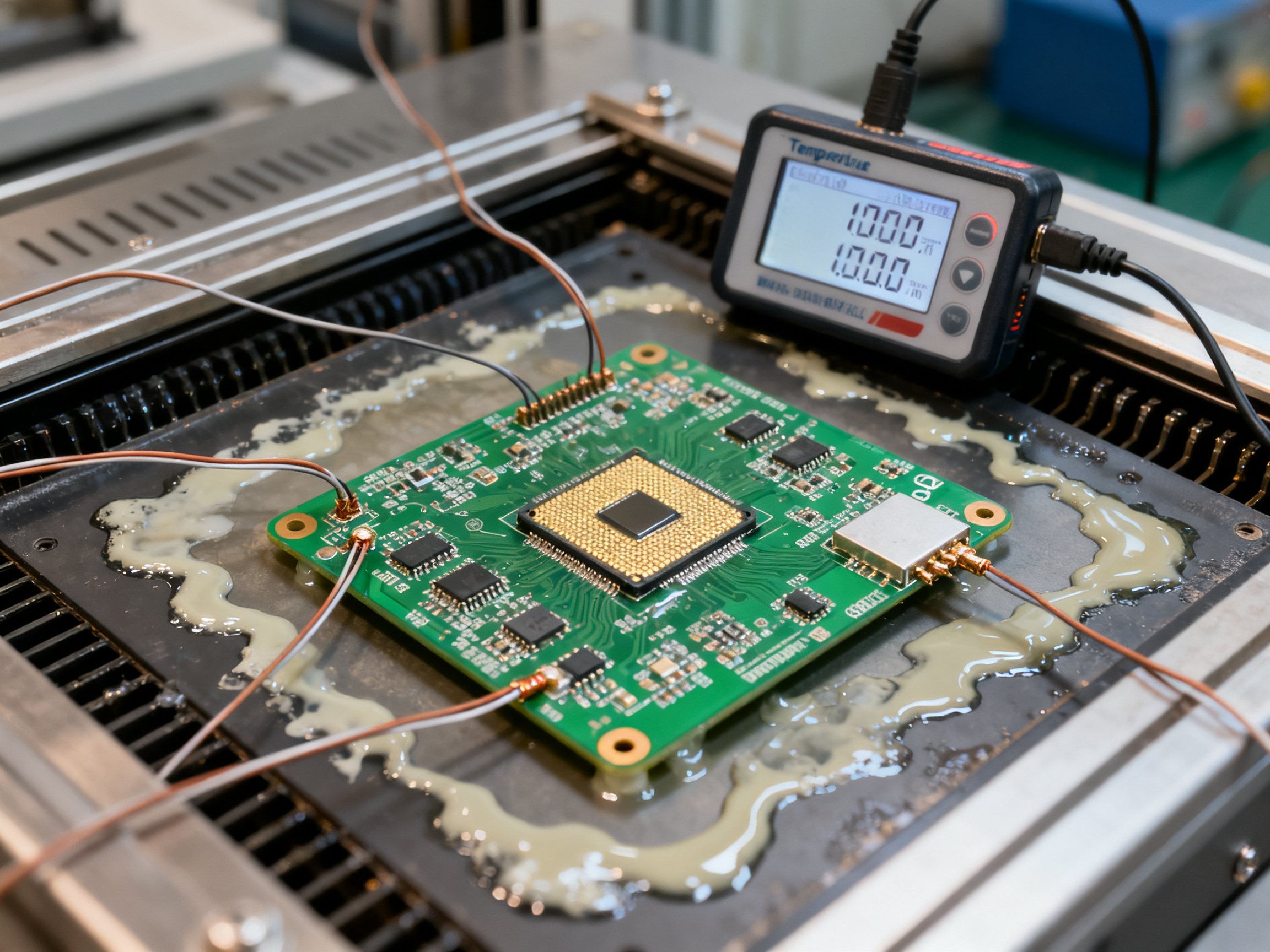
You can’t fix what you can’t measure, and thermocouple placement makes or breaks your profiling. Most labs make the mistake of placing sensors on board edges or empty areas, then wondering why components in the center fail.
For complex assemblies, use 6 to 12 thermocouples minimum. Focus on your thermal trouble spots: BGA centers (these hold heat and run hot), QFN thermal pads under the package, heavy copper areas that pull heat, components next to large heat sinks, and board corners that tend to run cold.
The goal is understanding the temperature spread, or delta T, across your assembly. During reflow, you want the hottest and coldest points on your board within 10 degrees of each other. If your delta T runs 20 degrees, some joints will be overcooked while others stay cold.
Understanding Profile Zones
A complete thermal profile has four distinct zones, and each one serves a purpose.
Preheat Zone: Ramp your board from room temperature to around 150 degrees Celsius at 1 to 3 degrees per second. This lets the flux activate gradually without thermal shock to components.
Soak Zone: Hold between 150 and 180 degrees for 60 to 120 seconds. This equalizes temperature across your entire board, which matters big time for assemblies with mixed thermal mass. Dense areas catch up to sparse areas, so everything hits peak together.
Reflow Zone: Peak temperature for SAC305 sits around 235 to 250 degrees. Time above liquidus (the window when solder stays molten) should land between 40 and 90 seconds. Too short means poor wetting; too long risks component damage.
Zona de refrigeración: Controlled cooling at 2 to 4 degrees per second prevents thermal shock. Let things cool naturally rather than yanking boards out of the chamber.
Sample Thermal Profile for Lead-Free Soldering
| Zone | Temperature Range | Duration | Purpose |
|——|——————|———-|———|
| Preheat | Room to 150C | 60-120 sec | Gradual heating, flux activation |
| Soak | 150-180C | 60-120 sec | Thermal equalization |
| Reflow | 235-250C peak | 40-90 sec TAL | Solder reflow, wetting |
| Cooling | 250C to room | ~3-5 min | Controlled solidification |
Expert Tip: For lead-free profiles, proper thermal profiling matters more than having the fanciest oven on the market. A well-tuned mid-range unit with good profiling will outperform a premium oven with poorly optimized settings. Spend time learning your paste datasheet and profiling your actual boards rather than assuming expensive equipment equals perfect results.
Profiling Tools and Software
You don’t need to guess at settings. Profiling software like KIC Pathfinder, Malcom Thermal Engineer, or even basic data logging tools let you capture actual board temperatures during test runs. Attach thermocouples to your production board, run a profile, and see exactly what your assembly experiences.
Most mid-range ovens include basic profiling capability. For precision work, dedicated profiling systems with real-time monitoring give you more control and better data for documentation. If you’re building for regulated industries, that documentation matters for compliance audits.
Start with your solder paste datasheet. It specifies recommended profile targets for a reason. Profile your actual board, adjust based on what you measure, and lock in recipes that work for your specific assemblies. That’s how you get consistent results instead of hoping for the best.
Key Features for Low-Volume Production Success
Not every feature on a spec sheet matters equally. For low-volume operations, the features that actually pay off are the ones that save you time, reduce rework, and let you switch between jobs without losing your mind. Here’s what to prioritize.
Profile Storage and Recall: This is non-negotiable if you’re running more than two or three different board types. Look for ovens that let you store dozens of profiles directly on the machine, with one-tap recall. The last thing you want during a production run is scrolling through menus to find a profile you ran three weeks ago. Quick-changeover capability matters more than most buyers realize until they have to juggle multiple customer orders in the same week.
Batch Tracking and Traceability: If you’re building for anyone outside your shop, documentation saves headaches. Even basic logging of profile name, date, operator, and cycle count gives you something to reference when quality questions come up. For regulated industries like medical or automotive, this becomes mandatory rather than optional.
Heating Method Tradeoffs: Convection heating gives you the best temperature uniformity for mixed boards, which matters when you’re running components of different sizes and thermal mass. IR heats faster but can create hot and cold spots depending on component color and geometry. For most low-volume shops running diverse assemblies, forced convection hits the sweet spot between consistency and cycle time 1.
Decision Matrix: Matching Features to Your Operation
| Your Situation | Must-Have Features | Nice-to-Have Features | Skip These |
|—————-|——————-|———————-|————|
| University lab, student projects | Basic profile storage, simple interface | Advanced profiling software | Production-level documentation, nitrogen capability |
| Prototype shop, multiple customers | Profile libraries, batch logging, quick-changeover | MES integration, real-time monitoring | Ultra-high throughput modes |
| Low-volume production, regulated industries | Full traceability, calibrated accuracy, profile validation | Advanced reporting, statistical process control | Budget-tier simplicity features |
| R&D with frequent experiments | Flexible profiling, thermocouple inputs, data export | Rapid profiling tools, experiment comparison | Fixed automation workflows |
Balancing Automation and Flexibility: Here’s the thing. Over-automation kills the adaptability that makes prototyping work. If your oven forces you through three menus to adjust a soak zone by 10 seconds, you’ll just live with suboptimal profiles instead. Look for systems where basic operations stay simple but advanced features are available when you need them.
The real ROI in low-volume work comes from reducing changeover time and eliminating profile guesswork. Features that support those goals pay back quickly. Features that exist only in production environments probably aren’t worth the extra cost for your operation.
Pro Insight: For labs and low-volume operations, features like multi-zone closed-loop control and advanced profiling software provide real ROI. But here’s the catch: if you’re mostly running the same simple board over and over, you probably don’t need all those bells and whistles. Save your budget for the features you’ll actually use daily, and skip the complexity that just adds learning curve without adding value.
Maintenance and Long-Term Reliability
Your reflow oven will only stay accurate if you actually maintain it. I know, groundbreaking stuff. But you’d be surprised how many labs treat their oven like that coffee maker in the break room, only remembering it exists when something breaks.
Daily and Weekly Upkeep
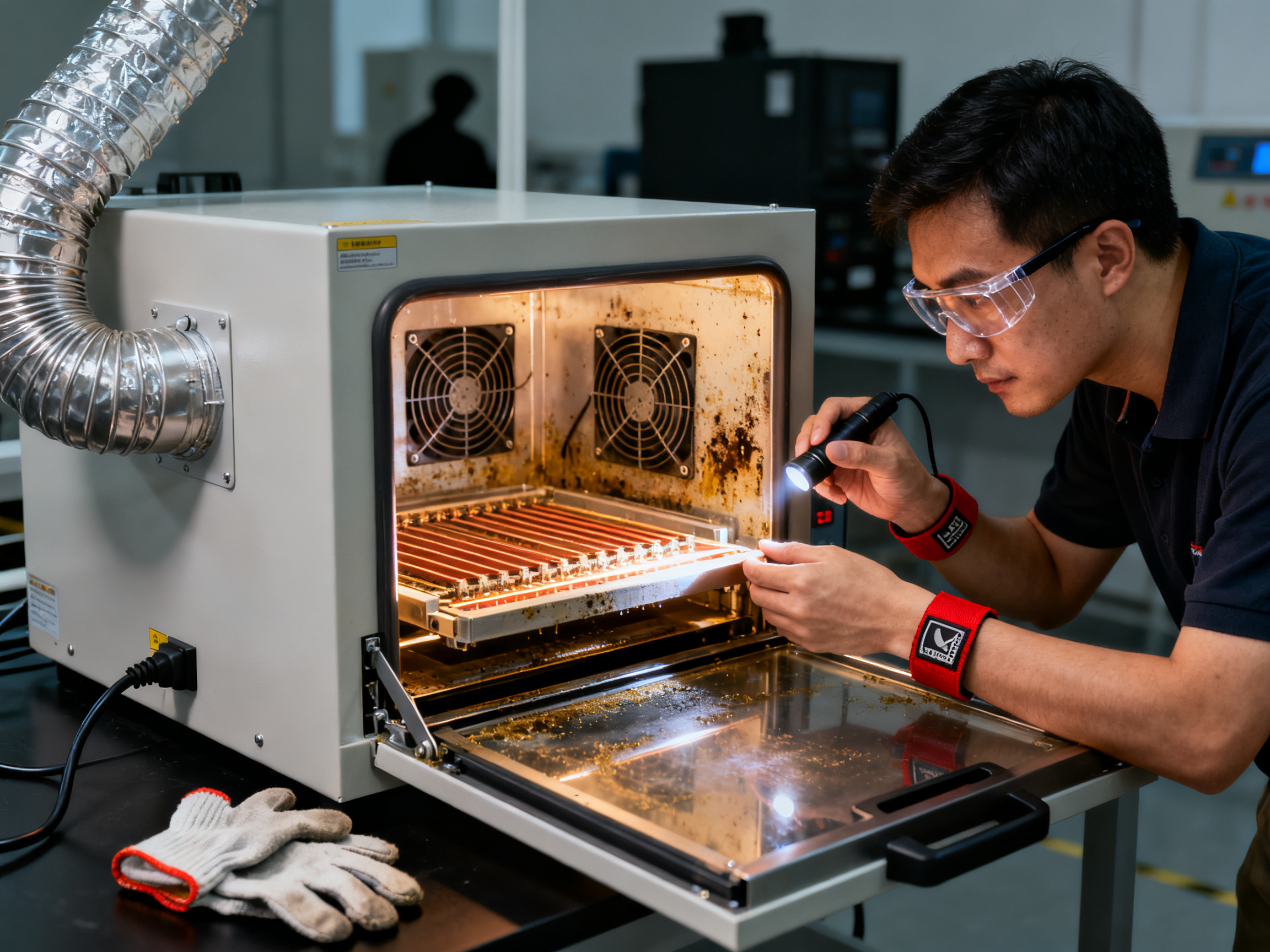
Let’s start simple. Every day, take 5 minutes after your last run to wipe down the chamber entrance and remove any solder balls or flux spatter. It’s not glamorous work, but flux residue buildup throws off temperature readings faster than you’d think. Check that your exhaust system is running clean, and listen for any weird fan noises.
Weekly, I do a more thorough clean once the oven cools completely. Vacuum out the chamber, clean the filters, and inspect the thermocouple wires for any damage or corrosion. This takes maybe 20 minutes and catches problems before they turn into expensive repairs.
Monthly and Quarterly Checks
Monthly, you should run a verification profile using your thermocouples to confirm temperature accuracy hasn’t drifted. If your readings are off by more than 2 or 3 degrees, it’s time to recalibrate. Quarterly, check electrical connections and inspect heating elements for any signs of wear or discoloration.
Most failures announce themselves before they become catastrophic. Watch for:
- Temperature drift across multiple boards that used to run fine
- Uneven heating where one side of your board looks different from the other
- Strange noises or vibrations from cooling fans
- Belt or chain tracking problems
- Flux buildup that keeps coming back no matter how much you clean
Catch these early and you’re looking at an adjustment. Wait too long and you’re ordering replacement parts and scheduling downtime.
Maintenance Schedule Summary
| Frequency | Task | Why It Matters |
|———–|——|—————-|
| Daily | Wipe chamber entrance, check exhaust | Prevents contamination, ensures airflow |
| Weekly | Vacuum chamber, clean filters, inspect thermocouples | Maintains accuracy, catches wear early |
| Monthly | Run verification profile, check temp accuracy | Confirms system is performing within spec |
| Quarterly | Inspect heating elements, check electrical connections | Prevents sudden failures |
| Every 6-12 months | Professional calibration, deep cleaning | Validates long-term reliability |
From Our Experience: The most common maintenance mistake I see is skipping the weekly clean because “there’s no time.” Here’s the truth: a 20-minute weekly maintenance session prevents hours of troubleshooting later. We’ve seen ovens fail prematurely because of neglected filters and accumulated debris in heating zones. An ounce of prevention really does work here.
Warranty and Support Contracts
When you’re buying, look for at least a one-year warranty, though two years is better for anything you’ll run daily. Extended service contracts cost extra, but they make sense for production-critical equipment. The true cost of unexpected downtime isn’t just the repair bill. It’s the lost production time, the missed deadlines, and the frustration of your team. For anything running more than a few cycles per week, on-site support options are worth considering.
Your reflow oven is an investment. Treat it accordingly.## Our Top Picks and Recommendations
Alright, let’s cut through the noise and get to what matters. Here’s my honest breakdown of which oven actually makes sense for your situation.
For university labs and student projects: The T200N Benchtop Lead-Free Reflow Oven hits the sweet spot. You’ve got limited budget, varying skill levels, and probably no dedicated electrical infrastructure. The T200N gives you professional results without the learning curve or infrastructure demands. It’s the one I’d recommend to most labs getting started with in-house reflow.
For startups and prototype shops: The Suneast Tech Mini-Flow 8 is your entry point into serious capability. If you’re upgrading from hand soldering, this unit delivers programmable profiles and repeatable results without the commitment to a mid-range system. You can always move up later, but you won’t feel limited out of the gate.
For precision semiconductor and sensitive assembly work: The PDR H636 earns its price tag when temperature uniformity actually matters for your yield. If you’re building anything with BGAs, QFNs, or moisture-sensitive components, the extra investment pays back through fewer field failures and less rework.
For low-volume production with growth potential: The Reflow Technologies Flow solder Pro gives you room to scale without jumping to production-line pricing. The automation features save real labor time once you’re running more than a few boards daily.
For high-mix operations: The JT Instruments IR-Pro 400 handles rapid profile switching and diverse board types without the setup delays that kill throughput in dynamic environments.
For space-constrained labs: The MiniTrace Pro 150 fits where full-sized benchtop units don’t. Just make sure you’ve actually measured your boards before buying this one.
For military and aerospace: The Shenzhen Chuxin Electronic E-Series delivers the documentation, traceability, and compliance posture that defense contracts demand. This isn’t the place to cut corners.
Recommendation Matrix: Matching Profiles to Ovens
| Your Situation | Best Match | Why |
|—————-|————|—–|
| University lab, student projects | T200N | Balanced capability, gentle learning curve, no special infrastructure needed |
| First upgrade from hand soldering | Suneast Mini-Flow 8 | Professional results without overcommitting budget |
| Precision semiconductor work | PDR H636 | Temperature uniformity that protects sensitive components |
| Low-volume production with scale plans | Flow solder Pro | Automation that saves labor, capacity that grows with you |
| High-mix contract manufacturing | IR-Pro 400 | Fast profile switching handles diverse work without bottlenecks |
| Tight on space | MiniTrace Pro 150 | Fits where bigger units don’t, but check your board sizes first |
| Defense and aerospace | E-Series | Compliance posture, documentation, and support for mission-critical work |
The bottom line: Don’t buy features you’ll never use. Don’t cheap out on things that actually matter for your work. Measure your boards, count your weekly runs, and match the oven to your actual workflow rather than the spec sheet that looks best on paper.
If you’re running boards with mixed thermal mass, invest in temperature control. If you’re doing compliance work, invest in documentation. If you’re just doing prototype validation, keep it simple and save your budget for when your operation actually scales.
The best reflow oven is the one that fits your work, your space, and your budget without leaving you wishing you’d spent differently. Figure out which two of those three matter most for your situation, and buy accordingly.## Conclusion: Investing in the Right Small Batch Reflow Oven
Picking the best lab reflow oven, prototype reflow oven, or low-volume production oven comes down to one thing: matching the machine to your actual work. The priciest unit on the market won’t help if you’re running student projects in a university lab, and the cheapest benchtop oven will leave you frustrated once your startup scales past a few boards per week.
The seven ovens we covered in this guide represent different points on that capability-to-cost spectrum. The T200N gives you professional results without the overhead. The PDR H636 delivers the temperature uniformity that sensitive semiconductor work demands. The Flow solder Pro balances automation with affordability for growing shops. And the E-Series handles the compliance requirements that defense and aerospace contracts bring.
Here’s what I want you to take away: measure your boards, count your weekly runs, and be honest about where your operation will be in 12 to 18 months. Buy for your current needs with enough headroom to grow, but don’t pay for capacity you’ll never use.
If you’re still unsure where you fit on this spectrum, start with the honest questions. What’s your board size? How many assemblies per week? Do you need documentation for compliance? Answer those three, and the right choice gets a lot clearer.
Frequently Asked Questions
What’s the typical price range for a quality small batch reflow oven in 2026?
Entry-level benchtop units run roughly $2,000 to $8,000, mid-range systems land between $8,000 and $25,000, and premium production-grade ovens start around $25,000 and climb past $60,000. Budget an additional 10% to 30% for setup costs including ventilation, electrical work, and training 1.
What’s the difference between convection and infrared heating for reflow ovens?
Convection heating provides better temperature uniformity across your board, which matters for mixed-density assemblies with components of different thermal mass. Infrared heats faster but can create hot and cold spots depending on component color and geometry. For most lab and low-volume work, forced convection hits the sweet spot between consistency and cycle time 2.
How often should I calibrate or service a benchtop reflow oven?
Run verification profiles monthly to check temperature accuracy. Perform deeper cleaning and inspection quarterly, and schedule professional calibration every 6 to 12 months. Daily, just spend five minutes wiping down the chamber entrance and removing flux residue 3.
Can I run lead-free solder in any modern reflow oven?
Most mid-range and premium ovens support lead-free soldering, but check that the unit can reach at least 250 to 260 degrees Celsius with stable control. Standard SAC305 profiles peak around 240 to 250 degrees, so you need adequate headroom above that for reliable results 4.