



פורסם: 08 August 2026
עודכן לאחרונה: 08 August 2026
זמן קריאה: 10 minutes> פורסם: 08 August 2026
עודכן לאחרונה: 08 August 2026
זמן קריאה: 10 minutes
Introduction: Why Gravity Conveyor Systems Still Matter in Modern Production Lines
Picture this. Your assembly line is humming along, but somewhere between workstations, products pile up because your transfer system cannot keep pace. Forklifts are idling. Workers are waiting. And your energy bill keeps climbing because everything runs on motors, even when it does not need to.
This is where gravity conveyor systems step in. A gravity conveyor is an unpowered material-handling conveyor that moves loads using gravity or a gentle push along a slight decline. Instead of a motor driving the belt, items glide across rollers, skate wheels, or a smooth chute surface. The concept sounds almost too simple, but that simplicity is exactly why factories, warehouses, and electronics assembly lines rely on it in 2026.
Here is how it works in practice. The conveyor frame sits at a small angle, typically around 2 to 4 degrees. Products placed at the higher end naturally roll or slide toward the lower discharge point. The rollers or wheels rotate as items pass over them, converting what would be sliding friction into much lower rolling resistance. No electricity required for movement. No complex controls. Just physics doing its job.
So why does this matter for your production line? Industry data from 2026 shows that roughly 65 to 70 percent of material-handling costs still come from labor. Energy-efficient, non-powered conveying solutions directly cut into that number. When you can move products between workstations without adding another motor, you save power, reduce maintenance, and free up your team for higher-value tasks.
This guide walks you through everything you need to know about gravity conveyor systems. We cover the working principle, slope design, main types, key benefits, and real-world applications in SMT manufacturing, warehousing, and assembly environments. By the end, you will have a clear picture of whether gravity conveyors belong in your operation and how to integrate them effectively.
Visual concept: A simple diagram showing product movement from a higher infeed point down to a lower discharge point across a roller conveyor, with arrows indicating direction of travel.
About the Author
Jace Liu is a sales and applications specialist at Shenzhen Chuxin Electronic Equipment Co., Ltd., focusing on SMT production line solutions and conveyor system integration for electronics manufacturers. With hands-on experience supporting overseas customers and full-line deployments, Jace brings practical insight into how gravity and powered conveyor systems fit into modern manufacturing environments. Before publication, credentials and technical qualifications should be independently verified.
About the Author
Jace Liu is associated with Shenzhen Chuxin Electronic Equipment Co., Ltd., a company specializing in SMT production line solutions and conveyor system integration for electronics manufacturers. Before publication, all professional credentials, technical qualifications, and claimed expertise in SMT equipment, factory automation, production-line layout, or conveyor systems should be independently verified. The author bio should be updated once verified credentials are confirmed available.
What Is a Gravity Conveyor? Meaning, Definition, and Core Concept
A gravity conveyor is an unpowered material-handling system that moves loads using gravity or a gentle push. Unlike powered conveyors that use motors and belts, gravity conveyors rely on a slight downward slope to let items roll or slide from one point to another. This simple design makes them one of the most cost-effective ways to move products across short distances in warehouses, factories, and assembly lines.
The core concept is straightforward. Products sit on rollers, skate wheels, or a smooth chute surface. When the conveyor frame is tilted at a small angle (typically 2 to 5 degrees), gravity pulls the load downward while the rollers or wheels rotate to reduce friction. Workers can also give items a manual push to start movement, making these systems flexible for both automated and manual workflows.
Gravity Conveyor Definition: A non-powered conveyor that uses rollers, skate wheels, or chutes to move loads via gravity or manual push along a slight incline.
Where Gravity Conveyors Fit in Material Handling
Gravity conveyors typically work as part of a larger material handling system. They excel at:
- Staging products before the next process step
- Accumulation areas where items wait between workstations
- Inspection and packing zones where operators need access
- Short-distance transfer between machines or areas
- Loading and unloading docks and shipping stations
In electronics manufacturing, gravity conveyors often handle PCB carriers, trays, and totes in buffer zones near SMT equipment. They move items without adding electrical complexity to areas where you just need steady, controlled flow.
| Conveyor Type | Power Source | Best For | Typical Cost |
|—————|————–|———-|————–|
| Gravity Roller | None (slope) | Cartons, totes, heavy loads | $30 to $80 per linear foot |
| Gravity Skate Wheel | None (slope) | Light packages, curves | $20 to $80 per linear foot |
| Powered Belt | Electric motor | High-speed, continuous flow | $100 to $350 per linear foot |
| Manual Cart | Human push | Flexible, multi-destination moves | Variable |
The table above shows how gravity systems compare to alternatives. Gravity conveyors cost less upfront and have minimal operating expenses since they use no motors. The trade-off is less control over speed and flow, which matters less for simple transfer tasks but becomes a problem for high-volume automation.
How Gravity Conveyor Systems Work
Think of rolling a shopping cart down a gentle ramp. The steeper the slope, the faster you go. Gravity conveyor systems work the same way, except the ramp has rollers or wheels built in, and you control the angle to match your product.
Here is the basic mechanics. The conveyor frame sits at a slight incline, typically around 2 to 4 degrees (or roughly 3 to 9 inches of drop per 10 feet). When you place a load at the higher end, gravity pulls it downward. As the item moves, it contacts a series of rollers or small wheels that rotate beneath it. This rolling action converts what would be sliding friction into much lower resistance, so products glide with surprisingly little force.
You do not always need a slope, either. On level ground, a light push from an operator gets items moving. The momentum carries them forward, and the rollers keep friction minimal. This makes gravity conveyors handy for manual workstations where workers feed products by hand.
So why do most gravity conveyor systems use rollers or skate wheels instead of a belt? Simple. Rollers support the full bottom of a carton, tote, or tray, which keeps awkward-shaped loads stable. Skate wheels work best for lighter items and make curved layouts easier to build. A gravity conveyor belt, by contrast, usually refers to a powered system. True non-powered belt conveyors exist, but they need more maintenance and offer less load support than roller-based designs.
The speed of movement depends on slope angle, load weight, and bottom surface friction. Heavier loads on smooth surfaces need less incline. Lighter items or rougher bottoms need more slope to keep moving reliably. Most setups include brake rollers or end stops to prevent items from speeding too fast at the discharge point.
Expert Tip: Always test slope with your actual product weight before locking in your layout. Load a carton with your heaviest expected weight, place it at the infeed end, and time how fast it travels. Adjust from there.
This hands-on testing catches problems that calculations alone miss, like packaging friction or uneven floor surfaces throwing off your flow.
Visual concept: A labeled cross-section showing product weight, roller rotation, slope direction, and a brake roller near the discharge end.
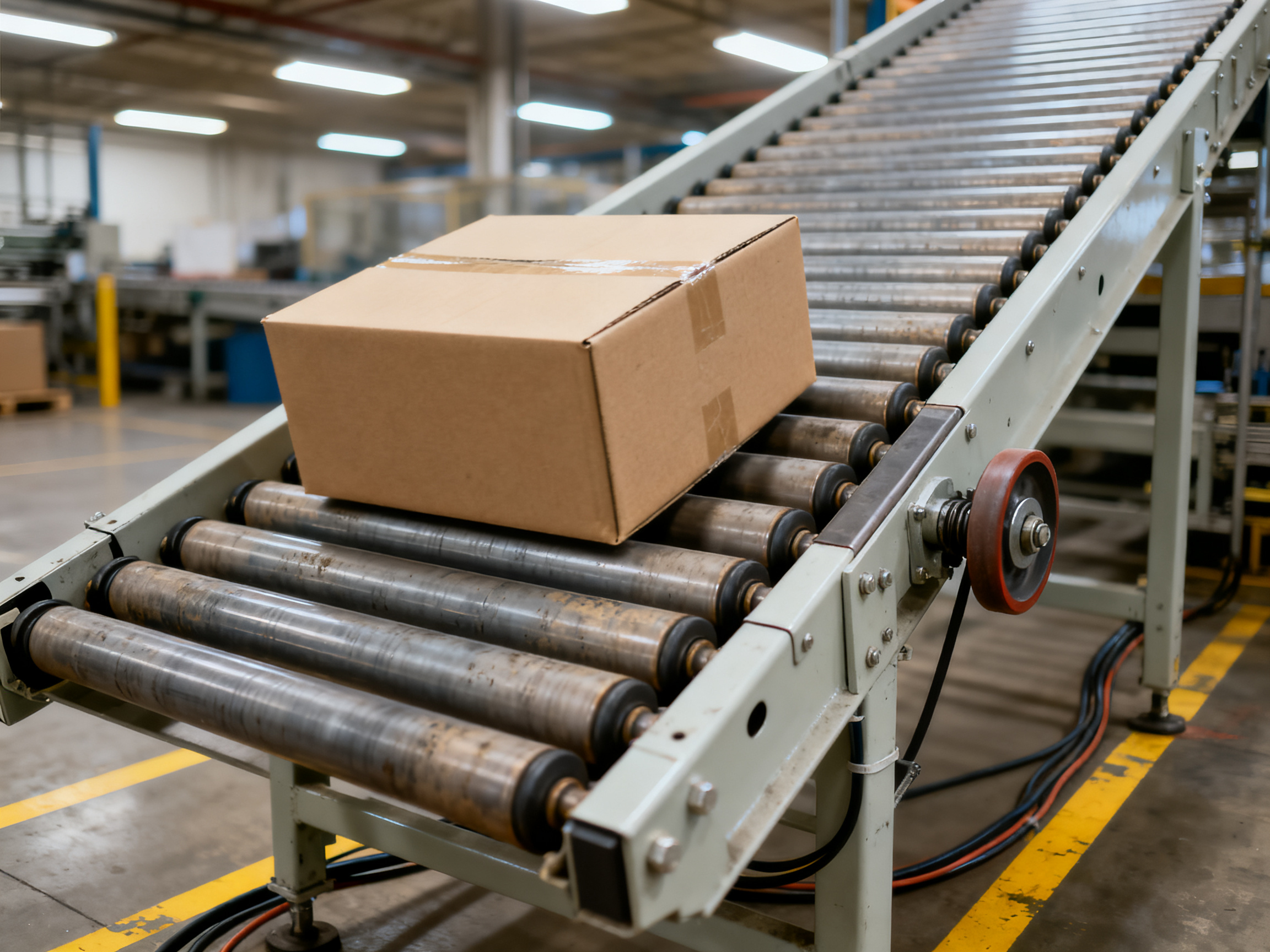
Main Types of Gravity Conveyors and Where Each Fits
Not all gravity conveyors look the same. The right type depends on what you’re moving, how heavy it is, and how your space is laid out.
Gravity Roller Conveyors
These use full-width cylindrical rollers that span the conveyor width. They’re the workhorse of material handling. Roller diameters typically range from 1.25 to 2 inches, with spacing around 3 to 6 inches between centers. This setup handles cartons, totes, pallets, trays, and fixtures with flat or stable bottoms. The broad roller contact keeps loads stable, which matters when you’re moving heavier items that could tip or shift.
Gravity Skate Wheel Conveyors
Instead of full rollers, these have lots of small wheels mounted on shafts. The lightweight design makes them easier to move around and perfect for building curved layouts. They work best for lighter packages, flexible temporary setups, and situations where operators need to nudge items along by hand. The lower startup force means products start moving with just a gentle push.
Gravity Chutes and Flexible Conveyors
Sometimes you just need items to slide down a slope. Gravity chutes are the simplest option, basically a declined surface with low friction. Flexible or expandable conveyors fold up and extend as needed, which makes them popular for loading docks and temporary packing stations.
Ball Transfer Tables
When products need to move in any direction, ball transfer tables use small balls mounted in a plate. Operators can push loads sideways, diagonal, or forward without lifting. These work well at workstations where items need precise positioning before the next step.
Pro Insight: Gravity conveyors work well for non-powered transfer zones near SMT equipment. They provide steady product flow without adding electrical complexity. Buffer zones handling PCB carriers and totes benefit from this simple approach.
Quick Comparison
| Type | Best For | Load Range | Advantages | Limitations |
|——|———-|————|————|————-|
| Gravity Roller | Cartons, totes, pallets | 50-2,000+ lb/ft | Stable, supports heavy loads | Fixed layout, higher cost |
| Skate Wheel | Light packages, curves | Up to 100 lb/ft | Lightweight, flexible routing | Limited load capacity |
| Gravity Chute | Direction changes, sorting | Varies | Simple, no moving parts | No accumulation control |
| Ball Transfer Table | Multi-directional moves | Medium loads | Full rotation capability | Higher cost per unit |
| Flexible/Expandable | Temporary layouts, loading | Light to medium | Portable, adjustable | Less durable for constant use |
Each type fills a specific role. Pick the conveyor that matches your product, your space, and how your team actually works.
Key Benefits of Gravity Conveyors for Electronics and Industrial Manufacturing
Gravity conveyor systems offer real advantages that show up on the shop floor and the balance sheet. Here is why more electronics manufacturers are adding them to their production lines in 2026.
Cost and Energy Savings
The biggest benefit starts with what you do not need. No drive motors. No electrical controls. No power consumption for movement. Gravity conveyors use the natural pull of weight to move products, which means your energy bill stays lower and your maintenance team deals with fewer motor failures, belt replacements, and control glitches.
Industry data from 2026 shows that roughly 65 to 70 percent of material-handling costs still come from labor Stryten, Atlas Toyota, Logisnext Americas. Energy-efficient, non-powered conveying solutions directly cut into that number. When you do not need electricity to move products between workstations, you save power, reduce upkeep, and free up your team for tasks that actually need human judgment.
Cost-wise, gravity conveyors typically run between $30 and $80 per linear foot, compared to $100 to $350 for powered belt systems H.H. Design Mfg, WarehousingCosts. For a 100-foot section, that difference adds up fast.
Smoother Material Flow
For high-volume production environments, gravity conveyors help products move steadily without the start-stop jerking that sometimes happens with powered systems. When integrated with buffer zones near SMT equipment, they provide a gentle, consistent flow that keeps workstations supplied without overwhelming operators.
Fewer manual touches mean fewer opportunities for mishandling. Workers spend less time nudging products along and more time on quality checks, assembly, and inspection tasks that require actual attention.
Quality and Reliability
Stable transfers matter for electronics. Sensitive components and PCB carriers benefit from the smooth, controlled movement that gravity rollers provide. When products glide consistently rather than jolt or bump, you reduce the risk of handling damage, misalignment, or dropped items.
For traceability workflows, consistent conveyor movement supports cleaner tracking. Products move through inspection and packing stations at a predictable pace, which makes it easier to match process data to physical units. This matters for aerospace, automotive, and medical electronics where documentation requirements are strict.
Pro Insight: ESD-safe gravity roller options exist for electronics manufacturing. Look for rollers with dissipative surfaces rated below 10^6 ohms, conductive bearing paths, and documented compliance with ANSI/ESD S20.20 standards Interroll, Damon Roller.
The combination of lower costs, reduced complexity, and reliable performance makes gravity conveyors a practical choice for manufacturers who want to streamline transfer zones without adding unnecessary electrical systems.
Gravity Conveyor Design Factors: Slope, Load, Layout, and Safety
Now that you understand how gravity conveyors work, let’s dig into the design side of things. Getting these factors right from the start saves you from headaches later. Trust me, I have seen plenty of conveyor setups that looked good on paper but simply did not flow right once products hit the rollers.
Slope Is a Design Variable, Not a Fixed Number
Here is something many people get wrong. Slope is not a one-size-fits-all setting. The right angle depends on several things working together.
Load weight matters most. Heavier products need less incline to start moving, sometimes just 1 to 2 degrees. Lighter items or those with rough bottom surfaces need more, often 3 to 5 degrees. A standard starting point for cartons sits around 2 to 4 degrees, which translates to roughly 3 to 9 inches of drop per 10 feet SJF, Engineering Toolbox.
Other factors chip in too. The roller diameter affects how easily items roll. Roller spacing determines how much support the load has underneath. The bottom surface of your product, whether cardboard, plastic, or metal, changes the friction level. Even small differences in these details can throw off your flow.
The fix? Test with your actual product. Place a carton loaded with your heaviest expected weight at the infeed end and time how fast it travels. Adjust the slope until the speed feels right for your workflow.
Expert Tip: Always test slope with your actual product weight before locking in your layout. Load a carton with your heaviest expected weight, place it at the infeed end, and time how fast it travels. Adjust from there.
This hands-on testing catches problems that calculations alone miss, like packaging friction or uneven floor surfaces throwing off your flow.
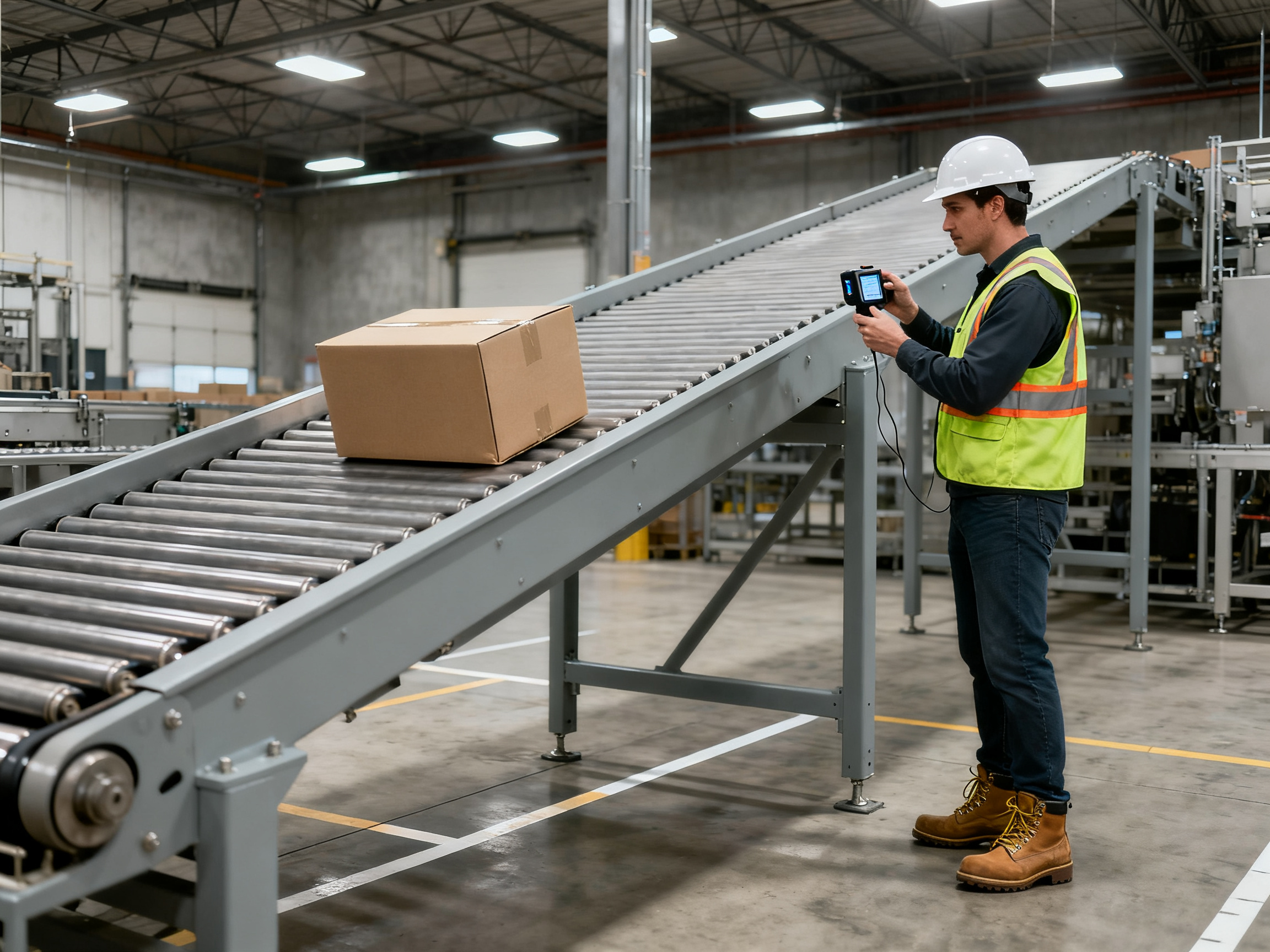
Core Design Factors to Lock Down
Beyond slope, these elements shape how well your gravity conveyor performs.
Load dimensions and weight. Know your product size, weight range, and whether the load sits flat or can shift during movement. Specify the heaviest single load, not an average, when requesting quotes or specs.
Roller pitch. This is the center-to-center spacing between rollers. A common range sits around 3 to 6 inches. The key rule: keep at least three rollers under the load at any time. Fragile or flexible items may need tighter spacing for better support.
Frame width. Give yourself at least 1 inch of clearance on each side of the load. This prevents products from catching on the frame edges and keeps movement smooth through curves and transitions.
Transfer height. Match your conveyor height to adjacent equipment. Misaligned transfer points cause jams and product damage. Even a small height difference can disrupt flow.
Stops, brakes, and side guides. End stops prevent items from rolling off the discharge end. Brake rollers slow products before they hit the end stop. Side guides keep loads centered, especially through curves.
Curves and accumulation zones. Curved sections need wider track and more slope to overcome the extra friction from the turn. Accumulation areas require careful spacing to prevent products from stacking and colliding.
Safety and Quality Controls
For electronics manufacturing, ESD considerations matter. Standard PVC rollers are not automatically ESD-safe. Look for dissipative surfaces rated below 10^6 ohms and conductive bearing paths if you are handling sensitive boards or carriers Interroll, Damon Roller.
Speed control keeps things safe. Gravity conveyors do not have motor brakes, so slope controls your speed. Add brake rollers or friction pads if products accelerate too fast. Test at both minimum and maximum load conditions before signing off on installation.
Ergonomics matter for manual workstations. Keep working heights comfortable to reduce operator fatigue and injury risk. The goal is steady, controlled flow that workers can manage without reaching or bending awkwardly.
Design Checklist Before You Buy
Use this quick list when evaluating or ordering gravity conveyors:
- Product type, dimensions, and weight range
- Roller pitch matched to load stability
- Frame width with proper side clearance
- Slope tested at production-weighted loads
- Brake rollers or end stops where discharge speed is excessive
- ESD-rated components for sensitive electronics
- Integration height matched to adjacent equipment
Getting these details right means your gravity conveyor actually works the way you need it to once it is installed.
Applications of Gravity Conveyors in SMT, Warehousing, and Assembly Lines
Gravity conveyors show up in more places than most people expect. The simple physics of rolling downhill solves real problems across electronics manufacturing, warehouse operations, and factory assembly lines. Here is where these systems earn their keep.
Electronics and SMT Manufacturing
In surface mount technology environments, gravity conveyors handle the steady flow of PCB carriers, totes, fixtures, and packed boards between workstations. They work especially well in buffer zones where products wait between SMT processes like printing, placement, and reflow. Because gravity rollers provide smooth, consistent movement without adding electrical complexity, they fit naturally near inspection stations and manual assembly points.
For sensitive electronics, ESD-safe gravity rollers matter. Standard PVC rollers can hold static charges that damage components. Look for rollers with dissipative surfaces rated below 10^6 ohms if you are handling bare boards or sensitive assemblies Interroll, Damon Roller. This keeps product flow gentle and safe for components that cost more than the conveyor itself.
Warehouse and Logistics Operations
Receiving docks, order picking zones, and packing stations all benefit from gravity conveyor deployment. Products arriving in cartons or totes can glide from the receiving area toward sorting without manual cart moves. During picking operations, gravity-fed lanes keep items flowing toward packers at a steady pace. At the end of the line, gravity conveyors feed loading docks where operators can stage shipments efficiently.
Temporary buffer zones work particularly well. When incoming volume spikes or downstream equipment slows, gravity conveyors give products a place to accumulate without blocking primary paths. Workers can pull items as capacity opens up rather than dealing with sudden rushes.
High-Reliability Industries
Automotive, aerospace, and military electronics manufacturers have their own reasons for choosing gravity conveyors. Process consistency matters when documentation requirements are strict. When products move at predictable speeds through inspection and assembly, matching physical units to process records stays straightforward.
Semiconductor production facilities also rely on controlled material handling. The cleanroom environment often limits motorized equipment anyway, so gravity systems provide a natural fit for moving wafers, carriers, and finished components between_tooling without introducing particles or electrical interference.
Pro Insight: Gravity conveyors work well for non-powered transfer zones near SMT equipment. They provide steady product flow without adding electrical complexity. Buffer zones handling PCB carriers and totes benefit from this simple approach.
Application Matrix by Industry
| Industry | Common Uses | Product Types Handled |
|———-|————-|———————-|
| Electronics/SMT | Buffer zones, inspection, manual assembly | PCB carriers, totes, fixtures |
| Warehousing | Receiving, picking, packing, loading | Cartons, packages, totes |
| Automotive | Component staging, sub-assembly flow | Containers, bins, pallets |
| Aerospace | Work-in-progress transfer, inspection | Fixtures, delicate assemblies |
| Semiconductor | Cleanroom transfer, carrier handling | Wafers, pods, finished units |
The right application depends on your load type, throughput needs, and how much manual intervention your process requires. Gravity conveyors shine where simplicity beats sophistication.
Visual concept: Split diagram showing a gravity conveyor in an SMT buffer zone (left) and a warehouse picking station (right) with product flow arrows.
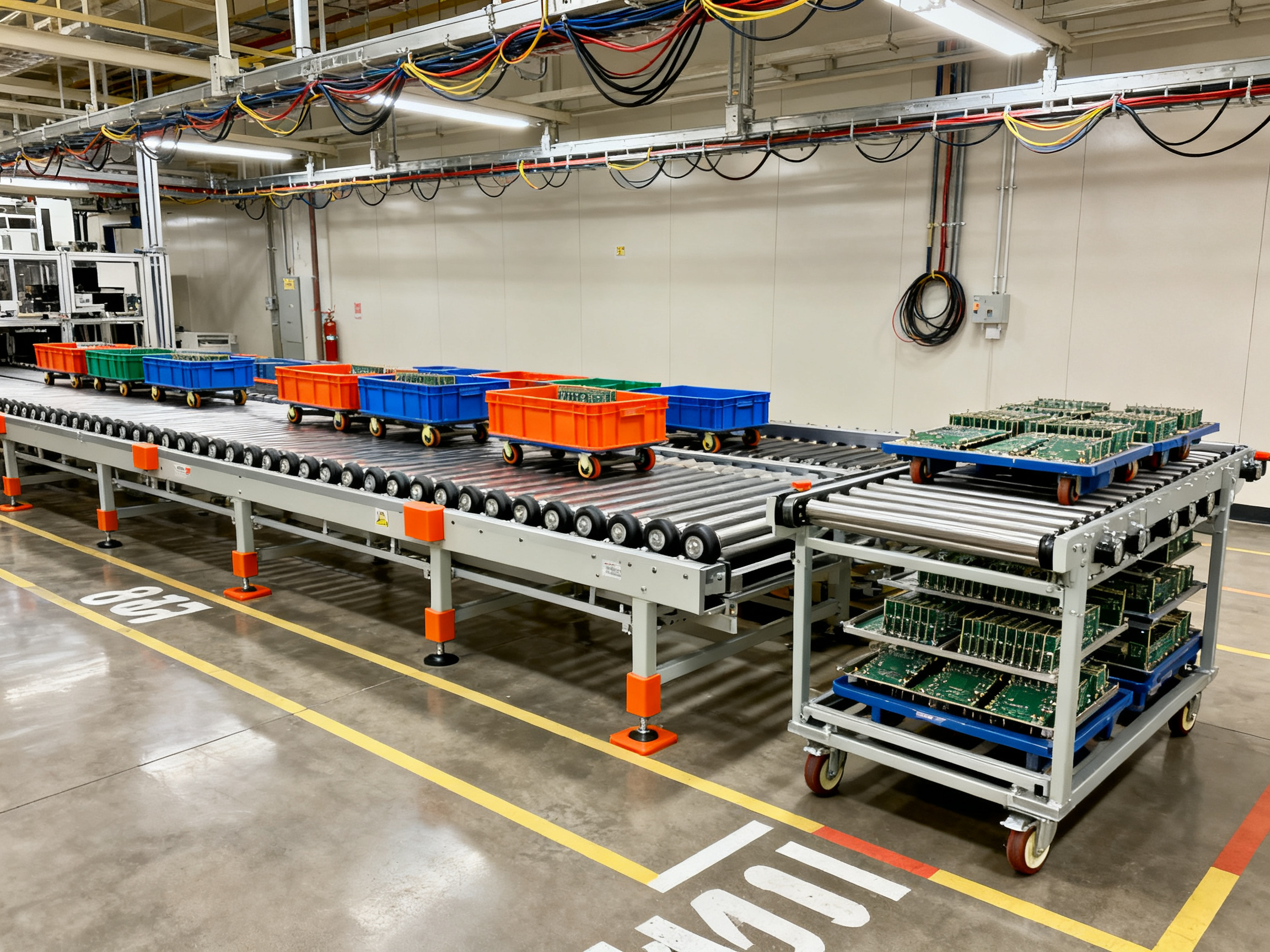
Gravity Conveyor vs Powered Conveyor: When to Use Each
Here’s the thing. Choosing between gravity and powered conveyors is not about finding the better technology. It is about matching the right tool to the right job.
Gravity conveyors win when you need simple, low-cost transfer over short distances. They work great for staging areas, manual workstations, buffer zones, and loading docks where products just need to move from A to B without complicated timing. No motors mean no electrical work, no control programming, and basically zero maintenance headaches.
Powered conveyors make sense when you need control. If products must travel uphill, stop precisely for indexing, accumulate without blocking the line, or maintain exact speed matching with other equipment, you need a motor doing the work. High-volume automation lines, sorting systems, and production lines with tight throughput requirements typically need powered solutions.
Powered systems do come with trade-offs though. They cost more upfront and add ongoing expenses for electricity and maintenance, but they handle automation that gravity simply cannot.
Most smart factories use both types together. Gravity handles the simple, the manual moments. Powered sections manage the controlled, automated flows. The real mistake is overengineering. Adding motors and controls everywhere just because you can often wastes money and creates unnecessary complexity.
From Our Experience: When quoting a conveyor system, match the frame width, roller pitch, and transfer height to your existing line equipment first. Gravity works fine for short manual transfers; powered sections handle accumulation and indexing.
| Choose Gravity When… | Choose Powered When… |
|————————|————————|
| Simple short-distance transfer | Products must move uphill |
| Manual or operator-fed zones | Precise indexing or stop-and-go control |
| Buffer or staging areas | High-volume automation |
| Tight budget, low complexity needed | Tight throughput, timing requirements |
| Loading docks, packing stations | Merging, sorting, or routing logic |
The sweet spot in most operations combines both. Use gravity where it fits naturally and powered sections where control actually matters.
How to Choose and Integrate a Gravity Conveyor System
So you have a good handle on gravity conveyor design. Now comes the practical part. How do you actually pick the right system and get it working in your facility?
Procurement Checklist: What to Nail Down First
Before you request quotes or place orders, lock in these details. The more specific you are, the better your supplier can match equipment to your needs.
From Our Experience: When quoting a conveyor system, match the frame width, roller pitch, and transfer height to your existing line equipment first. Gravity works fine for short manual transfers; powered sections handle accumulation and indexing.
Here is a checklist that covers the essentials:
| Field | What to Specify |
|——-|—————–|
| Product type | Cartons, totes, trays, pallets, or fixtures |
| Dimensions | Length, width, height of your product |
| Load weight | Heaviest single load (not average) |
| Throughput target | Units per minute or cartons per hour |
| Roller pitch | Center-to-center spacing; at least 3 rollers under load |
| Frame width | Product width plus 1 inch clearance each side |
| Layout | Straight sections, curves, accumulation zones |
| Environment | Indoor, temperature range, ESD requirements |
| Integration | Height at infeed and discharge, existing equipment interfaces |
For electronics work, ESD-safe rollers are non-negotiable if you are handling sensitive boards or carriers. Look for dissipative surfaces rated below 10^6 ohms and conductive bearing paths Interroll, Damon Roller. Standard PVC rollers will not cut it.
Integration Tips for Production Lines
Match transfer heights between your gravity conveyor and adjacent equipment. Even a small mismatch causes jams and product damage. If your SMT buffer zone sits at 900mm working height, your gravity conveyor discharge should hit that same mark.
Build in space for operator access at workstations. Workers need room to grab products, inspect items, and clear jams without awkward reaching.
Consider adding side guides through curves. Products tend to drift outward during turns, and a simple guide rail keeps everything centered.
Pilot Testing: Do Not Skip This
Run your actual products across the conveyor before you commit to full installation. Load your heaviest carton, time the travel speed, and check that products do not tip or collide at the discharge end.
For precision manufacturing environments, test with real PCB carriers, trays, or fixtures. What works for a cardboard carton may not work for a rigid fixture with different bottom geometry.
When the pilot runs clean, you are ready to scale up.
Conclusion: Practical Next Steps for Selecting Gravity Conveyor Systems
Gravity conveyor systems are simple, durable, and cost-effective when load, slope, and layout are engineered correctly. The key takeaway is this: successful projects start with real product testing and integration planning, not just catalog selection.
So what should you do next?
Action checklist:
- Map your process flow and identify transfer zones where gravity could replace powered movement
- Document your load requirements (weight, dimensions, bottom surface type)
- Test slope with your heaviest actual product before committing to a layout
- Compare conveyor types (roller vs. skate wheel vs. chute) for each zone
- Consult a qualified equipment supplier for final design and specifications
For manufacturers integrating these systems into SMT production lines or automated assembly workflows, getting the details right upfront means smoother operations and lower long-term costs. If you need help matching gravity conveyor specifications to your production requirements, reach out to a specialist who understands material handling and line integration.
Ready to explore SMT production line solutions? Learn more about ציוד לקו ייצור SMT, lead-free reflow ovens, wave soldering machines, ו conveyor automation solutions.