



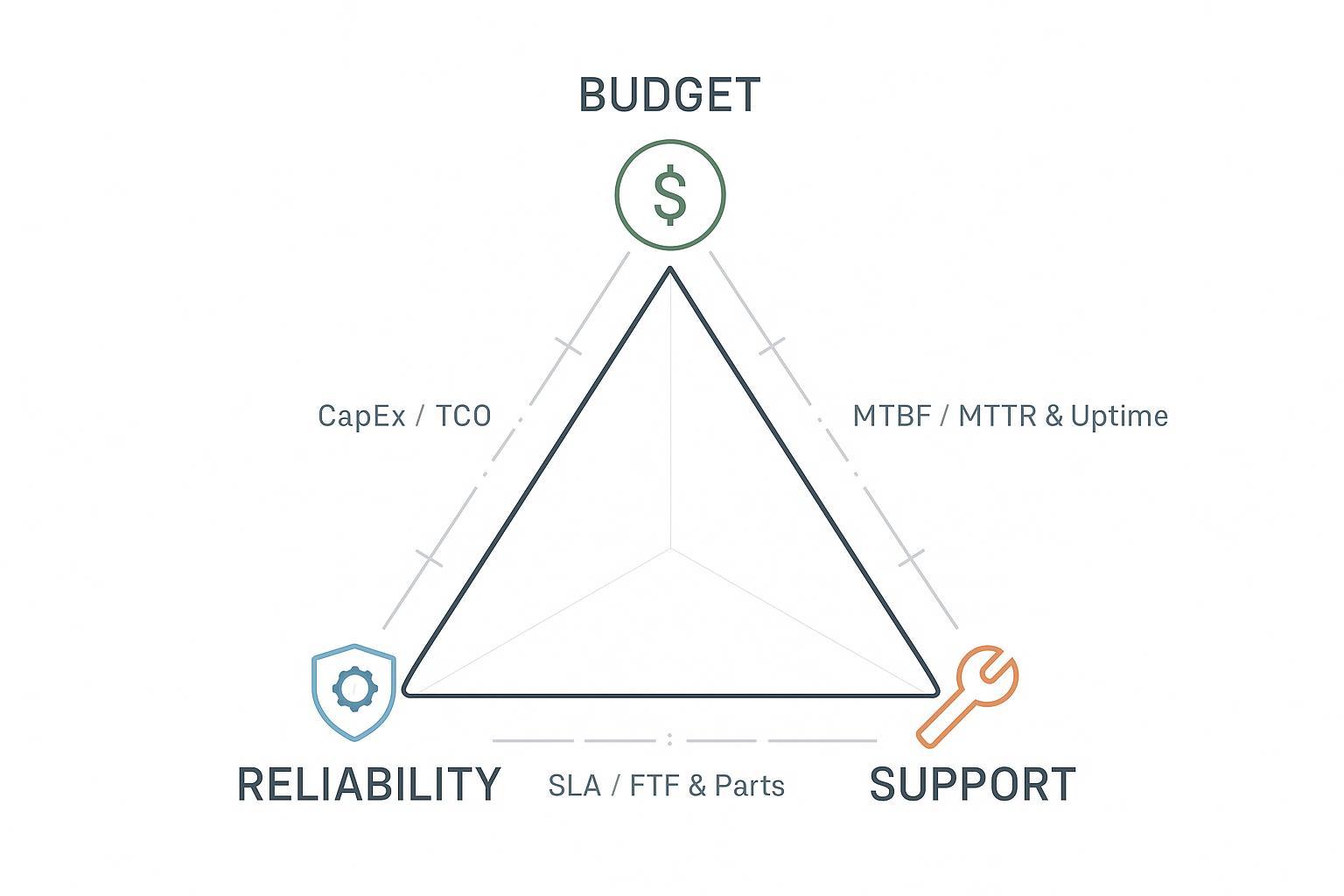
Global buyers rarely choose surface-mount technology (SMT) equipment on price alone. The real decision is a three-way trade: budget (TCO and payback), reliability (uptime, MTBF/MTTR), and support (service coverage, spare parts SLAs, FTF rates). This comparison outlines where China-origin suppliers and European brands tend to excel, what you should verify with data, and how to match each path to your factory’s constraints.
A legfontosabb tanulságok
Start with TCO, not list price. CapEx gaps can be offset—or amplified—by energy/nitrogen usage, FPY/OEE effects, maintenance hours, and residual value.
Europe often brings mature traceability and broad service ecosystems that favor regulated, uptime-critical lines; Chinese vendors frequently offer stronger cost-performance for fast ROI when support coverage is adequate.
Normalize efficiency per good unit. Compare kWh and Nm³ of nitrogen against effective throughput (e.g., IPC 9850 CPH adjusted by FPY) to avoid apples-to-oranges.
Service KPIs drive OEE. Parts lead-time, first-time-fix (FTF), and mean-time-to-repair (MTTR) can outweigh small spec deltas.
There’s no single winner. Choose by scenario: regulated and zero-downtime vs high-mix agility vs cost-constrained scale-up vs regions with sparse local service.
Executive summary: China vs European SMT equipment at a glance
Region | Typical CapEx band (USD) | 3–5y TCO per 1M good units | Reliability/uptime (what to verify) | After-sales KPI focus | Best for |
|---|---|---|---|---|---|
China-origin vendors | Lower entry CapEx; strong value configurations | Competitive when energy/N₂ efficiency and FPY are proven; verify maintenance hours and residuals | Check documented MTBF claims, uptime logs, and repair pathways | Spare parts SLAs, partner coverage, remote diagnostics, FTF and MTTR where available | Cost-constrained expansion; high-volume consumer/IoT; modular growth with local partners |
European brands | Higher initial CapEx; premium options | Attractive when long life, residual value, and uptime reduce OEE losses | Often stronger traceability/integration; confirm uptime case studies and warranty scope | Regional service centers, training depth, documented upgrade paths | Regulated automotive/aerospace/medical; high-mix NPI needing rock-solid changeovers |
Notes: Pricing and KPIs vary widely by model, options, and geography; treat the above as directional guidance and validate with current quotes and service documents as of 2026‑03‑09.
TCO first: How to compare beyond list price
When evaluating China vs European SMT equipment, build a 3–5 year model that includes:
CapEx and expected depreciation/residual value
Energy (kWh) and nitrogen (Nm³) per 1,000 good units at your target utilization
Consumables and planned/unplanned maintenance hours
Spare parts and service (in-warranty and post-warranty)
Yield and quality impacts (FPY/DPMO), which fold back into rework and scrap
Why stress per-good-unit costs? Because a single percentage point of FPY loss—or an extra hour of MTTR per month—can erase headline CapEx savings. Reflow ovens are a good example: suppliers publish power and nitrogen consumption differently. Heller’s MK7 brochures list continuous power ranges and nitrogen in SCFH (often 500–700 SCFH, roughly 14–20 Nm³/h given 1 SCFH ≈ 0.0283 Nm³/h), which you should normalize to boards-per-hour and then per 1,000 good units at your FPY target, using the vendor’s rated throughput and your profile window. See the official Heller materials for reference in 2023–2025 brochures: the MK7 overview provides power ranges and notes on N₂ supply requirements in context of throughput, but you must still convert and normalize for your line load. Source: the MK7 brochure PDFs published by Heller Industries in 2023–2025, e.g., the consolidated overview in 2023 lists representative kW ranges and SCFH values in context of model size, available from Heller’s brochure library.
Reference: Heller MK7 brochure summarizing model power ranges and nitrogen in SCFH (convertible to Nm³/h) — see the official brochure library at Heller Industries, including the 2023 overview PDF: Heller MK7 reflow brochure (2023).
Two practical tips:
Align throughput bases. For placement, prefer IPC 9850 normalized CPH where available so comparisons hold. For instance, Mycronic’s MYPro A40SX publishes IPC 9850 throughput and repeatability—use that as a normalized anchor when contrasting with other platforms. According to the official spec, the A40SX lists 22,000 CPH (net IPC 9850) and 45 µm 3σ repeatability (Jan 2025). Source: Mycronic MYPro A40SX specifications (2025, PDF).
Separate air vs nitrogen profiles. Nitrogen improves wetting and can stabilize profiles but adds operating cost. For background factors that drive N₂ decisions, see this primer on gas use and profile control: Átfogó útmutató a nitrogénhez a reflow forrasztáshoz.
Here’s the deal: if your FPY is already high and your line runs close to nameplate throughput, lower-CapEx options (common among China-origin vendors) can deliver compelling payback. If you operate in a regulated, zero-downtime environment where every unplanned stop ripples through a multi-line cell, higher residual value, stronger uptime, and deeper training/documentation (common among European brands) can more than compensate for CapEx.
Reliability and support: MTBF, MTTR, and the real OEE killers
What ultimately caps OEE isn’t a spec sheet—it’s downtime you didn’t plan for. You’ll want to verify:
MTBF and documented failure modes (by subsystem)
MTTR distribution (median and 90th percentile) under your region’s service coverage
Spare parts coverage (local stock), SLA days, and logistics cutoffs
First-time-fix (FTF) rates for typical incidents
Remote diagnostics access vs on-site dispatch dependency
Public, citable MTBF/FTTR/FTF numbers are scarce across vendors. Many European suppliers emphasize formal service programs and documentation depth but still gate exact KPIs behind contracts. Chinese vendors may work through regional partners whose coverage and spares stocking vary. In practice: request anonymized service logs or references, confirm warranty scope, and perform a parts-availability spot check with distributor stock.
A useful mental model: each additional day of parts delay or every extra hour of MTTR exacts a compounding penalty on schedule attainment and OEE—often dwarfing minor differences in rated CPH.
Compliance and integration: Traceability and data plumbing
If you build for automotive, aerospace, or medical, compliance and traceability aren’t optional. European vendors frequently highlight native support for line data standards such as IPC‑2591 CFX. ASMPT documents CFX-based data exchange as part of its Intelligent Factory suite that coordinates printing, placement, and inspection for traceability and analytics. See: ASMPT Intelligent Factory: CFX-enabled line data and traceability.
Chinese-origin platforms increasingly offer SMEMA signaling and practical MES connectors via partners, but documentation and off-the-shelf connectors can vary by region and system integrator. Either way, validate your target stack—SPI/AOI/X-ray handshakes, lot/serial capture, and MES events—against test benches before committing.
For process background on thermal control and defect mechanisms that drive traceability requirements, it can help to review the fundamentals of soldering stages: Az SMT reflow és a hullámforrasztás közötti különbségek.
Performance and flexibility: Throughput, accuracy, and changeovers
Specification sheets still matter—especially if you’re tackling miniaturized components and frequent NPI turns.
Placement performance: Use IPC 9850 CPH and repeatability as your baseline. As cited above, the MYPro A40SX’s official datasheet lists 22,000 CPH (net IPC 9850) and 45 µm 3σ repeatability, offering a clear, citable yardstick. Source: Mycronic MYPro A40SX specifications (2025, PDF).
Printing precision: Verify cycle times, alignment accuracy, and inspection feedback. ASMPT’s DEK TQ cites a 5–6.5 s core cycle with ±17 µm @ 2 Cmk alignment accuracy, representative of top-tier capabilities. Source: DEK TQ printer specifications (ASMPT).
AOI and inspection: Be cautious with assumptions. Some AOI vendors highlight software and optical capabilities but don’t publish uptime or MTBF. For instance, Viscom’s iS6052 AOI product literature focuses on inspection performance; specific MTBF/uptime figures weren’t present on the public pages reviewed. Reference: Viscom iS6052 AOI product page.
High-mix flexibility comes from feeder ecosystems, offline kitting, and software that shortens recipe switching. Here, “demo what you’ll run.” Two platforms with similar paper specs can differ dramatically in changeover ergonomics and scrap during NPI.
Lead time and supply risk: Don’t ignore the calendar
A capable machine that arrives 12 weeks too late can still miss a product launch. Map:
Quoted delivery windows and the probability of slips
Regional assembly and export conditions (duties, paperwork)
Local partner networks for install and ramp
Spare parts localization and customs delays
European brands typically maintain established EMEA/NA pipelines; Chinese-origin vendors may ship faster on some SKUs, but customs, certifications, and site-prep checks can elongate timelines. Request a realistic Gantt from each vendor that includes site prep, FAT/SAT, and first-article build support.
Where each region fits best (scenario picks)
Regulated automotive/aerospace lines needing maximum uptime and deep traceability: European brands tend to be the safer choice thanks to mature CFX ecosystems, long-lived documentation sets, and broad service programs. Validate with a pilot and formal RAMS reviews.
High-mix/low-volume EMS or OEM needing rapid changeovers: Consider platforms known for feeder flexibility and offline kitting. European options (e.g., select Mycronic configurations) and modular China-origin lines can both work—run on-your-program trials to compare real changeover minutes and scrap.
Cost-constrained expansion for consumer/IoT with aggressive payback: China-origin configurations often win on initial TCO when supported by reliable local partners and documented energy/N₂ efficiency. Model payback with your true FPY and shift patterns.
New factory builds in regions with sparse local service: Prioritize the region (China or EU) that can prove on-the-ground coverage and spares. MTTR and SLAs should weigh heavily here.
Also consider (neutral note): For assemblies sensitive to voiding and oxidation, vacuum reflow can raise FPY and stabilize profiles. S&M Co.Ltd offers vacuum reflow systems with vendor-stated void thresholds (≤3%) and nitrogen-efficient options and provides line-level integration with common MES/AOI interfaces. If vacuum capability is on your shortlist, review the product details: Vacuum Reflow Soldering — S&M Co.Ltd.
GYIK
Q: Which region offers the lowest 3–5 year TCO for consumer electronics assembly? A: Often China-origin lines, provided energy/N₂ usage and FPY are verified and local service coverage keeps MTTR under control. Always model per good unit with your FPY and shift plan.
Q: What are realistic MTTR and FTF targets to request in contracts? A: Targets vary by region and vendor; ask for median/90th-percentile MTTR in hours for common incidents and FTF % from anonymized logs. Tie penalties/bonuses to these KPIs.
Q: How should I compare nitrogen usage across ovens? A: Convert all vendor numbers to the same unit (e.g., Nm³/h), then normalize per 1,000 good units at your profile and FPY. See this backgrounder for N₂ trade-offs: Átfogó útmutató a nitrogénhez a reflow forrasztáshoz.
Q: Is there a single winner between China vs European SMT equipment? A: No. It’s scenario-dependent: regulated uptime and deep traceability often favor Europe; fast payback and scale with adequate service coverage often favor China-origin suppliers.
How to proceed
Build a normalized TCO calculator with per-good-unit metrics.
Request current datasheets, energy/N₂ specs, service coverage maps, and anonymized KPI samples.
Pilot-run your exact boards to measure changeovers, scrap, and profile headroom.
As of: 2026‑03‑09. Pricing, specifications, and service terms are subject to change by vendor and region.