



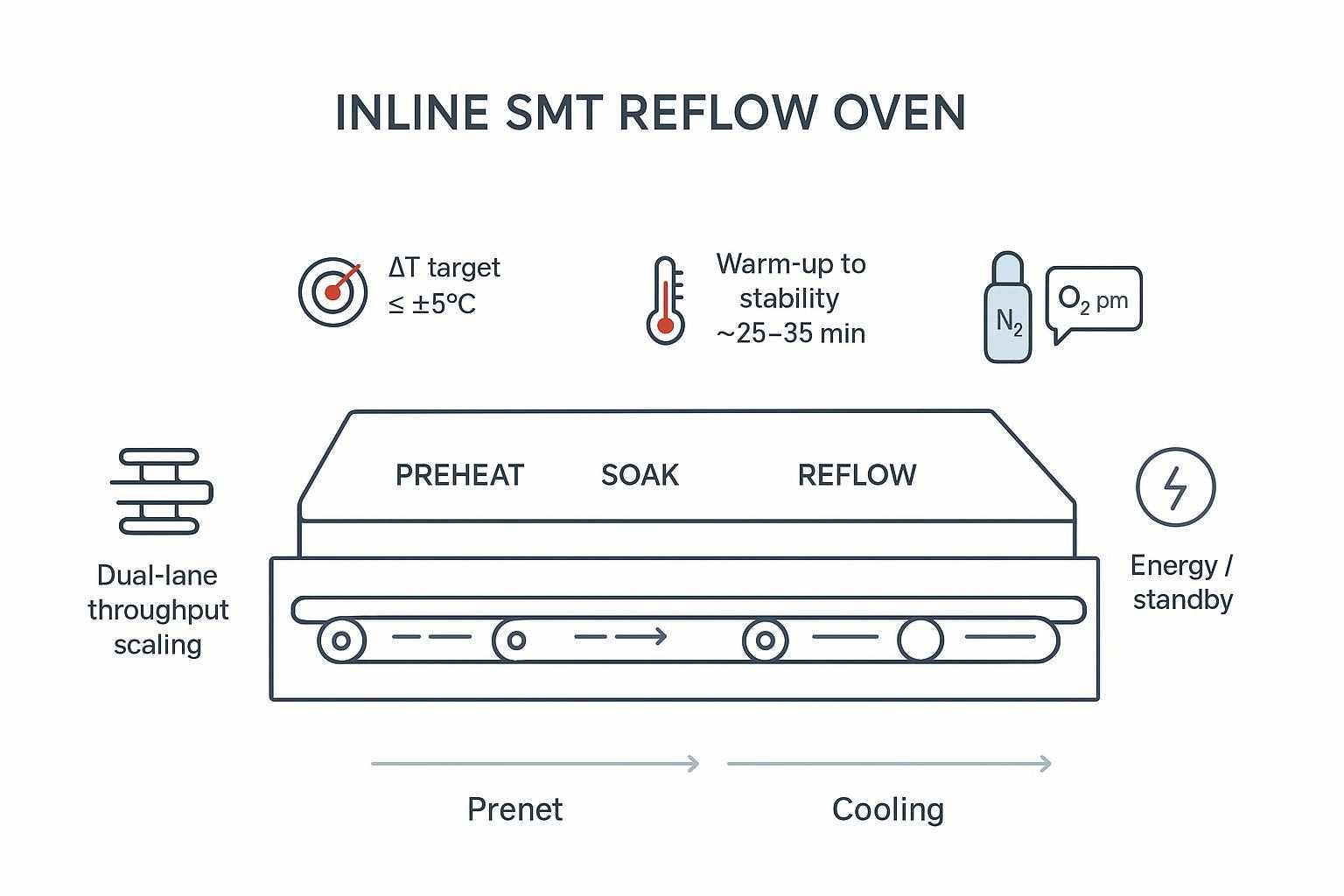
If you run a mid-volume EMS line, you don’t buy a reflow oven for wattage or zone counts alone—you buy it for stable takt, repeatable profiles, and low unplanned downtime. The best-fit choice balances throughput (often via dual-lane and usable speed window), profile stability (ΔT across the board and O2 ppm control), and day-to-day serviceability.
Two details separate top performers on the floor: how quickly they warm up to a stable profile after standby and how consistently they repeat the curve across three consecutive, fully loaded passes. Get those right and boards per hour—and FPY—tend to follow.
A quick refresher on the process phases and control points is here if you need it: see the reflow-process primer in our educational hub, Mastering the SMT reflow oven process fundamentals (internal guide).
Key takeaways
-
For the primary query—best reflow oven for EMS—start with use case, not brand: dual-lane independence, warm-up-to-stability, and ΔT class influence actual boards per hour more than headline zone counts.
-
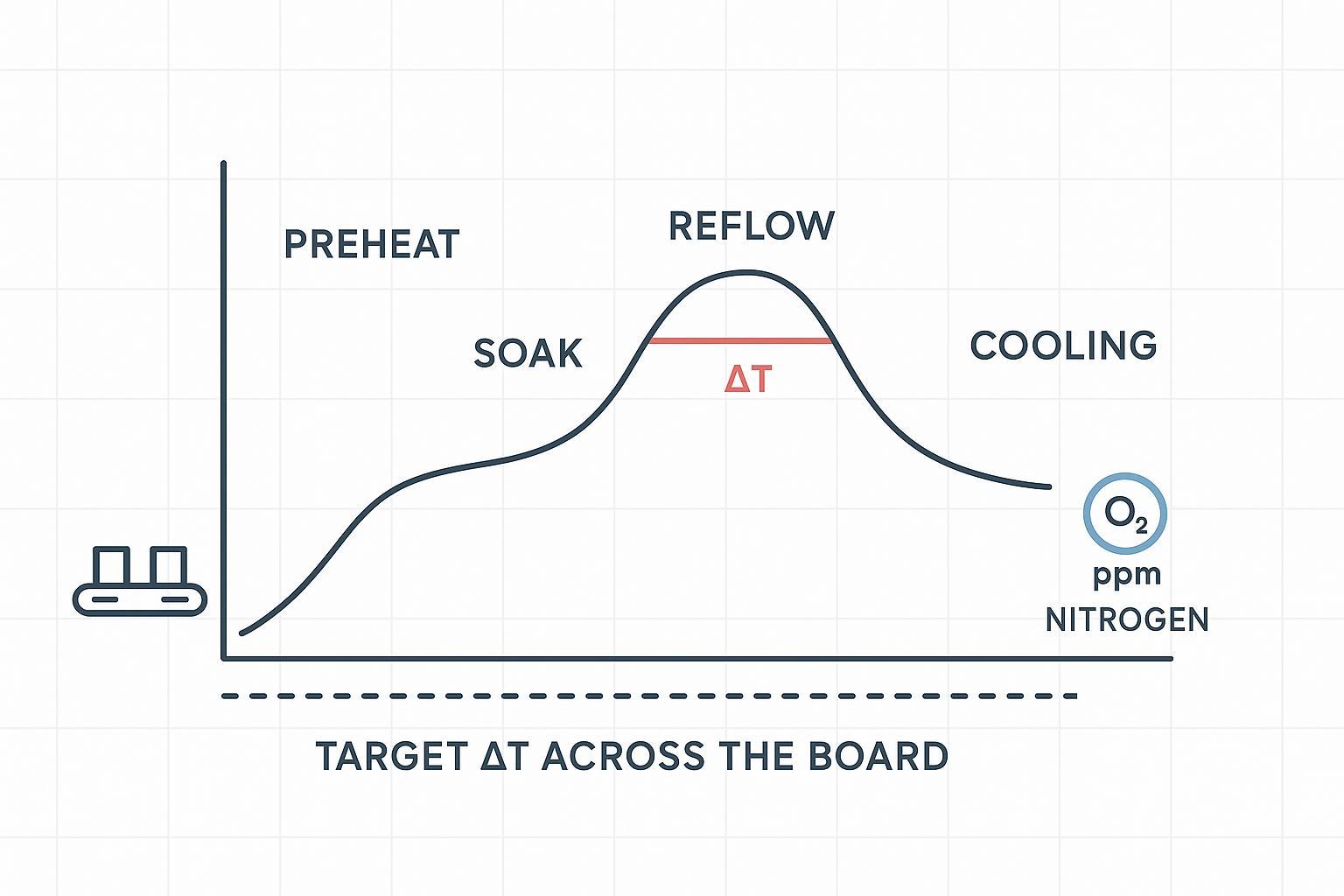
Aim to measure ΔT with 5–7 thermocouples across risk points and repeat the test three times; target class for typical EMS is often ≤ ±5°C across the board, with peak/TAL per J-STD-020.
-
Practical nitrogen operation for EMS commonly spans ~300–1000 ppm O2; verify recovery time and m³/h at your target ppm to estimate $/board.
-
Energy-saving/standby modes can cut kWh during gaps; what matters is profile recovery behavior when product returns.
-
Keep integration on the checklist: recipe versioning, SPC/export, and MES/AOI/X-ray hooks reduce changeover risk and audit friction.
How we chose: methodology and weights
We scored candidates against six audit-friendly dimensions, emphasizing throughput proxies and stability for mid-volume automation lines.
-
Profile stability and process control — 28%
-
Measure ΔT with 5–7 TCs at critical locations and repeat for three loaded passes; confirm closed-loop repeatability and any O2 ppm control range/stability.
-
Reference profiling practice in IPC-7530A and respect J-STD-020 limits for Pb-free peak and TAL. See the concise overview in Texas Instruments’ summary of J-STD-020 and profiling parameters in IPC-7530A.
-
-
Throughput and capacity scalability — 22%
-
Dual-lane availability and independent speeds; max board width and center support; conveyor speed window that still meets TAL; warm-up-to-stability after standby.
-
-
Energy and nitrogen efficiency — 15%
-
Standby/idle modes, insulation/sealing, kWh/h idle vs run; N2 m³/h required to maintain target ppm and recovery behavior after load changes.
-
-
Integration and traceability readiness — 12%
-
Recipe/version control, SPC/export formats, MES/AOI/X-ray hooks, audit logs, and role control.
-
-
Maintenance and uptime — 13%
-
Flux management, PM interval guidance, tool-less access; MTBF/MTTR data or service records; spares coverage.
-
-
Total cost of ownership (TCO) and service — 10%
-
Price band, warranty, energy/N2 per board estimates, lead times, after-sales coverage.
-
Evidence policy: When vendors do not publish numeric KPIs (e.g., O2 ppm control stability, ΔT), we note it and recommend on-site verification using IPC-7530A methods rather than inferring.
Quick comparison table (scan before details)
|
Brand/Model |
Lane & Max width |
Zones (heat/cool) |
Profile stability cues |
Energy/N2 features |
Hampa udara |
Approx. price |
Catatan |
|---|---|---|---|---|---|---|---|
|
Heller MK7 2043 |
Single lane, 22″ (55.9 cm) |
13/13; cool 3T (Btm opt.) |
Low ΔT claims; no public O2 ppm data |
EMS standby; catalyst flux removal |
Optioned in family |
POA |
Long heated length; global support |
|
BTU Aurora 200 |
Dual-lane/dual-speed; up to ~620 mm |
16/16; cool 6 |
No public ΔT/O2 ppm |
Energy Pilot standby/sleep |
Tidak. |
POA |
Five movable rails; heavy boards |
|
Rehm VisionXP+ Vac |
Configurable; ~600–700 mm typical |
Modular; vac between peak/cool |
Void reduction focus; ΔT verify onsite |
EC fans; pyrolysis option |
Ya. |
POA |
Modular lengths; quote exact spec |
|
Ersa EXOS 10/26 |
50–630 mm (100–630 mm w/ support) |
11/11; cool 4 |
Vacuum to 10 mbar; voiding ↓ |
— |
Ya. |
POA |
Premium; larger footprint |
|
Vitronics Soltec Centurion+ |
Dual-lane indep. speed; 610 mm SL |
12–16 total; 3–4 cool |
±1°C control; ±2°C uniformity |
Fast cool-down options |
Tidak. |
POA |
Documented accuracy |
|
S&M VS-1003-N |
Dual-lane 2–280 mm each; SL up to 610 mm opt. |
10/10; cool 3T (opt. 3B) |
±1°C control; ΔT ±1.5°C; 300–1000 ppm O2 |
N2 ~25–30 m³/h guidance |
Option (series) |
POA |
Positioned for mid-volume |
|
Heller 1826 MK7 |
Single lane, 22″ |
10/10; cool 2T (Btm opt.) |
— |
EMS standby |
Tidak. |
POA |
Compact, energy-conscious |
POA = Price on application. Pricing is configuration-dependent and subject to change.
The best reflow oven for EMS by use case
Best for mid-volume automation and SPC-driven lines — BTU Aurora 200
-
One-line positioning: Dual-lane, dual-speed reflow with long heated length and automated energy optimization.
-
Key configuration: Up to 16/16 heated zones with six cooling zones; wide-board handling to ~620 mm; up to five movable rails with center support.
-
Profile stability: Closed-loop convection; vendor pages do not publish ΔT or O2 ppm stability—verify via site trials and IPC-7530A methods.
-
Throughput proxies: Dual-lane independent speeds to align with upstream/downstream takt; extended process length supports TAL at higher conveyor speeds.
-
Maintenance & uptime: BTU literature emphasizes simplified service; plan PM around residue load and filter condition.
-
Energy/N2: Energy Pilot standby/sleep linked to product tracking to reduce kWh during gaps, with rapid recovery on product return.
-
Best for / Not for: Best for mid-to-high volume automation with wide boards; not for teams needing documented ppm control modules from OEM page.
-
Evidence links: See the BTU Aurora platform page and the Energy Pilot overview for energy logic and lane options.
Best for high-throughput with standby efficiency — Heller MK7 2043
-
One-line positioning: High-throughput convection reflow with mature energy-saving controls and long heated length.
-
Key configuration: 13/13 heated zones; three top cooling (bottom optional); max PCB width about 22″ (55.9 cm).
-
Profile stability: Public materials highlight “lowest delta T’s,” but do not publish ΔT or O2 ppm stability; confirm onsite.
-
Throughput proxies: Heated length around 449 cm and belt speeds up to ~1.88 m/min support aggressive takt when profiles permit.
-
Maintenance & uptime: Integrated catalyst-based flux removal to reduce residue load; broad service documentation and spares network.
-
Energy/N2: Energy Management System with smart standby/idle logic; exhaust slowdown during gaps.
-
Best for / Not for: Best for continuous EMS production seeking long process length; not for teams requiring documented dual-lane independent-speed operation.
-
Evidence links: Review the Heller MK7 brochure and the 2043 model page for specs and EMS notes.
Best for low-voiding and high-reliability builds — Ersa EXOS 10/26
-
One-line positioning: Premium inline vacuum reflow engineered to minimize voids for power and high-reliability electronics.
-
Key configuration: 11/11 heating zones plus four cooling; working width 50–630 mm (100–630 mm with center support).
-
Profile stability: Integrated vacuum chamber after peak with ultimate pressure to about 10 mbar; vendor materials cite major void reduction. Validate ΔT uniformity with your assemblies.
-
Throughput proxies: Long process length and robust cooling support thermally demanding panels.
-
Maintenance & uptime: Lubricant-free roller transport and quick-maintenance vacuum subsystem per Ersa literature.
-
Energy/N2: Not publicly quantified; check kWh/h and N2 flow at target ppm during trials.
-
Best for / Not for: Best for power devices and automotive/medical builds where voiding is critical; not for budget-constrained lines.
-
Evidence links: Consult the EXOS 10/26 product page and Ersa’s reflow overview.
Tip: Think of dual-lane like adding a second checkout at the same cashier—throughput rises only if upstream printing/placement and downstream AOI/handling can keep pace.
— Soft CTA — Want a vendor-agnostic KPI template (ΔT worksheet, warm-up tracker, and N2 m³/h-at-ppm estimator) to compare ovens? Download the neutral reflow KPI comparison sheet (no email required).
Best for flexible low-oxygen operation in mid-volume — S&M VS-1003-N
-
One-line positioning: Flexible dual-lane inline oven for EMS teams balancing throughput with practical nitrogen consumption.
-
Key configuration: 10/10 heated zones; three top cooling (optional three bottom); single-lane up to 610 mm (option); dual-lane rails 2–280 mm each; conveyor 200–2000 mm/min.
-
Profile stability: Closed-loop PID on a Siemens PLC with Windows 11 HMI; temperature accuracy ±1°C and lateral ΔT around ±1.5°C in internal documentation; supports 300–1000 ppm O2 operation. Plan to validate with 5–7 TCs.
-
Throughput proxies: Warm-up to stability typically ~25 minutes from cold/standby in typical line conditions; optional independent lane speeds aid takt alignment.
-
Maintenance & uptime: Negative-pressure rosin capture and recovery; auto lubrication; clear PM access points.
-
Energy/N2: Practical guidance of ~25–30 m³/h nitrogen at 300–1000 ppm O2 (verify on your line; consumption depends on sealing and target ppm).
-
Best for / Not for: Best for mid-volume automation and energy-conscious lines; not for ultra-wide boards unless the 610 mm option is selected.
-
Price & limits: Price on request; options materially affect cost; evidence level B pending additional third-party logs.
-
Evidence links: See the VS-1003 product overview and the nitrogen usage explainer for ppm and flow context.
Best for modular vacuum capability — Rehm VisionXP+ Vac
-
One-line positioning: Flexible convection platform with in-line vacuum unit immediately after peak to reduce voids.
-
Key configuration: Modular process lengths; vacuum between peak and cooling; typical working widths ~600–700 mm (variant-dependent).
-
Profile stability: Emphasis on zone separation and EC motors; verify ΔT by IPC-7530A and assess vacuum cycle time impact on takt.
-
Throughput proxies: Modular heating length and optional lower-side cooling; tuned for regulated applications needing consistent joints.
-
Maintenance & uptime: Optional pyrolysis for residue separation; redesigned residue paths to extend filter life.
-
Energy/N2: EC fans and optional nitrogen-saving elements; confirm N2 m³/h at target ppm for your assemblies.
-
Best for / Not for: Best for assemblies where void reduction drives quality metrics; not for tight floor-space constraints.
-
Evidence links: Review Rehm’s 2023 product overview and 2024 medical-tech guide.
Best for dual-lane with documented thermal accuracy — Vitronics Soltec Centurion+
-
One-line positioning: Dual-lane capable inline oven with published thermal accuracy/uniformity and controlled cooling options.
-
Key configuration: 12–16 total zones; single-lane up to 610 mm; dual-lane with independent speeds supported.
-
Profile stability: Published control accuracy ±1°C and uniformity ±2°C; nitrogen-capable modes; confirm with your profiling method.
-
Throughput proxies: Wide conveyor speed window and fast cool-down options enable higher line rates when profiles allow.
-
Maintenance & uptime: Quick-exchange components noted in literature.
-
Energy/N2: Efficient heat transfer and improved zone separation; quantify kWh/board during trials.
-
Best for / Not for: Best for mid-volume automation prioritizing documented accuracy; not for extra-wide panel formats beyond the listed envelope.
-
Evidence links: Consult the Centurion+ brochure and ITW EAE notes on controlled cooling.
PERTANYAAN YANG SERING DIAJUKAN
-
What ΔT should EMS teams target and how do you measure it?
-
For most EMS builds, a practical target class is ≤ ±5°C across the board, but your design and solder paste window dictate the exact limit. Measure using 5–7 thermocouples at critical component locations, run three consecutive loaded passes, and report mean ΔT and standard deviation. See IPC-7530A for placement guidance and J-STD-020 for Pb-free peak and TAL envelopes.
-
-
What O2 ppm targets make sense and how much nitrogen will that use?
-
Application-dependent. Many EMS lines see benefits between ~300–1000 ppm O2. Nitrogen flow to maintain 500 ppm in mid-size ovens can fall in the ~18–40 m³/h range depending on sealing and load. Validate with your O2 analyzer and log recovery under load.
-
-
Do standby/energy-saving modes hurt stability when production resumes?
-
The key is recovery behavior. Solutions like BTU’s Energy Pilot or Heller’s EMS can reduce kWh during gaps; assess how quickly the oven returns to a stable profile and whether the first-pass board after standby meets TAL and peak targets.
-
-
When is vacuum reflow worth it?
-
When voiding drives reliability KPIs (power devices, automotive/medical), inline vacuum units (Ersa EXOS, Rehm Vac) can dramatically lower voids. Confirm cycle-time impact, footprint, and cost versus your quality targets.
-
Evidence and sources
-
Lead-free envelope (peak/TAL) summarized by Texas Instruments under JEDEC J-STD-020 guidance: https://www.ti.com/lit/pdf/snoa550
-
Profiling best practices (thermocouple count/placement, repeatability) per IPC-7530A (reference document): https://www.scribd.com/document/887010332/IPC-7530A-Temp-Profile
-
BTU Aurora platform and Energy Pilot overview (dual-lane, standby/sleep): https://www.btu.com/reflow-ovens/aurora/ dan https://www.btu.com/fr/wincon-control-system/energy-pilot/
-
Heller MK7 brochure and model pages (energy management, heated lengths): https://hellerindustries.com/wp-content/uploads/2023/04/mk7_brochure_en.pdf dan https://hellerindustries.com/2043-reflow-oven
-
Rehm VisionXP+ Vac overview (vacuum module and options): https://www.rehm-group.com/fileadmin/user_upload/PDF_EN/Produktuebersicht_EN_2023.pdf
-
Ersa EXOS 10/26 vacuum platform: https://kurtzersa.com/products/electronics-production/soldering-machines/reflow-soldering-systems/exos-10-26
-
Vitronics Soltec Centurion+ brochure (accuracy/uniformity, dual-lane): https://www.itweae.com/sites/default/files/specs-downloads/Centurion_Plus.pdf
-
Nitrogen usage in reflow ovens (practical ppm/flow context): https://www.chuxin-smt.com/nitrogen-usage-in-reflow-oven-how-much-nitrogen-is-needed/
-
S&M VS-1003 product overview: https://www.chuxin-smt.com/products/vs-1003/
Note: External specs and features are subject to change by the OEMs. Where numeric KPIs are not published, perform onsite verification using IPC-7530A methods.
Next steps
-
If you’re shortlisting the best reflow oven for EMS needs, bring your profile logs and O2 analyzer data. We can walk through a neutral spec comparison or a quick takt-alignment study for dual-lane options. For background reading, see our nitrogen usage explainer and the VS-1003 series overview for a mid-volume configuration example.