



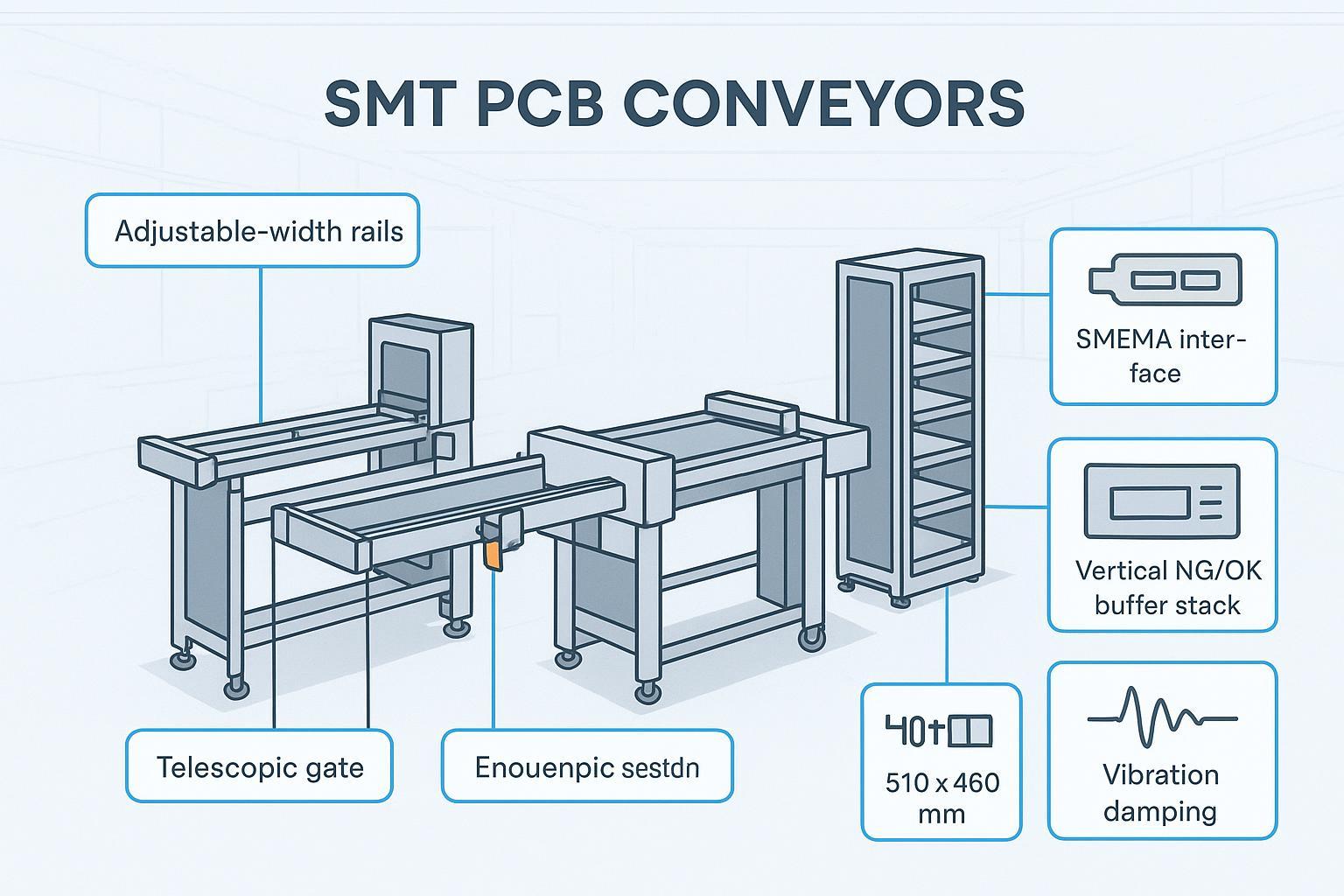
If you’re evaluating SMT conveyors for a brownfield line, three things decide real‑world success: clean SMEMA drop‑in compatibility, stable takt on long or heavy boards and fixtures, and maintainability proven by PM checklists and MTBF/MTTR. This comparison frames vendors through those lenses so you can configure the right modules without surprises.
Key takeaways
SMEMA remains the baseline for drop‑in interoperability; treat Hermes and CFX as future‑ready layers rather than gating factors today.
For long and heavy boards, prioritize envelope and weight limits, frame stiffness, vibration control, and cycle‑time consistency.
Ask for maintenance proof up front: published PM intervals and checklists, plus any MTBF/MTTR statements to protect uptime and TCO.
Buffers and NG/OK routing near AOI or reflow de‑couple stations and smooth takt; verify slot counts and cycle times.
Acceptance tests should include SMEMA handshake, auto‑width repeatability, vibration logging under load, and routing logic checks.
Quick scenario verdict
Best for SMEMA drop‑in on brownfield lines: Vendors with explicit SMEMA pinout and timing documentation and proven BA/RTR/INH handshake tests. Use this when you must minimize controls changes.
Best for long and heavy boards: Models with wider envelopes, higher weight capacity, rigid frames, and damping measures that hold speed without jarring transfers.
Best for AOI or reflow buffering and NG/OK routing: Systems offering configurable buffers, shuttles, or diverters that keep flow continuous while isolating inspection.
Best for maintenance documentation: Vendors publishing preventive maintenance intervals, task lists, and any MTBF/MTTR data, plus tool‑less access and common spares.
The SMT conveyor comparison table
Specs and versions are based on the vendors’ public pages as of 2026‑03‑16. Where a data item wasn’t published on the cited page, it’s noted as “not published.” Link density is limited; consult the source pages for deeper options and variants.
Vendor / Model | SMEMA notes | Max PCB envelope and weight | Auto‑width | Buffering and NG/OK | Throughput window | Maintenance evidence | Catatan | Evidence (accessed 2026‑03‑16) |
|---|---|---|---|---|---|---|---|---|
S&M Co.Ltd — Transposition Conveyor (PTH‑460) | Portfolio pages state standard SMEMA signaling | Up to 510 × 510 mm; weight not published on cited page | Options vary by SKU; not published on cited page | Not applicable for this unit | Rotation cycle about 8 s | PM checklists and MTBF/MTTR not published on cited page | Source: S&M transposition model page with spec and cycle time | |
S&M Co.Ltd — Telescopic Gate Conveyor (PTS‑650) | Portfolio pages state standard SMEMA signaling | Up to 700 × 650 mm; weight not published on cited page | Not applicable | Not applicable | Gate cycle about 10 s | PM checklists and MTBF/MTTR not published on cited page | Large envelope for access ways | https://www.chuxin-smt.com/products/normally-closed-telescopic-gate-converyor/ |
S&M Co.Ltd — Inspection Conveyor (PTC series) | “Standard SMEMA signal communication” stated on portfolio pages | Up to 510 × 460 mm on variants; indicative PCB weight 1.5–3 kg by belt spec | Auto‑width options on certain models; details vary | Optional inspection or reject modes | Typical 0.5–20 m/min | PM checklists and MTBF/MTTR not published on cited page | Particularly strong envelope options for long or heavy fixtures | https://www.chuxin-smt.com/products/conveyor-inspection-conveyor/ |
Nutek — NTE0510ICL Inspection | SMEMA typical per portfolio | 80–460 × 50–460 mm; up to ~3 kg per PCB | Auto‑width variants exist; model dependent | Inspect and bypass modes | Variable ~2–14 m/min | PM/MTBF not published on cited page | See Nutek model page for exact options | https://www.nutek-europe.com/e-nte0510ic-inspection-conveyor |
ASYS Group — VEGO TRM 01–03 | SMEMA or synchronous modes depending on config | Max sizes vary; see datasheet | Tool‑free belt change design; auto‑width options | Not applicable | Speed range model dependent | PM/MTBF not published on cited page | Datasheet notes self‑tensioning ESD belts | |
Promation USA — VBB Post‑AOI Buffer | SMEMA NG/OK integration | Slot‑based buffer; PCB weight per slot ~1 kg where specified | Not applicable | NG to upper buffer; OK pass‑through | Cycle times not published on cited page | PM/MTBF not published on cited page | Vertical buffer with multiple pitch options | |
JOT Automation — 470 series handling | SMEMA typical per portfolio | 100–457 × 50–457 mm | Auto‑width options vary | FIFO/magazine buffers in portfolio | Speed not stated on cited page | PM/MTBF not published on cited page | Long‑board capability ≥510 mm not evident on cited page | https://www.jotautomation.com/products/material-handling/470-series |
Evidence links referenced in this table:
Nutek lists envelopes and speeds on model pages such as the NTE0510ICL inspection conveyor.
ASYS details ESD belts and tool‑free belt changes in its VEGO TRM series datasheet.
Promation outlines NG/OK buffer logic on its VBB page.
Where to start deeper: For Hermes or CFX plans, consult the 2024 update of the standard for message‑level capabilities and IPC’s CFX QPL to validate vendor claims.
How to choose for your line
Here’s the deal: most mis‑picks happen because teams optimize for the wrong bottleneck. Use this quick checklist.
Define your limiting case. Is it envelope and mass, AOI/reflow stop‑and‑go, or brownfield compatibility risk?
Lock SMEMA first. Verify BA, RTR, and INH mapping, transfer height 900 ± 20 mm alignment, and mechanical rail plan in the vendor manual or FAT sheet.
Validate long/heavy capability. Request the max L×W×T with fixture weight limits, frame stiffness notes, and any damping or anti‑vibration features.
Confirm auto‑width performance. Ask for the adjustment range, repeatability in millimeters, and seconds per 100 mm.
Size buffers using takt math. For AOI or reflow decoupling, calculate required slots and confirm routing options (diverter, shuttle, lift).
Demand maintenance proof. Request PM intervals and task checklists; if available, MTBF/MTTR statements and parts commonality.
Buffer sizing with Little’s Law
Given: AOI average cycle 12 s, reflow loading rhythm 8 s, target WIP cushion 2 minutes during AOI slowdowns. You need about 120 s ÷ 8 s ≈ 15 slots to keep the oven fed. Then check slot pitch against your board thickness and fixture height.
Maintenance and acceptance testing that proves uptime
Use the following condensed FAT/SAT protocol to validate claims and document readiness.
SMEMA handshake and transfer
- Verify BA/INH/RTR logic with oscilloscope or logger across upstream/downstream.
- Confirm transfer height and rail alignment with 900 ± 20 mm target; document shim points.

Auto-width repeatability
- Run n=10 changes across min/median/max widths; record time per 100 mm and repeatability (±mm).

Vibration and stability under load
- Place a small accelerometer at the board edge or pallet; run at min/nominal/max speed with worst-case long board.
- Record RMS and peak; confirm no jams or excessive oscillation entering AOI/reflow.

NG/OK routing logic
- Inject NG from AOI; confirm selected path (buffer, return, upper deck) and cycle time consistency over n=20 events.

Throughput verification
- Ten-minute continuous run at target takt; record stops, average interval, and any accumulation behavior.

Maintenance documentation
- Collect vendor PM intervals and checklists; note tool-less guards and spare-part commonality; request any MTBF/MTTR letters.
What “good” looks like: reproducible width change times, stable vibration profiles with long or heavy fixtures, and routing that never blocks the oven even during NG bursts. You’ll also want a clear PM cadence with tasks that fit standard shift maintenance windows.
Pricing and TCO notes
Conveyor pricing and options are quote‑only and vary by region, lead time, and module mix. Treat energy draw, wear parts, PM labor hours, and expected MTBF as the main TCO drivers. Any price or TCO comparisons should be labeled indicative only, as of 2026‑03‑16.
PERTANYAAN YANG SERING DIAJUKAN
What SMT conveyor is best for long and heavy PCBs?
Pick models with larger verified envelopes, higher weight capacity, rigid frames, and damping features. Confirm stability with a loaded vibration test and a 10‑minute throughput run.
How do I test SMEMA compatibility on a conveyor?
Run a handshake test for BA, RTR, and INH, verify the transfer height and mechanical alignment, and confirm board‑present sensors at handoff points during FAT.
How many buffer slots do I need near AOI to avoid blocking reflow?
Use Little’s Law. Divide your desired buffer time by the downstream takt to calculate slot count, then ensure slot pitch clears your thickest assemblies.
What maintenance evidence should I ask vendors to provide?
Preventive maintenance intervals and task checklists, plus any MTBF/MTTR statements and notes on tool‑less access and spare‑part commonality.
Standards and sources
For future‑ready messaging between machines, see the 2024 update of the Hermes specification in the consortium’s official PDF under the title The Hermes Standard IPC‑HERMES‑9852 v1.6. IPC notes Hermes as a successor to older SMEMA‑style signaling in its Factory of the Future overview. For vertical connectivity validation, check vendors against the IPC CFX Qualified Products List.
According to the consortium’s 2024 release, the The Hermes Standard v1.6 PDF clarifies error handling and keep‑alive behavior: see the official document under The Hermes Standard IPC‑HERMES‑9852 v1.6 (2024).
IPC’s industry explainer describes Hermes as the evolution path from legacy SMEMA: see IPC’s Factory of the Future overview for context.
For CFX validation, refer to IPC’s IPC‑2591 CFX Qualified Products List.
Selected vendor evidence for deeper reading:
Nutek lists envelopes and speeds on model pages such as the NTE0510ICL inspection conveyor.
ASYS details ESD belts and tool‑free belt changes in its VEGO TRM series datasheet.
Also consider
If you need large‑envelope handling or configurable buffering, S&M Co.Ltd’s portfolio includes long‑board options and routing modules. For example, the inspection conveyor overview provides up to 510 × 460 mm variants, while the normally closed telescopic gate and transposition modules extend access and orientation control. These pages help validate SMEMA compatibility and envelope planning without committing to a specific model.
Internal references for engineers:
Inspection conveyor overview/specs: https://www.chuxin-smt.com/products/conveyor-inspection-conveyor/
Normally closed telescopic gate conveyor: https://www.chuxin-smt.com/products/normally-closed-telescopic-gate-converyor/
Dual station shuttle conveyor: https://www.chuxin-smt.com/products/dual-station-shuttle-conveyor/