



A greenfield SMT line build has an uncomfortable truth: you’ll make some layout decisions before you’ve learned everything you need to know.
Conveyors are a perfect example. You need something to connect your printer, pick-and-place, reflow, AOI, and downstream stations. But if you lock every gap into a fixed dimension too early, you can end up paying for rework in steel, floorspace, and downtime.
This guide explains how to choose between a fixed-length conveyor section and an adjustable length PCB conveyor using a criteria-first framework that layout and SMT engineers can apply.
Key takeaways
Fixed-length conveyor sections are usually the right default when machine spacing is stable, access is already designed, and you want maximum mechanical simplicity.
Adjustable-length sections earn their cost when layout uncertainty is real: late equipment changes, aisle/pass-through needs, or future expansion plans.
In SMT transport, many failures happen at interfaces—stops, sensors, and handoffs—so your decision should include how many interfaces you’re creating (or eliminating).
Treat “adjustable” as two categories: length-adjustable linking sections (fit) and telescopic gate conveyors (operator access).
Quick definitions (so we don’t talk past each other)
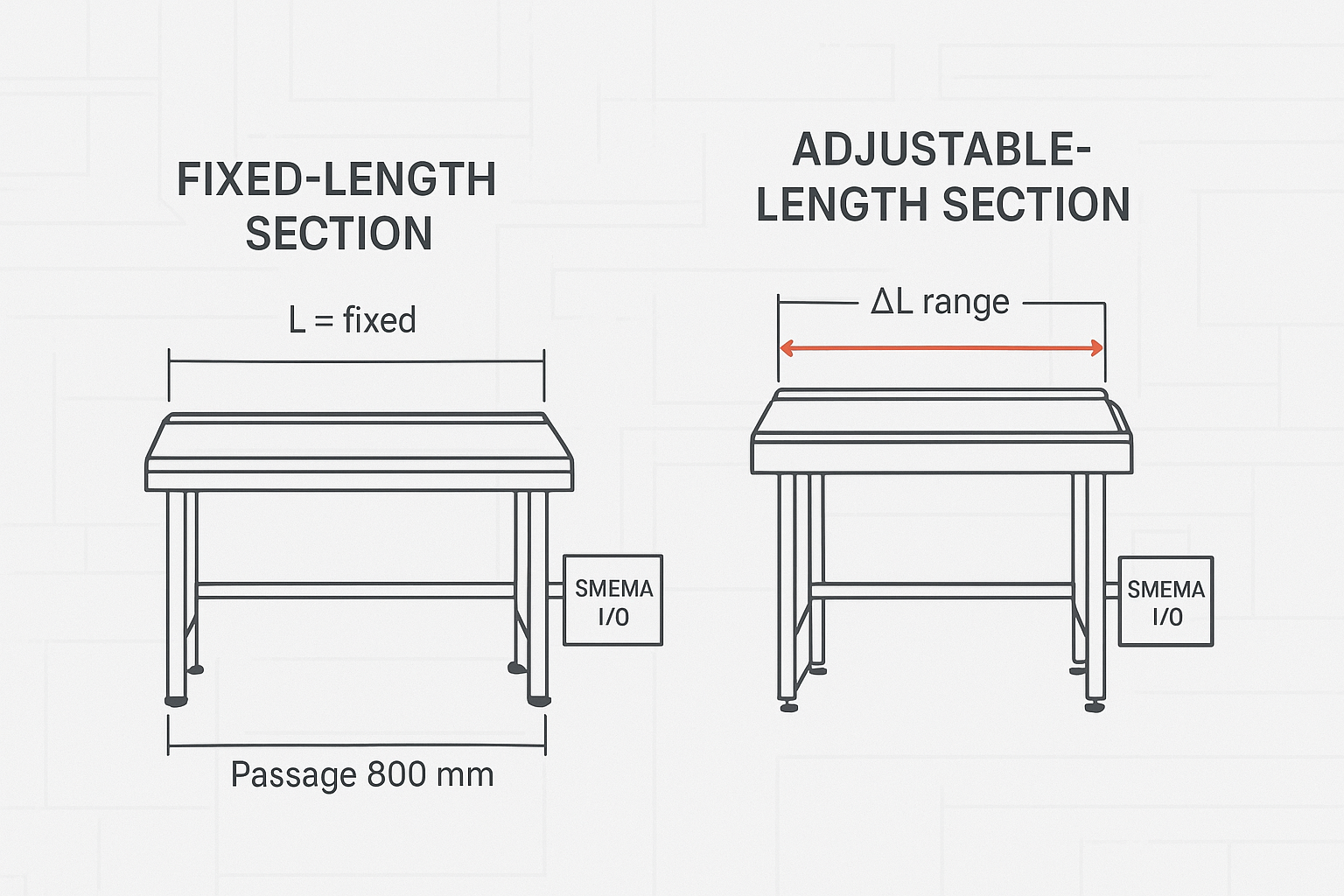
Fixed-length conveyor section: A conveyor with a set frame length. You choose the section length during layout and it stays that way unless you physically replace it.
Adjustable length PCB conveyor: A conveyor designed to change its effective length after installation. In practice, this might be a telescoping frame or modular extension design.
Telescopic gate conveyor SMT line: A specific adjustable-length design used to create a walkway through the line. Some designs are described as “normally closed” or “normally open.” For a simple explanation of the behaviors, see Eflex’s overview of normally open vs normally closed telescopic gate conveyors.
Buffer conveyor SMT line (buffer / stocker / reject conveyor): A conveyor section that holds boards temporarily (buffering) or routes boards to NG/OK paths. These are layout tools for flow stability, not just transport.
主な収穫: In layout discussions, clarify whether you’re talking about length adjustment for fit or length adjustment for access. They solve different problems.
Fixed vs adjustable PCB conveyor: a summary comparison
Use this matrix as your first pass. Then read the sections that match your constraints.
Evaluation criterion | Fixed-length section | Adjustable-length section | When it matters most in a greenfield build |
|---|---|---|---|
Layout certainty | Strong fit when distances are known | Best when distances may change late | Early project phases with evolving equipment list |
Access across the line | Requires planned aisles or detours | Gate/telescopic designs can create a pass-through | When operators/maintenance must cross frequently |
Mechanical simplicity | Highest | More moving parts / mechanisms | When uptime and maintainability are top priorities |
Interface risk | Predictable; fewer moving interfaces | Can reduce rework but may add mechanism complexity | When jam risk at interfaces is a known pain point |
Future re-layout flexibility | Low unless you replace sections | Higher if adjustment range covers change | When expansion/duplication is likely |
Commissioning effort | Lower (usually) | Requires more verification of positions/safety | When you have tight ramp schedules |
Cost / TCO | Lower unit cost, fewer mechanisms | Higher unit cost; may avoid later rebuild | When late changes are expensive or common |
Criterion 1: How certain is your machine-to-machine spacing?
In a greenfield build, “uncertainty” isn’t just design indecision. It’s real project dynamics:
Equipment lead times shift and substitute models appear.
Facilities constraints change (power drops, exhaust routing, fire lanes, columns).
Your “final” line list gets revised after the first detailed process review.
Choose fixed-length sections when:
You already have locked footprints for each major machine.
You have stable interface standards (height, handoff method, direction).
You’re optimizing for mechanical simplicity and easy spares.
Choose adjustable-length sections when:
You expect at least one late-stage equipment swap.
You know you’ll re-balance spacing after first trial runs.
You’re building a layout template for replication across sites.
A practical way to decide is to label each gap in your CAD with a certainty score (high/medium/low). If several “low certainty” gaps sit in critical flow locations (e.g., printer → SPI → placement), an adjustable-length approach can reduce the cost of late rework.
Criterion 2: Do people need to cross the line—and how often?
Layouts that look clean on paper can become daily friction on the shop floor.
If your operators or maintenance techs must cross the line to restock feeders, respond to alarms, or perform preventive maintenance, you need a safe, repeatable crossing plan.
Option A: Plan aisles and keep conveyors fixed
This is the simplest mechanically. You preserve a continuous fixed transport path and handle crossing via designed walkways.
長所だ:
fewer moving parts
easier safety validation
predictable transport behavior
短所だ:
consumes more floor space
can force longer operator travel paths
Option B: Use a gate conveyor crossing point
A gate conveyor is a purposeful “break” in the line that can open for operator passage.
S&M’s ノーマルクローズ式テレスコピックゲートコンベア page describes a passage width of 800 mm (or customer-specified) and an approximate 10-second cycle time.
長所だ:
can preserve a compact line footprint
makes crossing explicit and repeatable
短所だ:
introduces a mechanism that must be maintained
adds an operational “event” to the line (open/close cycles)
⚠️ Warning: A gate conveyor solves access, but it does not automatically solve buffering. Don’t use a gate where you actually need accumulation capacity.
Criterion 3: Flow stability—where do you need buffers?
Greenfield lines often fail in the “boring” places: inconsistent spacing, small stops, and interface handoffs.
S&M’s engineering guide on conveyor reliability points out that many transport problems show up at interfaces such as infeed/outfeed points, buffers, and stop gates—and recommends evaluating those interfaces early during vendor selection (see the jam-risk evaluation checklist).
That matters for the fixed vs adjustable decision because:
every extra interface is another place for stop timing and sensor logic to go wrong
every rework to a fixed-length segment can create a new interface you didn’t plan
If you need explicit NG handling or temporary caching, a reject conveyor isn’t “just another conveyor.” S&M describes its リジェクトコンベア as being used for NG screening after inspection and also for temporary caching.
Criterion 4: Interfaces, rails, and repeatability
When you’re choosing section types, you’re also choosing how much repeatability work your team will do during commissioning and changeovers.
Rail parallelism and width repeatability
Even though width adjustment is not the same as length adjustment, it’s a good proxy for how disciplined the system needs to be.
S&M’s guide on PCB conveyor width adjustment and rail-guide verification emphasizes checking rail parallelism at entry/middle/exit, setting minimal lateral play without clamping, and documenting settings.
Why this matters for length decisions:
the longer the section (fixed or adjustable), the more you need parallelism discipline
the more you change physical geometry, the more you should plan a verification run
Spacing logic and speed synchronization
A fixed-length line can still jam if spacing logic is wrong. And an adjustable-length section won’t save you if upstream speed pushes boards into a stop.
S&M’s overview of speed synchronization and spacing logic in PCB conveyors highlights the role of accumulation zones, synchronized speeds, and control strategy.
Pro Tip: In a greenfield build, treat SMT line conveyor layout spacing rules as a design deliverable—not a commissioning afterthought.
Criterion 5: Future flexibility and changeover reality
Greenfield doesn’t mean stable product mix.
If you expect high-mix builds, frequent program changes, or future machine upgrades, conveyors become part of your flexibility system.
Fixed-length sections support stability: fewer variables, less tuning, easier SOP.
Adjustable-length sections support adaptability: they give you physical tolerance for “what changed” events.
But there’s a boundary: adjustable length should not become a substitute for a real layout plan. If you’re relying on adjustment range to “figure it out later,” you’re shifting risk from the project phase to production.
Criterion 6: Maintenance, MTTR, and spares strategy
Mechanisms don’t just add cost. They add additional inspection points, sensors and interlocks that can trip, and wear surfaces that need routine checks.
If your organization has a strong maintenance culture and parts strategy, an adjustable solution can be manageable.
If your organization struggles with spare parts availability, training, or standard work, fixed-length sections usually reduce operational risk.
Criterion 7: Safety and reliability for gate conveyors
If the “adjustable-length” section you’re considering is a gate conveyor, your decision must include safety behavior:
How is the opening initiated (button, interlock, permission)?
What sensors prevent movement when something is in the way?
What happens on power loss?
How is the risk assessed with EHS?
Treat vendor feature lists as prompts for your internal safety review—not as a substitute for it.
Criterion 8: Cost and total cost of ownership (without guessing numbers)
Here’s a more reliable way to frame fixed vs adjustable costs without inventing ROI numbers:
Fixed-length tends to minimize:
initial unit cost
mechanism-related maintenance
commissioning complexity
Adjustable-length tends to minimize:
late-stage fabrication rework
forced line detours for access
future layout retrofit cost
If your project history includes “late changes are normal,” adjustable sections often function as insurance.
If your project history includes “we lock the layout early and execute tightly,” fixed sections are often the better default.
A practical greenfield workflow: decide lengths without painting yourself into a corner
Use this sequence to avoid two classic failures: locking too early, or staying vague too long.
Step 1: Classify each conveyor gap by purpose
For each machine-to-machine connection, write one of:
Linking only (transport)
Linking + buffering (accumulation)
Linking + decision (inspection NG/OK routing)
Linking + access (operator passage)
Step 2: Freeze a baseline transport standard
Even a “basic” conveyor choice has integration implications. On S&M’s コンベア / 検査コンベア page, the baseline design includes SMEMA communication, an anti-static belt, a common transmission height (900 ± 20 mm), and a stated speed range (0.5–20 m/min). Use these as planning anchors, then verify against your full line.
Step 3: Run an interface-first review
Before purchase, walk the line by interfaces:
infeed/outfeed alignment
stop positions and sensor locations
where boards will accumulate
where operators will intervene
Step 4: Define verification checks for commissioning
Borrow the mindset from rail verification:
check alignment at multiple points
do a dry run
document the setup
The details differ for length adjustment, but the principle is the same: verify, then lock.
A layout checklist you can use before you freeze conveyor lengths
Use this as a quick engineering sanity check during layout reviews.
Is the purpose of every gap defined? (linking / buffering / decision routing / access)
Are all crossing points explicit? (aisle or gate—no “we’ll step over it” assumptions)
Are interfaces minimized at high-risk points? (printer infeed, post-reflow, AOI transitions)
Are spacing rules documented? (minimum board gap, who controls it, where sensors enforce it)
Do you have a verification plan? (dry run, stop repeatability check, jam logging plan)
Do you have a spares/MTTR strategy? (especially for any moving gate mechanism)
Do you have a future-change plan? (what happens if one machine’s footprint changes?)
Who should choose which?
Choose fixed-length sections if…
Your equipment list and footprints are stable.
You have a clear aisle plan and don’t need a pass-through.
Your maintenance team prefers the simplest hardware.
You want to standardize spares across multiple lines.
Choose adjustable-length sections if…
Your layout is likely to change late in the project.
You’re building a template for future line replication.
You expect periodic equipment swaps and want tolerance in spacing.
Use a telescopic gate conveyor if…
Crossing the line is frequent and unavoidable.
Space is constrained and an aisle is not practical.
You can maintain the mechanism and validate safety behavior.
Next steps
If you’re early in layout planning, the fastest way to reduce conveyor-related risk is to formalize your interface and verification checklist before you lock purchase specs.
よくあるご質問
Is a telescopic gate conveyor the same thing as an adjustable-length conveyor?
Not always. A gate conveyor is “adjustable” because it retracts/extends, but its purpose is access (creating a passage). A length-adjustable linking section is usually meant for fit (adapting to spacing changes).
Can I rely on adjustable-length conveyors to avoid doing detailed layout work?
You can use them to absorb late changes, but they shouldn’t replace layout engineering. You still need a buffer plan, spacing logic, and interface discipline.
What’s the most common mistake in greenfield SMT conveyor planning?
Treating conveyors as passive “connectors.” In practice, conveyors are part of flow control, buffering strategy, and operator access design.