



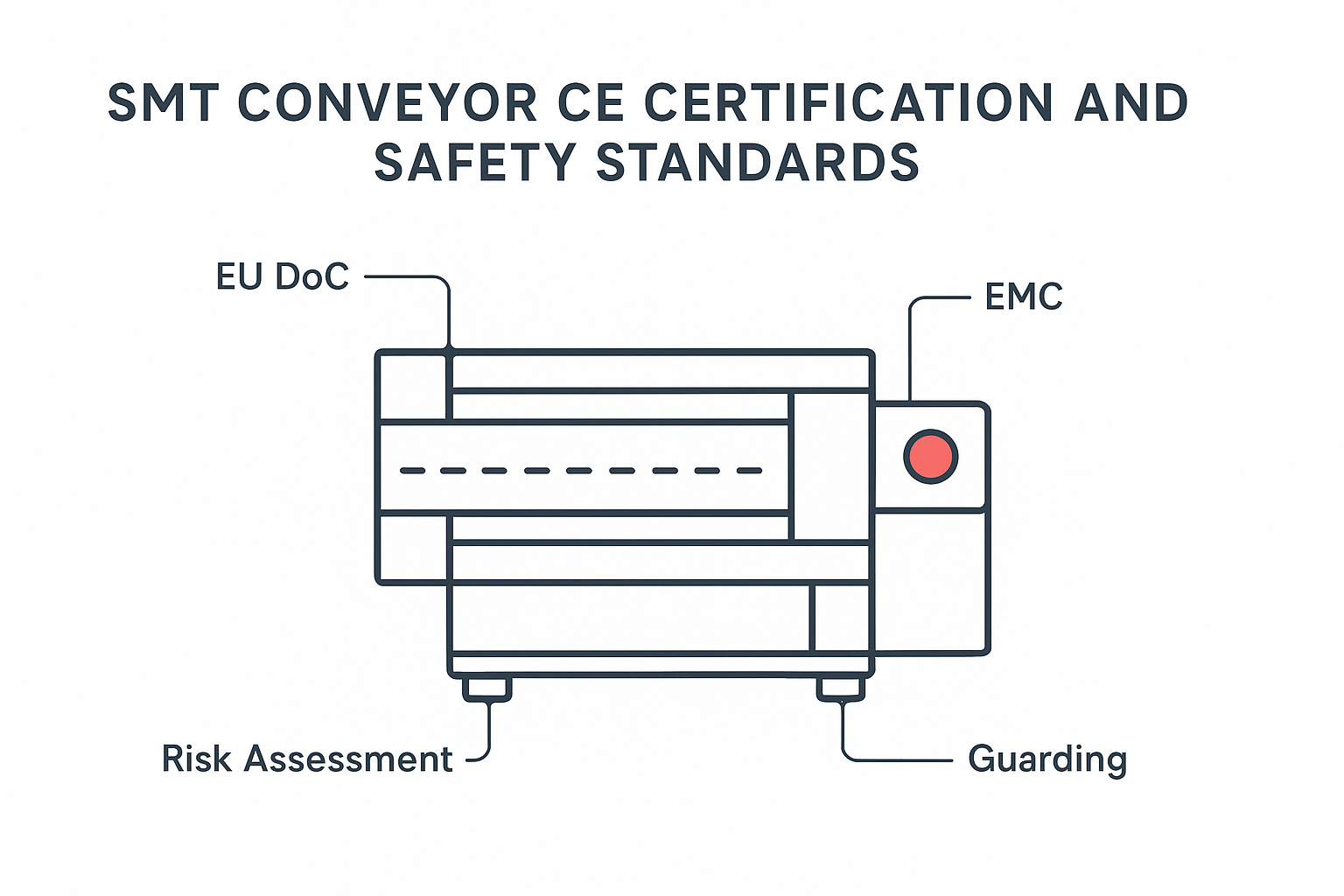
Buying an SMT conveyor looks simple until it hits a compliance review.
If your line is shipping into (or operating inside) Europe, “CE” isn’t a badge you accept on faith. It’s a legal claim backed by documents, test evidence, and safety engineering choices.
This guide gives overseas buyers a practical framework to confirm whether a conveyor is actually ready for EU deployment—before you sign the PO.
Key takeaways
について EU Declaration of Conformity (EU DoC) is the core document—CE marking without a credible DoC and supporting evidence is a risk.
Ask for technical documentation that proves safety work was done (risk assessment, manuals, electrical documentation).
Confirm which EU requirements are relevant for your conveyor configuration—commonly machinery safety, EMC, electrical safety (voltage range dependent), and (for EEE components) RoHS.
Your fastest filter is a buyer checklist: what to request, what to verify, and what counts as a red flag.
SMT conveyor CE certification: the pre-order confirmation checklist
This section summarizes the minimum checks you should run before you approve the order.
Quick pre-order checklist (10 yes/no checks)
EU DoC provided for the exact model/configuration you’re buying (not a generic template).
EU DoC is signed by an accountable person and lists the applicable EU legislation.
Supplier can share a risk assessment summary (hazards → controls → residual risks).
Guarding/interlocks are defined for pinch points and access areas (especially gates/lifts).
Operating & maintenance manual is available before shipment and in the required destination language(s).
Electrical pack is available: schematics, wiring/terminal map, I/O list, interfaces (e.g., SMEMA).
Supplier can explain EMC evidence covering both emissions そして immunity.
Voltage ratings are confirmed and it’s clear whether the build falls under LVD scope.
RoHS/material declarations are available (or a clear scope rationale is provided).
A FAT/SAT plan exists with acceptance criteria, commissioning checklist, and critical spares list.
The rest of the guide explains why each item matters and what evidence to request.
1) Start with the buyer’s mindset: CE is a declaration, not a “certificate”
A useful way to frame CE during procurement:
CE marking is tied to the manufacturer’s responsibility to ensure conformity and complete the required conformity assessment steps.
The manufacturer should be able to present an EU Declaration of Conformity and maintain technical documentation that enables conformity assessment.
The European Commission’s overview of manufacturer responsibilities for CE marking is a good baseline for what “responsibility” actually means in practice.
主な収穫: If a supplier cannot provide a credible EU DoC plus supporting technical documentation, treat the CE claim as unverified.
2) Confirm which EU legislation your conveyor will be placed under
Most industrial SMT conveyors and transfer modules fall under machinery safety requirements. The regulatory framework is also in transition:
The EU’s machinery rules are currently governed by the Machinery Directive 2006/42/EC.
について Machinery Regulation (EU) 2023/1230 will apply on a mandatory basis from 20 January 2027.
Because EU requirements and harmonized standards can change (and interpretation can vary by configuration and destination market), treat this article as a procurement guide—not legal advice—and align the final applicability list with your compliance/EHS team before shipment.
The European Commission’s machinery page summarizes the Machinery Directive and Machinery Regulation timeline.
Commonly relevant “supporting” directives
Depending on your exact build (power ratings, control cabinet, connected devices), buyers commonly need to confirm:
EMC requirements (emissions + immunity)
Electrical safety requirements (voltage range dependent)
RoHS substance restrictions (for electrical/electronic equipment within scope)
For example:
The Commission explains that the EMC Directive 2014/30/EU aims to limit electromagnetic emissions and ensure equipment has adequate immunity to electromagnetic disturbance.
The Commission’s Low Voltage Directive (LVD) overview states the directive covers electrical equipment designed for use within 50–1000 V AC そして 75–1500 V DC.
The Commission describes the RoHS Directive as restricting hazardous substances in electrical and electronic equipment (EEE) to protect health and the environment.
⚠️ Warning: Don’t let a vendor “bundle” directives casually. Your conveyor configuration (power supply, cabinet design, add-on modules) drives what’s relevant. When in doubt, align engineering + EHS + compliance early.
3) The documents you should request (minimum viable compliance pack)
Your goal is to collect enough evidence to believe the CE claim is backed by real engineering work.
3.1 EU Declaration of Conformity (EU DoC)
Request the EU DoC and check that it is:
Specific to the equipment (model, type, identifiers)
Signed by a responsible person (not just a stamp)
Listing the applicable EU legislation and (where relevant) harmonized standards
A buyer-friendly summary of how the declaration connects to supporting evidence is explained in Pilz’s overview of the EU declaration of conformity and supporting documentation.
3.2 Risk assessment and risk-reduction evidence
In practice, you’re looking for proof the supplier has systematically identified hazards and implemented controls.
Even if the supplier doesn’t hand you their full technical file, ask for an extractable summary:
Hazard list (pinch points, entanglement, electrical shock, unexpected start)
Risk reduction measures implemented (guarding, interlocks, safe stop)
Residual risk notes and operator warnings
For context, ISO’s description of risk assessment standards is often anchored in ISO 12100 principles. ISO/TR 22100-1 explains how the foundational approach of ISO 12100 risk assessment and risk reduction is used with other machinery standards.
3.3 Operating instructions and maintenance documentation
What you want:
Installation instructions (including leveling, anchoring, grounding)
Operating instructions with intended use / reasonably foreseeable misuse
Maintenance schedule and required competencies
Spare parts list with recommended critical spares
If the supplier can’t give you a usable manual before shipment, you should assume training, ramp-up, and audit readiness will suffer.
3.4 Electrical documentation for integration and troubleshooting
SMT buyers routinely underestimate how much downtime comes from “small” integration mismatches.
Ask for:
Electrical schematics
Wiring diagrams / terminal maps
I/O list (signals, voltage levels)
Communication interface description (e.g., SMEMA integration points)
For example, some conveyor designs highlight PLC control and SMEMA communication; a typical product spec like Chuxin SMT’s リジェクトコンベア lists PLC control with SMEMA and includes multiple electrical distribution circuit protections—details that matter for integration planning.
4) Safety verification checklist (what to confirm before ordering)
Use this checklist as a procurement gate. Each item is binary.
A) CE evidence and traceability
Supplier provides an EU DoC specific to the exact model/configuration you’re buying.
The EU DoC lists applicable legislation and is signed by an accountable representative.
Nameplate/labeling is consistent with the DoC identifiers (model/type/serial logic).
Documentation is provided in the required language(s) for the destination market.
B) Risk assessment and guarding
Vendor can provide a risk assessment summary (hazards → controls → residual risks).
Guarding exists where pinch points are present (transfer points, belts, chains, lift gates).
Interlocks are used where access during operation creates risk.
Emergency stop locations are practical for real operators (not “engineering-only” placement).
If you’re buying gate or lift modules, ask how the safety behavior is handled during pass-through and maintenance. Even a product overview like the Normally Closed Telescopic Gate Conveyor emphasizes protection detection and controlled motion modes—buyers should confirm what interlocks and detection logic are actually implemented.
C) Control system safety (when safety functions are implemented in controls)
Vendor clarifies which functions are safety-related (E-stop, guard interlocks, safe stop).
Vendor can explain the design basis for safety-related parts of the control system.
ISO’s abstract for ISO 13849-1 safety-related control systems describes how the standard provides guidance for the design and integration of safety-related parts of control systems (and performance level concepts) across machinery. Buyers don’t need to be functional-safety experts, but they should be able to ask the right questions.
D) EMC and electrical safety
Vendor confirms EMC evidence exists for the conveyor’s electrical/electronic equipment.
Vendor confirms immunity considerations (not just emissions) for the intended factory environment.
Vendor clarifies whether the build falls within the LVD voltage range.
For reference, the European Commission’s EMC page explains the EMC Directive 2014/30/EU covers emissions and immunity, and its LVD page states the LVD voltage range (50–1000 V AC, 75–1500 V DC).
E) Materials/environmental compliance (scope-dependent)
Vendor confirms RoHS applicability (or provides a clear rationale if excluded).
Vendor can provide material declarations for relevant electrical/electronic parts.
The European Commission’s RoHS page explains that the directive restricts hazardous substances in EEE.
F) Integration and reliability (what prevents hidden cost)
Compliance isn’t your only risk. Unplanned downtime is the fastest way a conveyor becomes “expensive.”
SMEMA handshake behavior is documented and tested with your line’s upstream/downstream equipment.
Conveyor speed range, acceleration behavior, and stop-gate behavior are specified.
Changeover method (rail width adjustment, support strategy) is documented.
Vendor provides a commissioning checklist and acceptance test plan (FAT/SAT).
If you need a deeper evaluation framework for conveyor reliability, use these internal guides:
Buyer’s evaluation guide for jam-resistant PCB conveyors (how to translate “no jamming” into measurable requirements)
PCB conveyor width adjustment best practices (repeatable rail setup without warpage)
5) Red flags that should pause the order
Treat these as escalation triggers:
“We have CE” but no EU DoC, no directive list, and no one willing to sign responsibility.
Manuals are “after shipment.”
No risk assessment evidence or refusal to discuss guarding/interlocks.
Vague EMC claims with no explanation of emissions vs immunity.
A DoC that appears generic (no model identifiers, no standards list, no signature).
No wiring diagrams or I/O list—especially if your line has mixed vendors.
6) A practical RFI template you can send to vendors
To make vendor comparisons easier, use this request-and-verify table as a front page to your RFI.
Item | Ask who | What you verify (acceptance criteria) | Red flag |
|---|---|---|---|
EU Declaration of Conformity | Supplier compliance/QA | DoC matches your quoted model/config, lists EU legislation/standards, signed | Generic DoC with no identifiers/signature |
Risk assessment summary | Supplier engineering | Hazards → controls → residual risks are documented and make sense for your line | “We don’t share anything about risk assessment” |
Operating & maintenance manual | Supplier documentation | Manual available pre-shipment, destination language-ready, includes intended use/misuse | “Manual after shipment” |
Electrical pack | Supplier electrical/controls | Schematics, wiring/terminal map, I/O list, interface notes (SMEMA) | No I/O list / unclear interfaces |
Guarding & interlocks | Supplier engineering | Pinch points addressed; interlocks behavior explained for gates/lifts | “It’s safe” with no details |
EMC evidence | Supplier engineering/QA | Emissions + immunity considered; assumptions match your factory environment | “EMC ok” with no explanation |
Voltage & LVD scope | Supplier electrical | Voltage ratings clear; LVD scope confirmed/not applicable with rationale | Vague voltage answers |
RoHS/material declarations | Supplier compliance | RoHS applicability clarified; material declarations provided where relevant | “Not sure” / no declarations |
FAT/SAT & commissioning | Supplier project/service | Acceptance criteria + checklist + responsibilities are defined | No test plan / no acceptance criteria |
Spares & after-sales support | Supplier service | Critical spares list + response expectations + post-warranty plan | No support commitments |
Use these as copy-paste questions (and require document attachments where possible):
Please provide the EU Declaration of Conformity for the exact conveyor model/configuration quoted.
Which EU legislation/directives are declared on the EU DoC for this equipment?
Provide a risk assessment summary: key hazards, implemented risk reduction measures, and residual risks.
Provide operating instructions and maintenance schedule.
Provide electrical schematics, wiring diagrams, and I/O list.
Describe EMC evidence and the intended operating environment assumptions.
Confirm voltage ratings and whether LVD scope applies.
Provide RoHS/material declarations for relevant EEE parts (if applicable).
Provide FAT/SAT acceptance criteria and the commissioning checklist.
Provide after-sales support coverage, response time expectations, and recommended critical spares.
Why trust this guide (and what S&M can provide)
S&M Co.Ltd has been focused on SMT equipment R&D and manufacturing since 2000. With an experienced engineering team and practical integration know-how, we build and support SMT conveyors and transfer modules that are designed for factory deployment—where documentation quality and troubleshooting speed matter as much as mechanical specs.
If you’re evaluating a supplier (or evaluating us), you can request a buyer-ready deliverables pack aligned with this guide, typically including:
EU DoC (model/configuration-specific)
Risk assessment summary (hazards → controls → residual risks)
Operating & maintenance manual (pre-shipment)
Electrical pack (schematics, wiring/terminal map, I/O list, SMEMA points)
FAT/SAT plan, commissioning checklist, and recommended critical spares
This article is for general procurement guidance and does not constitute legal advice. Final applicability of EU legislation/standards should be confirmed by your compliance/EHS team for your exact configuration and destination market.
Next steps
If you want, we can review your vendor’s compliance pack as a pre-check (EU DoC + manuals + electrical documentation + risk assessment summary) and flag gaps before the shipment is locked.
Or, if you’re building a high-mix line and want to reduce downtime risk alongside compliance risk, start with the conveyor reliability checklist in the jam-resistance evaluation guide above and align it with your acceptance tests.