



Published: 07 August 2026
Reading Time: 11 minutes
Reviewer: Simon Scrapes, Founder
Shop for a PCB pick and place machine price today and you will hit a wall pretty fast. Catalog numbers do not match reality. A machine listed at $35,000 can land in your factory at $55,000 once you factor in feeders, software licenses, freight, and the team needed to get it running. That gap between sticker price and production-ready cost trips up most procurement teams, and honestly, it tripped us up too the first few times.
So this article cuts through the noise. We are talking about real pcb pick and place machine price bands for 2026, from desktop units meant for prototyping labs all the way up to high-speed production lines that run tens of thousands of components per hour. We will look at where the budget options actually make sense, what the total cost of ownership really looks like over five years, and how to structure a buy so you do not get surprised three months after signing the purchase order.
The 2026 SMT equipment market is shifting hard. Demand for automation is climbing because lead-free solder profiles need tighter process control, and regional supply chains are pushing more buyers to source equipment outside traditional channels. Whether you are a procurement manager at an electronics manufacturer, a production lead at an EMS facility, or an engineer building out a new SMT line, the fundamentals of how these machines are priced have not changed. But the market context has.
About the Author: Jace Liu brings hands-on experience in SMT equipment procurement and SMT line economics. Working with Shenzhen Chuxin Electronic Equipment, he has guided overseas buyers through equipment selection, vendor negotiation, and production-line scaling for high-mix assembly operations. His background spans project management at major electronics manufacturing facilities and direct involvement in customized SMT production-line solutions.
What buyers mean when they talk about a pick and place machine cost has a lot of layers. Let us break those down.Jace Liu works in SMT equipment procurement at Shenzhen Chuxin Electronic Equipment, helping overseas buyers navigate equipment selection and production-line scaling. His background includes project management at a major electronics manufacturer, giving him firsthand exposure to how pick and place machine cost decisions play out across real production floors. That mix of technical knowledge and procurement experience lets him connect equipment specs with the economics that actually matter when you are budgeting an SMT line.
2026 market snapshot: how PCB pick and place machine prices are segmented
The 2026 SMT equipment market segments into four clear tiers, and knowing where a machine sits tells you most of what you need about its capabilities and limitations.
| Machine Class | Throughput (CPH) | Typical Use Case | 2026 Price Band |
|—————|——————|——————|—————–|
| Desktop / benchtop | 1,000–5,000 | Prototyping, NPI, labs | $4,999–$15,000 |
| Semi-automatic | 5,000–15,000 | Small-batch assembly, pilot lines | $8,000–$35,000 |
| Mid-range automated | 20,000–40,000 | Growing EMS, mixed production | $40,000–$120,000 |
| High-speed production | 40,000–78,000+ | Volume manufacturing | $150,000–$500,000+ |
Desktop units like the Neoden YY1 at $4,999 or Neoden 4 at $12,499 handle smaller assemblies and work well for prototyping and NPI runs where quick turnaround matters more than speed. Accuracy sits around 0.05mm and feeder counts max out around 12 to 20 slots.
Semi-automatic systems fill the gap for small-batch assembly and shops moving away from manual operations. Speeds land between 5,000 and 15,000 CPH, accuracy improves to roughly 0.035mm, and you get more feeder flexibility for complex bills of materials.
Mid-range automated machines, priced between $40,000 and $120,000, serve growing EMS teams and higher-mix production environments. Throughput jumps to 20,000 to 40,000 CPH, feeder counts expand significantly, and software integration becomes more robust.
High-speed production platforms like the Fuji SX4, Mycronic iineo+ V2, and Juki RS-2 start around $50,000 and commonly run $150,000 to $400,000+ when configured for real production lines. These machines hit 40,000 to 78,000+ CPH with accuracy at or below 0.03mm. The jump in price reflects the motion systems, heads, and controls needed to sustain that output hour after hour.
One thing worth noting: quoted base prices often rise 20 to 40 percent once feeders, vision systems, software licenses, freight, and installation get factored in.
What drives pcb pick and place machine price
Base machine price tells you very little about what you will actually pay. When you start comparing quotes, the real cost drivers fall into several categories that multiply the sticker fast.
Hardware specs push the base price up most noticeably. Placement head design matters because rotary heads cost more than linear heads but deliver much higher throughput. Vision systems range from basic LED backlit cameras at the low end to laser profilometry and 3D inspection at the premium tier. Feeder count also drives cost; each additional feeder slot needs its own motor and lane, and that adds up quickly when your BOM has 40 or more unique components.
Board size capability affects pricing too. Machines handling 300mm x 250mm boards typically cost less than those rated for 510mm x 460mm or larger. If your products span multiple board sizes, you need to account for that flexibility premium.
Software licensing catches many buyers off guard. Some vendors bundle software into the machine price, but others list it as a separate line item. SMT line management software, feeder optimization tools, and MES integration modules often run $2,000 to $25,000 depending on complexity. Always ask for the software breakdown before comparing quotes.
Pro Insight: How quoted prices change when you compare placement speed, feeder capacity, vision systems, and software licenses rather than just the base machine list price. A $65,000 base quote can easily hit $85,000+ once you add a proper feeder package, vision system upgrade, first-year software license, and installation support. Always get a line-item quote.
Service and warranty terms affect the true cost as well. Standard warranties usually cover 12 months, but extended coverage with preventive maintenance visits adds $2,000 to $25,000 depending on machine class. Calibration schedules, spare parts availability, and remote diagnostics capabilities all factor into ongoing operating cost.
The biggest gap most buyers miss is the difference between base machine cost and fully-loaded line cost. Installation, foundation work, tooling changeovers, initial spare parts kits, and operator training can add another 10 to 20 percent on top of the purchase price. For a mid-range machine at $80,000, you might realistically budget $95,000 to $105,000 before factoring in feeders or software.
| Cost Driver Category | Typical Impact on Quote |
|———————-|————————|
| Placement head upgrade | +$5,000 to +$30,000 |
| Vision system upgrade | +$3,000 to +$25,000 |
| Additional feeder slots | +$200 to +$800 per slot |
| Software licenses | +$2,000 to +$25,000 |
| Installation and training | +$5,000 to +$20,000 |
| Extended warranty | +$2,000 to +$25,000 |
Budget options under $5000: where they fit and where they do not
Let me be straight with you. If your budget is under $5,000, the machines available are desktop or benchtop units. The Neoden YY1 sits at $4,999 and the Neoden 4 comes in around $12,499. So that strict $5,000 ceiling basically gets you one machine from one vendor. If you stretch to $15,000, you open up a few more options, but the class stays the same.
So what do you actually get at this tier? Throughput runs 1,000 to 5,000 placements per hour. Accuracy hovers around 0.05mm. Feeder counts max out at 12 to 20 slots. Board sizes typically handle 300mm x 250mm or smaller. These specs tell you right away: this is not production equipment.
The sweet spot for under-$5,000 machines is prototyping, lab work, and small-scale NPI runs. If you are building a handful of boards to prove out a design, these units work. They also make sense for academic settings, maker spaces, or any environment where quick turnaround matters more than volume. Some repair shops use them for board-level rework and component recovery.
From Our Experience: Desktop and entry-level machines make real sense for prototyping or NPI work. We have seen teams use them successfully for design validation and low-mix builds. But they usually do not replace a production SMT line. The moment you need volume, repeatability, or complex assemblies, you outgrow the budget tier fast.
Caution Box: Prototype Use vs. Production Use
| Factor | Prototype / NPI | Volume Production |
|——–|—————-|——————-|
| Throughput needed | Under 5,000 CPH acceptable | Typically 15,000+ CPH |
| Feeder complexity | 5-15 unique components | 20-200+ components |
| Repeatability | Low stakes, quick runs | Critical for quality |
| Operator skill | Higher manual intervention OK | Automation required |
| ROI timeline | Weeks to months | Calculated per unit cost |
If your roadmap includes scaling beyond prototypes, buy for where you are going, not just where you are now. A budget machine might solve today’s problem but become a bottleneck in 18 months.
Total cost of ownership: the number procurement should actually price
Here’s what nobody tells you when you are comparing pick and place machine quotes. The purchase price is usually only about 35 to 40 percent of what that machine will actually cost you over five years. The rest sneaks in through shipping, installation, feeders, nozzles, spare parts, training, maintenance, and those 2am service calls when something breaks right before a big run.
We have seen buyers get excited about a $65,000 quote only to discover the fully-loaded cost landed closer to $95,000 once everything was said and done. That gap hurts when you have already locked in your budget.
Expert Tip: The exact vendor questions and sample-run tests procurement teams should use to compare quotes on the same basis. Ask for a five-year total cost breakdown, not just the purchase price. Request that feeders, nozzles, software licenses, installation, training, first-year service, and import duties each appear as separate line items. Then ask for the same breakdown from every competing vendor so you can compare apples to apples.
A realistic TCO worksheet for a mid-range pick and place running about $80,000 purchase price looks like this:
| Cost Category | Estimate (% of Purchase) | Typical Range |
|————–|————————-|—————|
| Purchase price | 100% | $80,000 |
| Feeders and nozzles | 10-15% | $8,000-$12,000 |
| Installation and training | 5-15% | $4,000-$12,000 |
| First-year spare parts | 3-5% | $2,400-$4,000 |
| Annual maintenance/service | 3-5% per year | $2,400-$4,000/year |
| Freight and duties | 2-8% | $1,600-$6,400 |
| 5-year estimated TCO | ~250-350% | $200,000-$280,000 |
Now let us apply this to a real scenario. Say you run a high-volume manufacturer placing 5 million components per month. A $120,000 machine with a 3.5x TCO multiplier over five years costs roughly $420,000 all in. That works out to about $0.028 per placement. Manual placement or outsourcing typically runs $0.08 to $0.12 per component. At those rates, your automation pays for itself in around 14 months.
But what if your production is high-mix, low-volume? The math changes fast. Changeover time, feeder reloading, and recipe management eat into automation benefits. In those cases, a lower purchase price might actually make more sense until your volume scales up.
The bottom line: always ask vendors for the five-year TCO estimate before you sign anything. If they cannot or will not provide it, that tells you something too.
2026 cost trends and regional pricing signals
The pick and place machine cost you see in a catalog is not the number that matters most. Landed cost, once freight, duties, and currency conversions get factored in, tells a different story depending on where you are buying from.
India operates as a distinct procurement context. Domestic listings on IndiaMART show entry-level systems around ₹1.8 lakh to ₹9.5 lakh, with higher-speed machines climbing to ₹25 lakh to ₹50 lakh or beyond. Import duties on SMT equipment typically run 7.5 to 18 percent depending on classification, and the Indian rupee exchange rate against the US dollar directly shifts what Chinese equipment costs on the ground. Buyers sourcing from Shenzhen or other Chinese hubs need to calculate the landed figure, not just the ex-works price, before comparing against domestic options.
China functions as both origin point and regional market. Made-in-China listings show smaller-to-mid systems from roughly US$2,300 to US$80,000, with high-end equipment reaching US$50,000 to US$550,000. For overseas buyers in North America or Europe, the quoted price is only the start. Shipping a mid-range pick and place machine from Shenzhen to Los Angeles or Rotterdam adds $3,000 to $12,000 depending on dimensions and urgency. Import duties and port fees then layer on top.
North America serves as the benchmark pricing tier. Desktop systems land around US$4,500 to US$13,500, mid-range automation typically sits at US$29,000 to US$80,000, and high-speed production lines run US$150,000 to US$400,000 or more when fully configured. Domestic buyers pay more upfront but avoid international logistics complexity and longer service response times.
について used and refurbished market softens price points across all three regions. Refurbished desktop units go for roughly $3,800 to $10,000, mid-range systems in the $15,000 to $60,000 range, and production-grade refurbished machines from $60,000 to $180,000. For buyers who need real SMT capability without full new-machine pricing, the used market remains an active channel in 2026.
Bottom line: regional context reshapes what you actually pay, so always calculate landed cost before making comparisons.
How to buy the right machine without overpaying
Buying a pick and place machine without a clear process is how procurement teams end up with the wrong equipment or prices that balloon after the PO goes out. Here is a practical checklist that works.
First, lock in your requirements before you talk to any vendor. Write down your minimum throughput, the range of board sizes you need to handle, your most complex component package, and where you expect to be in three years. That last part matters because a machine that fits your needs today might bottleneck your growth in 18 months. Get these numbers on paper and share them with every vendor you contact.
Second, demand apples-to-apples quotes. Ask every vendor to break their pricing into the same categories: base machine, feeder package, vision system, software licenses, installation, training, first-year service, and freight. If one vendor quotes $65,000 all-in and another quotes $50,000 without mentioning feeders and software, you cannot compare them fairly.
Third, run a sample placement test before signing anything. Send your actual board files and BOM to each finalist. Ask them to run a pilot and report real throughput and accuracy on your components, not their standard test board. The difference between brochure specs and your actual product can be 20 to 30 percent.
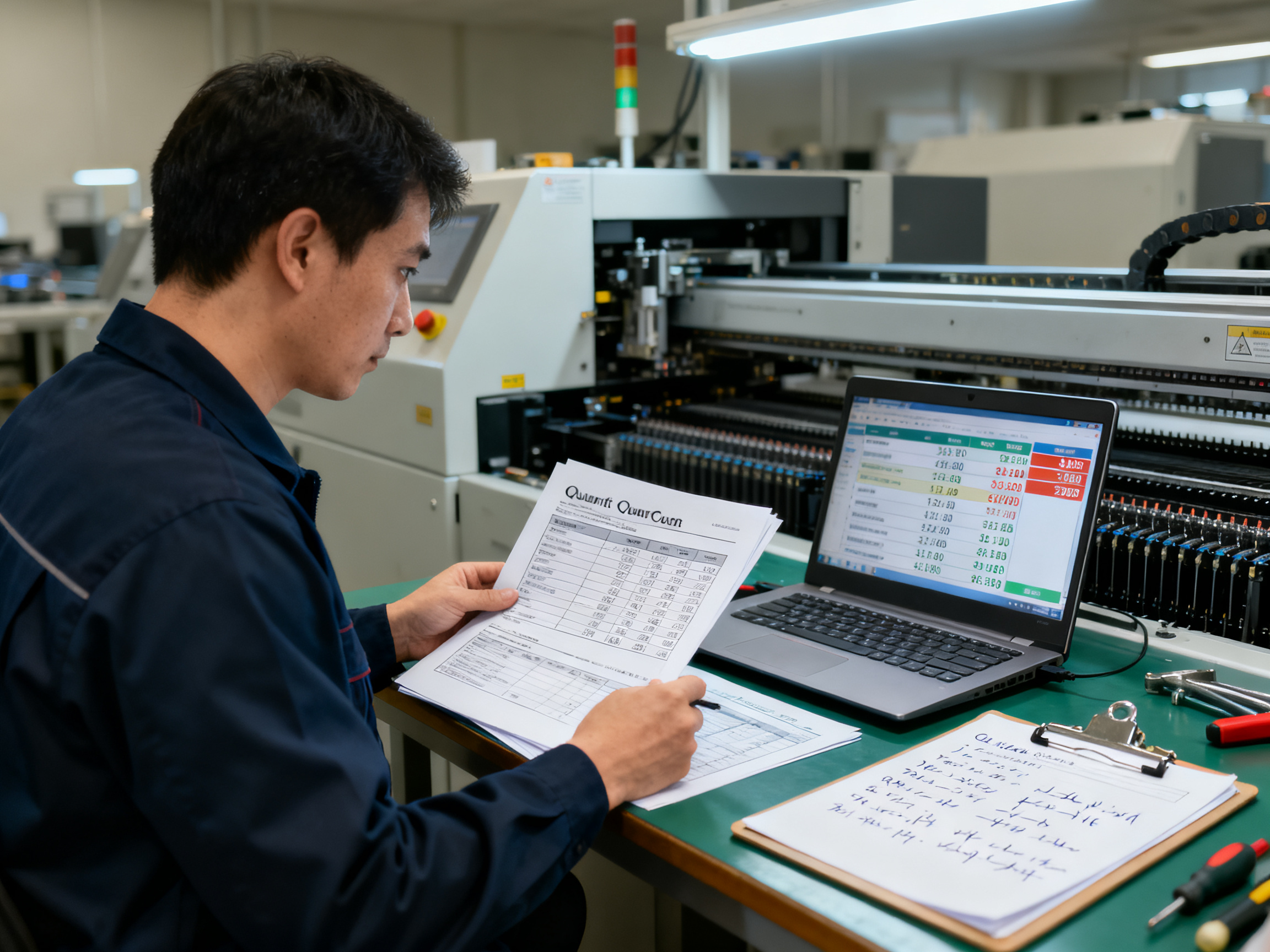
Expert Tip: Ask for a five-year total cost breakdown, not just the purchase price. Request that feeders, nozzles, software licenses, installation, training, first-year service, and import duties each appear as separate line items. Then ask for the same breakdown from every competing vendor so you can compare apples to apples.
Finally, negotiate the soft stuff. Support response time, spare parts availability, and remote diagnostics matter just as much as the price. A machine that costs $5,000 less but takes three weeks to get service when it breaks is not a savings.
Vendor Scorecard for Pick and Place Machine RFQ
| Criteria | Weight | Vendor A | Vendor B | Vendor C |
|———-|——–|———|———|———-|
| Base machine price | 20% | | | |
| Feeder package cost | 10% | | | |
| Software included | 10% | | | |
| Installation and training | 10% | | | |
| Real CPH on your boards | 15% | | | |
| Accuracy on your packages | 10% | | | |
| Service response time | 10% | | | |
| Warranty terms | 5% | | | |
| Spare parts lead time | 10% | | | |
| Total Score | 100% | | | |
Conclusion: the right 2026 buying lens for PCB pick and place machine price
PCB pick and place machine price should never be the only number on your evaluation form. The real decision pivots on what you get for that cost: sustained throughput on your actual product mix, placement accuracy that matches your component packages, and a total ownership figure that does not blindside your finance team 18 months later.
Best-fit tiers at a glance:
| Production Stage | Recommended Tier | Why It Works |
|——————|——————|————-|
| Prototyping / NPI | Desktop ($5K–$15K) | Quick turnaround, low volume, fast changeover |
| Small-batch / pilot | Semi-automatic ($8K–$35K) | More feeder flexibility, better accuracy |
| Growing EMS / mixed | Mid-range automated ($40K–$120K) | Higher CPH, software integration, scalability |
| Volume production | High-speed ($150K–$500K+) | Sustained throughput, line balance, uptime |
Next steps to move from research to shortlist:
- Write down your minimum throughput, board size range, and component complexity
- Request line-item quotes from at least three vendors
- Ask for a five-year TCO estimate from each one
- Send your actual BOM to finalists and request a sample placement run
- Score vendors using the criteria in the table above
Jace Liu works in SMT equipment procurement at Shenzhen Chuxin Electronic Equipment, where he helps overseas buyers translate spec sheets into production-line decisions. His experience with high-mix assembly operations has shown him one thing: the buyers who do the math before the PO goes out are the ones who do not regret it after.