



Opublikowano: 21 June 2026
Czas czytania: 10 minutes
Recenzent: Placeholder, Manufacturing Automation Specialist
You know that moment when a production line slows down for something that seems tiny? A tray jams, a board shifts, a part arrives late. Then the whole day feels off. That’s why conveyor belts matter so much in 2026. They don’t just move stuff from one spot to another. They help factories keep pace, cut hand-carrying, and make work smoother across busy lines.
If you’re comparing types of conveyor belt options, the real question is simple: which setup fits your process without causing new problems? Some belts are built for boxes. Some handle heat. Some help delicate electronic parts move through SMT production lines with better control. And some are all about layout, speed, or clean handling. The best choice depends on your product, floor space, load type, and how much accuracy your team needs every day.
Jace Liu is a manufacturing technology expert specializing in Surface Mount Technology (SMT) systems and industrial automation. With over a decade of experience in developing precision soldering solutions, Jace has helped several major manufacturers optimize production lines and reduce defects.
Why conveyor belts still matter in 2026
Industrial conveyor belts are a core part of factory automation. At the most basic level, they are moving belts inside conveyor belt systems that carry parts, packs, raw materials, or finished goods between steps. But that simple idea does a lot of heavy lifting. In manufacturing plants, warehouses, farms, and mining sites, these systems keep work flowing, lower physical strain on staff, and reduce stop-start delays that eat up output.
A good belt setup can also make quality easier to manage. That’s a big deal in electronics, where timing and position matter. In SMT lines, for example, boards often move between loaders, printers, pick-and-place machines, reflow ovens, and inspection stations. If that movement is shaky or uneven, defects can pile up fast. We see this a lot with high-density assemblies, especially when teams are trying to keep throughput high and scrap low.
One widely cited overview of conveyor use explains how belt conveyor systems support steady movement across assembly, sorting, and packaging work, while also cutting manual handling in industrial settings in this conveyor belt guide.
Where different conveyor belt systems fit best
Not all types of conveyor belt systems do the same job. Flat belts are common for general product movement. Modular plastic belts help in lines that need easy cleaning or quick part swaps. Cleated belts hold goods in place on inclines. Wire mesh belts deal better with heat and airflow. Vacuum conveyor belts can grip delicate items that should not slide around. Funny enough, what looks like a small design choice often changes the whole line.
Here are a few industries where industrial conveyor belts show up every day:
| Industry | Common conveyor need | Why it matters |
| — | — | — |
| Electronics and SMT | Precise board handling | Helps reduce part shift and solder defects |
| Warehousing | Box transfer and sorting | Speeds up picking, packing, and dispatch |
| Food processing | Washdown-friendly movement | Supports cleaner handling |
| Mining and aggregates | Heavy bulk transport | Moves large volumes over long distances |
| Automotive | Part flow between stations | Keeps assembly timing steady |
In electronics, the best conveyor belt for specific industries often means a belt that supports accuracy first, not just speed. That’s where companies like S&M Co. Ltd., also known as Shenzhen Chuxin Electronic Equipment Co., Ltd., fit naturally into the picture. Their SMT equipment, including lead-free reflow ovens, wave soldering machines, and full SMT production lines, depend on reliable transfer between stations. If you’re reviewing belt conveyor systems for sale for a lead-free line upgrade, it’s smart to think about conveyor performance as part of the whole soldering process, not as a side detail.
A quick look at what this guide covers
This buying guide walks through 10 common types of conveyor belt choices used across modern plants. We’ll look at what each one does well, where it tends to struggle, and which industries usually get the most value from it. We will also keep an eye on layout limits, part sensitivity, incline needs, and line compatibility.
Look, I get it. Conveyor choices can blur together at first. Rubber, PVC, cleats, curves, vacuum hold-down, it starts sounding like a parts catalog from 1997. But once you line each option up against your actual process, things get much easier. And if you’re running SMT or soldering operations, that clarity can save real money in downtime, rework, and missed output.
If you want a simple next step, keep reading with one question in mind: what manual process or transfer weak spot is eating your time right now? That answer usually points you toward the right conveyor belt systems choice.
1. Flat Conveyor Belts: Versatile and Common
If you’ve seen a conveyor in a factory, there’s a good chance it was a flat belt. This is one of the most common types of conveyor belt systems for a reason. It gives products a stable, level surface, which helps items move from point A to point B without tipping, slipping, or bunching up.
Flat conveyor belts are used all over the place, especially in automotive plants, food processing, warehousing, and electronics assembly. They work well for cartons, trays, sealed packs, and small manufactured parts. And because the surface is simple, teams can often fine-tune belt width, speed, frame length, and load rating without turning the whole project into a headache.
In SMT production lines, flat belts are often the quiet hero. I’ve seen lines where one uneven transfer caused board drift before placement, and that tiny shift turned into hours of inspection trouble later. A flat, well-set transfer path usually gives operators better consistency, especially when lead-free compliant conveyor belts need to move assemblies cleanly between printers, mounters, and soldering equipment.
Porada eksperta: To help flat conveyor belts last longer in SMT lines, keep belt tension checked on a routine schedule, clean flux dust before it builds up, and watch tracking after any speed change. Small upkeep habits often save big repair bills.
Another reason buyers like flat belts is flexibility. You can match them to light-duty packaging jobs or heavier industrial conveyor belts used on busy production floors. Speed control matters too. In electronics, slower and steadier often beats faster and messy. But in food packing or automotive subassembly, a faster flat belt may be exactly what keeps output on target.
So, if you’re comparing belt conveyor systems for sale and want a starting point, flat conveyor belts are usually it. They are simple, proven, and easy to fit into existing factory automation plans. Not flashy. Just useful.
2. Modular Plastic Conveyor Belts: Easy to Repair and Adapt
Modular plastic belts are built from interlocking pieces, kind of like a snap-together path for parts and packs. That design is the big reason many teams pick them. If one section gets damaged, you usually replace that section instead of the whole belt. Less waste. Less downtime. Pretty nice.
This style works well in high-volume lines that need steady movement and simple maintenance. Warehouses use them for totes and cartons. Food plants like them because cleaning is easier. And factories choose them when product sizes change often, because these types of conveyor belt systems can be customized with side guards, different widths, drainage gaps, or grip surfaces.
For heavier loads, modular belts often feel more stable than lighter flat-belt setups. That’s helpful when a line handles packed goods, trays of components, or repeat loads all day long. And if your production floor has turns, transfers, or odd spacing, modular systems give engineers more room to build around real layout problems instead of pretending the floor is perfectly neat. We both know it never is.
In SMT-adjacent operations, modular plastic belts are not always the first choice for direct PCB transfer, but they can make sense around packing, subassembly, or support zones near the main line. If your team is adding automation around a reflow oven or wave soldering cell from S&M Co. Ltd., a modular conveyor can help move trays, carriers, or boxed units without adding a lot of maintenance burden.
3. Cleated Conveyor Belts: Managing Incline and Materials
Now let’s jump into something that fixes one of those sneaky line troubles—stuff rolling where it’s not supposed to. Cleated conveyor belts are built with little raised sections called, naturally, cleats. These stick up at regular spots and keep whatever you’re moving from slipping back, especially on steep parts of your line.
These belts pop up a lot in packaging, recycling, and factory setups where the work needs a lift—literally. They’re a handy fit for electronics too. Not always for the boards themselves, but for moving parts, reels, support trays, or even bulk material between assembly zones. Whenever incline is part of your layout, cleated conveyor belts cut down on lost time picking spilled parts off the floor (and save you some sarcastic comments from the night shift).
Here’s the other thing: cleats come in different shapes and sizes. The best type for your line depends on product size, shape, and how much you need to climb. Smaller cleats spaced close together are great for little pieces. Big, sturdy cleats with more room in between handle heavy cartons or bigger bulk items. It’s not a “one style fits all” deal.
4. Roller Bed Conveyor Belts: Better for Long Runs and Heavier Loads
A roller bed conveyor belt uses rollers under the belt to reduce friction. Simple idea, big payoff. Because the belt glides over rollers instead of a flat surface, it can move heavier items more easily, especially over long distances.
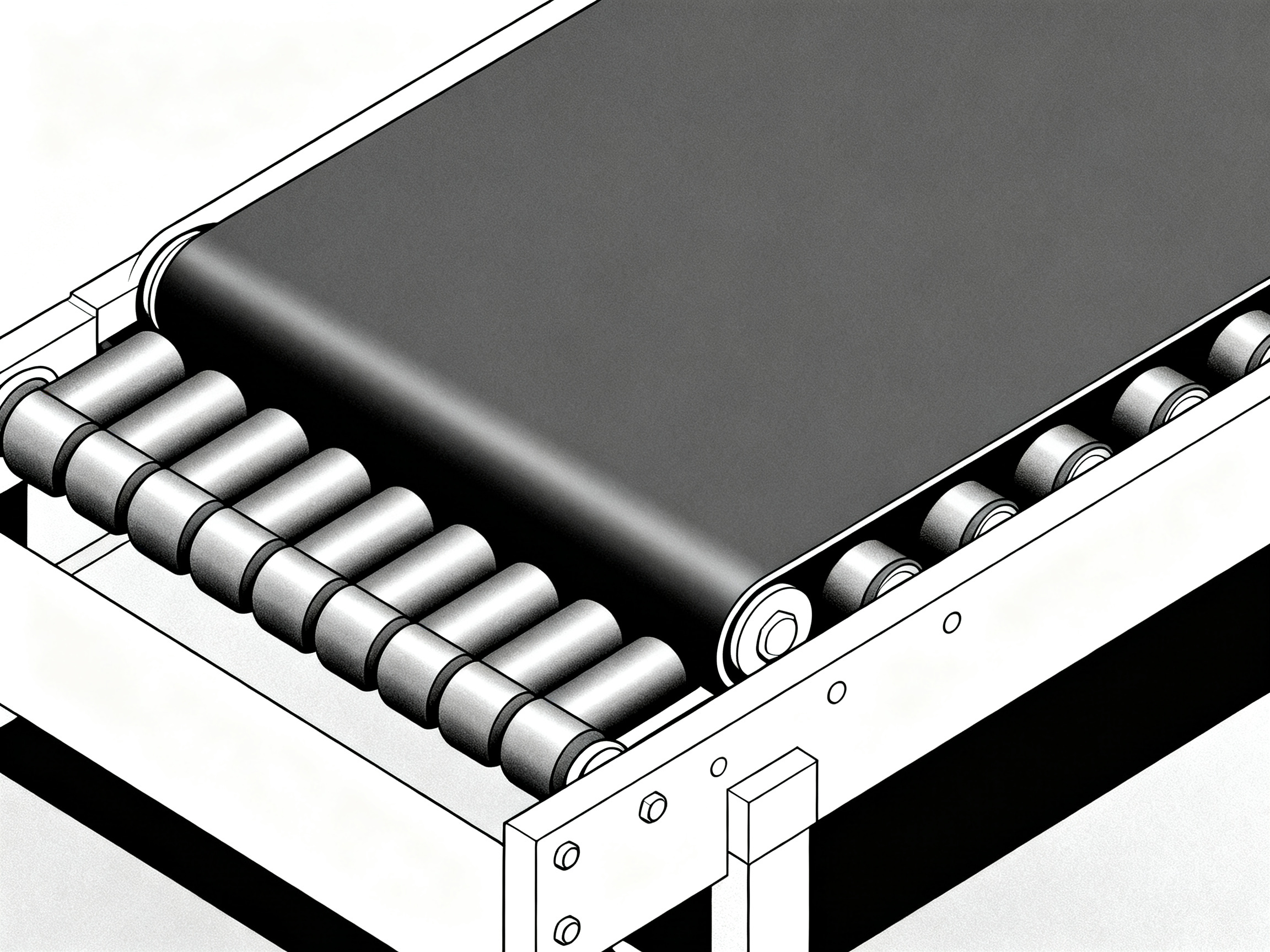
This makes roller bed systems a solid fit for distribution centers, shipping zones, and manufacturing plants moving boxes, totes, or larger components. If your line covers a longer footprint, or your products have enough weight to drag on a standard bed, this setup can cut strain on the motor and help the belt last longer.
By tailoring conveyor belt systems to the needs of your products and factory layout, you can dramatically improve efficiency and reduce bottlenecks across the floor. Whether you’re working with flat belts, modular plastic systems, or any of the specialized designs mentioned here, the options are endless. Invest in the right tools today to future-proof your production line and optimize performance for years to come.