



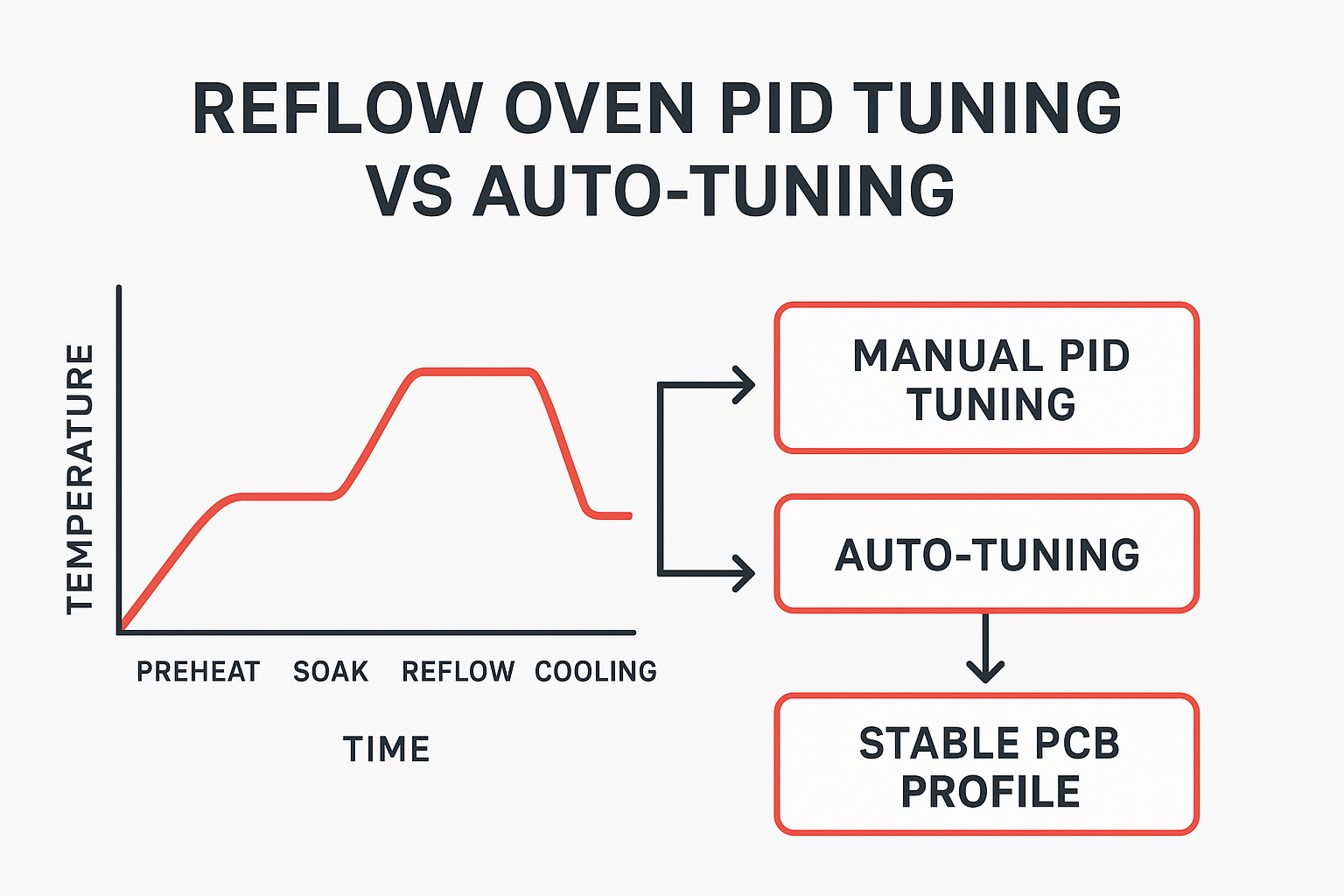
Thermal stability in reflow isn’t just “the zones hold their setpoints.” What your line really cares about is thermal stability in a reflow oven: whether the PCB temperature profile stays inside the process window across shift-to-shift, board-to-boardoraz changeover-to-changeover runs.
This is where the PID-tuning vs auto-tuning debate often gets misframed. Both methods can produce a profile that looks fine on day one. The question is which approach holds up when reality shows up: different thermal masses, different loading, belt speed tweaks, fan wear, and an audit trail that needs to explain why your profile is controlled.
First, define reflow oven temperature profile repeatability
In practice, you’ll see three layers of “stability” that can drift independently:
Zone air temperature stability (what the oven controller regulates)
PCB profile stability (what the assembly experiences)
Process output stability (FPY, solder joint appearance, defect modes)
IPC’s profiling guidance emphasizes that you profile the populated assembly and that each product can require a unique profile because thermal mass and component sensitivity vary. It also frames profiling as a balancing act: reaching the necessary soldering temperatures long enough for metallurgical bonding without overheating sensitive parts.
For high-mix lines, this definition matters because it prevents a common trap:
Key Takeaway: A perfectly “stable” zone setpoint can still produce an unstable PCB profile if airflow, sensor placement, load, and belt speed discipline aren’t controlled.
What manual PID tuning actually controls (and what it can’t)
What it controls well
Manual PID tuning (done correctly) is a way to set how aggressively each zone reacts to error:
P (proportional): how hard you push when the zone is off target
I (integral): how you eliminate steady-state offset
D (derivative): how you damp rapid change and reduce overshoot
In general furnace/oven control literature, PI/PID control is widely used because it can reduce steady-state error and improve settling behavior compared with on-off or P-only control (while avoiding the continuous oscillation behavior of on-off). A summary of tuning methods and performance metrics (overshoot, settling time, steady-state error) is discussed in PID tuning techniques for furnace temperature control.
Dla multi-zone reflow oven temperature control, manual tuning tends to be strongest when:
You need predictable behavior under known operating conditions
You want to reduce overshoot during step changes (start-up, recipe transitions)
You’re building standard work for a stable product family
What it cannot control by itself
Manual tuning cannot fix the most common causes of profile drift in production:
The sensor isn’t measuring what matters (zone sensor vs board temperature)
Airflow balance changes (fan wear, filters, ducting, leakage)
Load changes (board thickness, copper planes, pallet/fixture use)
Belt speed variation (or undocumented changes during changeovers)
Maintenance state drift (heater aging, SSR performance, fan RPM drift)
If your “stability” target is the PCB profile, the controller’s job is necessary but not sufficient.
What auto-tuning is (and why it can look better than it is)
Auto-tuning usually means the controller runs a test to identify process dynamics, then computes PID values. In practice, people often search for this as reflow oven auto tuning PID—but the key is understanding what the autotune test actually identified.
A common family of approaches is relay feedback autotuning: the controller introduces a controlled switching behavior that forces the process to oscillate, then measures the oscillation amplitude and period to estimate parameters (often expressed as ultimate gain and ultimate period) and derive PID gains using known relationships.
For a plain-language explanation of this mechanism (including oscillation amplitude/period and the Ku/Pu concept), see relay feedback PID autotuning.
Where auto-tuning can help
Auto-tuning can be useful when:
You’re commissioning a new oven or a major repair and need a safe baseline
Your team doesn’t have consistent tuning expertise and you need repeatable starting points
You need to recover quickly after a controller replacement
Where auto-tuning can hurt stability
Auto-tuning becomes risky when it’s treated as “set-and-forget.” The tuning test is run under a specific condition. If your production conditions differ, the derived parameters can be wrong.
In reflow, those condition changes are frequent—especially in high-mix:
board thermal mass changes
belt speed changes
recipe transitions are common
airflow and maintenance state evolve
⚠️ Warning: If auto-tuning is run on a lightly loaded or “easy” setup, it can produce aggressive gains that overshoot or oscillate when a high-thermal-mass board family is introduced.
Reflow oven PID tuning vs auto-tuning: which gives better thermal stability?
Here’s the practical answer for multi-zone forced convection reflow in standard air:
If your definition of stability is “zone temperature holds setpoint,” either method can look good.
If your definition of stability is “PCB profile repeatability across changeovers,” the winner is usually the method that enforces process discipline (profiling, documentation, maintenance, and change control)—with tuning as a supporting tool.
Comparison (what matters on the line)
Dimension | Manual PID tuning | Auto-tuning |
|---|---|---|
Day-1 results | Strong if tuned by an experienced engineer | Often fast to a reasonable baseline |
Repeatability across high-mix changeovers | Strong when paired with documented recipe rules and re-profiling triggers | Can drift if the autotune conditions don’t match production |
Overshoot risk | Engineer can tune conservatively for fragile products | Higher if auto-tune yields aggressive gains |
Troubleshooting clarity | High (you know what changed and why) | Medium (harder to justify in audits without records) |
Training burden | Higher (requires tuning competence) | Lower for baseline, but still needs validation |
Audit readiness (IATF mindset) | Strong if you log parameter revisions and acceptance checks | Strong only if you treat auto-tune as a controlled change with validation |
What improves thermal stability more than either tuning method
If you want fewer profile surprises, focus on these controls first.
1) Stabilize what you control: belt speed, load, and setup rules
High-mix problems often come from “minor” adjustments that aren’t treated as process changes.
Minimum rules that reduce drift:
define a belt speed band per product family
define allowed fixture/pallet usage (or require re-profiling)
define when conveyor width/rail changes trigger a profile check
2) Treat profiling as the source of truth (PCB temperature, not controller setpoints)
IPC profiling guidance frames the soldering outcome around the assembly’s temperature history (and the need to balance minimum soldering temperature vs component limits). Use that mindset to structure your control plan and translate it into your shop-floor standard work.
3) Maintain airflow and heating hardware like they are measurement instruments
In forced convection ovens, airflow is part of the process. If it changes, your “same setpoint” does not mean the same heat transfer.
Practical maintenance items that correlate with stability:
fan performance checks (RPM/condition)
filter and duct inspection
heater/SSR health checks
verify alarms for temperature deviation and speed deviation are enabled and acted on
4) Use tuning to remove instability—not to compensate for an unstable process
A tuning method can’t compensate for a drifting system indefinitely. If you see repeated retuning, it’s often a signal to fix:
thermocouple placement or calibration
airflow imbalance
mechanical wear (belt/chain behavior)
recipe discipline
An audit-ready way to choose (simple decision logic)
For automotive lines, the “best” choice is usually the one you can control, explain, and reproduce.
Choose manual PID tuning when
you have an experienced process engineer who can tune conservatively
the product family is sensitive (low margin for overshoot)
you want clear, documented rationale for parameter revisions
Use auto-tuning as a controlled baseline when
commissioning after installation or major maintenance
recovering a line quickly after controller/hardware replacement
you have a validation step that checks PCB profile repeatability before release
A neutral example: what to look for in an oven platform
Regardless of your tuning method, look for controller and documentation features that support stability:
closed-loop control and alarms for deviations
parameter storage with timestamps / alarm logs
optional real-time monitoring
For example, S&M Co.Ltd (Chuxin SMT) describes its VS series hot air reflow ovens as using Siemens PLC + PID closed-loop control and lists ±1°C temperature accuracy (with profile-repeatability framing on the product page). See the S&M Co.Ltd VS-1003 lead-free hot air reflow oven for the exact configuration and options.
Kluczowe wnioski
“Thermal stability” for reflow should be defined as PCB profile repeatability, not just stable zone setpoints.
Manual PID tuning can be more predictable and easier to justify in audits, but it depends on engineer skill and documented change control.
Auto-tuning can be a fast way to reach a baseline, but it must be treated as a controlled process change with validation—especially for high-mix.
In production, stability is usually won by profiling discipline + airflow/maintenance control + belt speed and load standardization, with tuning as a supporting tool.
Next steps
If you want, I can turn this into a one-page “Reflow Thermal Stability Checklist” your team can use for high-mix changeovers and IATF-style evidence (what to record, when to re-profile, and what counts as an out-of-control condition).