



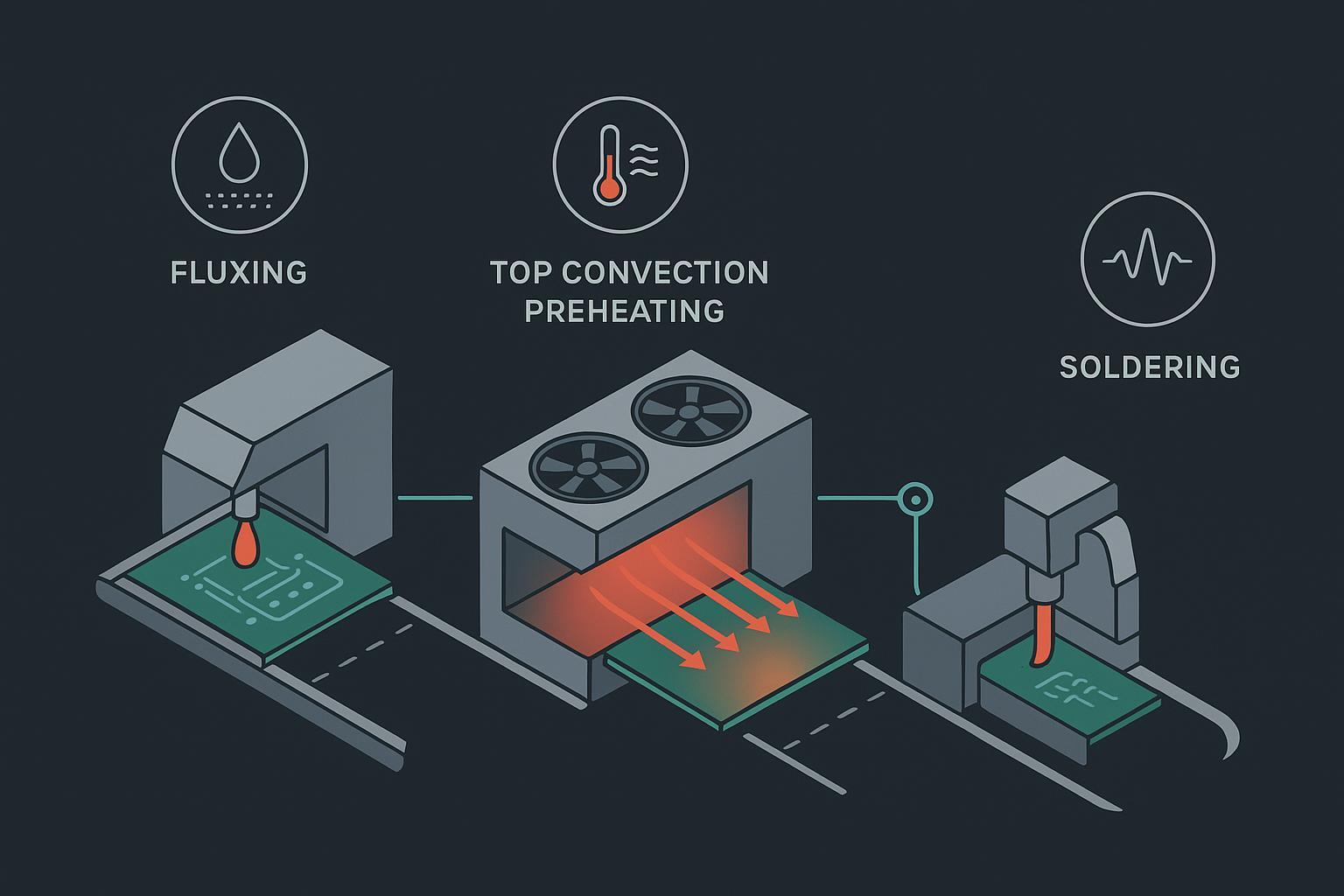
A management quick read on how subsystem coordination and closed-loop controls in a modern selective soldering machine system architecture cut bridging and burr risk around dense SMD neighborhoods while keeping throughput steady.
- Architecture in one line: Targeted flux deposition → uniform top-side convection preheat → selective miniwave or multiwave soldering under nitrogen, with sensors closing the loop on volume, temperature, and wave stability.
- Primary risk: Flux spread and uneven thermal activation drive solder excursion near fine-pitch SMD pads adjacent to THT pins.
- What moves the needle: Flux footprint control, board-side thermal uniformity via top convection, stable wave height and short dwell, local nitrogen purity, and nozzle geometry.
- Decision angle: Miniwave offers flexibility and fine control; multiwave adds takt, but needs tooling and careful validation around dense SMD keepouts.
- Manager action: Demand closed-loop monitoring and a short verification protocol before release to mass production.
Selective soldering machine system architecture at a glance
Coordinating the three subsystems matters more than dialing any single knob. Precision fluxing defines where chemistry works. Top-side convection preheating brings the board to an even, activation-friendly state. The soldering module then applies the minimum stable solder volume with controlled contact and a clean peel-off in nitrogen. Closed-loop sensors and logs stitch these steps into a stable process window.
Fluxing controls
- Management checkpoint: Targeted drop-jet placement with verifiable footprint per joint via on-machine vision or inspection logs.
- Management checkpoint: Compatible low-solids no-clean flux and a documented maintenance routine to prevent nozzle misfire or drift.
- Management checkpoint: Traceable recipes for flux type, droplet density, and keepout masks for zones near dense SMDs.
Why it matters: Excess flux footprint and over-wetting are frequent precursors to bridging, especially where SMD pads sit close to THT exits. The control is geometric and chemical.
Top-side preheating controls
- Management checkpoint: Mixed IR and top convection modules to reduce board temperature gradients on thick copper or high-thermal-mass assemblies.
- Management checkpoint: Logged temperatures from profiling runs showing a consistent board-side target band before solder contact.
- Management checkpoint: Documented delta-T limits and alarms to avoid cold spots and boil-off.
Why it matters: Even activation prevents localized de-wetting and spatter. Top convection improves uniformity on complex stacks; this is frequently the missing piece on dense SMD adjacency.
Soldering module controls
- Management checkpoint: Closed-loop wave height and solder temperature with data logging; stable pump RPM and XYZ pathing.
- Management checkpoint: Nozzle selection and shielding to minimize splash; stable nitrogen shroud around the wave.
- Management checkpoint: Short, repeatable contact time verified in trials, with AOI/X-ray feedback on hole fill and bridges.
Why it matters: Bridging correlates with excessive immersion height, prolonged dwell, unstable peel-off, and spatter from the nozzle region. Control the volume and the exit mechanics, and defects fall.
According to vendor overviews of modern platforms, closed-loop wave monitoring, modular preheat including top-side options, and integrated vision support are baseline capabilities in current systems; see the concise architecture descriptions in the Ersa selective systems overview. For process levers and common defect mechanisms, the qualitative guidance in RPS Hentec’s optimization paper remains a practical reference for engineering teams.
Throughput and quality trade-offs
Use this table to frame your default choice per product family. Validate on your boards before committing.
| Option | Throughput | Flexibility | Tooling cost | Dense SMD friendliness | Typical fit |
| ——— | ———————————————————– | —————————————— | —————– | ——————————————- | ————————————————– |
| Miniwave | Lower, sequential joints | Highest, per-joint tuning and path control | Low | Good with proper shielding and profiling | High-mix, engineering builds, frequent changeovers |
| Multiwave | Higher, many joints in parallel | Lower, plate-specific | Higher, per plate | Good when plate design enforces keepouts | Stable products, mid-volume lines |
| Hybrid | Balanced, parallel where safe plus miniwave for tight zones | Medium | Medium | Best when risk zones get miniwave attention | Mixed portfolios needing takt and control |
Risk checklist near dense SMDs
Apply these during NPI or when a bridging spike appears. They are short, specific, and management-auditable.
- Constrain flux footprint to the land area; verify placement with vision or first-article inspection. Excess spread is a leading cause of bridges near fine-pitch pads. See practical mitigations in the internal guide on reducing solder bridging in wave soldering.
- Add top convection preheating when boards show high mass or thick copper. Log top and bottom temperatures to prove uniformity; uneven activation invites spatter and shorts. Internal context on profiling and uniformity: minimizing thermal stress in selective soldering.
- Set conservative contact time and wave height first, then inch up to hole-fill acceptance. Over-aggressive values raise bridging and icicles. For practical control concepts, refer to how to adjust solder wave height.
- Use narrower miniwave nozzles and consider shields or pallets for near-SMD joints. Smaller footprints reduce splash and solder excursion.
- Maintain high-purity nitrogen at the nozzle shroud to stabilize wetting and peel-off; verify local O2 levels periodically.
- Enforce robust solder mask dams and sensible keepouts on future spins; panelize to favor solder drainage away from SMD pads.
- Profile flux activation and preheat after any BOM change in copper thickness or thermal mass; treat it as a re-qualification item.
- Start shifts with SPC checks on wave height stability and pump RPM; drift correlates with late-shift bridges.
- Audit nozzle condition and cleanliness daily; residue and nicks increase splash. A short routine based on inspection and re-tinning prevents instability. See the internal note on maintaining selective soldering nozzles for upkeep practices.
- Gate release with AOI/X-ray thresholds aligned to IPC-A-610 class; require an engineer and QA sign-off when any risk factor changes.
Fast verification protocol
Use this six-step path to qualify or re-qualify a product family. It is fast, auditable, and aligned to common industry practice.
- Define acceptance metrics upfront: AOI coverage, FPY target, and a bridging defect threshold appropriate to the product’s IPC class. Reference scopes for acceptability and process requirements are outlined in the IPC overview of J-STD-001 and IPC-A-610.
- Build a representative sample set of at least 30 boards with the densest SMD-adjacent THT features included.
- Baseline the process: record top and bottom preheat temperatures, confirm flux footprint per joint, and log wave height stability.
- Run controlled trials varying one factor at a time: flux volume or footprint, top convection flow or power, and wave height or contact time; capture AOI and, where applicable, X-ray data.
- Lock nominal parameters once bridging is at or below threshold and hole fill meets the acceptance class; launch SPC with sampling frequency tied to feature density.
- Formal sign-off by process engineering, QA, and production leadership. Archive recipes and logs to support future audits.
Practical workflow example
Disclosure: S&M is our product.
A neutral example seen across modern lines: Engineering constrains flux to each THT land with a drop-jet program, then profiles top convection to bring board-side temperatures into a stable activation band before soldering. For near-SMD pins, a narrow miniwave nozzle with a shield is used, wave height is set conservatively, and contact time is kept short but sufficient for hole fill. AOI checks focus on SMD-adjacent joints first; if a bridge appears, the team trims flux footprint and wave height before extending dwell. This sequence balances quality against takt without resorting to multiwave tooling unless volumes justify it.
Further reading
- Closed-loop architecture and modular options are summarized in the Ersa selective systems overview.
- Practical levers and qualitative process windows are organized in RPS Hentec’s “Optimizing Selective Soldering Processing”.
- Acceptability and process requirement scopes are outlined in the IPC overview of J-STD-001 and IPC-A-610.
Appendix: parameter ranges
These indicative ranges are management-ready starting points. Validate on your equipment and assemblies through profiling.
| Parameter | Typical practice or guidance | Why it matters | Source |
| ————————- | ——————————————————————— | —————————————————— | ———————————————————— |
| Nitrogen purity at nozzle | About 99.99% to 99.999% N2, verify local O2 | Reduces oxidation and dross, stabilizes peel-off | Circuits and vendor summaries; see RPS and industry articles |
| Preheat board-side target | Roughly 110–150°C on high-mass boards with delta-T control | Aids flux activation and wetting, avoids thermal shock | Ersa success notes; reliability manuals |
| Contact time for miniwave | Short, seconds-level; tune to meet hole fill with minimal over-wet | Excess dwell raises bridging and icicles | Practical guides and vendor notes |
| Wave height | Precisely controlled; too high increases bridges, too low limits fill | Controls solder volume and immersion | Practical guides and internal procedures |
| Flux deposition | Localized footprint per joint with vision verification | Excess spread near SMD pads drives bridging | RPS qualitative guidance |
Author: SMT Process Lead — selective soldering process and line integration advisor