



Nitrogen Reflow vs. Air Reflow: How Inert Gas Reflow Soldering Works and When to Use It
Published: 07 September 2026
Last Updated: 07 September 2026
Reading Time: 15 minutes
Author: [Author name and credentials – pending]
Reviewer: [Reviewer name and credentials – pending]
Article Type: Technical Comparison
Audience: Production, Engineering, and Procurement Decision-Makers
Nitrogen or Air: The Atmosphere Choice Behind Reflow Quality and Cost
Picture this: your forno de refluxo is humming along, boards moving through the heat zones, paste melting into shiny solder joints. Everything looks good. But then the AOI catches something. Bridging on a QFN. A few cold joints on a BGA. Your team scratches their heads and asks the obvious question: should we be running nitrogen?
Here’s the deal with nitrogen reflow. It can actually help with those oxidation-related defects and give you a wider process window. The solder wets more cleanly, the fillets look sharper, and you’ve got a bit more breathing room on your profile. Sounds like a no-brainer.
Except nitrogen costs money. Real money when you factor in gas consumption, the specialized equipment needed to control oxygen levels, ongoing sensor maintenance, and the infrastructure to monitor everything.
So before you flip that nitrogen switch, you need to know whether it actually makes sense for your line.
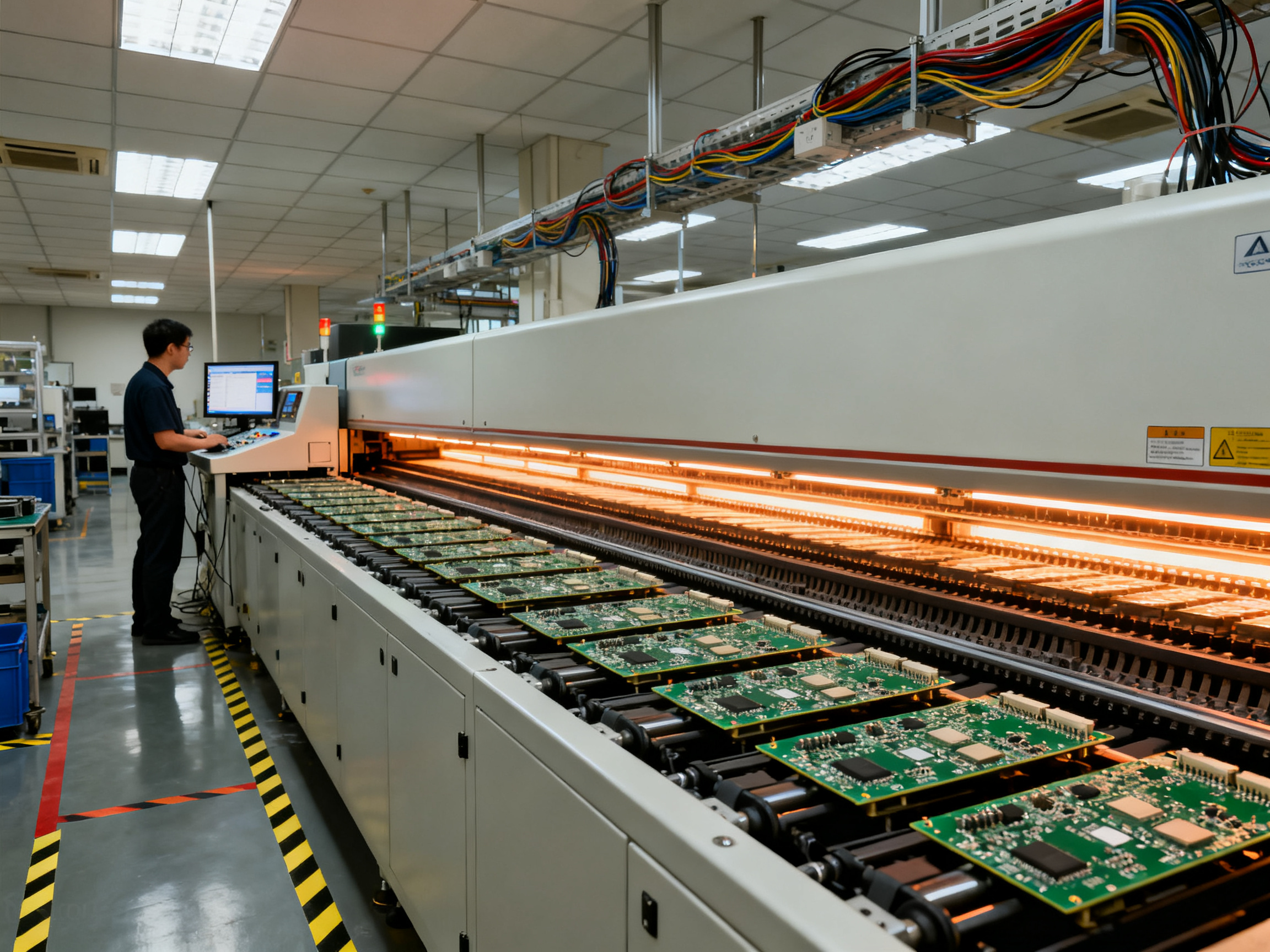
One important thing to clear up first: inert gas reflow soldering is not some special technique you do with a fancy soldering iron or gun at home. It means running your boards through a nitrogen-controlled reflow oven tunnel that maintains a low-oxygen environment, typically between 300 and 1000 parts per million O2. That’s it. No magic wands, no secret wire, just controlled atmosphere processing.
In this guide, we’re going to walk through a practical decision framework. We’ll look at assembly complexity, real defect data, oxygen targets, throughput needs, compliance requirements, and the actual total cost of ownership. By the end, you’ll have what you need to make a call based on your specific situation, not generic advice.
About the Author
Author credentials are pending verification. The author biography will be updated upon confirmation of verified SMT or electronics manufacturing expertise.
This article requires an author with documented experience in surface mount technology reflow processes, process engineering, or electronics manufacturing. Ideal credentials include hands-on work with lead-free reflow profiling, BGA/QFN assembly, nitrogen atmosphere control, or SMT line integration.
If you have relevant qualifications or professional associations you would like listed, please contact our editorial team for verification before publication.
What Inert Gas Reflow Soldering Is and How It Works
Let me clear up a common misconception first. Inert gas reflow soldering is not about using some fancy soldering iron or gun with inert gas flowing through it. That is not how this works. What we are talking about here is running your boards through a nitrogen-controlled reflow oven tunnel that maintains a low-oxygen environment during the entire thermal cycle.
So how does it actually work?
The reflow oven has a sealed tunnel or chamber with nitrogen injected into the heating and cooling zones. As boards move through, the nitrogen displaces the regular air inside the chamber. Regular air contains about 21% oxygen, which is enough to cause oxidation on hot metal surfaces. Nitrogen brings that oxygen level down, typically to somewhere between 300 and 1,000 parts per million (ppm) O2. Some processes go even lower, down to 100 ppm or less for ultra-critical work.
This lower oxygen environment limits oxidation on several surfaces at once. The component leads stay cleaner. The PCB pads氧化更少。The solder powder in the paste does not oxidize as much during the thermal cycle. And the molten solder joint itself stays protected while it melts, flows, and solidifies.
The actual thermal sequence inside the oven does not change. Paste gets printed, components get placed, and then the board moves through the same preheat, soak, time above liquidus (TAL), peak, and cooling zones. What changes is the atmosphere inside those zones.
Expert Tip: When evaluating oxygen ppm readings, you need to look at what the oxygen level actually reads during production, not just at idle. A nominal setting of 500 ppm O2 might climb to 800 or 1,000 ppm once the conveyor is running and boards are loading heat into the system. The only way to know what your boards actually experience is to measure oxygen continuously while the line is at production speed with product on the conveyor.
The Role of Flux and Why Lead-Free Makes This Tighter
Flux plays a critical role in any reflow process, and it becomes even more important when oxygen levels drop. Flux cleans oxide from surfaces so solder can wet properly. In an air environment, flux has to work harder against atmospheric oxygen. In nitrogen, flux does not have to fight as much oxidation, so it can focus its cleaning energy on the actual solder joint.
But here is the catch with lead-free alloys. Lead-free solders like SAC305 (tin-silver-copper) have a narrower practical process window compared to traditional tin-lead. They need higher peak temperatures, they exhibit higher surface tension when molten, and wetting can be more sensitive to surface conditions. This narrower window is exactly why nitrogen becomes attractive. Reducing oxidation gives you more margin to work with.
The oxygen concentration matters because different ppm levels affect different things. At 300 to 1,000 ppm O2, you typically see improved wetting and cleaner fillet appearance. Below 100 ppm, the solder can wet more aggressively, which sounds good but can actually worsen tombstoning if your thermal balance is off. Most production lines land in that 500 to 1,000 ppm sweet spot where you get the benefits without the downsides.
Nitrogen purity matters too. For standard and fine-pitch work, 99.99% nitrogen purity is typical. The tiny bit of residual oxygen is what your oxygen sensor is monitoring and controlling. Very low oxygen targets below 100 ppm typically require even higher purity nitrogen or specialized oven configurations.
This is fundamentally different from hand soldering with an iron or gun. Those tools apply heat locally to individual joints. Controlled atmosphere reflow soldering applies a precisely managed thermal profile across an entire board simultaneously, with the added variable of atmosphere control throughout that profile.
Nitrogen Reflow vs. Air Reflow: Process and Equipment Differences
The atmosphere inside your reflow oven changes everything about how you run the line. Let me break down what actually differs between nitrogen and air operation, because it is not just about flipping a switch.
Atmosphere Delivery and Sealing
Air reflow ovens pull in regular shop air and move it through the heating zones. Simple. Nitrogen ovens need a sealed tunnel or chamber that can actually hold the low-oxygen environment while boards travel through. This means better door seals, reduced conveyor openings, and chamber designs that minimize leakage paths.
A nitrogen-ready oven typically includes sealed tunnels, nitrogen inlet plumbing, and provisions for continuous oxygen monitoring in the reflow zone [1]. Retrofitting an existing air oven is not as simple as adding a gas hose. You need gas injectors, flow controls, chamber sealing improvements, and an oxygen sensor loop. Field estimates put retrofit costs around $5,000 to $15,000 per oven [2].
Oxygen Monitoring and Control
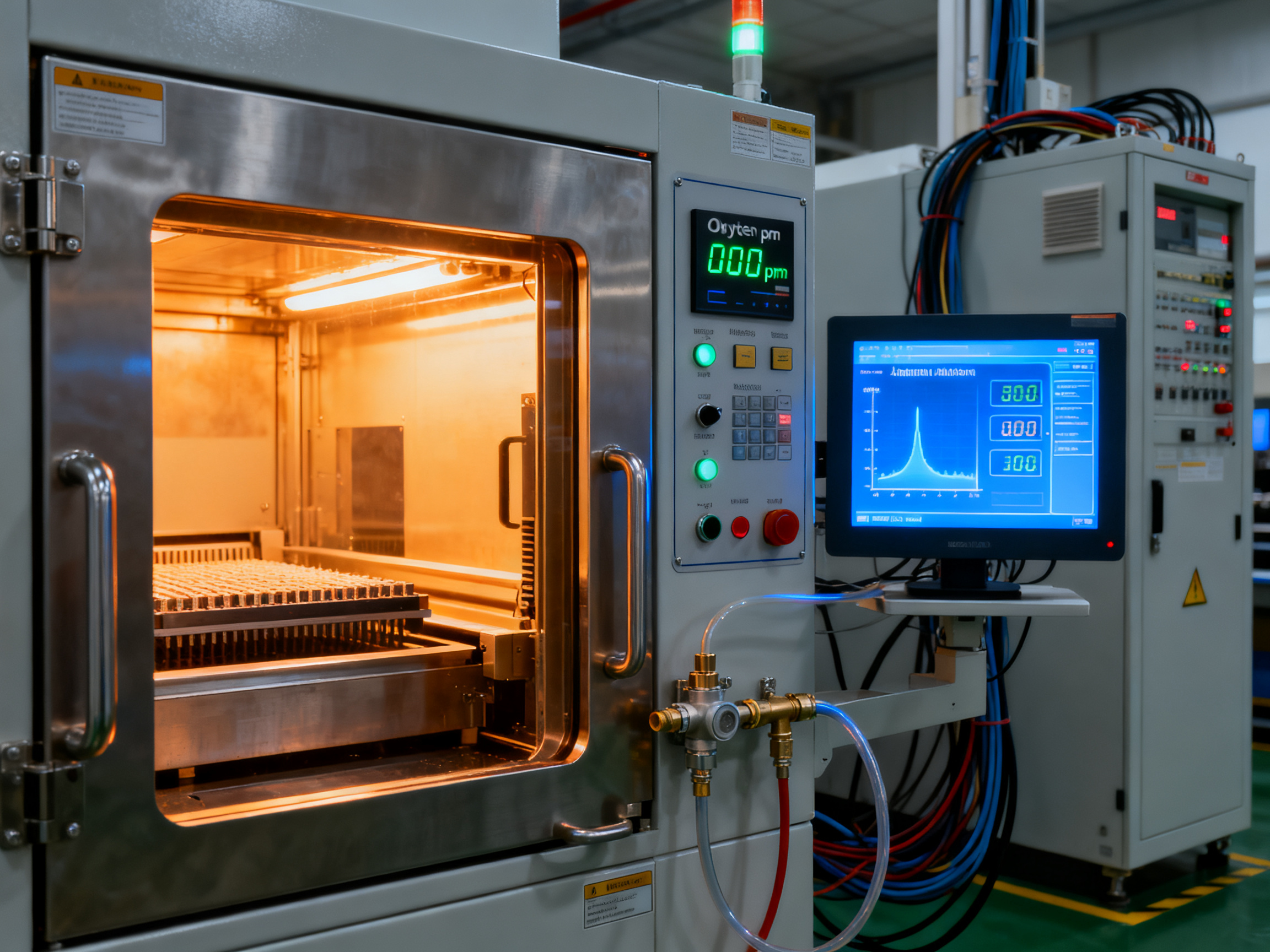
Here is where the real difference shows up. Air ovens do not monitor oxygen at all. Nitrogen ovens need continuous oxygen measurement, typically using an electrochemical or zirconia sensor that feeds back to the gas control system. The oven adjusts nitrogen flow automatically to maintain your target ppm, whether that is 500 or 1,000 or lower.
Closed-loop nitrogen control, where oxygen gets measured continuously and gas flow adjusts automatically, is repeatedly described as the more economical setup compared to fixed high-flow operation [1]. You use only the nitrogen you need instead of blasting gas continuously.
Startup, Operation, and Shutdown Procedures
Running nitrogen adds some procedure steps that air-only lines do not have. At startup, you need to purge the chamber and wait for oxygen levels to stabilize at your setpoint before running product. This stabilization period can add 15 to 30 minutes depending on oven size and how tight your target ppm is.
During production, you set recipe-level oxygen setpoints. Changeover to a different product? You might need to adjust oxygen targets based on the assembly complexity. Alarms trigger when oxygen climbs above your setpoint, indicating either a leak or nitrogen supply issue.
At shutdown, you typically flow nitrogen through the system briefly to keep moisture out, then shut down the gas supply. Air ovens just get turned off.
Capital and Recurring Costs
Capital requirements differ significantly. A basic air reflow oven costs what it costs. A nitrogen-capable oven includes the sealed chamber, gas plumbing, oxygen sensor system, and control integration. On the recurring side, nitrogen adds hourly gas consumption costs.
Typical consumption for a 10-zone oven runs about 15 to 25 cubic meters per hour [3]. At industrial nitrogen pricing of $0.30 to $0.80 per Nm3, that translates to roughly $0.75 to $3.75 per hour in gas costs. A mid-size oven running 16 hours daily, 250 days per year, could see annual nitrogen costs around $24,000 to $40,000 depending on flow rates and pricing [4].
The bigger long-term cost question is whether your defect and rework savings justify that recurring spend.
From Our Experience: When we qualified our first nitrogen line back in 2024, we underestimated the importance of sensor placement. We put the oxygen sensor downstream of the peak zone and it gave us a false sense of security. The front zones were running 200 ppm higher than our setpoint because we had not balanced the gas flow properly. Get your sensor placement right during commissioning, or you will spend months chasing phantom atmosphere issues.
What Does Not Change
One thing that stays the same regardless of atmosphere: your thermal profile still needs to be dialed in. Nitrogen improves wetting and reduces oxidation, but it does not fix a poorly designed reflow profile. Your preheat ramp, soak time, time above liquidus, and peak temperature still need to match your paste data sheet and component requirements. Nitrogen helps your profile work better; it does not replace the need for a good profile.
Flux management also stays fundamentally the same. You still need the right paste for your application, still need to manage stencil design and print parameters, still need to verify placement. Nitrogen just gives your flux a cleaner working environment so it can focus on the joint instead of fighting atmosphere oxidation.
So the real question becomes: do the operational differences and costs make sense for what you are building? That is where we head next.
Benefits of Nitrogen Reflow for High-Reliability and Fine-Pitch Assemblies
Here is where nitrogen starts to pull its weight. When you strip away the oxygen, solder behaves differently. It wets cleaner, spreads more predictably, and forms joints that look sharper and measure more consistently. But the benefits are not uniform across every assembly type, and that matters for your decision.
Wetting, Fillets, and Visual Quality
At oxygen levels between 300 and 1,000 ppm, nitrogen gives solder a fighting chance against oxidation during the thermal cycle. The molten solder stays cleaner as it flows, which means better wetting on pads and leads. Fillet formation improves. You see fewer icicles, less rollover, and more consistent fillet geometry across the board.
Air Products research shows that nitrogen at 1,000 ppm O2 or lower improves wetting, reduces flux residue, and lowers ionic contamination on the assembly [1]. Less oxidation also means cleaner joint appearance, which matters when your customer is doing incoming inspection or your assemblies are going into visible locations.
The High-Density and Fine-Pitch Advantage
This is where nitrogen really earns its keep. BGA, QFN, CSP, and other bottom-terminated components have small solder volumes and tight thermal margins. When solder needs to collapse and wet properly on a tiny pad, any oxidation on the paste, pad, or component termination fights against you.
Nitrogen reduces that fight. Less oxidation means solder can flow more freely during reflow, which helps BGAs self-align and QFNs wet evenly. Practitioners consistently flag fine-pitch work and bottom-terminated parts as the strongest cases for nitrogen because the margin for error is so small [2].
For high-density boards where you have 0.3mm pitch or finer, the difference between air and nitrogen often shows up in AOI reject rates. Bridging decreases. Head-in-pillow defects, while not universally solved by nitrogen, tend to decrease when wetting improves.
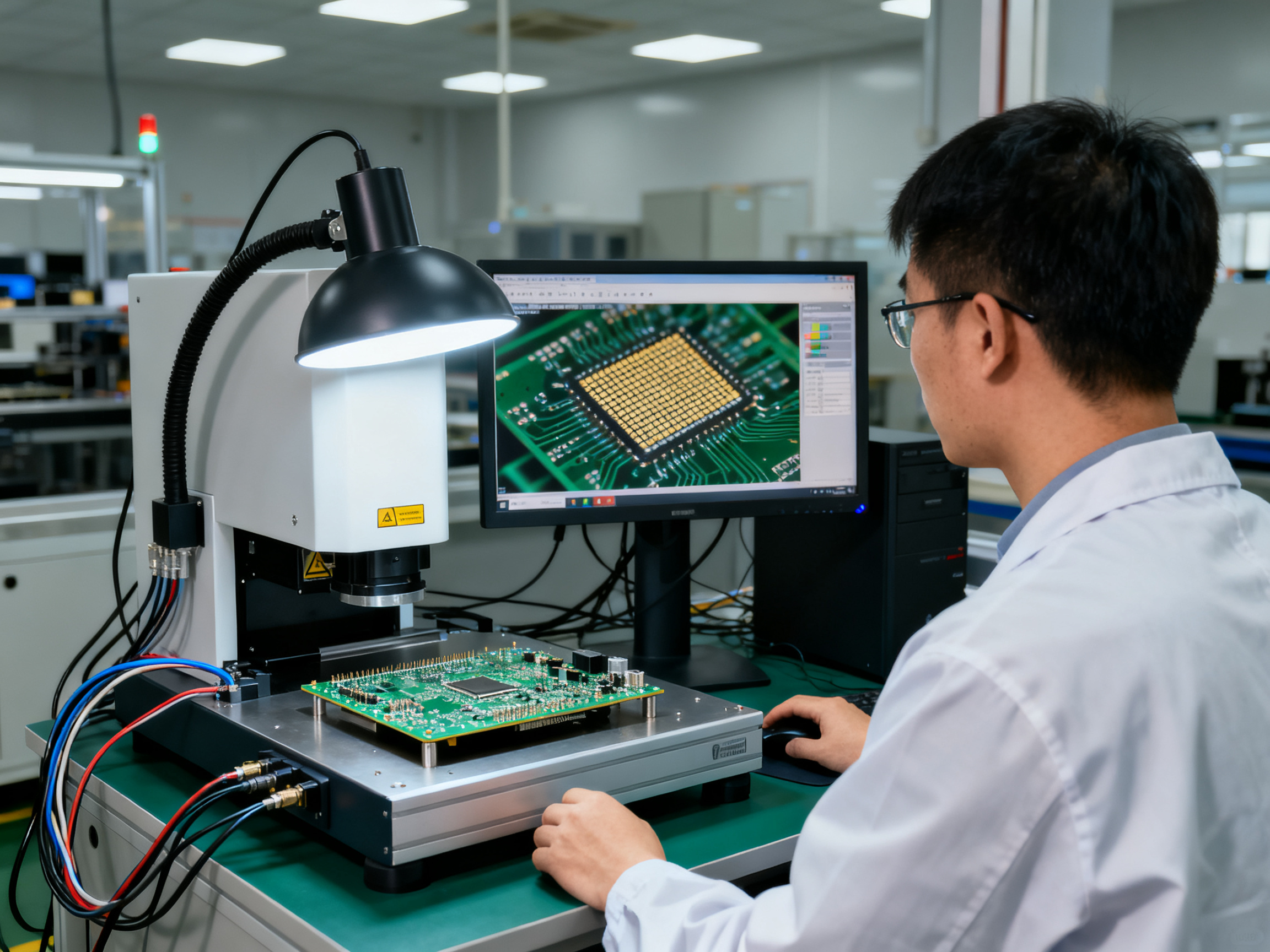
Pro Insight: In documented trials with fine-pitch QFN assemblies, nitrogen at 500 ppm reduced bridging defects by roughly 40% compared to air reflow. But here is what the data did not change: tombstoning rates stayed flat because that defect is driven by thermal imbalance, not atmosphere. Nitrogen helps wetting; it does not fix your profile.
Finish Sensitivity and Flux Considerations
Not all surface finishes respond equally to nitrogen. OSP-coated boards are the most oxygen-sensitive because the organic protection on exposed copper is vulnerable during preheat and soak. Nitrogen helps preserve that finish until the solder melts and takes over.
Immersion silver benefits similarly because silver can tarnish in air. ENIG finishes are more forgiving, but you still see improved wetting and more consistent results with nitrogen on fine-pitch BGAs.
On the flux side, nitrogen lets you run lower-activity formulations in some cases. You do not need flux fighting as hard against atmospheric oxygen, so a milder flux can do its job without leaving aggressive residue. This can simplify cleaning, reduce ionic cleanliness concerns, and sometimes let you skip post-reflow cleaning entirely for certain applications.
Reliability and Compliance Targets
For automotive, aerospace, medical, and military builds, nitrogen often makes sense beyond just defect rates. These industries have stricter cosmetic criteria, more demanding reliability requirements, and customers who ask questions about process control. Nitrogen gives you documented atmosphere control as part of your quality story.
That said, nitrogen is not magic. It improves conditions for wetting and reduces oxidation-related defects. It does not universally fix voids, tombstoning, opens, or head-in-pillow defects if your profile, paste, or component condition are the real problems [3]. The benefits you actually see depend on your paste formulation, board finish condition, component lot age, thermal profile design, and the oxygen level you maintain during production.
The practical payoff comes when your defect data tells you the problem is oxidation-related. Run your trial, measure oxygen continuously, compare AOI and X-ray results, and let the numbers guide you.
Table: Nitrogen Benefits by Assembly Type
| Assembly Type | Primary Benefit | Typical Oxygen Target | Evidence Strength |
|————–|—————-|———————–|——————-|
| Fine-pitch BGA/QFN | Reduced bridging, better self-alignment | 300-500 ppm | Strong |
| OSP-finished boards | Preserved finish, improved wetting | 500-1000 ppm | Moderate to Strong |
| Immersion silver | Reduced tarnishing, cleaner joints | 500-1000 ppm | Moderate |
| High-reliability automotive | Process margin, cosmetic quality | 100-500 ppm | Moderate |
| General SMT | Improved fillet appearance | 500-1000 ppm | Moderate |
Drawbacks, Costs, and Misconceptions About Nitrogen Reflow
Nitrogen reflow sounds like a magic fix. Less oxidation, better wetting, cleaner joints. What is not to like?
Here is what nobody tells you upfront. Nitrogen will not save a bad process. If your stencil design is sloppy, your paste is wrong for the job, your components are damaged or aged, or your reflow profile is just plain incorrect, nitrogen will not fix it. You are just oxidizing your bad joints a little slower. The fundamental rule: nitrogen enhances a good process; it does not rescue a broken one.
The Real Costs Add Up Fast
Let us talk money. The nitrogen system itself is just the beginning. You need the sealed chamber, gas delivery, oxygen monitoring, and control electronics. Retrofitting an existing air oven typically runs $5,000 to $15,000 per unit depending on oven size and current configuration.
Then there is the gas. A 10-zone reflow oven chews through 15 to 25 cubic meters of nitrogen every hour at production speed. At industrial pricing of $0.30 to $0.80 per cubic meter, you are looking at roughly $0.75 to $3.75 per hour just in gas. Run a mid-size line 16 hours daily, 250 days per year, and your annual nitrogen bill lands somewhere between $24,000 and $40,000. Double that if you need higher flow or tighter oxygen targets.
You also need to budget for oxygen sensor calibration on a regular schedule, periodic leak checks on your sealed tunnel, and maintenance on gas delivery components. These are not huge line items individually, but they add up over a year.
Supply Risk and Safety
One thing that does not get discussed enough: nitrogen dependency. If your gas supply gets disrupted, your line stops. Bulk tank runs dry. Delivery truck does not show up. Liquid nitrogen has a boil-off problem if you do not use it fast enough. On-site generation helps, but that is another piece of equipment to maintain, plus it needs power and compressed air.
On the safety side, nitrogen displaces oxygen. The room where your nitrogen system lives needs oxygen monitoring because atmospheres below 19.5% oxygen are considered hazardous. You need alarms, ventilation, and trained staff who understand the risks. This is manageable, but it is not zero cost and it is not optional.
Where Nitrogen Can Mislead You
Here is a subtle problem. Nitrogen makes solder wet more aggressively. That sounds like a good thing, and usually it is. But if your thermal balance is off, that extra aggression can actually increase bridging on fine-pitch parts. You trade one defect for another.
Nitrogen can also mask upstream problems. If your flux is not doing its job or your surfaces are contaminated, air reflow would show you the problem clearly. Nitrogen reduces the oxidation fight enough that the joint might look acceptable even when the root cause is still there. This hides problems rather than solving them, which is dangerous long-term.
Expert Tip: One misconception we see constantly: people assume that “using nitrogen” means their atmosphere is controlled. But if your oxygen sensor is out of calibration or placed in the wrong location, you might be running at 1,500 ppm while thinking you are at 500 ppm. The only way to know what your boards actually experience is continuous oxygen logging during production runs, not just trusting the controller display.
Table: Nitrogen Reflow Risk Categories and Mitigations
| Risk Category | Primary Issue | Mitigation Approach |
|————–|—————|———————|
| Capital cost | $5K-$15K retrofit per oven | Budget planning, phased implementation |
| Operating cost | $24K-$96K annual gas spend | On-site generation comparison, closed-loop control |
| Process risk | Does not fix bad profile or design | Validate fundamentals before adding nitrogen |
| Maintenance | Sensor drift, leaks, tunnel wear | Scheduled calibration, leak testing protocol |
| Supply continuity | Delivery disruption, boil-off losses | On-site generation, supply agreement SLAs |
| Safety | Oxygen deficiency hazard | Fixed O2 monitoring, ventilation, staff training |
The bottom line: nitrogen reflow has real costs and real limitations. It works when your process is already sound and you need that extra margin for fine-pitch work or oxidation-sensitive assemblies. It does not work as a band-aid for fundamental process problems, and the costs need to make sense for your volume and defect picture.
When to Use Nitrogen Reflow and When Air Is the Better Choice
Here is the practical part. After reading about how nitrogen works, what it costs, and where it helps, you need a way to actually decide. Not vague guidance, but something you can use on the floor or in a meeting.
The decision framework starts with one question: is your current air reflow process actually failing you?
Start With Your Defect Data
Before you consider nitrogen, you need to know what is actually breaking in air. Run your current air profile for several production days and capture baseline defect data. AOI rejects, X-ray voiding, reworks, and field returns. If air reflow is hitting your yield targets and your customers are not complaining, nitrogen is probably not urgent.
But if you are seeing consistent problems like recurring bridging on QFNs, persistent head-in-pillow on BGAs, or wetting defects that do not go away despite profile adjustments, nitrogen might be worth testing.
One thing to remember: nitrogen does not fix everything. If your defect data shows tombstoning, opens, or voids, those are usually profile or paste problems, not atmosphere problems. Adding nitrogen to a broken profile just costs you more money while the defects stay.
Decision Matrix: When Each Atmosphere Makes Sense
| Factor | Lean Toward Air Reflow | Lean Toward Nitrogen |
|——–|———————-|———————|
| Product complexity | Standard SMT, mature designs | Fine-pitch BGA/QFN, bottom-terminated parts |
| Surface finish | ENIG (forgiving) | OSP, immersion silver (oxidation-sensitive) |
| Flux type | Standard no-clean or water-soluble | Low-activity formulations needing cleaner environment |
| Reliability class | General consumer | Automotive, aerospace, medical, military |
| Dominant defect mode | Profile-related (opens, tombstones) | Oxidation-related (bridging, wetting, fillet quality) |
| Volume | Low to medium | Medium to high |
| Cost sensitivity | High | Moderate to low |
| Process margin | Generous | Tight or inadequate |
The Payback Question
Nitrogen costs money. Here is a simple way to think about whether it pays off:
Annual nitrogen benefit must exceed annual nitrogen cost.
Your annual cost includes gas consumption plus maintenance and sensor calibration. Based on current 2026 pricing, a typical 10-zone oven running 16 hours daily at 20 m3/h and $0.30 per Nm3 runs about $24,000 per year. Tighten that to $0.80 per Nm3 and you are looking at roughly $64,000 annually.
Your benefit comes from reduced defects, lower rework, less scrap, and fewer warranty claims. If you are throwing away 2% of boards due to atmosphere-related defects and nitrogen cuts that in half, calculate what half your defect rate is worth against your volume and material costs.
Most medium-volume lines see payback in 8 to 14 months if they have a real defect problem. High-volume operations often see faster payback because even small percentage improvements add up quickly. Low-volume or prototype work almost never justifies nitrogen because the math does not work.
A Simple Decision Path
Start here:
- Is your air reflow process meeting yield and quality targets? Yes. Keep running air. No. Continue.
- Is the problem oxidation-related (bridging, wetting, fillet quality) or profile-related (opens, tombstones)? Profile-related. Fix your profile first.
- Do you have fine-pitch parts, OSP or immersion silver finish, or high-reliability requirements? Yes. Run a nitrogen trial. No. Fix your profile first.
- Does the trial show measurable improvement that outweighs annual gas cost? Yes. Adopt nitrogen. No. Keep running air.
From Our Experience: We wasted six months running nitrogen on a product line that did not need it. The defect rate was the same as air. We kept thinking the gas was helping somehow. It was not until we actually ran a controlled split that we proved air was just fine for that product. The lesson: run the trial with real data before committing to the ongoing cost.
The bottom line: air reflow works great when your process is dialed in and your defects are under control. Nitrogen earns its keep when you have oxidation-sensitive work and measurable problems that air cannot solve. Let the data guide you, not assumptions or vendor promises.
How to Qualify and Control a Nitrogen Reflow Process
Qualifying a nitrogen reflow process is not a one-time setup thing. It is an ongoing discipline. You need to prove the process works, document how you know it works, and keep watching it over time. Here is the practical path.
The Qualification Approach
First, establish your air baseline. Run several boards through your current air profile and capture defect data with AOI, X-ray, and electrical test. Without this baseline, you have no way to measure whether nitrogen actually helps.
Then run your nitrogen trial as a controlled comparison. Hold everything constant: same paste lot, same stencil, same placement program, same profile settings. Change only the atmosphere. Measure oxygen continuously during production, not just at idle. Then compare defect rates.
One thing to keep in mind: the oxygen level you set matters. Going from 1,000 ppm down to 500 ppm can improve results, but going below 100 ppm sometimes causes solder to wet too aggressively, which can worsen tombstoning if your thermal balance is off. Find the sweet spot for your specific product.
For the actual inspection stack, use the right tools for the right questions. SPI checks paste volume before reflow. AOI catches bridging, fillet shape, and tombstoning after. X-ray looks inside BGAs and QFNs for voids. Cross-sections through worst-case joints confirm IMC thickness and wetting angles look right. Electrical test and daisy-chain resistance verify the joints actually work [1].
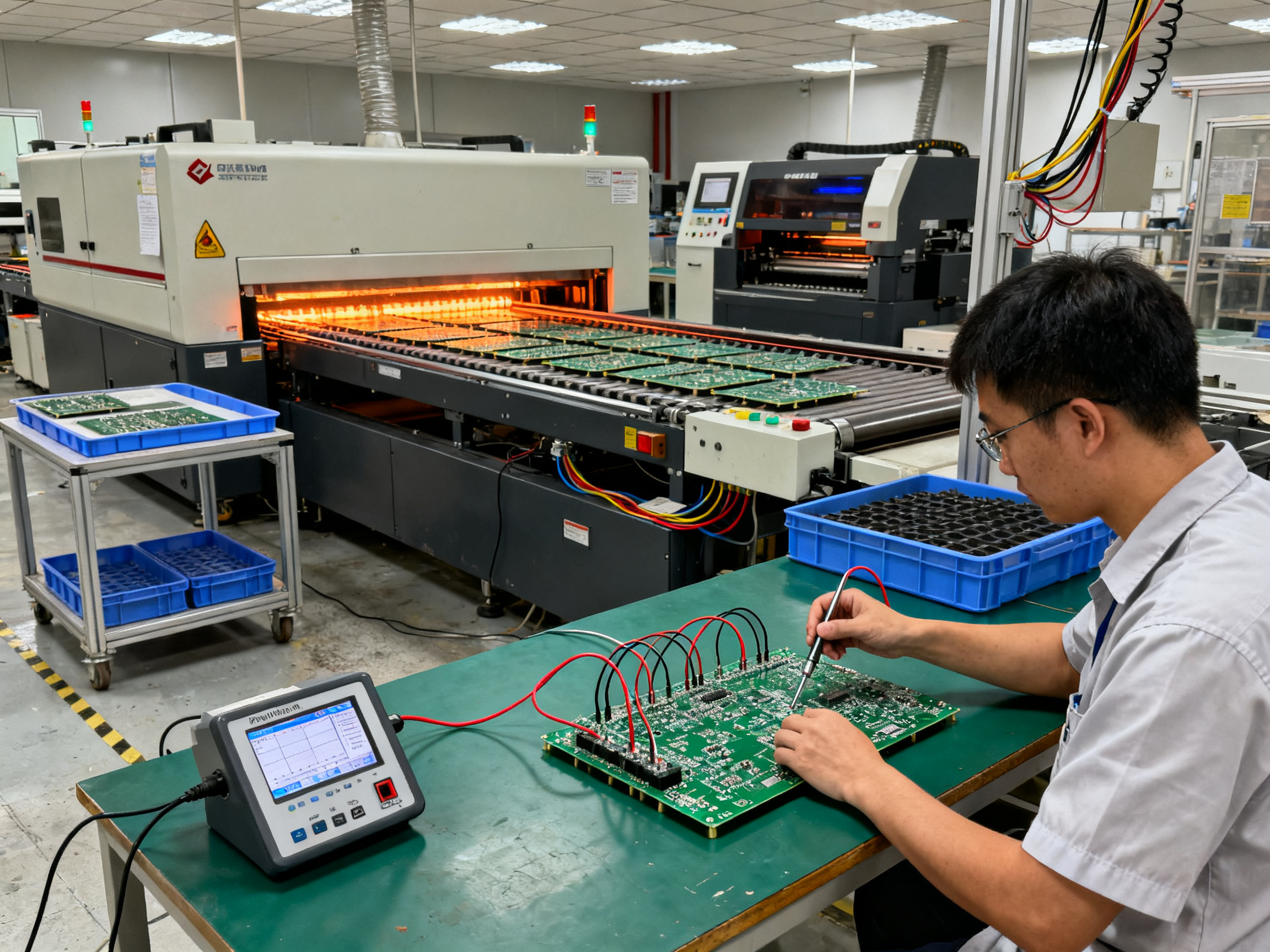
From Our Experience: When we qualified our first nitrogen line back in 2024, we underestimated the importance of sensor placement. We put the oxygen sensor downstream of the peak zone and it gave us a false sense of security. The front zones were running 200 ppm higher than our setpoint because we had not balanced the gas flow properly. Get your sensor placement right during commissioning, or you will spend months chasing phantom atmosphere issues.
The Control Plan
A qualified process means nothing if nobody watches it. Once you have approval, you need ongoing controls.
Table: Nitrogen Reflow Control Plan
| Parameter | Specification | Frequency | Owner |
|———–|————–|———–|——-|
| Oxygen ppm | 300-1000 ppm O2 | Continuous | Process |
| Nitrogen flow | Per oven spec | Continuous | Process |
| Conveyor speed | Recipe setting | Hourly | Operator |
| Zone temperatures | Per profile | Start/shift | Operator |
| Sensor calibration | Per schedule | Monthly | Metrology |
| Tunnel leak check | No visible drift | Weekly | Maintenance |
| Nitrogen purity | 99.99% minimum | Per delivery | QA |
Closed-loop nitrogen control, where oxygen gets measured continuously and gas flow adjusts automatically, is the more economical setup compared to fixed high-flow operation [2]. You use only the nitrogen you need.
The oxygen sensor needs regular calibration with traceable reference gas. A drifting sensor gives you false readings, and false readings mean your boards might be running at 1,500 ppm while your controller shows 500. Check calibration on schedule and log the results.
What You Need Before Scaling
Before rolling nitrogen across multiple lines or products, you need several things documented and in place.
Documented acceptance criteria that show the process meets capability targets. Process capability review using Cpk or similar metrics for your critical outputs. Change control so nobody adjusts the recipe without going through review. Operator training on startup, operation, shutdown, and what to do when alarms trigger. Safety assessment for oxygen deficiency hazards, fixed O2 monitoring, and ventilation requirements. And periodic revalidation because a process that qualified clean 12 months ago might need rechecking if your paste, board finish, or components have changed.
Nitrogen reflow can give you real benefits when your process is sound and your defect data tells you the problem is oxidation-related. But the qualification and control discipline is what separates shops that get consistent results from shops that wonder why their nitrogen line performs nothing like the trial did.
Looking for equipment to support your nitrogen reflow process? S&M Co. Ltd. offers lead-free reflow ovens designed for controlled atmosphere operation in high-volume SMT environments.
Expert Recommendation: Choose the Atmosphere From Process Evidence
Here is my bottom line after years of working through this decision on real production floors. Nitrogen is a process-window tool. It earns its cost when your defect data tells you oxidation is the limiting factor and when you have fine-pitch or high-reliability assemblies that need every bit of margin they can get. Controlled air reflow remains the smarter economic choice when your line is already hitting quality targets and your defects are profile-related rather than atmosphere-related.
Do not take my word for it. Do not take a vendor’s word for it either. Run the trial, measure the oxygen, compare the results, and let the data make the case.
Five-Point Action Checklist
1. Baseline your current air reflow
Run several production shifts on air. Capture AOI reject rates, X-ray voiding data, and rework counts. Without a baseline, you have nothing to measure against.
2. Isolate the defect type
Ask whether your problems are oxidation-related (bridging, wetting failures, fillet quality) or profile-related (opens, tombstones, voids). Nitrogen helps only the first group.
3. Conduct a controlled nitrogen trial
Hold everything constant. Change only the atmosphere. Measure oxygen continuously during production. Compare defect rates side by side.
4. Calculate real payback
Annual nitrogen cost typically runs $24,000 to $96,000 depending on flow rates and pricing. Your benefit comes from defect reduction, rework savings, and scrap avoidance. If annual benefit does not exceed annual cost, nitrogen does not make sense for that product line.
5. Approve investment only from validated results
Document your trial data. Get engineering sign-off. Then and only then commit to the ongoing gas spend and infrastructure.
Final Recommendation Table
| Scenario | Recommendation | Rationale |
|———-|—————|———-|
| Standard SMT, mature product, no defect issues | Stick with air reflow | Nitrogen cost not justified |
| Fine-pitch BGA/QFN, recurring bridging or wetting defects | Run nitrogen trial | Oxidation is limiting factor |
| OSP or immersion silver finish, high-density board | Consider nitrogen | Finish is oxygen-sensitive |
| Automotive, aerospace, medical, strict reliability targets | Evaluate nitrogen | Process margin and compliance value |
| Profile-related defects (opens, tombstones, voids) | Fix the profile first | Nitrogen will not help |
Production leaders, your job is to protect yield and manage cost. Start with the data. If air is working, keep running it. If it is not, prove the problem is atmosphere-related before spending $24,000-plus per year on nitrogen gas.
Process engineers, your job is to validate before committing. Design the trial properly. Measure oxygen continuously. Document the results. A well-run trial with real data beats vendor promises every time.
Procurement teams, your job is to model the total cost of ownership. Gas spend is only part of the picture. Factor in sensor calibration, maintenance, safety requirements, and supply continuity risk. On-site nitrogen generation may cut costs significantly at high volumes, but the economics depend on your specific situation.
The atmosphere choice should never be a guess. It should always be a decision backed by evidence from your own line, your own product, and your own defect history.
Ready to evaluate reflow oven options for your production environment? S&M Co. Ltd. offers lead-free reflow ovens designed for both controlled atmosphere and standard air operation to support whatever your process data tells you is right.