



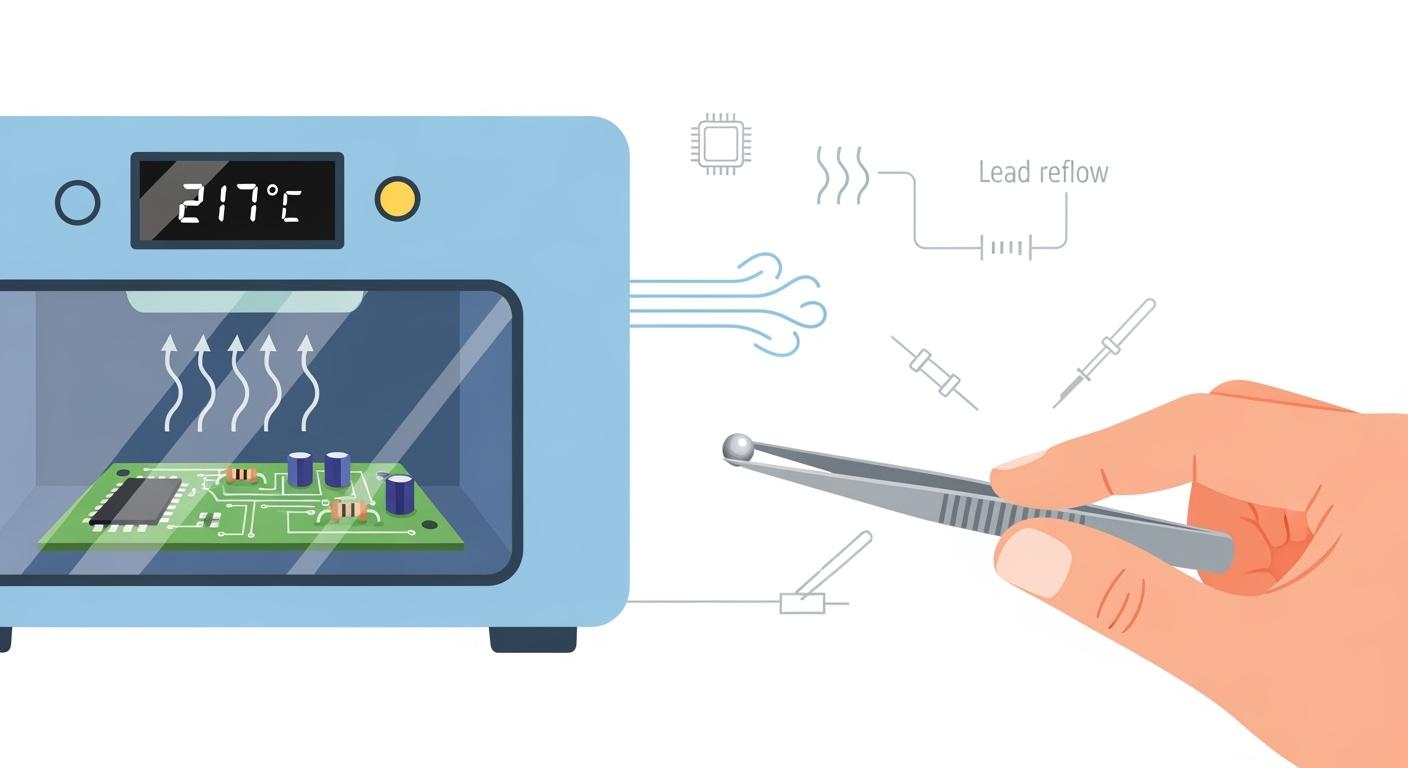
You use a reflow oven to heat up solder paste. This melts the paste and connects electronic parts to circuit boards. In lead-free soldering, you must control the temperature very carefully. Lead-free solder melts at a higher temperature than older types. If you do not control the heat, joints can be weak. Parts can also get damaged. Lead-free soldering is harder and brings new problems.
Here is a quick look at the main differences:
Provocare | Descriere |
|---|---|
Higher melting points | Lead-free solder melts at 217°C, which is harder to work with. |
Increased costs | Lead-free solder costs more because it uses tin and silver. |
Lower wettability | Lead-free solder does not spread as well as lead-based solder. This makes joints less strong. |
Joint reliability issues | Higher reflow heat can stress parts more and make them less reliable. |
You need better equipment to fix these problems and keep your line working well. S&M has solutions that help you get good results every time.
Principalele concluzii
Watch the temperature closely when using lead-free solder. This helps stop weak joints and broken parts.
Use a reflow oven that has many heating zones. More zones help you control the temperature better. This makes solder joints stronger.
Use a careful thermal profile for lead-free soldering. Follow the steps of preheating, soaking, reflowing, and cooling. This helps make sure the work is good.
Think about using a nitrogen atmosphere while soldering. This cuts down on oxidation and makes joints stronger.
Check your reflow oven often. Regular checks help the oven work well. This also makes solder joints more reliable.
Reflow oven basics for lead-free soldering
What is a reflow oven?
A reflow oven helps connect parts to circuit boards. First, you put the board with solder paste and parts inside. The oven heats the board in steps. Each step uses a set temperature and time. Look at the table below to see the steps:
Stage | Intervalul de temperatură (°C) | Duration (seconds) | Slope Rate (°C/sec) |
|---|---|---|---|
Preîncălzire | 150 – 190 | 60 – 120 | 0.75 – 2 |
Înmuiați | 217 | 60 – 120 | 0.5 – 1 |
Reflow | 240 – 248 | 40 – 70 | Nu se aplică |
Răcire | Down to 75 | Nu se aplică | Nu se aplică |
You need to follow these steps for strong solder joints. The reflow oven controls heat and time for each step. This makes the process work the same way every time.
Why lead-free soldering needs precision
Lead-free soldering uses more heat than old solder. You need special ways to do this right. The reflow oven must heat evenly and keep the temperature steady. If you do not control the heat, parts can break or joints can be weak. The table below shows how heat changes solder joints:
Descriere | |
|---|---|
Microstructure Changes | Changes in heat can change the inside of the solder joint and make it weaker. |
Internal Stress | Heat changes can cause stress inside the joint and make it less strong. |
Aging and Thermal Cycling | Heat affects how the joint ages and handles changes in temperature. |
You must use careful steps and watch the process to stop problems.
S&M’s role in advanced soldering
You need better tools for lead-free soldering. S&M is a leader in SMT and reflow oven tools. S&M makes ovens that handle more heat and keep it steady. You can use S&M’s ovens to use careful steps in soldering. S&M’s ovens help you get good results every time. You can count on S&M for smart features and strong ovens.
Key features of a solder reflow oven
Temperature control and zones
You need to control the temperature very well for strong solder joints. The reflow oven has different heating zones. Each zone heats up to its own set temperature. This helps you follow the right heat steps for every board. If you use the wrong heat, parts can break or joints can be weak.
Most new reflow ovens have 5 to 10 heating zones. Simple boards work fine with 5 to 7 zones. If you make more complex or many boards, use 8 to 10 zones. More zones give you better control over the heat steps. This helps you use better ways for lead-free soldering.
Tip: More heating zones let you adjust each step. This means you can use better methods and get stronger results.
Here is a table that shows the industry rules for temperature accuracy in lead-free reflow ovens:
Caracteristică | Specification |
|---|---|
Preheat rate | 0.75℃/s to 2℃/s |
Preheat time | 60s to 120s |
Preheat temperatures | 150℃ to 190℃ |
Temperature increase rate (soak) | 0.5℃/s to 1℃/s |
Soaking time | 60s to 120s |
Soaking temperatures | 217℃ |
Reflow temperatures | 240℃ to 248℃ |
Reflow time | 40s to 70s |
Reflow peak time | 10s to 30s |
Cooling rate | 1.5℃/s to 4℃/s |
Cooling temperatures | Cooling to 75℃ |
S&M’s reflow oven uses Siemens PLC and PID closed-loop control. This system keeps the heat steady in every zone. You can trust the oven to follow your heat steps exactly. This helps you use the best ways for every product.
Nitrogen atmosphere and S&M’s nitrogen reflow oven
You can make solder joints better by using a nitrogen atmosphere. Nitrogen keeps oxygen away from the solder. This stops oxidation and lowers the number of voids in joints. When you use nitrogen, your solder joints are cleaner and stronger. This is very important for careful work.
Studies show that nitrogen can lower voids by up to 50% compared to air. This means your joints will be stronger and work better. S&M’s nitrogen reflow oven gives you a controlled nitrogen space. You can use advanced ways to get the best results in lead-free soldering.
User interface and safety systems
You need an easy way to use the reflow oven. A good user interface lets you set and change heat steps fast. You can save many steps and switch between them when you need to. S&M’s ovens use a Windows 10 system. You can change the language and use the touchscreen to make changes quickly.
Here is a table that shows the most important user interface features:
Caracteristică | Descriere |
|---|---|
Programmable profiles | Save many steps for different products. |
Real-time monitoring | Watch the process and see heat steps live. |
Easy settings adjustment | Change settings fast to use better ways. |
Use a Windows system that is easy to use. |
Safety is important too. S&M’s ovens have alarms for problems. You get sound and light alerts if something is wrong. This helps you keep things safe and stop damage.
Maintenance and modular design
You want your reflow oven to be easy to fix. A modular design lets you reach parts fast. You can fix or clean the oven without special tools. This saves you time and keeps your line working.
Evidence Type | Descriere |
|---|---|
User-friendly design features | You do not need tools to do maintenance. |
Easier access to components | You can fix or adjust parts quickly. |
Supports precise temperature control | Keeps the oven working its best. |
S&M’s ovens use a modular design. You can take out and put in parts easily. This design helps you use better ways and keeps your heat steps steady. You spend less time fixing and more time making good products.
Note: Good maintenance and modular design help you use the newest ways and keep your reflow soldering process strong.
Setting the lead-free reflow profile
Understanding the thermal profile
Trebuie să understand the thermal profile before you start the reflow soldering process. The thermal profile is a plan for how the temperature changes as your board moves through the reflow oven. The first stage dries out the solvents in the solder paste. This step is important because it gets the flux ready to clean the metal surfaces. You must heat the board slowly. If you heat it too fast, you can get problems like solder spattering or slumping. A good ramp-up rate is between 0.75°C and 2°C per second. If you follow the right profile, you help the solder joints stay strong and reliable.
Profiling steps for lead-free solder
You will follow several steps to set the right profile for lead-free solder. Each step has a special job:
Preheat Stage: Raise the temperature slowly to activate the flux and prevent thermal shock.
Soak Stage: Hold the temperature between 150°C and 180°C for 60 to 120 seconds. This helps the board heat evenly.
Reflow Stage: Heat the board to a peak temperature of 235°C to 245°C. Keep it above the melting point for 30 to 90 seconds so the solder melts well.
Cooling Stage: Cool the board at a rate of 2°C to 4°C per second. This step makes the solder joints solid and strong.
If you change the temperature or the time in any stage, you can affect the reliability of your solder joints. Cracks, voids, and weak spots can happen if you do not follow the right steps.
Common challenges and S&M solutions
You may face some common challenges when you set up a lead-free profile. Here is a table that shows these challenges and how S&M helps you solve them:
Provocare | Soluție |
|---|---|
Thermal stress | Use careful reflow profiles |
Moisture in PCB materials | Store and bake materials to keep them dry |
Need for precise temperature control | Inspect and test thoroughly |
S&M gives you tools and features that help you set and control the profile. You can trust your process to make strong and reliable solder joints every time.
Solder joint quality and reliability
Impact of oven settings on joints
You can make solder joints better by setting the oven right. The peak temperature should be between 245°C and 260°C. This helps the solder melt and spread well. Keep the board hot enough for 60 to 90 seconds. This step is very important for strong joints. How fast you cool the board also matters. Cooling too quickly can shock the parts. Cooling too slowly can make big grains in the joint. Both ways can make the joints weaker.
Parametru | Recommended Value | Impact on Solder Joint Quality |
|---|---|---|
Peak Temperature | 245–260 °C | Makes sure solder melts and stays hot long enough |
Time Above Liquidus | 60–90 seconds | Needed for strong and reliable joints |
Rata de răcire | 3–6 °C per second max | Stops big grains and protects parts from shock |
Cooling Duration | ~3 minutes from 260 °C to ~50 °C | Makes joints shiny and stops them from warping |
You also need to set the viteza benzii transportoare to fit your heat steps. If it moves too fast or too slow, joints can turn out bad. Always check your oven settings before you start.
Typical defects in lead-free reflow
You might see some problems when you solder with lead-free solder. These problems can make joints weak or cause them to fail.
Punte de lipire happens if you use too much paste or the stencil is not right.
Tombstoning is when one end of a part pops up from uneven heat or not enough paste.
Solder balling comes from wet paste or dirty boards.
Cold solder joints form if there is not enough heat or if parts are dirty.
Voids show up when air or flux gets stuck inside the joint.
Defect | Cauze |
|---|---|
Punte de lipire | Too much paste, bad stencil, wrong oven steps, parts not lined up right |
Tombstoning | Uneven heat, pads not the same size, not enough paste, parts not placed right |
Solder Balling | Wet paste, too much paste, wrong oven steps, dirty boards |
Îmbinări prin lipire la rece | Not enough heat, dirty parts |
Goluri | Air or flux trapped inside the joint |
You can stop many of these problems by using the right paste and putting it on the board the right way.
Best practices for consistent results
You can make solder joints stronger and more reliable by following these tips:
Check and fix your oven often. This keeps heat and speed steady.
Use the right solder paste for your job. Always read the label.
Design boards so they are easy to solder. Use pads that are the same size and do not make big changes in heat needs.
Make a special oven plan for each board and set of parts.
Be careful with parts that do not like water.
Keep your work area clean. Good paste and clean boards stop many problems.
Use inspection to find mistakes early.
Tip: If you follow these tips, your solder joints will be better and you will have fewer problems in every batch.
Choosing the right reflow oven
Evaluation criteria for lead-free ovens
When you pick a reflow oven, look at many features. These features help you make strong solder joints that last. The table below shows what is important and why:
Caracteristică | Why It Matters |
|---|---|
Temperature Uniformity | Makes solder joints strong and last longer |
Number of Heating Zones | Lets you control heat for different boards |
Nitrogen Control | Stops oxidation and makes solder better |
User Interface | Makes the oven easy to set up and use |
Maintenance and Safety | Keeps your team safe and lowers downtime |
Energy and Nitrogen Consumption | Helps you save money over time |
Real-Time Profiling | Lets you change settings for better results |
Support and Warranty | Gives you help if something goes wrong |
You should also check if the oven has certifications. Certifications show the oven meets high standards. Look for features that help you set the right heat steps. Make sure the oven works with your materials. Train your team to use the oven well.
S&M product advantages and value
S&M gives you smart solutions for lead-free soldering. You get exact temperature control with Siemens PLC and PID systems. The modular design makes fixing the oven quick and easy. You can use Chinese or English on the Windows 10 screen. S&M’s nitrogen reflow oven helps you make cleaner and stronger joints. Safety alarms and live monitoring keep your line safe. You save money because the oven uses less energy and nitrogen. S&M gives you good support and warranty, so you get help fast.
Tip: S&M’s ovens help you meet industry rules and make your line work better.
Testing and validation tips
Before you start making lots of boards, you need to test your oven and process. Here are some important tests:
Solderability Test (IEC 60068-2-58): Checks if parts and pads take solder well.
Mechanical Stress Test (IEC 60068-2-21): Checks how strong the solder joints are.
Humidity and Heat Test (IEC 60068-2-67): Checks if joints can handle tough conditions.
You should also check your results with automated optical systems. Train your team to handle lead-free soldering problems. Make sure your heat steps match your boards and solder paste.
You need a good reflow oven for strong solder joints. Advanced features help you control heat in each step. These steps are preheating, soaking, reflow, and cooling. Good control lowers defects and makes better joints. S&M’s solutions give you exact control and easy fixing. You can use S&M’s nitrogen reflow oven or regular reflow oven. Check your process and pick the oven that fits your needs. This helps you get better results.
ÎNTREBĂRI FRECVENTE
What is the main purpose of a reflow oven?
You use a reflow oven to heat solder paste and connect electronic parts to circuit boards. The oven controls the temperature in steps. This makes sure you get strong and reliable solder joints.
Why do you need nitrogen in lead-free soldering?
Nitrogen keeps oxygen away from the solder. This stops oxidation and helps you make cleaner, stronger joints. You get fewer defects and better results with nitrogen.
How often should you maintain your reflow oven?
You should check and clean your oven every week. Regular maintenance keeps the oven working well. This helps you avoid problems and keeps your production line running smoothly.
Can you use the same profile for all boards?
No, you should set a special profile for each board type. Different boards need different heat steps. This helps you get the best solder joints every time.
What safety features should you look for in a reflow oven?
Look for alarms, emergency stops, and safe access panels. These features protect you and your team. S&M ovens include sound and light alarms for extra safety.