



Опубликовано: 10 July 2026
Время чтения: 10 minutes
Reviewer: [Awaiting reviewer credentials]Why Batch Curing Oven Design Matters for Composite and Carbon Fiber Parts
Think about the last time you tried to bake something in an oven that just couldn’t hold temperature. The edges burned while the center stayed raw. Now imagine that same problem happening to a carbon fiber aerospace component worth thousands of dollars. That’s exactly what happens when composite manufacturers use the wrong curing equipment.
The market for composite curing equipment keeps climbing. Analysts put the global composite curing oven market at $3.8 billion in 2025, with projections reaching $6.2 billion by 2033. A big chunk of that growth comes from aerospace programs, electric vehicle production, and defense contracts that all need lightweight, strong composite parts done right.
Here’s the thing though. Not every heat-processing oven can handle carbon fiber or advanced composite materials. These parts need very specific temperature control, often between 120°C and 250°C, depending on the resin system. Get that wrong and you end up with voids, delamination, or parts that simply fail in service.
That’s why buyers spend so much time comparing carbon fiber curing oven specs, looking at industrial composite curing oven options, and trying to figure out what custom batch oven build actually means for their production floor. This guide walks through all of it.
By Jace Liu. [Author credentials and relevant experience with industrial ovens, SMT equipment, composite curing, or manufacturing systems should be added here before publication because no author bio details were provided.]
Quick Comparison: Batch Ovens vs. Autoclaves vs. Conveyor Ovens
| Feature | Batch Oven | Autoclave | Conveyor Oven |
|———|————|———–|—————|
| Best for | Discrete parts, low-to-medium volume | High-pressure composites, large structures | Continuous high-volume production |
| Pressure capability | Atmospheric only | 100-200+ PSI | Atmospheric only |
| Typical temp range | Up to 850°F-1,200°F | Up to 800°F typically | Up to 1,200°F |
| Время цикла | Hours to days | Longer due to pressure ramp | Continuous |
| Capital cost | Moderate | High | High |
| Ideal for carbon fiber? | Yes, for most layups | Required for aerospace-grade voids | Limited to simple parts |
So when does a batch oven make sense for your operation? Most of the time when you’re working with layups that don’t need extreme pressure, when part sizes vary from run to run, or when you need flexibility to cure different configurations in the same chamber.
Let’s dig into what actually matters when you’re spec’ing one of these systems.
Author Expertise Note
By Jace Liu. [Author credentials and relevant experience with industrial ovens, SMT equipment, composite curing, or manufacturing systems should be added here before publication because no author bio details were provided.]
This article focuses on practical engineering specifications and build considerations for thermal processing equipment. Before publication, please supply verified credentials related to industrial equipment selection, thermal process control, or production engineering so readers can assess the author’s background in these areas.
What a Carbon Fiber Curing Oven Must Do in High-Reliability Manufacturing
Here’s what nobody talks about enough when you’re spec’ing a composite curing oven for aerospace or defense work. The oven isn’t just a heated box. It’s basically a precision instrument that has to hold your part’s chemistry hostage until the resin does exactly what you want it to do.
At its core, a carbon fiber curing oven has to deliver a composite cure cycle that heats your layup evenly, holds it at the right temperature for the right time, and cools it back down without causing thermal shock. Too hot? You risk resin degradation and exotherm events where the part basically cooks itself from the inside out. Too cold? The resin doesn’t fully polymerize and you’re left with soft spots, weak bonds, or parts that fail inspection weeks later.
High-volume manufacturers care about this stuff because repeatability is everything. You can’t have batch 47 come out perfect and batch 48 end up in the scrap bin. That means documentation, traceability, and integration with plant quality systems aren’t optional extras. They’re the whole point.
The process flow matters too. Most serious composite shops run through these stages: load preparation, controlled ramp-up, dwell/soak at target temperature, controlled cool-down, unload, and final inspection. Skip a step or rush the ramp phase and you’re asking for trouble.
What actually happens when your oven delivers consistent temperature uniformity throughout the cycle? You get void reduction because resin flows properly without premature gelation. Bond strength stays consistent across parts. Dimensional stability improves because the whole layup cures at the same rate. And scrap rates drop, which makes your production manager happy.
The numbers tell the story. Poor cure control leads to voids and porosity, delamination between layers, incomplete cure leaving parts brittle or tacky, and resin-rich zones that create weak points. None of that flies in aerospace, defense, or high-reliability electronics manufacturing where parts have to perform first time, every time.
Expert Tip: Temperature uniformity under loaded conditions matters more than an empty-chamber maximum temperature claim. When you’re comparing industrial composite curing oven options, ask for temperature maps taken with actual production loads inside, not just chamber specs. The performance you get with your parts, fixtures, and vacuum bags will be different from an empty chamber every single time.
So when you’re evaluating a batch curing oven build, remember that the oven’s job is to take control of your part’s chemistry and hold the line until cure is complete.
Temperature Specs That Matter: Range, Uniformity, Stability, and Recovery
Alright, so let’s talk specs. When you’re comparing a carbon fiber curing oven for sale, the temperature specifications will either make your production floor run smooth or keep your quality engineers up at night.
Here’s what you need to ask for, and why it matters.
Maximum operating temperature sounds straightforward, but there’s a catch. Most composite resins cure between 120°C and 180°C for standard epoxy systems. High-temperature resins like BMI can push up to 230°C, and cyanate esters used in aerospace radar applications sometimes need 250°C or higher. Your oven needs headroom above your target cure temperature, not just a rating that matches it.
Working temperature range tells you what the oven can actually maintain during production cycles. Some ovens perform beautifully at 150°C but struggle at 400°C for post-cure operations. Know your entire process window.
Temperature uniformity is where things get interesting. This measures how consistently heat distributes across your load. Industry standards like AMS 2750 define tolerance classes from ±3°C for aerospace work down to ±28°C for basic industrial applications. But here’s the thing, and this is critical: these numbers usually come from empty-chamber testing.
Your actual production load, with molds, fixtures, and vacuum bags, behaves completely differently. Dense tooling absorbs heat. Large layups create thermal mass gradients. Mixed part configurations heat unevenly.
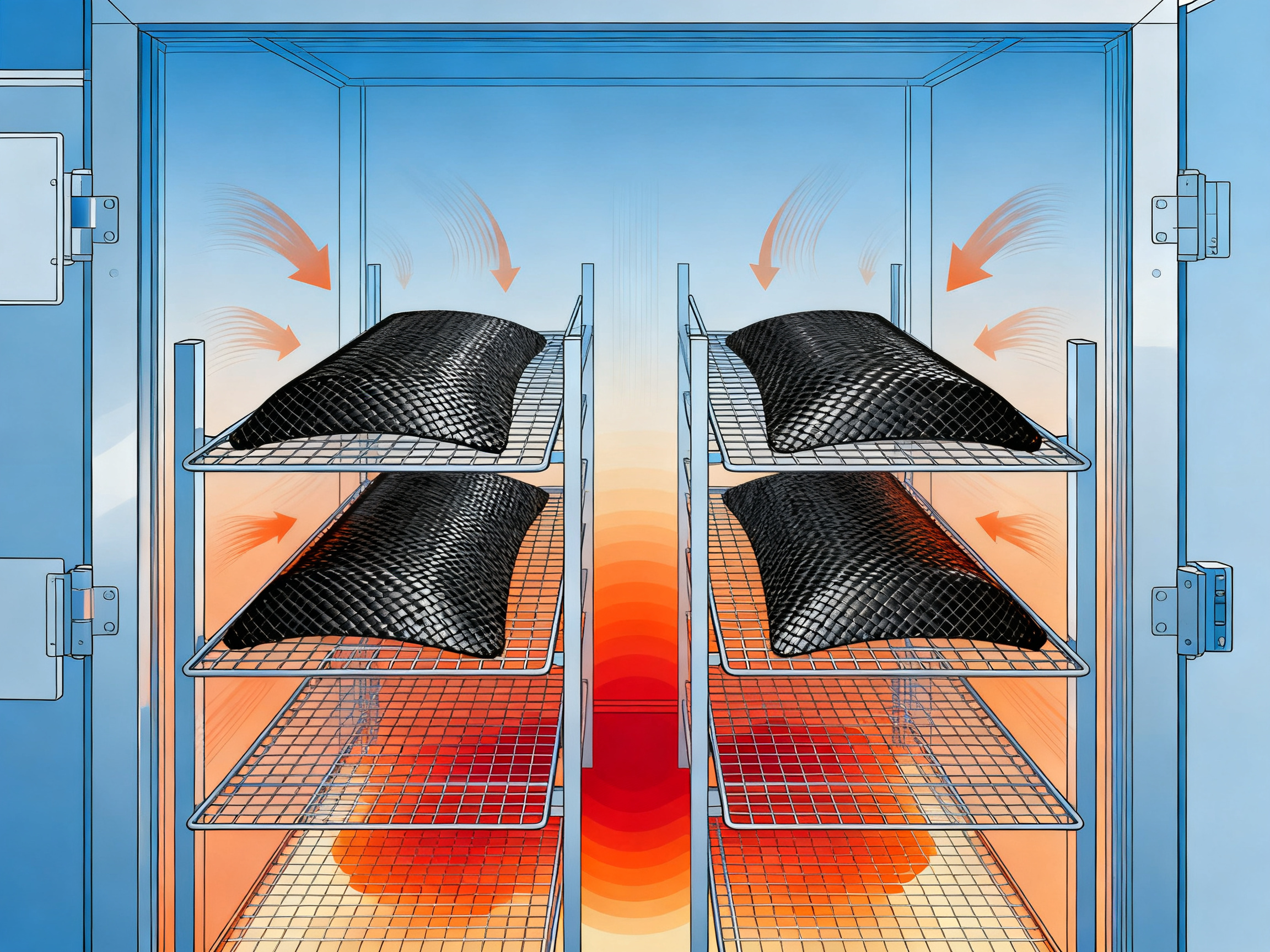
Control stability measures how well the oven holds setpoint during dwell periods. Drift over time creates inconsistency.
Heat-up rate matters for cycle time but affects your parts. Fast ramps save hours but risk exotherm events in thick layups. Programmed multi-step profiles give resin time to relax and flow properly.
Recovery time after door opening shows how quickly the chamber returns to setpoint. Frequent batch changes mean this matters more.
| Parameter | Why It Matters | Buyer Question to Ask | Evidence to Request |
|———–|—————–|———————-|——————–|
| Max operating temp | Must exceed your cure + post-cure | What is sustained max vs. intermittent? | Data sheet with duty cycle notes |
| Temperature uniformity | Affects void content and bond strength | Empty chamber or loaded test data? | TUS report with actual load configuration |
| Control stability | Consistent cure quality | PID tuning documentation? | 8-hour stability test trace |
| Heat-up rate | Cycle time and exotherm risk | What ramp rates are programmable? | Sample cure profile from similar application |
| Recovery time | Batch change efficiency | Time to ±5°C after full door open? | Time study from FAT |
Expert Tip: Temperature uniformity under loaded conditions matters more than an empty-chamber maximum temperature claim. When you’re comparing industrial composite curing oven options, ask for temperature maps taken with actual production loads inside, not just chamber specs. The performance you get with your parts, fixtures, and vacuum bags will be different from an empty chamber every single time.
The bottom line: get your resin system data sheets, know your qualification requirements, and demand loaded-chamber test data before signing anything.
Ramp-Soak Control: How Cure Profiles Are Built and Verified
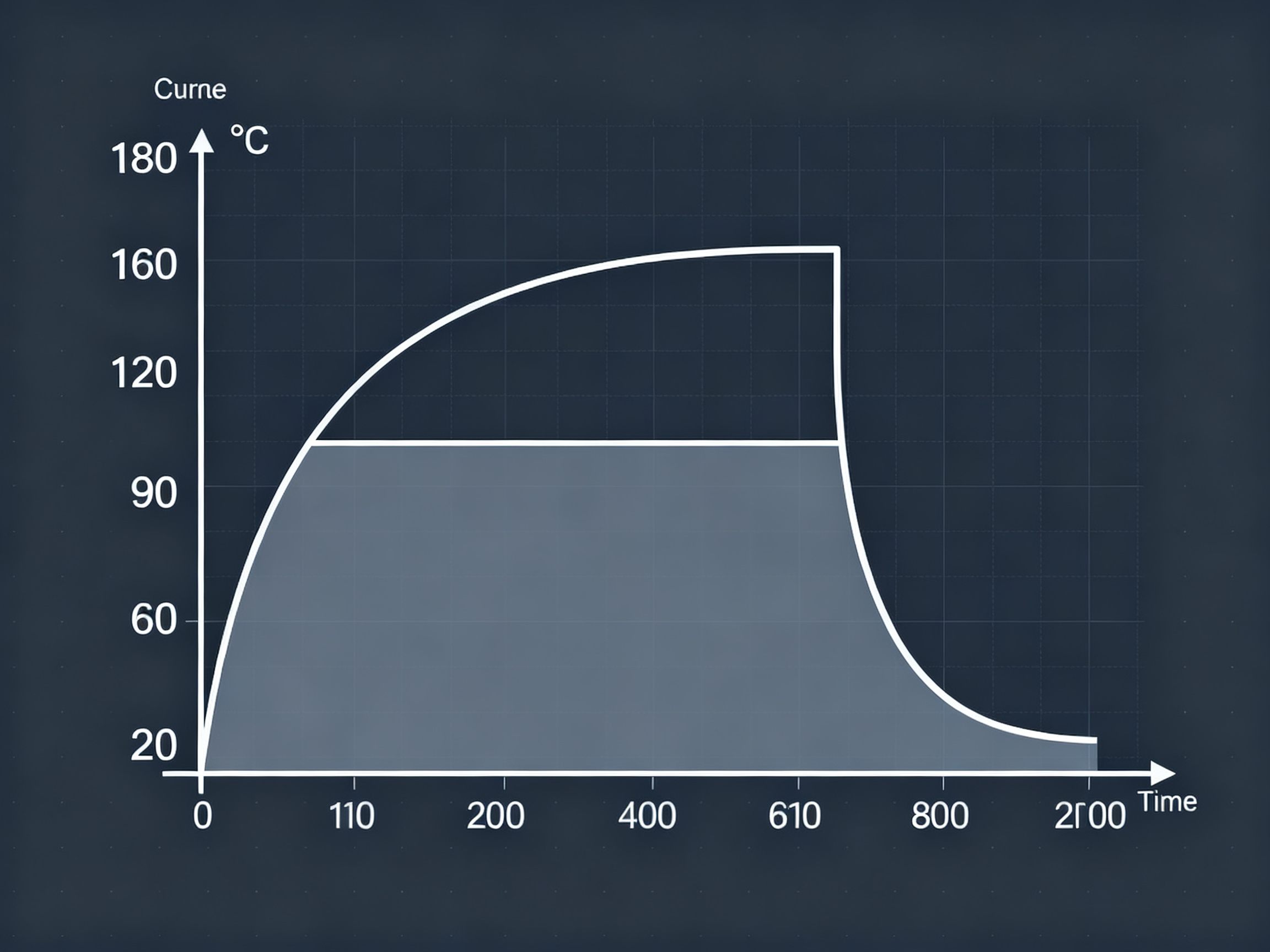
A ramp-soak profile is basically a recipe for your part’s heat treatment. Think of it like following a slow-cooker program instead of just cranking up the heat and hoping for the best.
The basic structure goes like this:
- Preheat or initial dwell – You bring the chamber up to a starting temperature and let everything stabilize. This prevents thermal shock to your layup.
- Controlled ramp rate – The oven heats up gradually, usually between 1°C and 5°C per minute for composites. Faster ramps save time but risk exotherm events where the resin generates its own heat and goes out of control.
- Soak temperature and time – This is where the magic happens. The resin polymerizes. Typical soak times run 60 to 120 minutes depending on part thickness and resin system.
- Optional staged cure – Some complex layups need multiple temperature plateaus. You might soak at 130°C, then ramp to 180°C for a second dwell.
- Controlled cool-down – Rapid cooling causes thermal gradients that lead to warpage and residual stress. The cooling rate should be programmed and gradual.
- Alarm limits – The controller flags deviations from setpoint so bad parts do not finish the cycle.
What the controller needs to do
For aerospace and defense work, your controller cannot just be a fancy thermostat. You need multi-segment programming so you can build complex profiles with multiple ramps and dwells. Recipe storage means operators load the right program without guessing. PID tuning keeps overshoot minimal. Data logging creates a traceable record for every batch.
Password access stops unauthorized changes. And exportable batch records? Those are non-negotiable for AS9100 compliance and NADCAP audits.
How engineers verify the cure cycle
This is where theory meets reality. Process engineers place thermocouples directly on representative parts, not just in the chamber. They also map loads with sensors on tooling, fixtures, and cold spots.
The data tells the real story. Chamber temperature and part temperature can diverge by 10°C or more depending on thermal mass and load configuration.
| Measurement Point | Typical Observation | Action if Gap Exceeds 5°C |
|——————-|———————|————————–|
| Chamber ambient | Setpoint reference | Check airflow, PID tuning |
| Part surface | Actual cure temperature | Adjust ramp rate, extend soak |
| Tooling/mold | Heat sink effect | May need longer dwell time |
| Cold spot (load center) | Worst-case location | Validates full-load capability |
Pro Insight: When validating multi-stage cure profiles, place thermocouples on representative carbon fiber parts, fixtures, and cold spots. Document the lag between chamber setpoint and actual part temperature at each stage. This data becomes your proof of cure for quality records and makes troubleshooting much easier when something goes wrong.
The resin manufacturer’s data sheet gives you the target cure window. Your thermocouple traces prove you hit it.
Build Options: Cabinet, Walk-In, Truck-In, Rotary, and Custom Batch Oven Designs
Not all batch curing ovens look the same, and that’s kind of the point. The format you pick depends entirely on what you’re making, how big those parts are, and how your production floor flows.
Cabinet and benchtop ovens work great for small-to-medium parts, prepreg sheets, or test panels. They sit on the floor or bench, load from the front, and typically handle parts up to a few hundred pounds. If your operation involves electronics manufacturing or smaller composite assemblies, these make sense. They fit easily into existing facilities without major infrastructure changes.
Walk-in ovens handle larger assemblies like aircraft interior panels, wind turbine blades sections, or automotive body panels. The operator literally walks in to load and unload. These usually have higher floor loading capacity, multiple rack levels, and better airflow patterns for distributed loads. Your facility needs adequate headroom and strong floor structure.
Truck-in or car-bottom ovens let you load a cart outside the oven and roll it in on rails. This protects operators from heat exposure during loading, speeds up cycle changes, and handles heavier payloads than walk-ins. Perfect for aerospace shops where parts come in on standardized carts.
Rotary batch ovens tumble the load during curing. Here’s where it gets interesting. These work really well for small parts, fasteners, 3D-printed composite components, or granular materials that need 3D heat exposure. The tumbling action ensures every surface gets equal convection. But for large, fragile layups? Skip it. Those parts need to stay stationary.
The real question is what your part geometry demands. Flat panels want horizontal airflow. Complex 3D shapes might need vertical or recirculated patterns. Thick layups with high thermal mass require careful airflow to avoid cold spots.

| Oven Type | Best For | Load Size | Key Advantage | Watch Out For |
|———–|———-|———–|—————|—————|
| Cabinet/Bench | Small parts, prepreg, R&D | Up to 500 lbs | Fits anywhere | Limited volume |
| Walk-in | Large assemblies, panels | 500-5,000 lbs | Full operator access | Floor loading |
| Truck-in/Car-bottom | Heavy payloads, carts | 1,000-10,000+ lbs | Reduced operator exposure | Infrastructure cost |
| Rotary | Small parts, tumbling cure | Up to 200 lbs | Uniform 3D exposure | Fragile parts unsuitable |
From Our Experience: Before requesting a quotation for any composite curing oven for sale, nail down these spec gaps: exact load size and weight, your resin system and cure temperature, required cycle time, preferred airflow direction, available utilities (electric vs. gas capacity), floor space constraints, and which acceptance tests you need. Suppliers can’t quote accurately without these, and you’ll end up with the wrong oven if you skip this homework.
Custom batch oven designs open up even more possibilities. Stainless steel interiors resist corrosion from resin off-gassing. HEPA filtration keeps cleanrooms clean. Nitrogen purge creates inert atmospheres for oxygen-sensitive resins. Viewing windows let operators monitor parts without opening the door. And PLC integration connects your oven to plant MES systems for full traceability.
Pick the format that matches your parts, your facility, and your workflow.
Choosing the Best Industrial Curing Oven Heater and Airflow System
Here’s where a lot of buyers get hung up. They obsess over temperature range and chamber size, then grab whatever heater type the supplier recommends. That can bite you later. The heater and airflow system is what actually delivers heat to your parts, and getting it wrong means hot spots, cold spots, and batches that come out inconsistent.
Electric heaters are the go-to choice for most composite curing work. They hit 95-99% thermal efficiency, give you precise temperature control, and produce zero combustion contamination. For aerospace and electronics manufacturing, that cleanliness matters. The catch is operating cost. If you’re running multiple large ovens at high volumes, your electrical infrastructure might need serious upgrades. We’re talking about substantial transformer capacity and distribution panel work.
Gas-fired heaters cost less to run per BTU and heat up faster for high-throughput operations. But you deal with lower baseline efficiency (60-75%), combustion emissions, and NFPA 86 requirements for explosion relief venting. These work best when you have bulk heating demands and existing gas infrastructure.
Infrared-assisted systems target specific applications where direct heat penetration helps, like thick layups or thermoset prepregs. The infrared energy heats the fiber directly rather than just the air, which can reduce cycle times for certain part geometries.
| Heater Type | Thermal Efficiency | Precision | Operating Cost | Best For |
|————-|——————-|———–|—————-|———-|
| Electric | 95-99% | Excellent | Higher at scale | Clean, precise cures |
| Gas-fired | 60-75% | Good | Lower per BTU | High-volume bulk heating |
| Infrared-assisted | Varies | Good | Moderate | Thick sections, fast cycles |
Now here’s the part most spec sheets skip. Airflow design matters just as much as the heater itself. Horizontal airflow pushes heat across the chamber from one side to the other. Vertical patterns push from top to bottom. Recirculation rates determine how quickly the chamber stabilizes after a door opening. Baffles and dampers shape the flow around your load geometry.
For complex part loads with molds and fixtures, CFD modeling helps predict airflow behavior before you commit. A good supplier will map actual airflow patterns during FAT, not just show you temperature uniformity numbers.
Blower sizing ties directly to your recovery time requirements. Heavy tooling absorbs heat. Fast cycle demands need bigger blowers. And energy-efficient variable frequency drives let you dial back airflow when full power isn’t needed, saving electricity without sacrificing performance.
How Industrial Curing Ovens Are Made: From Heat Source to FAT Documentation
Ever wonder what goes into building one of these things before it shows up at your facility? Understanding the build process helps you ask better questions and spot potential problems before you sign on the dotted line.
The whole thing starts with requirement capture. Your supplier needs to know your exact load sizes, cure temperatures, cycle times, airflow requirements, and which standards you have to meet. AMS 2750 for aerospace? NADCAP accreditation? These details drive everything downstream. Skipping this step is how you end up with an oven that technically works but doesn’t actually fit your process.
Thermal calculations come next. Engineers figure out how much heat input you need based on your target ramp rates, thermal mass of your load, and recovery time requirements after door openings. Too little heater capacity and your cycles run long. Too much and you overshoot setpoints and waste energy.
Then the physical build starts. The chamber shell gets fabricated from heavy-gauge steel, welded together and insulated with high-temperature ceramic fiber or mineral wool. Quality welds here matter because poor seams create hot spots and heat loss. The interior gets lined with panels designed for clean air flow patterns, whether that is horizontal, vertical, or recirculated.
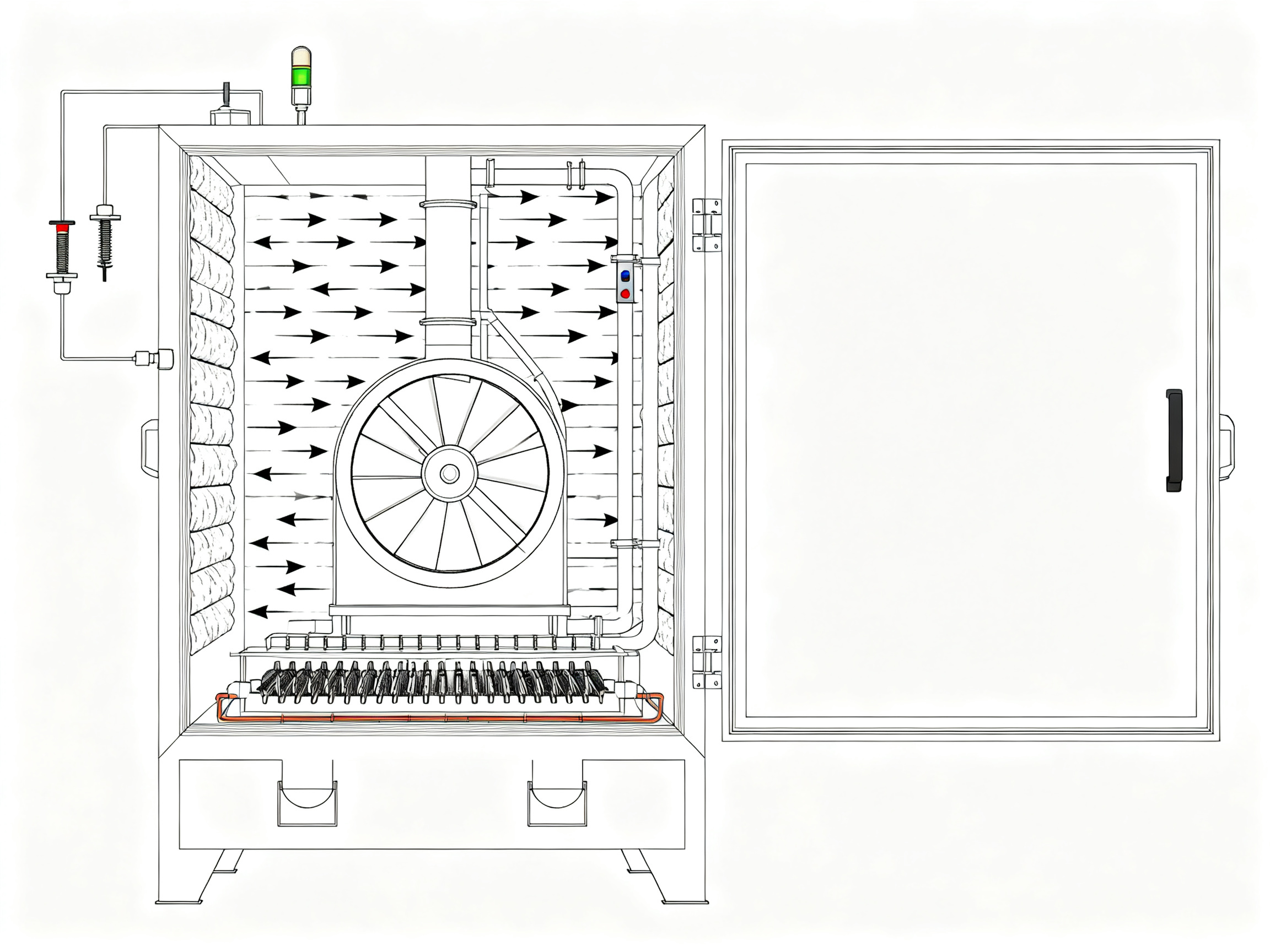
Heater elements and blower assemblies get mounted next. Electric heaters typically run as open coils or tubular elements. Gas-fired units need combustion chambers, burners, and proper venting. The blower wheel and ductwork get sized to move enough air volume for your uniformity requirements.
Controls integration happens in parallel with the mechanical build. The PLC or temperature controller gets programmed, PID loops get tuned, and safety interlocks get wired in. For aerospace work, this includes multi-zone control, data logging, and integration with plant MES systems.
Safety systems follow NFPA 86 requirements, especially for ovens processing materials with VOC emissions or resin off-gassing. Explosion relief doors, solvent concentration monitors, and automatic exhaust ventilation all need to be specified and installed correctly.
What documentation you should get with your oven
Before shipment, you want the complete documentation package. This includes general arrangement drawings showing dimensions and clearances, electrical schematics for every circuit, P&ID diagrams for process piping and instrumentation, materials list specifying every component, controller manuals with full programming documentation, calibration certificates for all temperature sensors and instruments, and temperature uniformity survey results from factory testing.
The factory acceptance test, or FAT, is your proof that the oven performs. Ask for the raw test data, not just a pass/fail statement. TUS reports with thermocouple locations, calibration certificates for test instruments, and loop verification results all should be included. Any reputable supplier will have this ready before asking you to sign off on acceptance.
Service access matters too. Can your maintenance team actually reach the heater elements, blower motor, and filters without disassembling half the oven? Look for removable access panels, easy-clean filters, and clear documentation of spare parts availability. Ovens with poor service access end up down for longer when things break.
Spending time understanding the build quality upfront saves headaches later. You will know what to look for during commissioning and have a baseline for evaluating performance over the oven’s operational life.
Buying Checklist: How to Compare a Composite Curing Oven for Sale
Before you send one email to a supplier, get your requirements straight. I’ve seen buyers waste months going back and forth because they did not nail down the basics upfront. Here’s the checklist that actually works.
RFQ Checklist for Composite Curing Ovens
| Category | What to Specify | Why It Matters |
|———-|—————–|—————-|
| Part dimensions | Max length, width, height per part and batch | Determines chamber size you actually need |
| Load weight | Single-part weight and total batch weight | Drives structural design and heater sizing |
| Resin system | Epoxy, BMI, cyanate ester, or other | Defines cure temperature and post-cure needs |
| Cure temperature | Target soak temp and soak time | Your oven needs headroom above this |
| Пропускная способность | Batches per shift, cycle time target | Impacts blower sizing and recovery requirements |
| Uniformity target | ±3°C aerospace vs. ±10°C industrial | Determines cost and complexity of oven design |
| Data logging | Full batch records, MES integration | Mandatory for aerospace/defense work |
| Utilities | Electric vs. gas, voltage, capacity | Can’t quote without knowing what you have |
| Floor space | Available footprint and ceiling height | Walk-in vs. truck-in design decision |
| Compliance | AMS 2750, NADCAP, NFPA 86 requirements | Drives documentation and testing needs |
Comparing Suppliers Beyond Price
Price matters. But here’s what actually differentiates suppliers in 2026.
Engineering support during specification gets you an oven that fits your process. Some suppliers just take orders. The good ones push back on undersized heaters or airflow patterns that won’t work for your parts.
Customization depth matters if you need something non-standard. Ask about stainless interiors, nitrogen purge, HEPA filtration, or PLC integration before assuming it’s possible.
Delivery timeline varies wildly. Standard cabinets might ship in 8-12 weeks. Custom walk-ins can take 6 months or more. Factor that into your production planning.
Service response and spare parts availability keeps your oven running. Ask about response time guarantees and which parts are stocked versus made to order.
FAT quality makes or breaks your acceptance process. Get raw test data, not just a pass/fail statement. Temperature maps with actual load configurations tell you the real story.
References from similar industries help you gauge whether a supplier understands your application. An aerospace reference means they know AMS 2750. An EV reference means they understand high-volume throughput.
Common Mistakes to Avoid
Buying by maximum temperature alone is the biggest mistake I see. That 400°C rating means nothing if the uniformity drifts ±15°C or the recovery time kills your cycle time.
Undersizing airflow saves money upfront but creates cold spots on dense loads. Always demand loaded-chamber test data.
Ignoring documentation needs upfront creates headaches later. If you need AS9100 traceability, specify it before quoting, not after.
Failing to define integration requirements leaves you with a standalone oven that does not talk to your MES. Ethernet connectivity, batch record exports, and alarm integration need to be in the spec.
From Our Experience: Before requesting a quotation for any composite curing oven for sale, nail down these spec gaps: exact load size and weight, your resin system and cure temperature, required cycle time, preferred airflow direction, available utilities (electric vs. gas capacity), floor space constraints, and which acceptance tests you need. Suppliers cannot quote accurately without these, and you will end up with the wrong oven if you skip this homework.
Take a week to fill out that checklist. It will save you months of rework later.
Custom Design Considerations for Electronics, Automotive, Aerospace, and Defense Buyers
Not every buyer needs the same thing from a composite curing oven, and that’s kind of the point. A carbon fiber curing oven built for a defense contractor looks very different from one spec’d for an EV battery manufacturer, even if the basic heat-transfer physics stays the same.
Electronics manufacturers care most about clean operation. Residual flux, particulate, and outgassing from curing parts can contaminate nearby assemblies. These buyers want HEPA filtration, stainless interiors, and airflow patterns that keep contaminants away from clean zones. The focus is on process isolation and contamination control.
Automotive producers prioritize throughput and repeatability. High-volume EV manufacturers need ovens that fit into takt-time-driven production lines, run hundreds of cycles per month, and produce parts that match spec every single time. Here the emphasis is on speed, automation integration, and total cost per part.
Aerospace shops deal with the most demanding documentation requirements. AMS 2750 compliance, NADCAP audits, and AS9100 traceability mean every cure cycle needs recorded proof. These buyers pay a premium for data logging, multi-zone control, and documentation packages that survive customer quality reviews.
Defense contractors sit at the intersection of aerospace rigor and long-term program support. They need ovens that stay in production for decades, accept government source inspection, and deliver reliability above all else. Spare parts availability and supplier stability matter more than cutting-edge features.
| Industry | Primary Priority | Key Oven Feature | Buyer Question to Ask |
|———-|—————–|——————|——————–|
| Electronics | Clean operation | HEPA filtration, stainless interior | Does airflow isolate my parts from contaminants? |
| Automotive | Throughput and repeatability | Fast ramp/cool, automation ready | What is cycle time per part at target cure temp? |
| Aerospace | Documentation and compliance | Full data logging, multi-zone control | Can you provide TUS data matching my load config? |
| Defense | Reliability and traceability | Long-term support, government compliance | What is your spares program for 20+ year programs? |
Beyond industry requirements, smart buyers factor in scalability and serviceability. Can the oven accommodate bigger parts as programs grow? How easy is heater replacement when elements fail? What about operator safety features like cool-touch doors and automated material handling? These questions matter more after the oven runs for five years than they do on delivery day.
Expert Perspective: Specify the Process Before You Specify the Oven
Here’s the thing. After all these specs and configurations and standards, the biggest mistake I see buyers make is jumping straight to chamber dimensions before they’ve figured out their actual process requirements.
Your resin system drives everything. Epoxy cures between 120°C and 180°C. BMI and cyanate ester systems push higher. If you don’t know your cure temperature and hold time, you’re basically guessing at the oven you need.
Then there’s load configuration. Dense molds, vacuum bags, and fixture thermal mass change how your oven performs compared to an empty chamber. Ask yourself: how many parts per batch, what arrangement, and what tooling is required? Recovery time after door opening will make or break your cycle time, especially for high-volume production lines.
Documentation and traceability requirements matter more in 2026 than they did a few years ago. Aerospace and defense contracts demand batch records that prove your cure cycle hit spec. If you’re selling into those markets, data logging isn’t optional.
So here’s what I’d tell anyone starting this search. Collect your resin data sheets first. Map representative loads with thermocouples to see where cold spots actually occur. Define your acceptance tests before you send RFQs to any supplier. And get a complete specification together that covers load sizes, cure temperatures, cycle times, uniformity tolerances, and documentation needs.
That spec package does two things. First, it forces you to think through the process before you buy equipment. Second, it gets you better responses from suppliers who can actually meet your requirements, not just sell you what’s in stock.
A good supplier will challenge your assumptions. They’ll ask about your ramp rates, your load patterns, your quality standards. If they’re just taking orders without pushing back, you might not be working with an engineer who understands composite curing.
The cheapest quote usually isn’t the best value when you’re buying thermal processing equipment that needs to perform for years.
Quick Decision Checklist
- [ ] Define your resin system and cure temperature requirements
- [ ] Document load dimensions, weights, and thermal mass
- [ ] Specify ramp-soak profile and cycle time targets
- [ ] Determine temperature uniformity tolerance needed
- [ ] Confirm documentation and traceability requirements
- [ ] List utilities available (electric vs. gas, capacity)
- [ ] Define acceptance test criteria and FAT expectations