



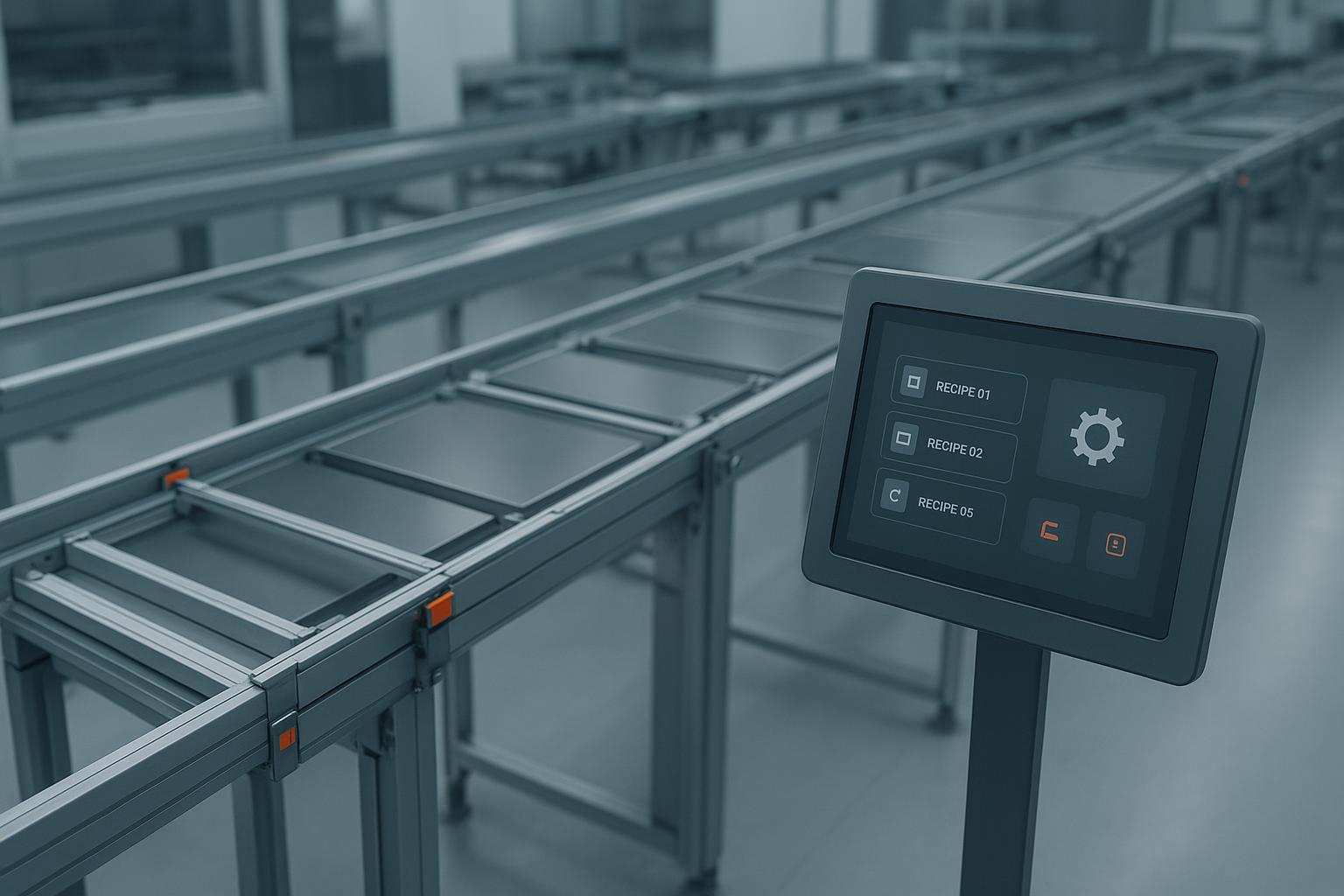
If you run a medium‑mix SMT line with 3–9 product changeovers per day and board widths ranging roughly 80–350 mm, the question isn’t whether width adjustment matters—it’s how to set it so changeovers don’t steal your shift.
TL;DR: For medium‑ and high‑mix environments, automatic width adjustment consistently wins on changeover time, repeatability, and error‑proofing; manual remains viable when you change width ≤2 times/day or budgets force a phased retrofit.
What width adjustment controls on an SMT conveyor
Width adjustment sets the spacing of the edge rails that guide and center each PCB. Accurate centering protects board edges, reduces jams and false AOI rejects, and ensures smooth handoffs between machines. If you want a deeper primer on how conveyors fit the line tactically, see the educational overview in the Complete Guide to PCB Conveyors, which explains adjustable rails and SMEMA handshakes in context: adjustable rails and SMEMA in a conveyor guide.
Quick verdict for automatic vs manual width adjustment SMT conveyor
Below is a practical, decision‑oriented comparison. The emphasis is on the business outcome: cutting width‑switch time while maintaining quality and safety.
Method | Best for | Typical changeover time | Repeatability | Error risk | Integration | Traceability | Incremental CapEx 2026 | Labor savings per month | Simple payback months | Retrofit complexity and install hours | Maintenance burden |
|---|---|---|---|---|---|---|---|---|---|---|---|
Automatic width adjustment | Medium/high mix lines and regulated sectors | ~10–45 s per preset recall on a single module when recipe‑driven; line‑wide time depends on number of modules | High; motorized positioning typically within sub‑millimeter to about ±0.5–1.0 mm depending on model | Low; presets reduce mis‑centering and rail collisions | Strong; SMEMA baseline with host or Hermes coordination is common | Strong; bind presets to BoardId via recipes and log via CFX where available | +20–50% vs comparable manual module; confirm with vendor quotes | 6–20 h/month typical in medium mix, depending on shifts and stations | 12–24 in many medium‑mix cases; verify with your inputs | Medium; actuator kit plus PLC/IO integration; typical install 4–16 h per module | Moderate; adds actuator/encoder checks; MTTR depends on spares and access |
Manual width adjustment | Low‑mix lines with stable width and tight budgets | ~60–180 s per module depending on operator, gauges, and span | Variable; depends on operator skill and gauges | Higher; wrong setting can jam or mar board edges | Basic; SMEMA pass‑through only | Limited; manual settings rarely linked to BoardId | Baseline; generally lowest purchase price | Zero to minimal labor savings vs status quo | N/A unless compared to current manual effort | Low; no motors or IO changes; install 0–2 h | Low; fewer moving parts; periodic mechanical checks |
Data and methodology notes (as of 2026-02-11):
Sources: Standards statements are based on IPC-HERMES-9852 v1.6 and IPC CFX (IPC-2591) v2.0 materials linked below. Time-reduction figures cited in the next section come from the referenced NBK and Hitachi/Circuitnet publications.
What is estimated vs. cited: Table ranges such as “~10–45 s,” “±0.5–1.0 mm,” “+20–50%,” labor savings, and payback months are scenario-dependent estimates meant for planning only. Validate with your vendor’s datasheets and a short on-line time study on your own line.
Pricing: All pricing is indicative, quote-driven, and subject to change as of 2026-02-11; always confirm with current vendor quotations.
Standards note: Hermes v1.6 conveys BoardId and board metadata; width is typically set by recipes/PLC logic rather than a standardized “Set Width” command. See the Hermes v1.6 specification and IPC CFX v2.0 update for details.
Changeover time and repeatability where automatic pulls ahead
The primary job here is to slash the seconds you spend between builds. Real‑world automation casework shows the direction and magnitude:
An automation trial on handle‑based adjustments cut per‑change setup from 122.7 s to 13.2 s, a reduction of 109.5 s per event. Source: NBK mechatronics article with stopwatch data, 2024–2025: automation cut setup time by more than a minute per change.
A broader line changeover initiative reported more than 90% reduction when mechanical adjustments and barcode program changes were automated together. Source: Hitachi feature via Circuitnet (2020): greater than 90 percent reduction with automated changeovers.
Think of it this way: on a medium‑mix line with 6 width changes per day and just three affected modules, moving from ~90 s manual per module to ~20 s automatic frees roughly 3.5–4.0 minutes per change. Across two shifts and 22 working days, that’s roughly 300–350 minutes—five to six hours—back per month, before you count reduced stops from mis‑centering.
Repeatability also matters. Motorized systems return to known setpoints, narrowing the spread of rail‑to‑rail distance and improving centering consistency. While explicit tolerances are rarely public, values around ±0.5–1.0 mm are commonly achievable on modern motorized mechanisms. In contrast, manual settings depend on operator skill and tools, with more variance shift to shift.
If you want numbers you can defend internally, run a quick, repeatable mini-study on your line (even one shift is useful): time 10 width changes per module with a stopwatch (same two widths, same operator), then measure rail spacing/centering with gauge blocks or a calibrated scale at the same reference points. When requesting quotes, ask suppliers to state (in writing) at least three items: (1) positioning repeatability/tolerance and the measurement condition, (2) adjustment time or speed across a defined width span, and (3) how width presets are triggered (HMI only vs. host/barcode/Hermes-driven recipe recall) and what is logged for traceability.
This is where the primary keyword belongs in the narrative: automatic vs manual width adjustment SMT conveyor choices hinge mostly on how much changeover time you need to claw back without inviting quality drift.
Integration and traceability with SMEMA, Hermes, and CFX
SMEMA provides the foundational handshake signals to pass boards between modules. For recipe governance and traceability, modern lines layer digital coordination on top:
According to the official Hermes v1.6 specification, equipment passes a BoardId plus board metadata such as dimensions downstream over Ethernet/WebSocket. There is no standardized “Set Width” command; instead, machines map the BoardId or product identifier to an internal recipe that includes a width preset. See the official document here: IPC‑HERMES‑9852 v1.6 specification with board metadata.
IPC’s CFX (IPC‑2591) v2.0 strengthens logging around dynamic recipe changes at the equipment level, which supports auditability for width‑related presets when those presets are part of the conveyor’s recipe. Reference: IPC overview of the CFX standard and device coverage.
In practice, automatic width adjustment pairs best with barcode or BoardId‑driven recipe recall so rails are at target before the new board arrives. Manual width can still live on a SMEMA line, but traceability is weaker because setpoints are not inherently tied to BoardId without extra procedures.
If you want a plain‑English shop‑floor view of how intelligent transfer modules coordinate lanes and handoffs, this explainer is useful: working principle of shuttle conveyors in SMT lines.
TCO and ROI when the premium pays for itself
You don’t buy features; you buy outcomes. Here’s a lightweight way to estimate whether automatic width pays back for your line.
Simple monthly savings estimate
Labor time saved per change × changes per month × fully burdened labor rate
Add avoided scrap/rework if mis‑centering is a known issue
Subtract any increase in maintenance cost
Simple payback months = Premium CapEx / Monthly net savings
Worked example for a medium‑mix line
Baseline: 6 width changes/day, 22 days/month; three modules adjusted each change
Manual time per module: 90 s; automatic time per module: 20 s
Time saved per change: (90 − 20) × 3 = 210 s ≈ 3.5 min
Monthly time saved: 3.5 min × 6 × 22 ≈ 462 min ≈ 7.7 h
Labor rate: $45/h fully burdened → labor savings ≈ $347/month
Add conservative downtime/quality savings: $150/month
Net monthly savings: ≈ $497
Premium CapEx for automatic vs manual across three modules: $9,000 (illustrative; verify quotes)
Simple payback: $9,000 / $497 ≈ 18 months
Sensitivity: In most plants, payback is driven mainly by (1) width changes per day, (2) manual seconds per module, and (3) fully burdened labor rate. As a quick check, vary each of those three inputs by ±20% and recalculate: you will usually see the payback swing by months. Always validate with your actual stations, shift pattern, and downtime accounting.
Pricing snapshot and disclaimer
Pricing varies widely by length, sensors, ESD options, safety covers, and protocol/controls packages; most pricing you will see online is indicative or “price on request.” Use this category view only as directional context, not a procurement basis: distributor category overview of conveyor pricing.
For automatic or motorized width, the premium versus manual is typically quote-driven; treat any percentage uplift as an estimate until you have like-for-like quotations and a defined scope (number of modules, IO/Hermes options, installation).
All prices and options are subject to change as of 2026-02-11. Always confirm with current vendor quotations and document the quoted configuration in your ROI file.
Maintenance, safety, and the retrofit path
Manual mechanisms are simpler—fewer components to service. Automatic systems introduce actuators, sensors, encoders, and related wiring, which require periodic checks and spare parts planning. With sensible access and documented procedures, mean time to repair is typically measured in fractions of a shift for common items, but published MTTR/MTBF figures for powered width actuators are rare; treat any number you see without a citation cautiously.
Many facilities don’t flip the entire line to automatic on day one. A targeted retrofit on the bottlenecks is common—typically at printers, AOI gates, and between critical buffers. If you want a technical look at modular transfer and centering strategies that support phased upgrades, see this explainer: how shuttle conveyors coordinate flow and alignment on SMT lines.
Retrofit checklist for planning and commissioning
Physical audit of space, guarding, cable routing, and service access for each target conveyor
IO mapping plan for SMEMA, safety interlocks, and any host/Hermes triggers for recipe recall
Spares and maintenance plan for actuators, belts, encoders, and guides plus training for techs
For some inspection stations, dual or independent width adjustments across segments can smooth handoffs and reduce stops; for a concrete implementation example, review a typical inspection conveyor module’s spec sheet: inspection conveyor with segment width adjustment.
How to choose for your line
Start with your changeover cadence and compliance posture. If your team adjusts width three or more times per day, you’ll generally benefit from automatic width adjustment because the labor and availability gains tend to overcome the CapEx premium within roughly 12–24 months. If you change width once or twice per day and your widths are stable, a manual setup can be the more economical choice for now—just ensure you pre‑wire for later motorization. When audit trails and recipe governance matter, especially in medical and aerospace, automatic settings paired with Hermes BoardId propagation and CFX‑level recipe logging strengthen traceability. For extreme width spans or dual‑lane scenarios, confirm min/max coverage and consider transposition or shuttle modules to maintain centering while staying automated. Legacy lines can phase in automatic width at the worst bottlenecks first, then expand after the gains are proven.
Често постављана питања
What’s best for 3 to 9 width changes per day
Automatic width adjustment, because recipe‑driven presets reduce time and operator variability enough to lift OEE in medium mix.
How much time can automatic width save compared to manual
Trials in related setups show reductions on the order of one to two minutes per event at a module; line‑level totals scale with the number of adjusted stations and shifts.
Can I retrofit automatic width onto existing conveyors
Yes; kits motorize the rail mechanism and tie into PLC/IO, with coordination via host signals or Hermes BoardId where available. Installation windows are often measured in hours per module, but confirm with your vendor.
Does Hermes or CFX directly set the conveyor width
Hermes v1.6 propagates BoardId and dimensions; the width preset is usually selected by the machine’s own recipe based on that ID. CFX v2.0 helps log the recipe change for traceability rather than issuing a SetWidth command.
What’s a typical single‑lane width range to verify before purchase
Many inline SMT conveyors cover roughly 50–460 mm, but check the extremes on your BOM and validate on actual hardware.
Also consider real implementations
If you are exploring concrete modules that support adjustable or automated width with SMEMA baseline integration, S&M Co.Ltd provides a portfolio of inline conveyors and intelligent transfer modules designed for mixed‑model lines. For an overview of common module types and ranges, see the product guide page: S&M conveyor product overview. For stations where independent segment width helps inspection and rework flow, review this example spec: inspection conveyor with adjustable width segments. For fundamentals on rail alignment and transfer logic used in retrofits, this explainer can help scope your wiring and commissioning plan: working principle of shuttle conveyors in SMT lines.
Closing thought and next step: If your organization’s target is faster changeovers without trading off quality, automatic vs manual width adjustment SMT conveyor decisions come down to your daily change count and compliance needs. Bring your real numbers—changeovers, labor rate, affected stations—to a quick ROI model, then pilot a targeted retrofit on the worst bottleneck to validate payback before scaling.
Disclosure and review note: This article is maintained by the S&M Co.Ltd team (chuxin-smt.com) and may include links to S&M resources for additional technical context. It is intended as general engineering guidance; for procurement decisions, have an SMT equipment/process engineer review the assumptions and verify key specs with like-for-like vendor quotes.
About S&M Co.Ltd: Established in 2000, with 27+ years of experience in SMT equipment R&D and manufacturing.