



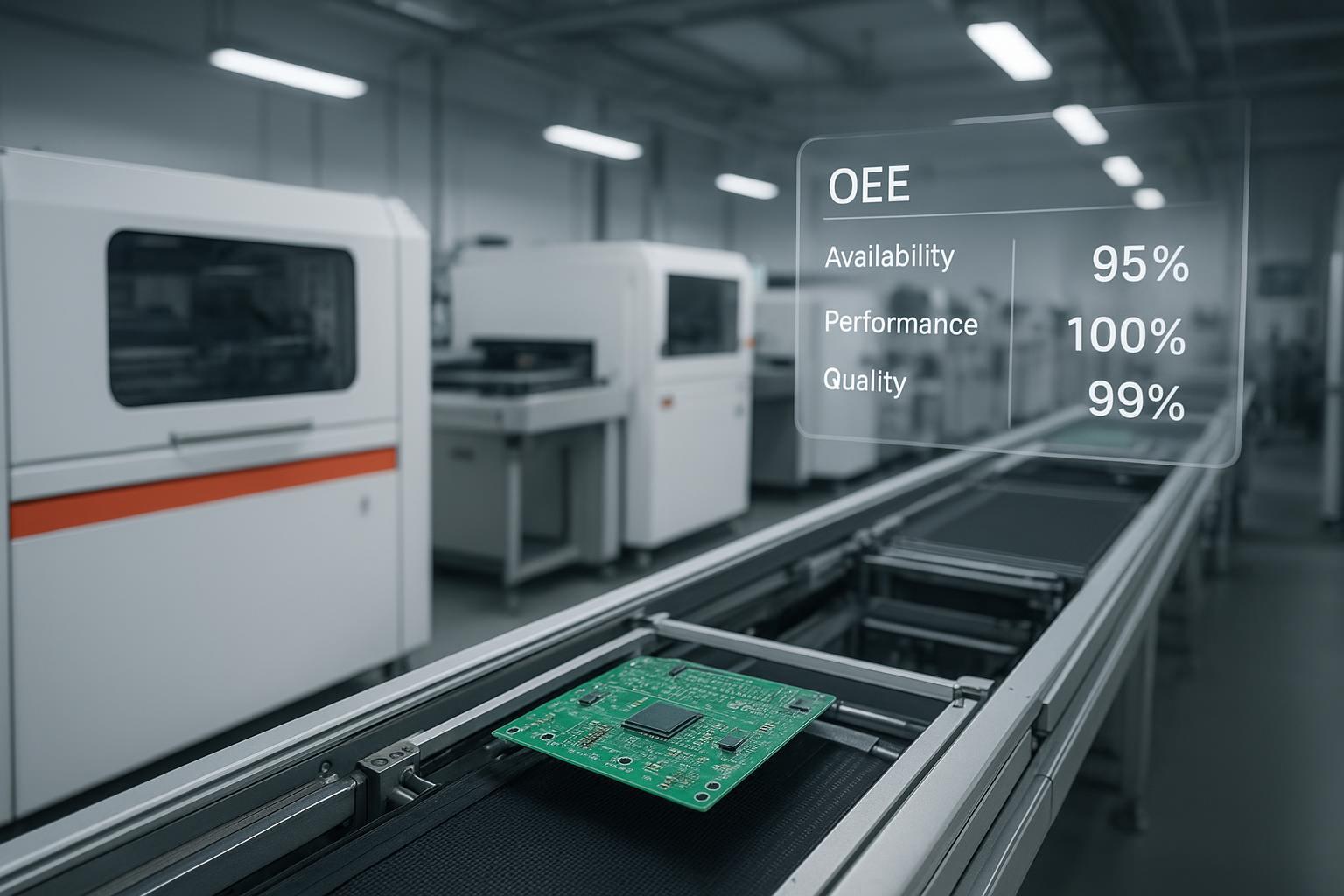
If your line never quite hits its planned takt, the conveyor might be doing more than just moving boards—it’s shaping your OEE. When baselines are missing, you can still build a defensible case for SMT conveyor ROI by anchoring on OEE (as the hero metric), using conservative assumptions, and proving impact in a short pilot. This playbook gives you the formulas, a step‑by‑step worked example, an input template, and a pilot plan you can run this quarter.
What OEE, FPY, and payback mean on an SMT line
Overall Equipment Effectiveness (OEE) is defined as Availability × Performance × Quality. Authoritative guides align on this structure; IBM’s overview “OEE: measure manufacturing productivity” and Autodesk’s “OEE: Productivity, Availability, and Quality” both explain the three factors and practical calculations. For reference: IBM — OEE overview и Autodesk — OEE definitions.
Availability: proportion of planned production time that is actually running (subtracting unplanned stops, changeovers, jams).
Performance: actual output vs the theoretical maximum at the ideal cycle time.
Quality: good units as a share of total produced. FPY (first‑pass yield) directly supports this term.
Payback is the period for savings to cover the investment; ROI% compares net savings to total investment.
How conveyors move OEE’s three levers
Conveyors touch all three OEE components on an SMT line.
Availability
Transfer reliability reduces minor stops from jams, misalignment, and blocked sensors. The shift from legacy SMEMA wiring to data‑rich machine‑to‑machine protocols (Hermes) plus MES connectivity helps prevent handshaking stalls and speeds recovery. See the official IPC‑HERMES‑9852 v1.6 specification.
Changeover acceleration matters. A mechatronics application report documented automated width change on SMT conveyors cutting a handle action from 122.7 s to 13.2 s and reducing monthly changeover time at the line level—evidence that width automation can sustain Availability. Reference: NBK — mechatronics SMT width change article.
Performance Stable indexing and speed synchronization prevent micro‑idling. Moving from simple ready/busy signals toward richer data exchange and MES context (IPC‑2591 CFX) allows tighter coordination across printer, placement, inspection, and reflow. For the standard’s scope (omnidirectional equipment‑to‑system messaging for electronics manufacturing), see IPC‑2591 (CFX) overview and IPC’s Connected Factory Exchange (CFX) overview.
Quality Gentle, consistent transport reduces handling defects (edge chipping, misplacement after transfer). Controlled cooling after reflow also stabilizes solder joints and board flatness; for a practical overview of cooling’s role on quality and throughput, see the internal guide on PCB cooling conveyors and SMT quality.
Cost buckets that actually show up in SMT conveyor ROI
When you build an SMT conveyor ROI model, tie each assumed OEE improvement to visible cost buckets:
Lost production from downtime and minor stops (Availability). Quantify as units not produced during planned time. If demand is capped or another station is the constraint, treat the gain as time and labor savings rather than incremental revenue.
Changeover labor and schedule loss (Availability/Performance). Faster, more repeatable width adjustment and recipe swaps shrink non‑productive time.
Rework and scrap (Quality). Reducing transfer‑induced defects (board collisions, bent leads, post‑reflow warpage) converts directly into FPY gains.
WIP and inventory carrying. Smoother flow and fewer stalls reduce buffers you carry between machines.
Maintenance and energy. Stable belts, sensors, and handshakes cut emergency interventions; modern drives can be more energy‑efficient at matched speeds.
By aligning each lever with an OEE term, you’ll make SMT conveyor ROI both traceable and finance‑friendly.
A conservative worked example you can audit
When not to monetize OEE as “more boards sold”
Before you convert an OEE lift into incremental units and margin, sanity-check the constraint:
Demand-capped schedules: you may not be able to sell more units this quarter.
Bottleneck elsewhere: if the true constraint is the printer, placement, AOI, or reflow, a better conveyor won’t translate 1:1 into line output.
Quality dominated upstream: if most defects come from print or placement, FPY gains from transport will be limited.
In those cases, monetize conveyor improvements as time saved (overtime avoided), labor saved, rework/scrap reduced, or schedule stability (fewer expedites) rather than pure incremental revenue.
Assumptions (replace with pilot numbers):
Planned production time: 250 days/year × 16 h/day = 240,000 min/year (illustrative; substitute your calendar, shifts, and planned downtime)
Ideal cycle time: 8.0 s/board (7.5 boards/min) (illustrative; use your bottleneck station’s true ideal cycle time)
Baseline OEE: 65% (illustrative; many factories report typical OEE in the ~40–60% band and “world-class” at ~85%+, but use your site baseline where possible)
Target OEE after conveyor upgrades: 80% (illustrative target; must be supported by measured reductions in transfer stops and/or changeover minutes)
FPY baseline: 90%; FPY target where conveyor-related defects apply: 95% (illustrative; only apply where transfer/cooling is a known contributor, and validate with defect Pareto)
Average contribution margin per good board: $6 (illustrative; replace with your product mix and margin model)
Conveyor project CAPEX + install: $25,000; annualized maintenance increase: $1,000 (illustrative; depends on conveyor type, lanes, options, and service model)
Important constraint note
If customer demand or an upstream/downstream station caps throughput, do not monetize all additional units. Convert the OEE improvement to time saved, overtime avoided, or scrap/rework reduction for a conservative ROI.
Step 1: Baseline output of good units
Theoretical max units/year = 240,000 min ÷ 8.0 s × 60 s = 1,800,000 boards
Baseline OEE 65% → total produced = 1,800,000 × 0.65 = 1,170,000 boards
Baseline good units (FPY 90%) = 1,170,000 × 0.90 = 1,053,000 boards
Step 2: Post‑improvement output of good units
Target OEE 80% → total produced = 1,800,000 × 0.80 = 1,440,000 boards
Target good units (FPY 95% where conveyor effects apply) = 1,440,000 × 0.95 = 1,368,000 boards
Step 3: Incremental good units and contribution
Delta good units = 1,368,000 − 1,053,000 = 315,000 boards
Contribution = 315,000 × $6 = $1,890,000 per year
Step 4: Net savings after costs
Incremental contribution $1,890,000 − incremental maintenance $1,000 = $1,889,000/year
Step 5: ROI and payback
Simple ROI% = (Annual net savings − CAPEX) ÷ CAPEX = ($1,889,000 − $25,000) ÷ $25,000 ≈ 7,436%
Payback ≈ $25,000 ÷ $1,889,000 ≈ 0.013 years ≈ 4.7 days
Sensitivity note
If only half the assumed OEE and FPY gains materialize (e.g., OEE rises to 72.5% and FPY to 92.5%), the delta good units roughly halves. Your payback may still be weeks, not months, but validate through the pilot below.
Risk-adjusted view (P10/P50/P90): model three outcome bands instead of a single point estimate—P10 (only ~25–40% of the assumed gains), P50 (~50–70%), and P90 (near 100%). Use the resulting payback range as the number you share with finance.
References: IBM’s OEE structure in “OEE: measure manufacturing productivity”; Autodesk’s schema in “OEE: Productivity, Availability, and Quality”; IPC’s CFX overview; the official Hermes v1.6 spec; Hermes implementation guidance in IPC‑HERMES‑9852 Best Practices; and NBK’s mechatronics SMT width change article.
A simple input template you can copy
Replace the Example column with your pilot values.
Input | Units | Example | Your value |
|---|---|---|---|
Planned production time per year | minutes | 240,000 | |
Ideal cycle time | seconds/board | 8.0 | |
Baseline OEE | percent | 65% | |
Target OEE | percent | 80% | |
Baseline FPY | percent | 90% | |
Target FPY | percent | 95% | |
Contribution margin per good board | USD | $6 | |
Conveyor CAPEX + install | USD | $25,000 | |
Added annual maintenance | USD/year | $1,000 |
Calculation checklist
Compute Theoretical Max Units = (Planned minutes ÷ Ideal seconds) × 60.
Baseline Good Units = Theoretical Max × Baseline OEE × Baseline FPY.
Target Good Units = Theoretical Max × Target OEE × Target FPY.
Delta Good Units = Target − Baseline; Annual Contribution = Delta × Margin.
Annual Net Savings = Contribution − Added maintenance; ROI% and Payback from Net and CAPEX.
Common pitfalls to avoid
Unit checks: confirm seconds vs minutes (and whether your “ideal” time is per board, per panel, or per lane).
Double counting quality losses: if you already embed Quality in OEE, don’t subtract the same scrap/rework again elsewhere unless you’ve separated the terms intentionally.
High-mix lines: if cycle time varies by SKU, use a weighted average by volume (or run the math per product family and sum).
Pilot plan: prove it in 30–90 days
A short, well‑instrumented pilot beats any spreadsheet. Structure yours so improvements are attributable to the conveyor and its integrations.
Scope and duration
30–90 days on one representative line; if possible, keep a parallel control line or normalize for shift mix, product mix, and demand.
Metrics and instrumentation
OEE by component (Availability, Performance, Quality) per shift; a downtime Pareto with explicit conveyor and transfer reason codes; changeover times and frequency; FPY and defect modes likely tied to transfer or cooling; queue lengths before/after conveyor.
Attribution method
If you implement automatic width adjustment or richer handshakes (Hermes/CFX), log the before/after changeover minutes and transfer‑related stops. Use disciplined measurement so finance can accept the normalization.
Controls Lock major variables during the pilot window (paste lot, feeder maintenance windows, placement program versions) or document changes for traceability.
Micro‑example: applying auto width adjust and modern handshakes
On high‑mix lines, manual width changes and basic ready/busy signals can quietly erode Availability. In practice, combining automatic width adjustment with standards‑based machine communication can trim changeover minutes and smooth transfers:
Width automation: See the internal guide on PCB conveyor width adjustment for how automatic vs manual mechanisms are set up and tuned. (Knowledge Base Source)
M2M signaling: Moving from legacy SMEMA wiring to Hermes‑class communication supports barcode/ID transfer and richer state, which helps avoid stalls and mismatches. For a concrete conveyor platform that supports SMEMA communication and PLC control, review S&M’s Inspection Conveyor specification. Pairing this capability with MES via CFX‑style messaging enables better synchronization across printer, PnP, and AOI. (Knowledge Base Source)
Used this way, the conveyor stops being “just transport” and becomes a stability component that supports higher OEE and a more believable SMT conveyor ROI.
Where to go next
Run a 30–90 day pilot using the template above, then substitute your measured numbers into the SMT conveyor ROI math. For capability details and setup practices, start with S&M’s guides on width adjustment и cooling conveyors. If you’d like a neutral review of your pilot plan, contact S&M to compare notes and assumptions—not a sales pitch, just engineering.