



By S&M Co.Ltd Applications Engineering Team (SMT line integration & conveyor systems; 20+ years of manufacturing equipment experience).
If you run a high-mix SMT line, the SMT line conveyor is rarely just a passive link between machines. It’s where changeovers stall, where boards get blocked or starved, and where integration issues surface first.
A modular, plug-and-play conveyor approach can make those problems easier to contain. A fixed-line conveyor configuration can make them easier to optimize. This guide gives a practical way to choose—without assuming one is always better.
Quick comparison matrix for modular SMT conveyor systems (modular vs fixed)
Evaluation criterion | Modular plug-and-play sections | Fixed-line configuration |
|---|---|---|
Layout changes & expansion | Easier to re-route, extend, or re-segment | Best when layout is stable for years |
High-mix changeovers | Supports adding buffers/inspection/gates where needed | Efficient when the flow is predictable and repeatable |
Downtime containment | Failures can be isolated to a section | A single interface issue can ripple further |
Multi-vendor integration | Strong fit when you standardize interfaces (e.g., SMEMA) | Strong fit when the full line is engineered as one system |
Optimization potential | Fast iteration, “swap and test” | Highest ceiling when tuned end-to-end |
CapEx vs lifecycle change cost | Often trades slightly higher upfront complexity for lower change cost | Often trades lower system complexity for higher rework cost when changes happen |
Key Takeaway: Choose modular sections when the factory reality is change—new products, new routings, shifting bottlenecks, or mixed-vendor equipment. Choose fixed when stability and maximum tuning matter more than reconfiguration.
Criterion 1: Layout volatility and future expansion
Pick modular sections if any of the following are true:
You expect new product introductions (NPI) to force routing changes.
Your facility layout is likely to change (space constraints, new lines, new inspection stations).
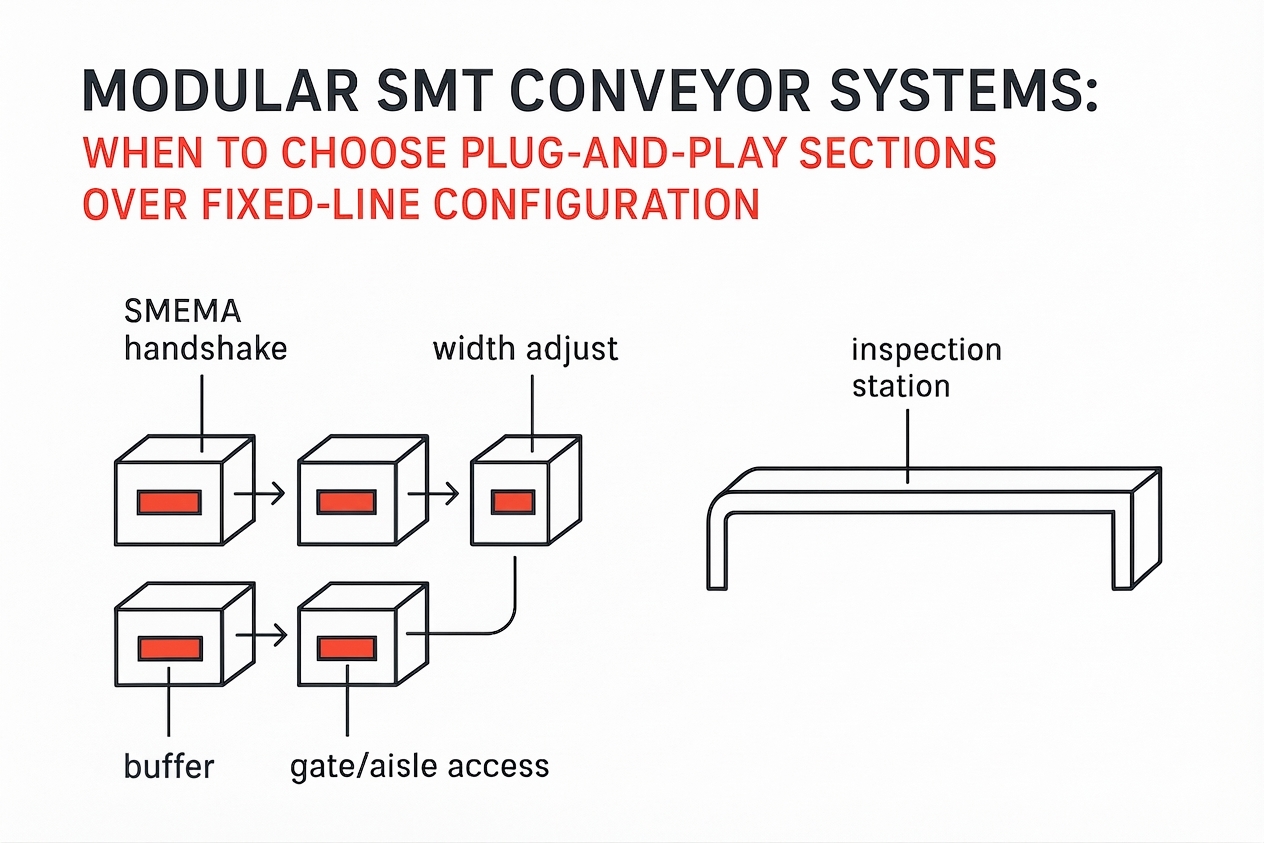
You routinely add or move points like operator inspection, buffering, rework routing, or cross-aisle access.
Pick a fixed-line approach when:
The line layout is stable and the goal is to optimize one consistent flow.
You can justify a one-time commissioning effort because the design will not be disturbed.
The key question isn’t “Do we ever change?” It’s “Do changes happen often enough that rework becomes a recurring downtime driver?”
Criterion 2: Changeover frequency and product mix
In high-mix environments, the conveyor system becomes part of the changeover.
Modular sections typically make sense when:
You run frequent width changes and need a repeatable adjustment process.
You change routing often (e.g., different inspection paths, different downstream equipment).
You need the ability to insert or relocate buffer points to protect the constraint.
A fixed-line configuration is typically the better fit when:
Product mix is stable enough that the line can be balanced once and kept balanced.
Most changeovers are limited to machine programs and feeders, not physical flow.
If you’re unsure, map your last 8–12 weeks:
How many times did you stop the line for a layout reason (not a machine reason)?
How many times did you wish you had one more buffer/inspection point “right there”?
Those are modularity signals.
Criterion 3: Uptime risk, troubleshooting, and MTTR
From an operations perspective, the best PCB conveyor decision is often the one that reduces:
how often you stop the line, and
how long it takes to recover when you do.
A modular approach can reduce blast radius because:
you can isolate issues to a smaller physical segment,
you can standardize spare sections or subassemblies,
you can change a problem area without “touching everything else.”
A fixed line can reduce failure points when:
the line is engineered as one coherent system,
there are fewer ad-hoc transitions,
the control scheme and mechanical interfaces are fully validated as a whole.
Practical advice: if your team’s biggest pain is diagnosing intermittent stops, modularity plus standardized interfaces and documentation often improves recovery speed more than any single component upgrade.
A simple way to make this decision less subjective is to track two metrics for 4–8 weeks:
MTTR at transfer points (minutes per stop): how long it takes to recover from board-transfer-related downtime.
Stops per shift attributed to “handoff” issues: jams, misalignment, handshake mismatch, or buffer starvation/blocking.
If transfer-related MTTR and stops concentrate in one or two interfaces, modular segmentation (plus standardized spares and documentation per section) often reduces the time-to-recover—even when the root cause is intermittent and hard to reproduce.
Criterion 4: Integration and interoperability (SMEMA handshake)
“Plug-and-play” only works if interfaces are consistent.
In SMT lines, one widely used baseline is the SMEMA interface, formalized as the IPC mechanical equipment interface standard. A practical explainer is PCBSync’s overview of the IPC-SMEMA-9851 (IPC-9851) mechanical equipment interface standard.
What matters for day-to-day integration is the handshake logic:
Board Available (upstream) indicates a PCB is ready to transfer.
Machine Ready (downstream) indicates the next machine can accept it.
Transfer occurs when both are active—simple, but easy to get wrong in mixed-vendor lines.
When modular wins:
You frequently reconfigure segments, so you benefit from standard electrical and mechanical expectations.
You mix vendors and need predictable behavior at every interface.
When fixed wins:
You can engineer and validate the entire chain as a single system, minimizing integration variability.
⚠️ Warning: Modular hardware doesn’t reduce integration risk by itself. It shifts the risk to interface discipline—signal integrity, timing assumptions, and consistent mechanical alignment.
Criterion 5: Process control, buffers, and line balancing
Conveyors are where many manufacturers add “small” stations that end up protecting yield and schedule:
operator inspection/verification
buffers to prevent starvation/blocking
routing decisions (send to rework vs continue)
gates for aisle access (so operators aren’t trapped by the line)
If you anticipate moving these points as your process stabilizes, modular is usually the better operating model.
A concrete modular example (with internal references)
A practical way to think about modularity is: keep a standard “link conveyor” as the backbone, then add specialized sections as your constraints become clear.
For example, a link/inspection conveyor that communicates via SMEMA can sit between upstream and downstream equipment while also supporting inspection tasks. Chuxin’s S&M Co.Ltd conveyor / inspection conveyor describes a PLC-controlled unit using SMEMA communication and an anti-static conveyor belt, with options such as multi-segment transmission and length customization.
For routing flexibility (e.g., changing board direction or selecting different paths), shuttle conveyors are often used. Chuxin’s single-station shuttle conveyor และ dual-station shuttle conveyor both describe configurable board position/direction with PLC + touch-screen control and SMEMA compatibility.
(These are examples of module types and integration patterns—not performance claims.)
Disclosure: The product links in this section reference S&M Co.Ltd / Chuxin offerings and reflect a commercial relationship. They are included as illustrative examples of conveyor module types and SMEMA-based integration patterns, and do not constitute performance guarantees for any specific line.
Criterion 6: Cost structure (CapEx vs lifecycle change cost)
A useful way to compare cost is to separate:
CapEx: hardware, install, commissioning
Change cost: every time you modify routing/layout
Downtime cost: unplanned stops, troubleshooting time, re-validation
A fixed line can be cost-effective when you rarely change. But if you change often, the “cheap” configuration becomes expensive through recurring rework and validation.
A modular line can look more complex initially, but often pays back when:
expansions are frequent,
lines are rebalanced repeatedly,
you standardize spare parts and documentation across sections.
Who should choose which? (Scenario-based guidance)
Choose modular plug-and-play sections if you match 2+ of these
High mix with frequent routing or inspection changes
Regular capacity expansions or line moves
Mixed-vendor equipment where interface consistency is a recurring issue
You need to add/relocate buffers to protect the constraint
You want to standardize spares by section type
Choose a fixed-line configuration if you match 2+ of these
Stable product family and stable factory layout
Primary goal is maximum optimization of one repeatable flow
You can validate the entire line end-to-end and keep it untouched
Your downtime is dominated by machine process issues, not transfers/routing
Implementation checklist (what to standardize either way)
Scope & safety note: Conveyor layout changes can affect throughput, ergonomics, and safety. Treat the guidance below as a decision framework—not a substitute for on-site engineering review. Before commissioning or re-segmenting a line, confirm mechanical clearances, electrical interfaces, guarding, and EHS requirements, and perform validation runs appropriate to your product and process.
Use this as a pre-commissioning checklist for either approach:
Define your interface standard: document the handshake assumptions and verify them at every connection (especially in mixed-vendor lines).
Control the mechanical handoff: rail alignment, consistent working height, and reliable PCB guidance reduce “mystery jams.”
Plan buffer strategy intentionally: place buffer points around known constraints rather than “where there’s space.”
Document changeover steps: width adjustment steps, verification checks, and responsibilities.
Design for service access: maintenance clearance, safe access to belts/rails, and a plan for section swap.
ประเด็นสำคัญ
Modular conveyors help when your factory reality is change: high mix, evolving layouts, shifting constraints.
Fixed lines help when stability is high and you want to tune a single flow to a very high level.
“Plug-and-play” depends on interface discipline—standardize signals and mechanical assumptions to reduce integration risk.
For many plants, the most practical answer is hybrid: a stable backbone with modular sections where process control needs evolve.
ขั้นตอนต่อไป
If you want a faster, lower-risk decision, define your top 3 constraints (changeover time, downtime hotspots, and future expansion needs) and map them to required conveyor functions (link, buffer, inspection, routing, gate access). From there, a modular-vs-fixed choice becomes a criteria match—not a preference.
If you’d like, บริษัท เอส แอนด์ เอ็ม จำกัด can help you translate your current line layout into a conveyor segmentation plan (where to keep the backbone fixed, and where modular sections reduce downtime and change cost).