



By the SMT Process Engineering Team at S&M Co., Ltd. (Shenzhen). Technical review: compliance-focused engineering review with hands-on CE / UL / NRTL documentation and acceptance experience. This article uses vendor-neutral methods; any brand references are provided only as practical examples, not endorsements.
Choosing a wave soldering machine is no longer just about quoted throughput or a glossy spec sheet. If you build high‑mix THT products or run audited lines, you need hard evidence that a supplier can keep the process stable day after day, support you abroad with references you can call, and deliver equipment that clears regional compliance without delays. This guide gives you a measurement‑first framework to compare any wave soldering machine manufacturer China buyers are considering on what actually moves FPY, OEE, and total cost.
Key takeaways
Make nitrogen consumption stability and long‑term dross rate your primary process health signals; define, measure, and trend them with SPC rather than chasing one‑off benchmarks.
Ask for verifiable overseas references you can interview, including model, serial, commissioning date, and consented contacts; triangulate with shipment and certification records.
Treat export readiness as contract deliverables: EU CE documentation under the new Machinery Regulation, North American NRTL strategy, and clear warranty and spares lead times by region.
Validate interoperability during FAT and SAT with live Hermes and IPC‑CFX message traces and sample data exports for traceability.
Keep claims evidence‑anchored with standards and neutral sources; prefer methods you can reproduce over marketing numbers.
What process stability means in wave soldering
Stable wave soldering is the absence of drift in the conditions that control wetting and defect formation. Two variables dominate the long game:
Nitrogen environment quality and how tightly its flow is controlled over time
Solder surface oxidation and how much of it converts into recoverable dross
Under a nitrogen blanket, oxygen exposure falls, wetting stabilizes, and oxidation slows. That’s why you should watch both the gas side and the metallurgy side. Industry primers consistently describe nitrogen’s role in lowering oxidation and improving joint quality; see, for example, Indium Corporation’s guidance on when to use nitrogen for wave soldering and how it affects wetting and defects in practice, summarized in the company’s technical notes: Indium’s application article on nitrogen in wave soldering. On the metallurgy front, dross management literature explains how turbulence, temperature, alloy choice, and oxygen exposure drive dross formation and how inerting reduces it; see AIM Solder’s white paper on dross causes and control strategies for a method‑level overview.
To keep this guide practical, we do not prescribe “universal” numeric targets; IPC acceptance standards are paywalled and vary by class and design. Instead, we define how to measure and control your own limits using repeatable methods and pilot data tied to your yields.
How to measure nitrogen consumption stability (for any wave soldering machine manufacturer China buyers evaluate)
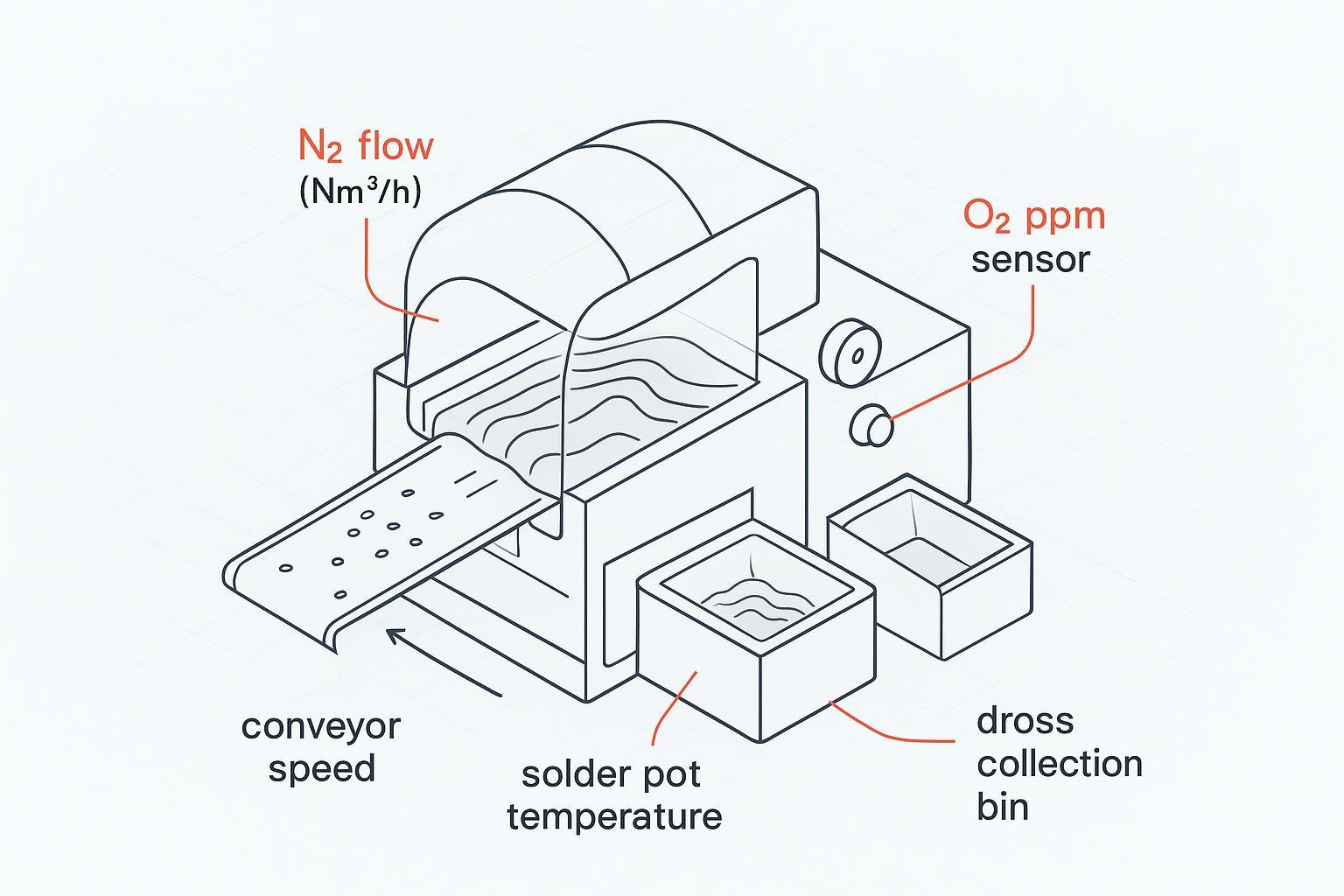
Your goal is not the lowest nitrogen number on a brochure; it’s a stable, right‑sized flow that maintains low oxygen at the wave with minimal waste. That requires instrumentation, normalization, and SPC.
Instrumentation: Install a calibrated thermal mass flow meter on the machine’s nitrogen feed and place a ppm‑level oxygen analyzer near the wave enclosure. Industry explainers outline these practices and the relationship between residual oxygen and wetting under inerting; see Holang’s overview of nitrogen’s role in wave soldering.
Normalization: Track Nm³ per hour alongside conveyor speed, board count, and soldered area so you can compare apples to apples across changeovers and shifts.
SPC discipline: Log flow, residual O₂, pot temperature, and key alarms on a fixed cadence; chart stability with X‑bar and range charts and define investigation rules for out‑of‑control points.
What to request from vendors before you buy: a 30‑day slice of anonymized logs from a comparable installation showing nitrogen flow, O₂ ppm, pot temperature, and production volume. Ask for CSVs, not screenshots. This proves they are instrumented, logging, and managing.
Below is a compact structure you can mirror in RFIs and FAT/SAT:
Tarih | Shift | Model/Serial | N₂ Flow (Nm³/h) | O₂ at Wave (ppm) | Pot Temp (°C) | Conveyor Speed (m/min) | Boards Processed | Notlar |
|---|---|---|---|---|---|---|---|---|
2026‑02‑01 | A | WX‑9000 #SN1234 | 22.8 | 680 | 265 | 0.9 | 1,240 | New lot code |
2026‑02‑01 | B | WX‑9000 #SN1234 | 23.1 | 710 | 265 | 0.9 | 1,180 | Minor seal check |
… | … | … | … | … | … | … | … | … |
Sampling guidance you can adopt:
Oxygen sampling: 1–5 s cadence for control; record 15–30 min rollups to the log.
Nitrogen flow: record 15–30 min snapshots; correlate to throughput and wave conditions.
Calibration: validate flow meter and O₂ sensor monthly; record certificates.
If you want a neutral explainer on typical utility ranges and why inerting matters, a concise industry compilation is available here: Gas Generation Solutions’ summary of wave solder nitrogen flow considerations. Treat any numeric “rules of thumb” as planning inputs, not acceptance targets.
How to quantify long‑term solder dross rate
Dross is a slow, silent margin killer. Treat it like any other line loss with a simple, auditable SOP so you can quantify trends and prove improvements.
Establish the baseline: Record alloy, pot temperature, wave settings, and starting solder mass or level.
Skim and segregate: At defined intervals, skim the pot, separate metallic dross from flux residues, and weigh the dross with a calibrated scale.
Track inputs: Weigh all solder bars added; record times to match production volume and uptime.
Compute and chart: Dross mass divided by total solder consumed, expressed as a percentage over a daily, weekly, or monthly window. Plot with control charts and annotate process changes.
Correlate: Move dross readings alongside residual O₂, pot temperature, conveyor speed, and turbulence issues to diagnose root causes.
Method‑level references describe the drivers and controls of dross formation and why inerting reduces it; see iConnect007’s primer on managing dross in soldering processes ve Circuits Assembly’s discussion of nitrogen benefits in PCB soldering. Use your own pilot data to set control limits that align with your defect and scrap economics.
Thermal profiling and delta‑T repeatability you can defend
Even the best inerting cannot fix a bad thermal profile. Validate that your preheat and solder contact conditions are consistent across the board and repeatable run to run.
Use distributed thermocouples across board corners and the center; repeat profiling for new products or changes and document your profiles and acceptance rules.
Adopt the method concepts summarized in IPC’s profiling guidance for mass soldering. Publicly available overviews of IPC‑7530B outline best practices for thermocouple selection, attachment, and analysis; see the IPC‑7530B table of contents and overview material. Training primers from reputable manufacturers also summarize IPC‑aligned profiling practices.
Tie your own acceptance rules to component limits and observed yield correlations instead of copying numbers that may not fit your designs.
For foundational acceptance context on soldered assemblies and documentation expectations that your quality team likely already follows, refer to neutral explainers of IPC J‑STD‑001 and IPC‑A‑610 which summarize requirements and visual criteria; a concise primer is here: Wevolver’s overview of core IPC standards for electronics manufacturing.
Verifying after‑sales capacity you can trust
Here’s the litmus test: can the supplier name overseas customers you can speak with, provide serial numbers and dates, and consistently ship spares on time? Don’t accept vague claims—build verification into your process.
Evidence pack to require: three or more overseas references comparable to your industry and region, each with company name, site, contact name/title/email/phone, model and serial, commissioning date, and written permission to contact. Request 30–90 days of anonymized logs for nitrogen flow, residual O₂, pot temperature, and dross collection.
How to verify: Conduct scripted reference interviews that probe uptime, spare‑parts lead times, response SLAs, yield trends, and changeover performance. Cross‑check claims against public shipment databases and the scope statements in ISO 9001 certificates. Keep dated notes in your procurement file.
Scoring approach: Fold this into your RFI/RFP as a weighted criterion so references aren’t a nice‑to‑have—they determine who advances.
A structured capital procurement playbook from public‑health supply chain experts outlines how to run due diligence and document outcomes; see the PFSCM roadmap for capital equipment procurement projects (2022) for neutral, step‑by‑step governance you can adapt.
Export readiness for North America, the EU, and Southeast Asia
Export success is about clearing compliance quickly and aligning acceptance paperwork with local expectations.
European Union: The new Machinery Regulation replaces the Machinery Directive and is applicable from January 20, 2027. Manufacturers must perform a risk assessment, compile a technical file, choose a conformity route, issue a Declaration of Conformity, affix CE marking, and provide instructions; cybersecurity obligations apply to networked machinery. See the official summary via the EU agency for safety and health at work: EU‑OSHA overview of Regulation (EU) 2023/1230.
North America: Plan for an OSHA‑recognized Nationally Recognized Testing Laboratory (NRTL) mark or an acceptable field evaluation aligned with local authority requirements. OSHA maintains program guidance and recognized standards; start with the OSHA NRTL frequently asked questions to frame your RFP acceptance language.
Southeast Asia: Several countries align with IEC/ISO baselines and require national conformity labels. Unless your contract targets a specific country, state that the supplier must provide evidence of conformity for your destination market and coordinate with your notified partners in advance.
Warranty and spares terms to nail down in contracts:
Coverage duration and exclusions; define what triggers a reset or extension after major repairs
Maximum lead times for critical spares and the minimum on‑hand stock level during warranty
Remote diagnostics capability and response SLAs by time zone
Commissioning scope, training deliverables, and acceptance‑to‑volume‑ramp timeline
Interoperability checks with Hermes and IPC‑CFX
Don’t wait until install to discover a data gap. During FAT and SAT, verify that horizontal handoffs and vertical data flows actually work.
Horizontal handoff: Require a live demonstration of board handover and attribute exchange using the Hermes protocol and capture message traces. The consortium maintains public documentation; the standard’s home is here: The Hermes Standard official site.
Vertical data: Request a live IPC‑CFX message stream to a test broker and verify basic events and traceability payloads. IPC publishes public materials that describe the scope and structure of CFX; see the IPC‑2591 CFX v1.5 table of contents and overview.
Evidence to keep: Save message traces, broker configurations, and screenshots in your FAT/SAT bundle; add recipe backups and language toggle proof for the HMI.
Practical example of logging nitrogen and dross with SPC
Here’s a compact, neutral example you can adapt. A buyer sets up a 30‑day pilot on a mixed‑model THT line. They install a thermal mass flow meter on the wave’s nitrogen supply and place an oxygen analyzer at the hood. They log flow in Nm³/h every 30 minutes and O₂ ppm at a 1‑second cadence, rolling it up every 15 minutes. They also weigh dross daily and record pot temperature and boards processed.
Using a simple script, they generate X‑bar and range charts for nitrogen flow and dross percentage. When a weekend maintenance event improves hood sealing, residual O₂ variance falls and dross starts trending down; control limits are then recalculated from the post‑improvement period and added to the control plan.
For teams without an existing template, a number of OEMs and integrators can provide basic logging exports. For instance, the engineering team at S&M illustrates how to capture nitrogen flow and dross measurements in routine process checks on inerted soldering equipment; the point isn’t the brand, it’s that your supplier should be able to show you similar, auditable logs on request.
If you’re new to wave parameter tuning and want deeper method context, two concise internal primers you can consult are a process setup and troubleshooting overview and a tutorial on wave height adjustment, which provide practical levers to stabilize the wave and reduce bridging; see the brand resources here: wave soldering process setup and troubleshooting guide ve how to adjust solder wave height for PCB soldering quality.
Quick buyer checklist for shortlisting suppliers
Do they provide 30–90 days of nitrogen flow, residual O₂, pot temperature, and dross logs for a comparable line, in CSV format?
Can they give you at least three overseas references with serials, commissioning dates, and consented contacts—and agree to direct interviews?
Do their FAT/SAT templates include stable‑run trials, data export samples, safety checks, and language‑toggle proof, with deliverables tied to EU CE or North American NRTL plans?
Can they demonstrate Hermes handoffs and an IPC‑CFX data stream with saved message traces?
Are warranty coverage, spares lead times, and response SLAs stated in measurable terms by region?
Do they accept your SPC plan and agree to hand over raw logs and maintenance records after install?
How to use this framework in RFIs, RFPs, and audits
Build your documents around evidence, not adjectives. Specify nitrogen and dross logging as standard attachments, make verifiable references a pass‑fail gate, and turn export readiness into acceptance paperwork rather than a promise. During FAT and SAT, capture message traces, sample logs, and signed checklists; during ramp, keep SPC and maintenance records in a shared repository. Do this well and you won’t just compare quotes—you’ll compare proven processes.
Further reading and standards overviews you can cite internally:
IPC thermal profiling method concepts for mass soldering: IPC‑7530B overview and TOC
IPC core acceptance and process requirement explainers: Wevolver’s IPC standards overview
EU compliance planning for machinery placed on the market from 2027: EU‑OSHA Machinery Regulation page
North American safety approval context: OSHA NRTL program FAQ
Nitrogen and dross context: Indium on nitrogen in wave soldering ve AIM Solder on dross control
Editorial and evidence notes
Last updated: 2026-03-16.
How to use numbers in this guide: We avoid universal “pass/fail” numeric thresholds for nitrogen (Nm³/h) and dross (%) because they are site- and product-dependent and acceptance standards are often paywalled; instead, we focus on reproducible measurement, normalization, and SPC.
Evidence standard: Prefer primary or standards-body sources (e.g., Regulation (EU) 2023/1230, OSHA NRTL program pages, IPC-HERMES-9852, IPC-2591 CFX) and manufacturer technical notes for process fundamentals.
How to verify supplier claims: Ask for raw exports (CSV/log files), calibration certificates, and dated FAT/SAT records—not screenshots—then triangulate with reference interviews and certification scope statements.
Neutrality statement: Brand mentions are limited to practical illustrations and should not be treated as comparative performance claims.