



If you run HDI (high-density interconnect) products, you already know the uncomfortable truth: you can do everything “right” and still get intermittent electrical failures weeks later.
ESD (electrostatic discharge) is one of the culprits that can produce latent damage—the kind that passes test today and fails in the field later. And on a modern SMT line, the PCB conveyor is a frequent “blind spot”: it touches boards continuously, spans multiple modules, and gets moved, adjusted, and serviced.
This article focuses on PCB conveyor grounding in practical terms—what to bond, what to test, what to document, and where grounding paths typically fail.
Why HDI boards are less forgiving of ESD events
HDI designs push more routing into smaller spaces: tighter trace/space, smaller pads, finer-pitch BGAs, microvias, and thinner dielectrics.
That density changes the risk profile:
Smaller geometries can mean lower tolerance for transient events.
Damage can be partial (not an immediate short/open), creating later-life failures.
If a board experiences multiple small events across handling steps, the risk compounds.
This is why ESD control in HDI is less about “one dramatic zap” and more about preventing repeated, low-level discharges across the line.
Grounding vs. bonding vs. “it’s metal so it’s grounded”
In ESD control, the goal isn’t mystical. It’s equipotential: reduce the voltage difference between objects so you don’t get a discharge when they touch or get close.
The ESD Association describes a practical two-step approach: first, bring workstation elements to the same electrical potential via a common point ground; then connect that common point to the equipment grounding conductor (AC ground) so everything references a known ground point (see ESDA’s Part 3: Basic ESD Control Procedures and Materials).
Definitions (in plain language):
Bonding: connecting conductive parts together so they share the same potential.
Grounding: providing a path from that bonded system to a known ground.
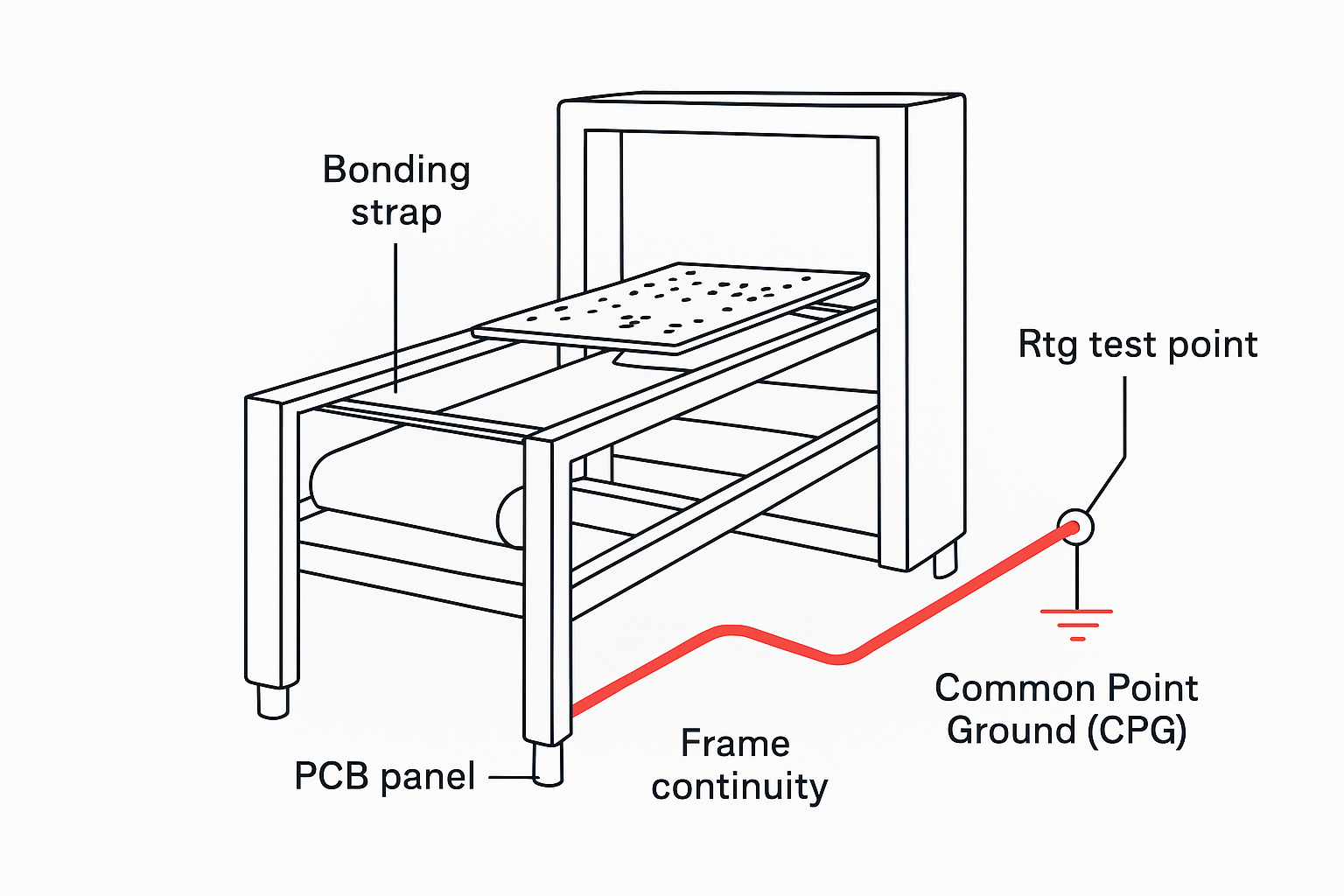
Common point ground (CPG): a single reference point where multiple grounding conductors connect.
Key Takeaway: For conveyors, the most common failure isn’t “no ground exists.” It’s that ground continuity is lost across modules, adjustments, or maintenance changes, creating floating sections.
Where PCB conveyors usually lose their ground path
Conveyors are modular, adjustable, and frequently serviced. Those exact traits create grounding problems.
Here are failure modes that show up repeatedly in factory environments:
1) Floating modules after maintenance
A section is removed, replaced, or repositioned, and the ground strap or ground lug isn’t reattached (or is attached to paint/anodizing).
What it looks like: the line runs normally, but you see inconsistent ESD audit readings or unexplained escapes.
2) Painted/anodized contact surfaces at frame joints
Relying on “metal-to-metal contact” at joints can be unreliable when surfaces are coated.
What it looks like: resistance spikes at specific module seams, especially after reconfiguration.
3) Adjustable rail assemblies that aren’t bonded consistently
Width adjustment mechanisms can introduce insulated interfaces (bushings, coatings, debris) that break continuity.
What it looks like: rails measure differently left vs. right, or continuity changes after rail width changes.
4) Worn or missing bonding straps, grounding brushes, or drag chains
Moving parts are hard on cables and straps. Flexing, vibration, and repeated motion can loosen or fracture connections.
A system-level grounding review in In Compliance Magazine notes that relying on implicit grounding is fragile and that disconnected grounds after service are a common, real-world cause of problems (see System-Level Grounding (In Compliance Magazine)).
5) Belt and contact material changes during “routine replacement”
Even if your conveyor uses an anti-static belt, ESD performance depends on the full system—belt material, rollers, frame bonding, and the path to the CPG.
If a belt is replaced with an unqualified substitute, the static behavior can change.
PCB conveyor grounding checklist: what to bond and what to inspect
Use this as a starting point for a preventive maintenance (PM) or ESD audit checklist. Keep it binary: pass/fail.
Grounding/bonding inspection (visual + mechanical)
Every conveyor module has a defined grounding point (labeled or documented).
Bonding straps (if used between modules) are present, intact, and secured.
Ground lugs are fastened to bare metal (not paint/anodizing), with corrosion controlled.
No “temporary” ground wires or dangling conductors are present.
Rail adjustment mechanisms have defined bonding (not relying on incidental contact).
Any moving sections (lifts, gates, turn modules) have a managed bonding method (flex cable/strap) and strain relief.
Replacement parts that affect static behavior (belts, rollers, brushes) are controlled by part number/spec.
Process controls (the part most factories miss)
Conveyor configuration changes (adding/removing modules, moving sections) trigger a grounding verification.
PM includes a documented ESD grounding check step (not informal).
ESD audit results are recorded per line/zone and kept for traceability.
Verification: resistance to ground, continuity, and repeatability
Grounding verification is where ESD programs either become real—or stay theoretical.
Start with the equipotential question
Before chasing numbers, confirm this:
If an operator touches the rail/frame at two points (or the board contacts different conveyor elements), are those points at the same potential?
That’s why continuity/bonding across modules matters.
Resistance-to-ground (Rtg) context you can cite
For ESD protective worksurfaces, the ESD Association lists a typical resistance-to-ground (Rtg) range of 1×10^6 to 1×10^9 ohms.
For workstation surfaces, Desco’s guidance references the ANSI/ESD S4.1 recommended range—1×10^6 to <1×10^9 ohms—and suggests periodic compliance verification using a resistance meter and standardized electrodes (see Best Practices for Establishing an ESD Workstation (Desco, 2017)).
How to use this on conveyors:
Use Rtg ranges when you’re evaluating dissipative surfaces (mat surfaces, certain coated surfaces, accessories) that are intended to bleed charge in a controlled way.
For metal frames and bonded structures, the more practical concern is continuity and a reliable connection to the facility’s grounding system—especially across modular joints.
A measurement plan that works on the shop floor
Map test points (and keep them consistent)
Left rail, right rail
Frame at module A, seam A–B, module B
Any moving module frame
CPG stud / ground bar connection
Choose tools based on what you’re testing
For dissipative surfaces: a resistance meter appropriate for Rtg testing.
For continuity/bonding across metal: a low-resistance/continuity check tool appropriate for your maintenance practice.
Test after events, not only on a calendar Calendar-based checks are useful, but many failures happen after:
module moves
belt/roller replacement
rail width change
maintenance on a gate/turn/lift
Record results in a way auditors and engineers can use
Line name / station
Test point ID
Reading
Pass/fail criteria
Date + technician
Trigger (PM / after change / after issue)
⚠️ Warning: A conveyor can “feel grounded” (metal frame) while still having a floating section. Visual inspection alone is not enough after reconfiguration.
Documentation and change-control: make grounding auditable
Enterprise environments don’t just need good engineering—they need repeatability.
Minimum documentation set:
A grounding/bonding diagram for each line (module seams marked).
A defined CPG location and connection method to the equipment grounding conductor.
A measurement SOP: test points, tools, pass/fail criteria, and triggers.
A replacement-parts control list for belts/brushes/straps that affect static behavior.
This closes the loop between engineering intent and factory reality.
Key takeaways
HDI boards are more vulnerable to latent ESD damage; repeated small events matter.
The goal of ESD grounding and bonding is equipotential control—avoiding voltage differences that create discharges.
Conveyors often fail grounding continuity at module seams, coated joints, adjustable rails, and after maintenance.
Use a binary checklist + a repeatable measurement plan with defined test points.
Document the method so the control survives staffing changes and line reconfiguration.
Next steps (practical)
If you’re updating an ESD control program or troubleshooting intermittent escapes, start with a simple step: pick one line and run a grounding continuity walk-down across every conveyor module seam and adjustable rail assembly, then log the results.
If you want a second set of eyes, S&M Co.Ltd (Chuxin SMT) can support SMT line conveyor selection and integration planning, including practical ESD-friendly transfer considerations. You can also reference these related resources from Chuxin SMT: