



Yayınlandı: 26 May 2026
Okuma süresi: 12 minutes
Reviewer: Placeholder, Placeholder
You know that sinking feeling when a line slows down for no obvious reason? One minute, your selective soldering cell is moving along. Next, you’re staring at uneven joints, extra rework, or a nozzle that just is not behaving.
That is why selective soldering nozzle cleaning matters so much. A small bit of flux residue, oxide, or solder buildup can throw off flow, hurt precision, and chip away at output over a full shift. And in high-volume SMT work, small problems love turning into expensive ones.
If you are trying to figure out how selective soldering nozzle cleaning fits into preventative maintenance, here is the simple version. Clean nozzles help keep solder flow steady, support better joint quality, and reduce the kind of surprise stoppages nobody wants at 4:40 pm on a Friday. They also help teams protect machine life and get more from every production run.
In this guide, we will look at what selective solder nozzle cleaning is, why it affects manufacturing efficiency, and what a smart cleaning routine usually looks like in 2026. We will also touch on the best selective soldering nozzle cleaning habits, common clog issues, and how teams can build a process that is easier to repeat.
[Author Name] is an expert in Surface Mount Technology with extensive experience in optimizing soldering processes. With a background in electronic manufacturing and a focus on quality assurance, they understand the intricacies of maintaining high precision in SMT environments.
Why nozzle cleaning matters more than most teams think
A selective soldering nozzle is a small part with a big job. It shapes and delivers molten solder exactly where it needs to go. The nozzle body, solder outlet, and tip profile all affect how the mini-wave behaves, which is why nozzle condition matters just as much as nozzle selection.
When buildup starts to form, things get messy fast. Flux residue can narrow the opening. Oxidation can interfere with heat transfer. Dross can change the solder wave. And suddenly, the process you dialed in on Tuesday morning does not look so dialed in anymore.
A practical maintenance guide from ALLPCB notes that nozzles should be cleaned daily or after each shift to reduce buildup and avoid defective joints. That lines up with what most production teams already feel on the floor, even before they see the data. Clean nozzles usually mean fewer interruptions, steadier solder flow, and less time spent chasing defects that should not have happened in the first place.
And yes, this affects more than quality.
It affects output, labor time, and machine uptime too.
How selective soldering nozzle cleaning connects to production efficiency
Selective soldering is often chosen because it gives better control, especially on mixed-technology boards where you cannot risk heating everything at once. It can lower rework and help protect nearby parts. But that precision depends on consistency. If the nozzle is dirty, consistency disappears.
Here is the real-world chain reaction:
| Nozzle condition | What happens on the line | Likely business impact |
|—|—|—|
| Clean and clear | Stable solder flow and wave shape | Better yield, less rework |
| Light residue buildup | Slight flow variation | More inspection time |
| Partial clog or oxidation | Poor wetting or uneven joints | Rework, scrap, slower throughput |
| Heavy buildup | Defects and machine stoppages | Downtime and higher cost |
This is where preventative soldering strategies pay off. Instead of waiting for defects to show up in AOI, ICT, or final inspection, you handle one root cause early. Simple. Boring, even. But very worth it.
For manufacturers running advanced SMT equipment, this is especially true. Companies using high-precision systems, like the SMT production solutions offered by S&M Co. Ltd. under Shenzhen Chuxin Electronic Equipment Co., Ltd., usually care about repeatability as much as raw speed. In smartphone, semiconductor, and military electronics work, one unstable nozzle can create a ripple effect across a whole batch.
So, what selective soldering nozzle cleaning really gives you is process stability. That tends to mean fewer surprises, cleaner joints, and a line that behaves more like it should.
Step-by-Step Cleaning Process
Let us keep this practical. If you are wondering how selective soldering nozzle cleaning should actually happen, a simple routine usually works best.
First, inspect the nozzle before production starts. Look for solder residue, flux buildup, oxidation, or a change in the outlet shape. If something looks off, it probably is.
Second, clean routine residue with a soft brush, brass wool, or another non-abrasive tool approved for the nozzle material. For many teams, this handles the everyday mess without damaging the surface.
Third, use a compatible cleaner. IPA is often used for flux residue, while manufacturer-approved solvents or dedicated nozzle cleaners are better for tougher contamination. If oxidation is stubborn, a tip cleaning paste may help. The key is using something that cleans without harming the nozzle coating.
Fourth, dry and recheck the nozzle. You want a clear opening and a surface that is free from loose residue before the next run begins.
Fifth, log what you found. I know, paperwork is not the fun part. But if one nozzle needs extra attention every three shifts, that pattern matters.
Expert Tip: For stubborn clogs, start with the mildest approved option, usually IPA or a maker-approved solvent, then move to a specialized cleaner or tip paste only if residue remains. Aggressive scraping can cost more than the clog.
A simple cleaning schedule for preventative maintenance
Not every factory needs the same schedule. A low-mix, lower-volume line may not clean as often as a high-output consumer electronics plant. Still, a basic cadence helps.
Here is a simple starting point for 2026:
- Before each shift: quick visual inspection
- After each shift: routine wipe-down and residue removal
- Weekly: deeper clean and nozzle condition review
- During recurring defect events: immediate inspection and targeted cleaning
- After process changes: verify nozzle cleanliness before restarting production
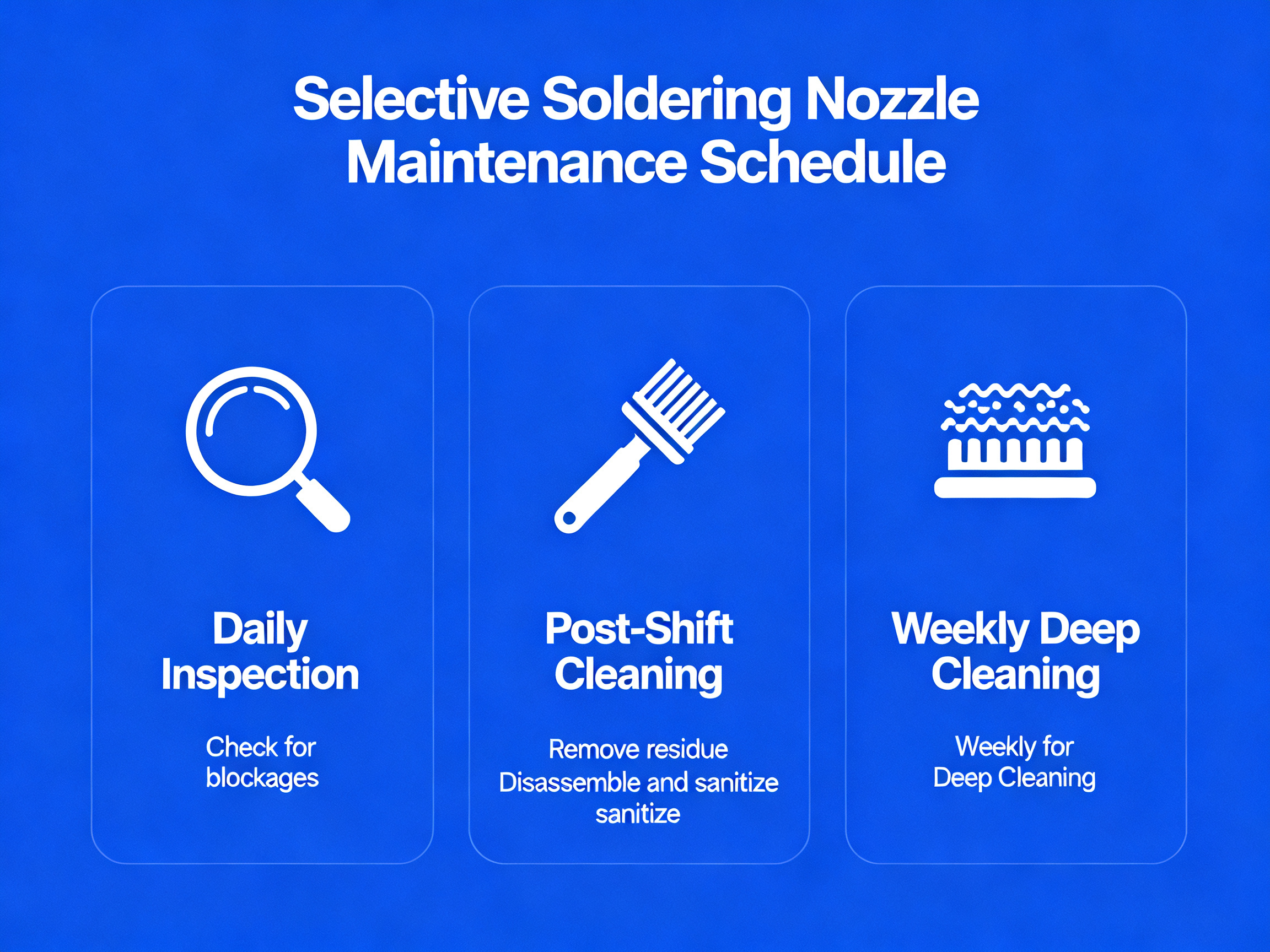
This schedule is not magic. It is just a strong baseline.
And if your boards are complex, your flux activity is high, or your line runs long hours, you may need more frequent checks.
Troubleshooting Common Issues
Sometimes cleaning the nozzle once is not enough. If the same issue keeps coming back, the nozzle might be telling you something about the process.
Repeated clogs usually point to one of a few problems:
- Too much flux residue drying near the outlet
- Oxidation from heat exposure
- Dross contamination
- Poor cleaning intervals
- Mismatch between nozzle geometry and the application
- Process settings that leave unstable solder flow
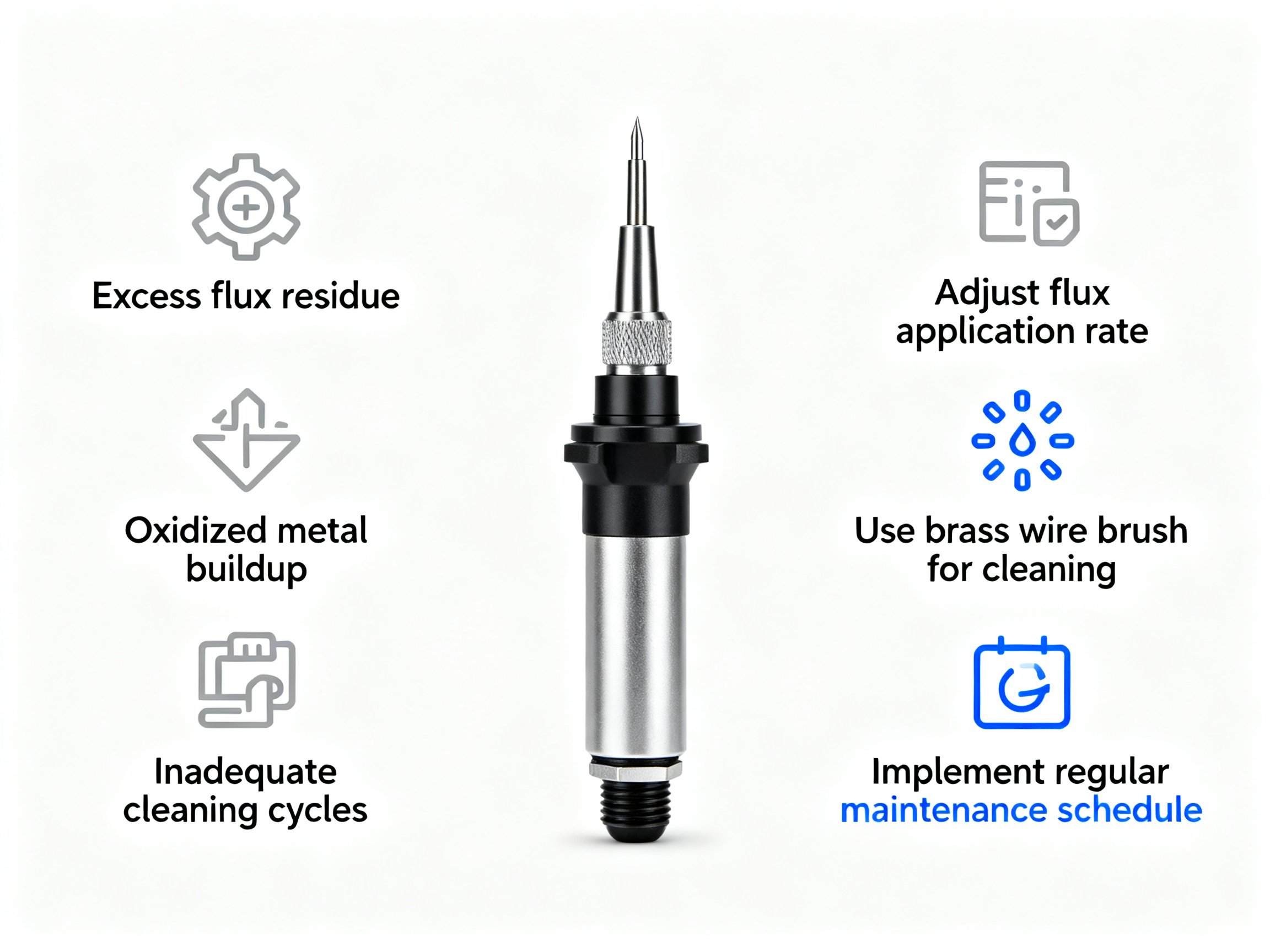
That is why selective solder nozzle cleaning should not live in a silo. It has to connect with setup, flux control, and inspection.
We have seen troubleshooting go a lot faster when teams stop asking, Why is this nozzle dirty again? and start asking, What in the process keeps making it dirty? Different question. Better answers.
Pro Insight: If clogging keeps returning after proper cleaning, check flux volume, preheat settings, nozzle alignment, and solder pot condition next. Recurring nozzle issues are often process issues wearing a maintenance costume.
Benefits of Regular Cleaning
This is the part teams usually feel the fastest.
When nozzles stay clean, solder flow stays more stable. That helps improve precision, supports wetting, and reduces the odds of bridges, weak joints, or random variation between one board and the next. It also means operators spend less time stopping the process for manual fixes.
We have seen lines settle down noticeably after consistent nozzle cleaning became part of the standard routine, not just something done when defects popped up. Yields got steadier. Rework dropped. And maybe best of all, people stopped having those last-minute panic moments before shipment cutoffs.