



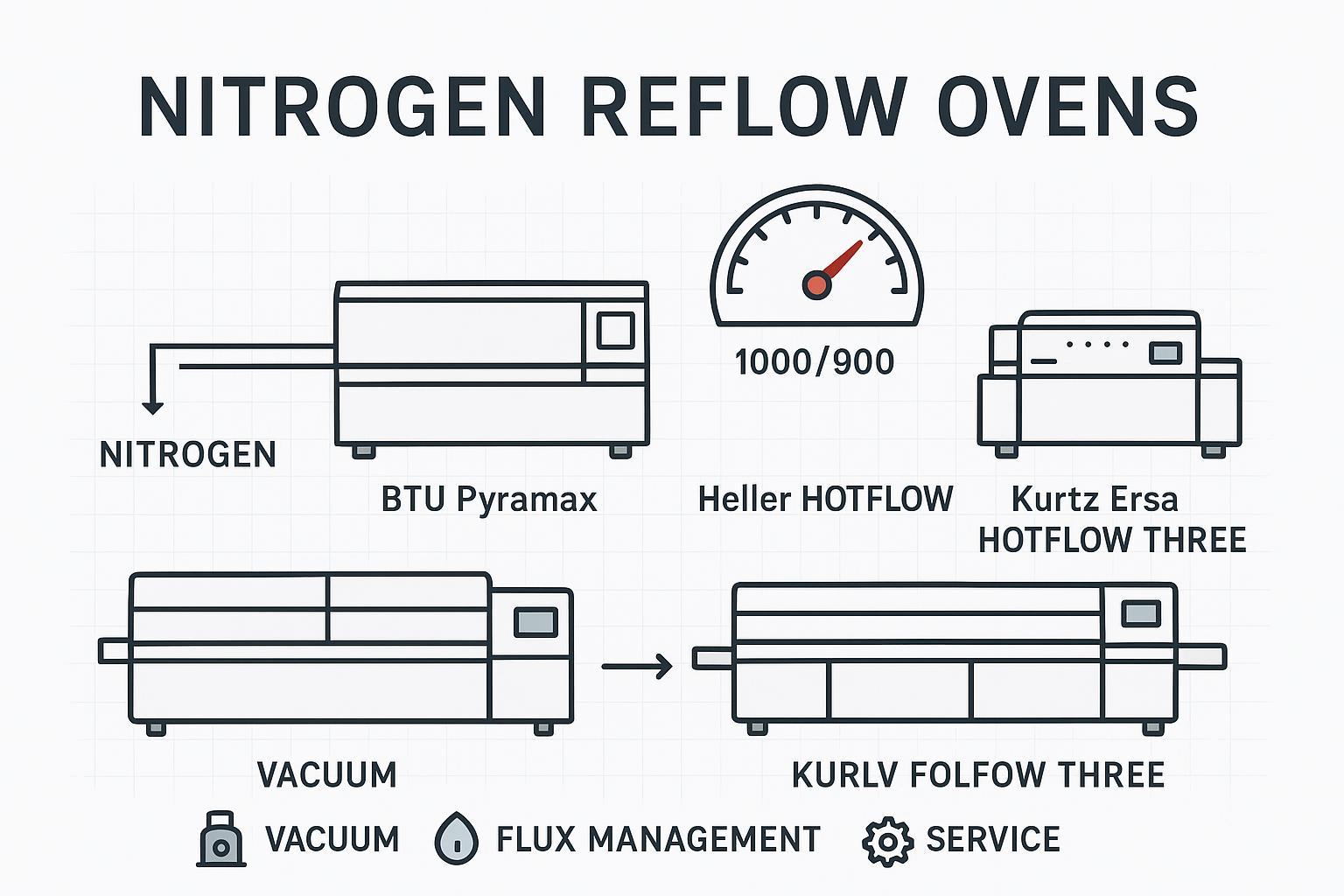
When buyers put four global reflow brands side-by-side, the decisive question increasingly becomes simple to ask and hard to answer: Which system controls oxidation best at the lowest nitrogen cost—without sacrificing yield or uptime? This comparison keeps oxidation control as the spine, then layers in yield/voids and lifecycle service/TCO so engineering teams and procurement can make a confident, evidence-led choice.
Disclosure & evidence boundaries: This comparison is editorial and not sponsored by BTU, Heller, Rehm, or Kurtz Ersa. The publisher operates in the SMT equipment industry; any references to S&M Co.Ltd products are provided as an optional alternative and should be treated as first‑party material.
Where vendors do not publish measured O2 ppm curves, N2 flow‑at‑ppm pairs, ΔT uniformity, or vacuum depth, this article does not infer missing numbers. Any quantitative claims are labeled as vendor‑claimed and linked to the primary source. For purchase decisions, require time‑series logs and acceptance‑test artifacts under your own board mass, belt speed, and maintenance condition.
TL;DR — Quick verdict by scenario
Sub‑100 ppm with aggressive void reduction: Prioritize vacuum‑capable systems (Rehm VisionXP+ Vacuum; Kurtz Ersa EXOS/HOTFLOW with vacuum). Validate vacuum depth (mbar) and X‑ray void % tables before committing.
300–800 ppm with low OpEx and idle savings: Shortlist BTU Pyramax with Wincon Energy Pilot for automated idle modes that cut energy (and related N2 use) during gaps; request O2‑stability logs.
Audit‑heavy builds (medical/aerospace) needing robust traceability: Favor platforms with mature MES protocols and granular logging; verify your region’s service coverage and spare‑parts SLAs.
High throughput with long heated length and dual‑lane options: Consider Kurtz Ersa HOTFLOW THREE 3/26 or comparable long systems; confirm ΔT at target belt speeds.
No universal winner emerged from public, numeric ppm/flow data (which vendors rarely publish). Expect to run RFIs and on‑site tests to secure O2‑ppm curves and N2‑flow‑at‑ppm pairs.
De vigtigste pointer
Oxidation control isn’t just the lowest ppm number—it’s the ability to hold a stable ppm band through load transients with efficient nitrogen use and good sealing.
Public O2‑ppm curves and N2 flow-at‑ppm pairs are scarce. Build them into your RFI and factory acceptance tests.
Vacuum reduces voids but doesn’t replace nitrogen for oxidation control; treat them as complementary levers.
Idle/energy features (e.g., BTU’s Energy Pilot) can materially lower OpEx during production gaps—measure recovery time and ppm stability.
Flux management (pyrolysis/condensation) stabilizes sensors and heat exchangers, indirectly supporting ppm stability and OEE.
Compare service where you operate—response SLAs and parts stocking drive uptime and total cost of ownership.
2026 nitrogen reflow oven comparison table — oxidation, yield, service
Two important notes before the table: (1) Fields labeled “vendor‑claimed” reflect official pages/brochures; (2) Most brands don’t publish measured O2 ppm or N2 flow figures—treat those rows as RFI targets.
Model / Vendor | Zones / heated length | Claimed O2 target (ppm) | Measured O2 (ppm) | N2 features / efficiency | Vacuum option | Flux management | Software / traceability | Evidence link |
|---|---|---|---|---|---|---|---|---|
BTU Pyramax series | 6/8/10/12 zones; multiple lengths | Not published (official) | Not public | Energy Pilot idle automation; Dynamic Gas Idle (vendor‑claimed) | Some variants/line options | Aqua Scrub upgrade; extraction/condensation | Wincon with CFX/Hermes/OPC/REST/MQTT; barcode recipes | BTU Pyramax/Wincon |
Rehm VisionXP+ (Nitro/Vacuum) | Multiple configs; XP+ family | Not published (official) | Not public | Energy‑optimized N2 operation (vendor‑claimed) | Vacuum variant available | Pyrolysis + cold condensation (Vision family) | Industry 4.0 integrations (verify) | Rehm Vision series |
Kurtz Ersa HOTFLOW THREE (3/16, 3/20, 3/26); EXOS 10/26 (vacuum) | Up to 26 zones; long heated sections | Not published (official) | Not public | Up to 25% N2 reduction with SCPU (vendor‑claimed) | EXOS vacuum; HOTFLOW with options | SMART PYROLYSIS CLEANER; SMART ELEMENTS | CONNECT digital services (verify MES list) | Ersa HOTFLOW THREE |
Heller HOTFLOW MK5/MK7 | 5–12 zones; various widths | Not published (official) | Not public | Low‑N2 operation (vendor‑claimed) | Options vary by model | Enhanced flux collection (vendor‑claimed) | Process control UI (verify MES list) | Heller HOTFLOW |
Evidence notes:
BTU Energy Pilot savings: Sleep modes can save >25% energy during short gaps and >40% for longer ones—official vendor description in Wincon materials (2025–2026) (BTU Wincon Energy Pilot).
Ersa nitrogen reduction “up to 25%” is vendor‑quantified in a reflow overview PDF (no ppm/flow pairs) (Ersa reflow overview).
Oxidation control: how ppm targets, sealing, and nitrogen flow interact
Think of oxygen ppm like speed limits for oxidation. Lower ppm typically improves wetting and mitigates defects, but the real test is stability: can the oven maintain your target band when you load five heavy panels back‑to‑back or open a door?
PPM bands and outcomes
<100 ppm: often targeted for power modules or high‑reliability joints combined with vacuum to reduce voids.
300–800 ppm: common for high‑mix EMS seeking a strong balance of solder quality and operating cost.
~1000 ppm and above: transitional; benefits versus air diminish, and flux chemistry dominates.
What actually drives stability
Zone sealing and leak paths across tunnel gaps and coolers.
Exhaust design and flux management: residue buildup raises backpressure, destabilizing ppm and ΔT.
Control strategy: gas idle, purge routines, and recovery ramps after interruptions.
What to measure before you buy
Log zone‑by‑zone O2 with an inline analyzer while you run production boards at target speed. Capture steady‑state ppm and the ppm time‑series during a multi‑panel load and a brief door open.
Record N2 flow (L/min or Nm³/h) needed to hold your ppm band. This is your true nitrogen efficiency.
For background on typical flow ranges and target bands, see a practical explainer on nitrogen usage and oxygen targets in reflow soldering that outlines how flow and ppm relate in production environments: nitrogen usage vs oxygen targets.
Yield and voids: why vacuum complements, not replaces, nitrogen
Vacuum stages reduce entrapped gases after peak, cutting voids in power packages and large thermal pads. Vendors frequently promote large reductions—Kurtz Ersa, for example, states voids can be reduced “up to 99%” on its EXOS 10/26 (vendor‑claimed) (Ersa EXOS 10/26). Treat these as starting points, not guarantees.
What to request
X‑ray void % tables (per IPC‑7095/7093) before/after vacuum, including sample size and cycle‑time impact.
Profile overlays showing vacuum timing relative to liquidus; verify there’s no adverse thermal or flux side effect.
Why nitrogen still matters
Vacuum tackles voids; nitrogen suppresses oxidation that drives wetting issues, solder balling, bridging, and tombstoning. In practice, best FPY comes from the right ppm band plus good profiling—with vacuum as an additional lever where packages demand it.
For a primer on where vacuum reflow fits in SMT lines, see this overview: why vacuum reflow is essential in some lines.
Service and TCO: idle modes, nitrogen cost, and what drives uptime
Idle and recovery
BTU’s Wincon Energy Pilot automates sleep modes and coordination with upstream/downstream equipment to cut energy during gaps while minimizing recovery time (vendor documentation, 2025–2026) (BTU Wincon). Ask vendors to quantify ppm and temperature recovery after a 3–5 minute pause.
Estimating nitrogen cost per 1,000 boards (simple model)
Inputs: N2 price ($/Nm³), average flow (Nm³/h), boards per hour.
Cost/1,000 boards ≈ (Flow × Price ÷ Boards/hr) × 1,000.
Example: 30 Nm³/h at $0.12/Nm³ and 50 boards/hr → ≈ $72 per 1,000 boards. Use your quoted gas pricing; actuals vary.
Flux management and uptime
Effective pyrolysis/condensation extends maintenance intervals and keeps sensors/heat exchangers cleaner—supporting ppm stability and OEE. Rehm emphasizes integrated flux systems in its Vision family materials (vendor‑claimed) (Rehm VisionXC process page).
What to include in RFIs/RFPs (compact checklist)
O2 time‑series (steady and multi‑panel load), plus N2 flow at target ppm.
ΔT across board at specified belt speed and mass (6–12 TC profile).
Vacuum specs (mbar) and X‑ray void tables with sample size and IPC method.
Flux‑residue handling (pyrolysis/condensation) and maintenance intervals.
Service coverage in your regions, response times, parts stocking, first‑time fix rate.
Brand capsules (parity format)
BTU Pyramax series
Specs snapshot: 6/8/10/12 zones; nitrogen or air; accessories include Aqua Scrub; Wincon control suite with Energy Pilot and Connected Factory options (BTU Pyramax).
Strengths (vendor‑claimed + visible features): Mature controls, strong connectivity (CFX, Hermes, OPC, REST, MQTT), automated idle modes to cut energy/gas during gaps.
Constraints: No published O2 ppm or N2 flow numbers on official pages; ΔT specs not public.
Best for: High‑mix EMS aiming at 300–800 ppm bands with emphasis on idle savings and MES connectivity; request ppm stability logs.
Evidence: See BTU Wincon pages for Energy Pilot savings percentages (2025–2026) (Wincon Energy Pilot).
Rehm VisionXP+ (Nitro/Vacuum)
Specs snapshot: VisionXP+ family with Nitro and Vacuum variants; emphasizes energy‑optimized design and integrated flux management; Industry 4.0 features (verify with datasheet) (Rehm Vision series).
Strengths (vendor‑claimed): Strong flux management (pyrolysis + condensation) that supports cleanliness and stability; vacuum variant for void reduction.
Constraints: Public ppm/flow numbers and ΔT specs not available on accessed pages; obtain official datasheet for specifics.
Best for: Automotive power packages and reliability‑critical builds needing vacuum plus good residue handling; confirm ppm stability at your target band.
Evidence: Vision family pages and process pages on convection soldering and flux systems.
Kurtz Ersa HOTFLOW THREE (3/16, 3/20, 3/26); EXOS vacuum
Specs snapshot: Up to 26 zones; optional vacuum via EXOS 10/26; collateral references up to 25% nitrogen reduction via SCPU® and major void reduction with vacuum (vendor‑claimed) (HOTFLOW THREE; EXOS 10/26).
Strengths (vendor‑claimed): Long heated length and dual‑track options for throughput; vacuum competence; digital service ecosystem.
Constraints: No public ppm/flow or ΔT specs on accessed materials; confirm MES protocol list and measured void data.
Best for: High‑throughput lines that may combine dual‑lane capability with vacuum for power packages.
Evidence: Ersa overview and product pages linked above.
Heller HOTFLOW MK5/MK7
Specs snapshot: 5–12 zones; various widths; nitrogen‑capable; emphasis on thermal repeatability (official pages) (Heller HOTFLOW MK7).
Strengths (vendor‑claimed): Established market presence, repeatable profiles, low‑N2 operation claims.
Constraints: Current public pages reviewed did not publish ppm targets, flow numbers, ΔT specs, or detailed MES protocol lists.
Best for: Teams that value Heller’s installed base and support network; still request ppm logs, ΔT profiles, and service specifics for your region.
Evidence: Heller MK5/MK7 official pages.
How to choose: a simple decision tree
If you need <100 ppm O2 plus minimal voids on power packages → Evaluate Rehm VisionXP+ Vacuum or Kurtz Ersa EXOS/HOTFLOW with vacuum; request vacuum depth (mbar), X‑ray void % tables, and ppm stability at your belt speed.
If your priority is 300–800 ppm with the lowest nitrogen/energy OpEx → Evaluate BTU Pyramax with Energy Pilot and any low‑N2 packages; ask for N2 flow vs ppm charts and recovery behavior after idle events.
If audit‑grade traceability and regional service matter most → Shortlist the vendors who can document MES protocol support and provide regional SLA/parts coverage in writing.
If throughput dominates → Favor longer heated lengths and dual‑lane options (e.g., HOTFLOW THREE 3/26) and require ΔT measurements at your target speed and board mass.
Also add these RFI artifacts to every vendor request: O2 curves (steady and 5‑board load), N2 flow at target ppm, ΔT profiles, flux maintenance intervals, and service response metrics.
Copy/paste RFI question set (for oxidation control & N2 efficiency)
Use the questions below verbatim in your RFI/RFP so every vendor answers in comparable units and test conditions.
Provide zone‑by‑zone O2 ppm time‑series logs (CSV preferred) for:
steady state at our target profile, and
a scripted 5‑board load transient (boards loaded back‑to‑back), and
a 30–60 second door‑open event with recovery logged.
For each run above, report N2 flow (L/min or Nm³/h), N2 purity, analyzer model, and analyzer calibration date.
Provide O2 ppm vs N2 flow data at a minimum of three flow points (e.g., low/medium/high) so we can build a flow‑to‑ppm curve.
Provide ΔT uniformity data (max–min °C) across a representative board using a 6–12 TC profile at the tested belt speed.
If vacuum is offered: provide vacuum depth (mbar), vacuum timing vs liquidus, and X‑ray void % tables (method + sample size).
Scoring rubric (quick, weighted)
To make shortlisting auditable, score each platform on the same weighted criteria (0–5 each) and keep the evidence files.
30% — O2 stability (ppm band hold + recovery after load/door events)
20% — N2 efficiency (flow required at target ppm + idle/purge behavior)
15% — Thermal uniformity (ΔT at target speed and board mass)
15% — Vacuum capability (if needed: mbar + void % results)
10% — Uptime & maintenance (flux management, access, interval evidence)
10% — Service readiness (regional coverage, parts stocking, response terms)
Tip: keep “Measured O2 (ppm)” and “N2 flow to achieve target” as must‑submit evidence gates. If they can’t provide them, treat the entry as provisional regardless of brand.
Also consider: S&M VS‑1003‑N for cost‑optimized N2 operation
S&M Co.Ltd publishes first‑party guidance and product information that may be useful if you’re also benchmarking mid‑range nitrogen operation alongside the “big four.” Because this is first‑party material, treat the ranges below as indicative until you validate them with the same demo protocol and logs requested from every vendor.
Practical oxygen band focus: 300–800 ppm is a common production target for high‑mix lines balancing solder quality and OpEx.
Reference points (first‑party): VS‑series materials describe typical nitrogen‑operation ranges and offer process background on how O2 ppm and flow interact.
See: S&M VS‑1003‑N og nitrogen usage vs oxygen targets.
Evidence boundary: No cross‑vendor measured ppm/flow comparisons are implied here; request O2 time‑series logs and flow‑at‑ppm pairs (plus any FPY/void tables) before weighting this option in a shortlist.
A simple benchmark protocol you can run in a demo (FAT/SAT)
Use this protocol to produce apples‑to‑apples oxidation‑control evidence across brands.
Board & load definition: document board size, copper weight, assembly density, and panel mass; run at your target belt speed.
Three phases to log (minimum 20–30 minutes total):
steady state (no door opens),
scripted 5‑board load transient,
door‑open event (30–60 seconds) then recovery.
What to record (same units for all vendors):
zone‑by‑zone O2 ppm time series
N2 flow (L/min or Nm³/h) and N2 purity
belt speed, exhaust settings, and any gas‑idle/purge logic
optional: temperature profile (6–12 TC) and ΔT summary
Pass/fail gates (set your own limits):
O2 returns to target band within X minutes after the door event
O2 overshoot/undershoot during the 5‑board transient stays within Y ppm
N2 flow to hold the band is within your cost model
This produces the two missing “hard proofs” most brochures omit: ppm stability curves og flow‑at‑ppm pairs.
OFTE STILLEDE SPØRGSMÅL
What oxygen ppm do I really need?
Power and reliability‑critical builds often target <100 ppm; many high‑mix EMS lines succeed in the 300–800 ppm band. The right answer depends on alloy, flux chemistry, and profile. Validate with O2 logs and FPY data. For context on ppm bands and gas flow, see this guide on nitrogen usage and oxygen targets.
Does vacuum reflow replace nitrogen?
No. Vacuum reduces voids after reflow peak; nitrogen suppresses oxidation throughout heating and reflow. They’re complementary. Vendor claims like Ersa’s “up to 99%” void reduction (vendor‑claimed) should be validated with X‑ray tables and IPC‑method reports (Ersa EXOS 10/26).
How can I estimate nitrogen cost per PCB?
Use: Cost/1,000 boards ≈ (Flow Nm³/h × $/Nm³ ÷ Boards/hr) × 1,000. Replace with your actual gas pricing and measured flow at target ppm.
What proves real oxidation control in a demo?
A vendor‑run time‑series showing steady‑state ppm and ppm during a scripted multi‑panel load, paired with logged N2 flow at your target belt speed and profile. Without that, “low ppm” is just a promise.
As‑of date, methods, and evidence transparency
As of March 16, 2026, official public pages for BTU, Heller, Rehm, and Kurtz Ersa rarely publish measured O2 ppm, N2 flow‑at‑ppm pairs, or ΔT specs. Where numbers are quoted (e.g., BTU Energy Pilot savings; Ersa N2 reduction and void claims), they are explicitly labeled as vendor‑claimed and linked to the canonical sources.
Readers should treat oxidation‑control and N2‑efficiency judgments as provisional until they obtain O2/flow logs under their own profile and board mass conditions.
External link density is intentionally limited; additional datasheets and logs should be requested directly from vendors.
Request these in your RFI today: O2 curves, N2 flow‑at‑ppm, ΔT profiles, vacuum depth and void tables, and regional service SLAs. That’s how you turn a brochure comparison into a purchasing decision grounded in data.