



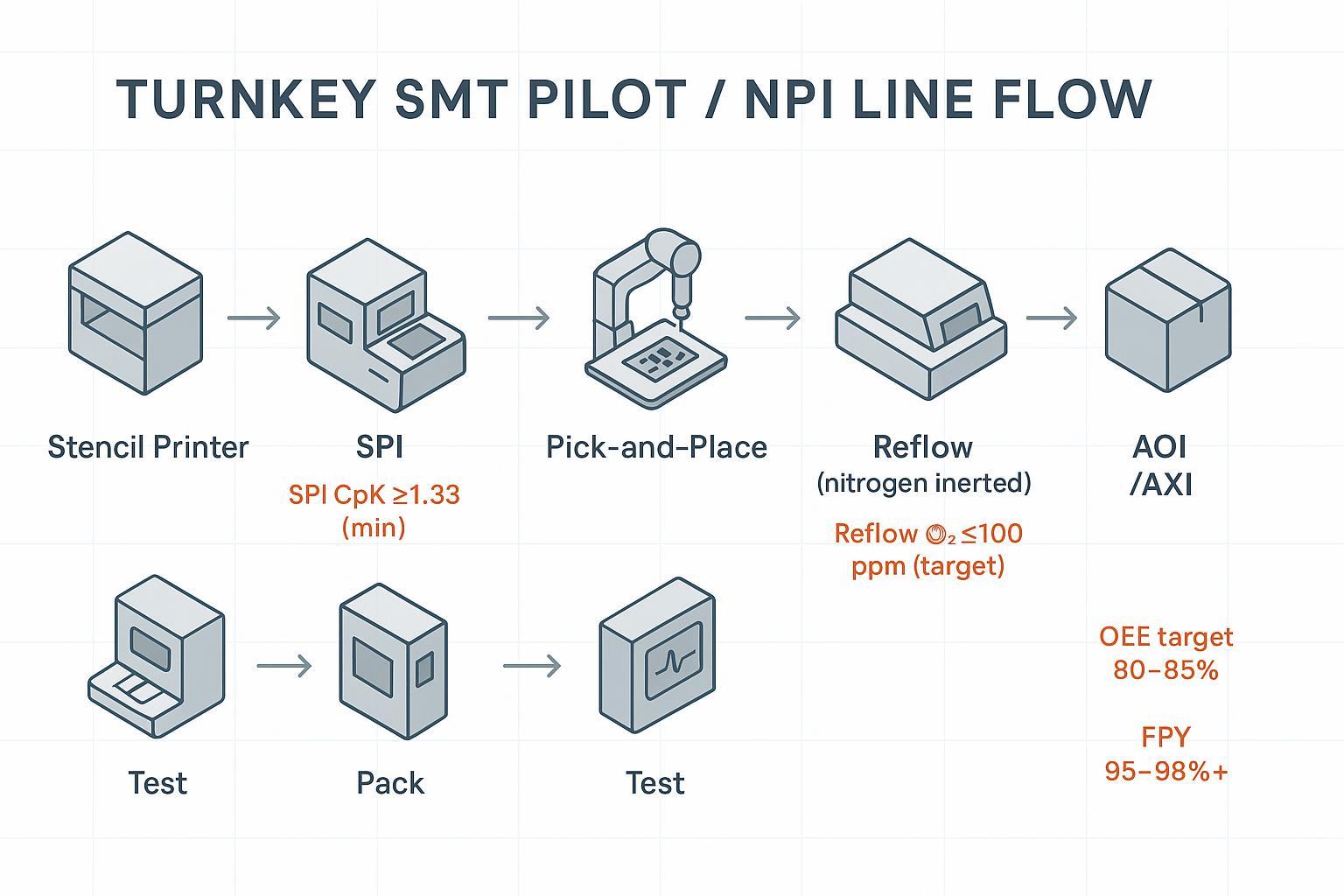
Launching a pilot/NPI high‑mix, low‑volume SMT line is where risk concentrates: new products, evolving programs, and tight audit expectations. This SMT turnkey production line checklist translates standards and good practice into concrete, measured checkpoints you can use from RFP to acceptance to ramp—so your first lots are compliant, traceable, and production‑ready.
De vigtigste pointer
Anchor the project to compliance and production readiness: ISO 9001 QMS; IPC J‑STD‑001 for process; IPC‑A‑610 for workmanship; ANSI/ESD S20.20 for ESD; J‑STD‑033 for MSL; right‑sized traceability per IPC‑1782A.
Treat acceptance as data, not opinion: require evidence artifacts (multi‑TC profiles, O2 ppm logs, SPI/AOI CSVs, genealogy export, calibration certs) for every gate.
For HMLV, set capability bands: SPI paste volume CpK ≥1.33 minimum (≥1.67 recommended on critical pads), AOI false calls <5% in NPI (<1% at maturity), escapes <2% then <1%.
Reflow windows for lead‑free: ramp 1–3 °C/s, soak ~150–200 °C, time‑above‑liquidus 60–90 s, peak ~235–250 °C; for inerted ovens, target O2 ≤100 ppm for high‑reliability builds.
Integration matters: enforce MES serialization and route interlocks; use OK/NG diverters; capture scan points from receiving → SPI → placement → reflow → AOI/AXI → test → pack.
Stabilization targets for HMLV: OEE 80–85% aspiration post‑tuning; FPY 95–98%+ after initial NPI learning.
Download the companion Vendor/RFP Scoring Checklist (weights + rubric) to make selection and acceptance auditable.
RFP & vendor scoring method (your SMT RFP vendor scoring)
Before a single crate ships, align stakeholders on how you’ll score vendors and what “minimum vs. recommended” looks like. Use a 0–5 rubric with weighted categories and evidence requirements.
Suggested weights (editable):
Equipment capability: 25%
Process control & SPC: 20%
Traceability & MES: 15%
Support, training & spares: 15%
Compliance & certifications: 10%
Total cost of ownership (TCO): 15%
Gate criteria (must‑have or eliminate):
Active ESD program per ANSI/ESD S20.20 with audits and logs.
IPC J‑STD‑001 process controls and IPC‑A‑610 Class appropriate to end market.
MSD handling per J‑STD‑033 with floor‑life tracking and bake SOPs.
MES serialization and route enforcement capability at printer/SPI/PnP/reflow/AOI.
Evidence you should demand in the RFP response:
Last calibration certificates for printer/SPI/PnP/reflow/AOI.
Sample multi‑TC reflow profile CSV and O2 ppm log from a recent build.
SPI capability summary (CpK) and AOI performance snapshot (false call/escape, coverage).
MES interface specs (Hermes/SMEMA, ISA‑95 mapping, API docs) and a sample genealogy export.
Scoring rubric (0–5): 0 = Not provided; 1 = Below minimum; 3 = Meets minimum; 5 = Meets recommended/best‑in‑class. Include a notes field with hyperlinks to artifacts.
According to the ANSI Blog’s overview of the 2021 revision, an ESD control program per ANSI/ESD S20.20 defines administrative and technical controls for EPAs, grounding, garments, packaging, and audits. For MSDs, JEDEC/IPC guidance in J‑STD‑033D describes floor‑life limits, dry storage, baking, and labeling—build these into your gates.
Pre‑install and FAT checks for a pilot/NPI line
Pre‑install is paperwork and utilities; FAT (factory acceptance test) is the first proof the turnkey set can run in control. For an HMLV line, bias toward changeover agility and measurement systems.
Documents & compliance to have in hand
ISO 9001 QMS certificate; process SOPs referencing IPC J‑STD‑001; acceptance criteria aligned to IPC‑A‑610 Class 2/3. See industry explainers on the roles of these standards in J‑STD‑001 and IPC‑A‑610 practice summaries.
ESD Program Plan, EPA map, and compliance verification logs per ANSI/ESD S20.20.
J‑STD‑033 MSD procedures and floor‑life/bake logs; reference the standard details in J‑STD‑033D.
Utilities & environment (verify with instruments)
Power: stable three‑phase per OEM specs; UPS/conditioning for control PCs.
Compressed air & vacuum: pressure/flow per each machine’s manual; dew point suited to pneumatics.
HVAC & ESD: 20–25 °C, 30–60% RH balance range for ESD versus moisture uptake; S20.20‑compliant floors/furniture/packaging.
Nitrogen for reflow (if inerting is specified): supply sizing and purity to hold target O2 ppm under load; continuous O2 monitoring provisioned.
FAT demonstration (at vendor site)
Safety and interlocks: E‑stop, guards; CE/UL documentation; interconnects proven.
Hermes/SMEMA signaling: pass/hold/E‑stop transitions are logged and reproducible.
Trial run: uninterrupted 4‑hour production at the intended takt with profile and inspection data captured; deliver logs and settings.
Evidence bundle to request: calibration certs, multi‑TC reflow profile CSV, O2 ppm log, SPI/AOI summary CSVs with images.
SAT & acceptance — golden runs that prove readiness
Site acceptance tests should look and feel like production, just smaller and fully measured. Treat this section as your core “SMT turnkey production line checklist” for go/no‑go.
Reflow profiling and nitrogen control
Windows for lead‑free SAC pastes: ramp 1–3 °C/s; soak ~150–200 °C; time‑above‑liquidus 60–90 s; peak ~235–250 °C; cooling 3–6 °C/s, as outlined in practical explainers like Wevolver’s reflow overview and application notes such as Psemi AN62. Validate on populated boards with multiple thermocouples and repeatability checks per IPC‑7530 practice.
Oxygen ppm targets in inerted ovens: for high‑reliability builds, a common target is ≤100 ppm; ultra‑low oxidation use cases may run 10–50 ppm; cost‑sensitive builds operate in the 500–1,000 ppm range. See primers like Venture Manufacturing’s nitrogen reflow note.
Practical example (neutral brand reference): A multi‑zone oven with closed‑loop O2 monitoring can be configured to hold a ≤100 ppm setpoint at or near the peak zone while maintaining profile stability. For a deeper primer on O2 control concepts, see S&M’s guide on nitrogen in reflow soldering.
SPI capability and printing controls
Establish capability on critical pads: require CpK ≥1.33 minimum during NPI; target ≥1.67 for stabilized builds. Capture volume/height/area/offset SPC and retain 30–50 sample short‑term studies.
Evidence: SPI capability report (CSV/PDF), stencil specs and tension, cleaning chemistry records, and sample control charts.
Placement accuracy and feeders
Verify placement offset and rotation capability on 0201/01005 as applicable; confirm feeder error‑proofing and changeover SOPs; run basic MSA on vision.
AOI/AXI performance and GR&R
During NPI, tune for coverage first (≥95% visible features); set AOI false call target <5% and escapes <2%, then tighten toward <1% each as libraries mature. Plan GR&R on decisioning to prevent drift. A recent industry call for metrics from iNEMI outlines relevant approaches in their AOI/AI metrics brief.
Traceability, interlocks, and OK/NG diverters
Serialization and scans: receiving → kitting → printer/SPI → placement → reflow → AOI/AXI → test → pack. Align rigor to IPC‑1782A levels; enforce route interlocks and quarantine lanes.
Practical example (neutral brand reference): When planning buffers around SPI/AOI/reflow, configure conveyor speeds, board sensors, and OK/NG diverters so NG automatically routes to hold/rework and can’t re‑enter the main stream during debug. For signal conventions and layout considerations, see S&M’s guide to automatic PCB conveyors and compliance.
Acceptance targets and pass/fail triggers
Reflow profile within paste window; document thermocouple attachment methods; demonstrate run‑to‑run peak repeatability target within about ±3 °C for similar assemblies.
SPI: CpK ≥1.33 (critical pads) minimum; ≥1.67 recommended after stabilization.
AOI: False call <5% in NPI (tighten to <1% in maturity); escapes <2% then <1%.
Traceability: 100% scans at defined nodes; export genealogy for the pilot lot.
Evidence bundle: multi‑TC profile CSV, O2 ppm logs including near the peak zone, SPI/AOI CSVs and sample images, MES route map and genealogy export, equipment calibration certs, ESD audit snapshot.
NPI ramp and stability for HMLV
The goal is predictable flow with disciplined adjustments. Here’s how to govern the first 4–8 weeks.
SPC you actually use: Control charts on paste volume, placement offsets, reflow peak and TAL. Define stop‑the‑line criteria and who can restart.
OEE and FPY targets: For HMLV, an attainable aspiration after early kaizen is OEE around 80–85% and FPY 95–98%+ at the AOI/AXI gate. For context on how electronics sites model OEE, see Vorne’s electronics OEE primer.
Recipe/version governance: Lock printer, PnP, reflow, and AOI programs to the released ECN; record hash/ID; audit loads via MES and block mismatches.
Training and spares: Operator certification on changeovers and recovery; PM schedule launched; critical spares and lubricant plans in place.
Audits and reviews: Weekly capability summaries, AOI false‑call trending, defect Pareto, genealogy sample checks; define triggers for DoE and recipe updates.
Common pitfalls to avoid
Measuring reflow O2 only at the entrance/exhaust—add a probe near the peak zone and log during the golden run.
Skipping AOI GR&R—false calls and escapes drift without a measurement system analysis on decisioning.
Allowing recipe mismatches across printer/PnP/reflow/AOI—enforce ECN locks and version checks.
Tracking MSL time outside MES—integrate counters and bake prompts per J‑STD‑033.
Bypassing diverters during debug—use quarantine lanes and jam/bypass tests to prevent mixed‑flow escapes.
Inconsistent thermocouple attachment—standardize per IPC‑7530 practice and record the method per TC.
What’s next: download the vendor/RFP scoring checklist
Use the companion, editable scoring matrix to weight equipment capability, process control/SPC, traceability/MES, support/training/spares, compliance/certifications, and TCO. It includes a 0–5 rubric, gate criteria, and an evidence column with links to artifacts. If you’d like a copy, let us know and we’ll share the latest version.
Note: If you’re mapping out profiling and nitrogen control or conveyor interlocks, S&M Co.Ltd provides reflow and transfer systems that support O2 monitoring, recipe governance, and OK/NG diverter configurations compatible with common MES/AOI integrations. Explore primers such as nitrogen in reflow soldering and an overview of reflow ovens and zone control to deepen planning without committing to a vendor.
References and further reading
ESD control program scope and requirements — ANSI/ESD S20.20 overview (2021)
Moisture sensitivity handling and floor‑life guidance — JEDEC/IPC J‑STD‑033D
Reflow process windows and parameters — Wevolver reflow soldering overview; Psemi AN62
Nitrogen ppm targets in reflow — Venture Manufacturing nitrogen primer
OEE in electronics manufacturing — Vorne industry page