



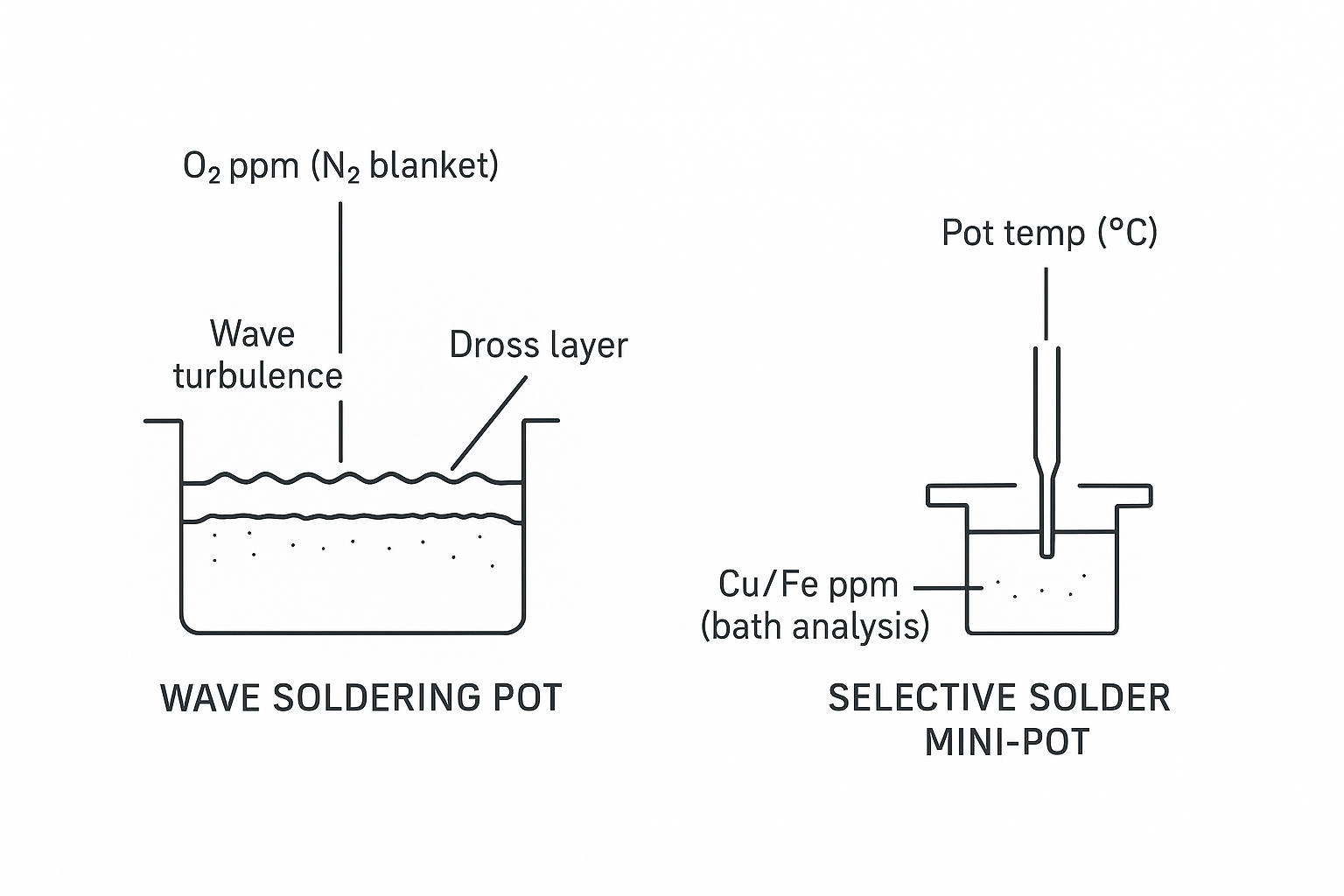
Solder pot “life” is rarely a single failure. It’s usually a slow drift: higher dross, unstable wave shape, more bridging/flags, rising solder bar consumption, and more time spent fighting symptoms.
If you run nitrogen wave and selective soldering, you already have the biggest lever for dross reduction. The next step is treating the solder bath like a controlled material system: measure what matters, keep it stable, and intervene early.
This guide gives you an implementable control plan—with “done when…” checkpoints and shift/weekly routines—for wave solder dross reduction without compromising wetting. It’s written for nitrogen wave systems (where nitrogen wave soldering dross should be controllable) and selective soldering cells where mini-pots drift faster. The goal is longer solder pot (“tin barrel”) service life by keeping bath chemistry and equipment condition in spec.
What “tin barrel life” really means in wave soldering
In US shops, “tin barrel” typically refers to the solder pot / solder bath and the hardware that keeps it moving: pump, wave former/nozzle, heaters, and any nitrogen tunnel/hood.
Extending life is about three outcomes:
Less oxidation waste (lower dross).
Stable solderability (wetting and flow stay consistent).
Less mechanical wear and corrosion (pot, pump, nozzles last longer).
A useful way to think about it: every hour you run, your bath is being “processed” by oxygen exposure + turbulence + contact with boards/components. That’s why wave is typically a high dross generator—turbulence and surface renewal matter a lot, as described in I‑Connect007’s “Managing Dross in Soldering Processes”.
The 3 drivers of dross—and what nitrogen does (and doesn’t) fix
Dross is oxidized solder (metal oxides plus entrained metal). Your nitrogen system reduces oxygen at the solder surface, slowing oxide formation, but it doesn’t eliminate the other drivers.
Driver 1: Oxygen at the solder surface
Lower oxygen = slower oxidation.
AIM Solder’s technical note “Understanding Solder Dross: Causes and Control Strategies” emphasizes that controlling existing process variables (atmosphere, temperature, agitation) is often more effective than “adding something” to the bath.
What to do in practice (nitrogen wave):
Treat oxygen level as a control variable, not a “set it and forget it” feature.
Check for leaks and poor sealing around the wave area and nitrogen tunnel/hood.
Driver 2: Turbulence and unnecessary wave exposure
Wave motion increases fresh surface exposure to oxygen and tends to increase dross.
Also, dross can accumulate under/around the pump and later get carried into the wave. Circuitnet’s troubleshooting note “Why is Solder Dross Sticking to Our PCBAs?” calls out this pump-area buildup as a real contributor to dross showing up in process.
What to do in practice:
Keep wave height/flow stable.
Don’t run aggressive pump settings to compensate for upstream issues (flux, preheat, board cleanliness).
Driver 3: Temperature discipline
Higher pot temperatures generally increase oxidation rates and can accelerate equipment wear. Temperature also interacts with contamination (e.g., higher viscosity/poorer flow when contaminants rise).
What to do in practice:
Run the lowest temperature that still gives you robust wetting for your alloy, finish, and thermal mass.
Use an idle strategy (see Step 4) so you’re not oxidizing metal at full process temperature when no boards are present.
Key Takeaway: Nitrogen helps most with the oxygen driver. You still have to control turbulence and temperature—or you’ll “buy” nitrogen and still fight dross.
Step-by-step: A dross reduction control plan (nitrogen wave + selective)
This is written as an implementation sequence. Don’t skip Step 1—baseline is how you prove your changes worked.
Step 1 — Establish your baseline (1–2 shifts)
Input: one stable product family (or your most common build), normal flux, normal conveyor speed.
Action: capture a baseline for:
dross removed per shift (mass or volume)
solder bar additions per shift
defects linked to wave stability (bridging, icicles/flags, insufficient hole fill)
nitrogen oxygen reading(s) and flow settings
Output: a “normal range” that becomes your control chart.
Done when: you can answer: “What’s our normal dross rate per hour of run time?”
Step 2 — Lock atmosphere control (nitrogen wave)
Input: your nitrogen wave running conditions.
Action:
Verify oxygen measurement is reading consistently (sensor calibration check per supplier).
Inspect and fix obvious leak paths: doors, curtains, tunnel joints, access ports.
Standardize a single oxygen target range for your line (your equipment supplier and solder/flux supplier should be able to recommend starting points).
Output: oxygen stays stable during a full shift—not just at startup.
Done when: oxygen isn’t “hunting” with conveyor loading, door openings, or product changeovers.
Step 3 — Stabilize the wave (mechanical + flow)
Input: current pump settings, wave height spec, nozzle/wave former condition.
Action:
Inspect nozzles/wave formers for wear, damage, and buildup.
Confirm wave height and contact length are within your process spec.
Make “wave stability” a first-class check (visual + measurement) at shift start.
Output: consistent wave shape and repeatable contact.
Done when: operators can identify “normal wave” vs “turbulent wave” quickly, and escalation triggers are documented.
Step 4 — Temperature discipline and idle strategy
Input: current pot setpoint, actual measured pot temperature, run/idle schedule.
Action:
Avoid running hotter to compensate for wetting problems.
If your line has long idle windows, define an idle temperature strategy (lower setpoint when no boards are running; return to process temperature with enough soak time).
Output: stable wetting without “hot pot” behavior.
Done when: you can maintain quality without increasing setpoint after changeovers.
Step 5 — Flux management (reduce rework without creating residues)
Flux issues often get misdiagnosed as “solder pot problems.” Too little activity causes poor wetting; too much or poorly controlled flux can increase residues and instability.
Input: current flux type, density/solids control method, spray pattern, and preheat profile.
Action:
Confirm flux is within its usable life and stored/handled per manufacturer guidance.
Standardize flux application checks (spray coverage, clogged nozzles, filter condition).
Verify preheat is doing its job: activating flux and driving off volatiles before contact.
Output: wetting improves without raising temperature or pump turbulence.
Done when: wetting and hole fill are stable across the shift.
Step-by-step: Keep solder bath quality in spec (so dross doesn’t come back)
Dross reduction is easier when your bath chemistry stays clean. Impurities build up over time and change wetting and flow.
Kester’s technical document “Effects of Metallic Impurities” (PDF) explains how metallic contaminants can shorten usable bath life and degrade performance.
Step 6 — Set up a bath analysis cadence (OES + logs)
Input: access to OES (optical emission spectroscopy) testing (in-house or external lab) and a sampling procedure.
Action:
Define your sampling points (e.g., flowing solder zone vs surface skim area).
Test at a frequency that matches your throughput (start weekly for steady high-volume; move to per-shift for very high-volume or when defects spike).
Track results with SPC trends (not just “pass/fail”).
Output: trend visibility before you hit out-of-spec.
Done when: you can correlate rising defects/dross with actual chemistry drift.
Step 7 — Control copper pickup (Cu)
Copper is a common contaminant source in solder baths (boards and component finishes). If you’re seeing solder bath contamination from copper, bath properties can drift and wave behavior becomes harder to keep stable. AIM Solder’s paper “Controlling Copper Build Up in Automatic Soldering Equipment” (PDF) details why copper is a well-known wave pot maintenance challenge.
What “high copper” can look like on the line:
sluggish flow / unstable wave
increased bridging risk
inconsistent hole fill margins
Corrective actions (choose based on your alloy spec and supplier guidance):
controlled top-up with known-good alloy to dilute
partial dump/refresh if trends show continued rise
investigate upstream sources (board finish change, mixed alloys, change in product mix)
Step 8 — Reduce iron pickup (Fe) from equipment wear and cleaning
Iron contamination can come from corrosion/leaching and mechanical wear—especially in lead-free environments.
ITW EAE’s technical paper “Equipment Impacts of Lead Free Wave Soldering” describes how tin-rich lead-free alloys can drive corrosion and higher maintenance frequency in wave solder systems—one pathway for increased contamination risk when equipment wear accelerates.
Action:
Avoid aggressive mechanical cleaning (wire brushes and abrasives).
Use non-abrasive methods to protect pot surfaces.
Stellar Technical Products’ guidance “How to Extend the Life of Your Solder Pot” reinforces non-abrasive cleaning to reduce damage that accelerates wear.
Done when: your maintenance routine improves cleanliness without visibly scratching or eroding pot surfaces.
Pro-tip: Treat “pot cleaning” like tool maintenance. If cleaning damages surfaces, you’ll pay for it twice—more contamination and shorter hardware life.
Selective solder pot maintenance: why mini-pots drift faster
Selective systems often have smaller solder volumes and more localized heating. That means:
chemistry can drift faster per unit of production
dross-to-volume ratio can be worse if idle management is sloppy
the “wipe before use” habit matters more
EPTAC’s note on solder pot maintenance and dross removal calls out wiping the surface to remove dross prior to soldering—this is especially relevant when the bath sits idle between runs.
Selective-specific controls to add:
a “pre-run wipe/skim” step
tighter sampling cadence when product mix changes
documented changeover procedures to prevent cross-contamination (e.g., tooling, carryover materials)
Wave solder pot maintenance checklists (printable SOP format)
This section is intentionally written as wave solder pot maintenance you can standardize across teams, then adapt for each product family.
Use these as binary checks. If you can’t answer “Yes” cleanly, it becomes an action item.
Start-up checklist (each shift)
Pot temperature is at the validated setpoint (not just “close enough”).
Nitrogen system is on-target and stable (no leak alarms / abnormal flow).
Wave/nozzle condition is visually normal (no unusual turbulence).
Dross layer is controlled (skim only what’s required to restore a clean working surface).
Flux system passes basic checks (spray pattern, filters, no visible clogging).
During production (hourly or per lot)
Oxygen reading remains stable under load.
Wave height/contact looks consistent.
Dross accumulation is within baseline range.
Defect signals (bridging/icicles/hole fill) are not trending upward.
End-of-shift
Record dross removed (mass/volume) and solder additions.
Record any parameter changes (temp, pump, nitrogen, flux).
Inspect for buildup near the pump area based on your equipment design.
Ugentlig
Review SPC trends: dross rate, solder additions, key defect metrics.
Verify flux maintenance items (filters/cleaning per supplier guidance).
Inspect nozzle/wave former for wear/buildup.
Monthly / quarterly (based on operating hours)
Schedule deeper cleaning/inspection of pump and pot interior (planned downtime).
Review bath analysis results and confirm chemistry remains in spec.
Refresh training: “normal wave” reference images and escalation triggers.
⚠️ Advarsel: Over-skimming can waste usable solder. The goal isn’t “zero dross”—it’s controlled oxidation and stable process. Use your baseline to decide what’s normal.
Where Chuxin SMT fits (equipment context, not a shortcut)
If you’re building or upgrading a nitrogen wave + selective process, equipment design influences how easy it is to control oxygen exposure, wave stability, and repeatability.
For reference:
Nitrogen wave soldering: Chuxin SMT’s SA‑350N nitrogen wave solder and the broader Nitrogen/Air Wave Solder line are designed for inline wave soldering workflows.
Selektiv bølgelodning: the Online Dual Platform Selective Wave Soldering (SM‑LⅡ) supports selective soldering scenarios where you need precision on mixed-technology boards.
De vigtigste pointer
Dross is driven by oxygen exposure, turbulence, and temperature; nitrogen mainly attacks the oxygen part, so you still need turbulence and temperature discipline.
Baseline first: track dross removed and solder additions per shift so improvements are measurable.
Bath chemistry is pot life: control contamination (especially Cu/Fe) with regular analysis, trending, and corrective actions before defects spike.
Selective mini-pots drift faster; add “wipe/skim before run” and tighter cadence.
Næste skridt
If you want to turn this into a line-ready SOP (with your actual alloy limits, oxygen targets, and sampling plan), schedule a process review with S&M (Chuxin SMT) and share:
your alloy type and operating temperatures
current oxygen readings and nitrogen consumption
last 4–8 weeks of bath analysis (Cu/Fe/others)
dross and solder addition logs
You can start by reviewing Chuxin SMT’s nitrogen wave options and selective solder platforms: