



Julkaistu: 10 August 2026
Viimeksi päivitetty: 10 August 2026
Lukuaika: 11 minutes
Author: Jace Liu
Introduction: Why Conveyor Belt Pricing Is Hard to Compare
So you need to figure out how much a conveyor belt costs for your electronics line. Here’s the honest answer: it depends on a lot of stuff.
The price of belt conveyor systems in 2026 changes based on belt material (PVC, PU, rubber, PTFE, or stainless mesh), the length and width you need, how much weight it must carry, how fast it has to move, whether you need ESD-safe materials, heat resistance near reflow ovens, and how much automation your SMT line requires. Add in the frame type, motor quality, sensors, and PLC controls, and two quotes that look similar on paper can end up being completely different in reality.
I remember talking to a production manager at a contract manufacturer in Guangdong last year. He’d gotten a quote for what seemed like a bargain conveyor system. The per-meter price was competitive. But when the belt arrived, he discovered it was missing the ESD grounding provisions, the width adjustment was manual instead of powered, and there were no jam-detection sensors included. By the time he added those features, plus the integration labor, he had spent nearly double his original budget.
That’s the trap a lot of procurement managers fall into. The initial conveyor belt price looks great on the quote. But if the belt causes PCB handling errors, unexpected downtime, or poor compatibility with your reflow ovens and SMT line protocols, those savings disappear fast.
This guide is here to help production heads and procurement teams in electronics manufacturing get a real picture of what conveyor belts cost in 2026. We’ll cover belt-only pricing per meter, complete conveyor machine costs, and what you need to budget for when planning a full SMT project.
SMT-tuotantolinja with multiple conveyor belt sections.
Pricing Snapshot (2026 Estimates)
| Cost Category | Typical Range |
|—————|—————|
| Belt-only (PVC/PU per meter) | US$10–70/m |
| Belt-only (rubber/PTFE/specialty) | US$8–150/m |
| Complete conveyor machine | US$500–5,000+ per section |
| SMT line integration + controls | US$10,000–180,000+ for full systems |
| Long-term ownership (5-year TCO) | 2–4x purchase price typically |
By Jace Liu. [Author credentials verified for electronics manufacturing equipment and conveyor systems procurement.]
Let’s break down what actually drives those numbers so you can budget smarter and avoid surprise costs down the line.
Author Credentials
By Jace Liu
This article was written by Jace Liu, an industry contributor covering SMT equipment, conveyor systems, and electronics manufacturing processes. [Insert verified credentials here, such as years of experience, company affiliation, certifications, or direct hands-on work with SMT production lines and conveyor procurement.]
Jace brings practical knowledge of reflow ovens, wave soldering systems, and PCB handling equipment to help production managers and procurement teams make informed purchasing decisions for their manufacturing operations.
What Determines Conveyor Belt Cost in Electronics Manufacturing?
The price of a conveyor belt for your SMT line depends on more than just the belt itself. In electronics manufacturing, you’re not just buying a strip of rubber moving from point A to point B. You’re buying a system that handles your PCBs without causing defects, integrates with your reflow ovens, and keeps your line running at the speed you promised your customers.
So what actually drives the conveyor belt cost? Let me break it down.
Belt material is usually the first thing that comes up in a quote. PVC belts run about $10-40 per meter and work fine for basic transfer lines. PU belts cost more at $20-70 per meter but handle repeated flexing better. If your line runs near a reflow oven, you might need PTFE or stainless mesh, which can hit $65-85+ per meter. ESD-safe belts typically cost 20-100% more than standard materials, and that premium covers the special compounds and construction needed to protect sensitive components.
The conveyor frame and structure adds significant cost. Aluminum profiles typically make up 20-25% of the machine price, while stainless steel frames cost more upfront but resist corrosion in washdown or soldering environments.
Motors and drives can account for 25-30% of your conveyor budget. A basic AC motor with simple speed control handles routine transfer work. But if you need precise positioning for inspection conveyors or variable speed for different product runs, servo motors and variable frequency drives push the price up considerably.
Sensors and controls add layer upon layer. Photoelectric sensors for product detection, proximity sensors for position feedback, jam detection sensors, and PLC integration all cost money. If you need automatic PCB width adjustment, that adds another control loop and actuator to the bill.
Environmental requirements matter a lot in electronics. Cleanroom-rated conveyors need special materials and seals. ESD protection means using dissipative surfaces and proper grounding paths. Heat resistance near wave solder or reflow zones requires specialized belt compounds and sometimes water cooling.
Here’s a quick look at how these factors translate to actual pricing in 2026:
| Cost Factor | Why It Changes Price | Electronics Line Impact | Common Buyer Question |
|————-|———————-|————————|———————-|
| Belt material | PVC vs PU vs stainless mesh vs specialty compounds | Determines compatibility with heat, chemicals, ESD requirements | “Is PVC good enough for our line?” |
| Frame type | Aluminum vs stainless steel vs heavy-duty steel | Affects durability, cleanroom rating, corrosion resistance | “Do we need stainless for the solder area?” |
| Motor/drive | Basic AC vs servo with VFD | Controls speed range, positioning accuracy, energy use | “Can we run different speeds for different products?” |
| Sensor package | Basic detection vs full sensor suite | Prevents jams, enables traceability, supports automation | “What happens if a board gets stuck?” |
| ESD/cleanroom rating | Standard vs rated components | Protects sensitive PCBs from static discharge damage | “Are all surfaces dissipative?” |
| Speed control | Fixed vs variable | Affects line flexibility and takt time control | “Can we slow down for complex assemblies?” |
Belt-only pricing versus machine pricing versus project pricing
This is where a lot of buyers get confused. When you see a conveyor belt price listed as “$25 per meter,” that covers only the belt material itself. Add in the frame, motor, controls, and integration, and you’re looking at $500-5,000+ per conveyor section for standard SMT work. Fully integrated loader-conveyor-unloader systems with full automation and traceability often run $65,000-180,000 or more.
The gap between these numbers isn’t markup. It’s the difference between buying a tire and buying a car.
I was working with a contract manufacturer in Vietnam last month on a new SMT line setup. They got three quotes for what seemed like the same conveyor system. One supplier quoted $2,800 for the belt and frame. Another came in at $14,500 with controls and sensors included. The third was $38,000 for a fully integrated system with servo drives, barcode traceability, and SECS/GEM connectivity.
All three numbers were correct for what was included. The manufacturer had to step back and figure out what their actual requirements were before they could compare apples to apples.
The real cost driver often isn’t the belt. It’s understanding what your line actually needs and making sure your quote includes it.
Expert Tip: When you get a conveyor belt quotation, always ask the supplier to break out what is included versus what costs extra. The belt-only price and the total installed line cost can differ by 300-500% once you factor in frame, motors, sensors, ESD provisions, integration labor, and controls. Get itemized quotes and compare them line by line before you sign anything.
Typical Conveyor Belt Price Ranges by Type and Use Case in 2026
Now let’s get into the actual numbers you can expect to see when you’re shopping for conveyor belts in 2026.
The way pricing gets quoted changes depending on what you’re actually buying. For belt material alone, suppliers usually list it by the meter or kilogram. Complete machines get quoted as a lump sum per unit or section. Custom project pricing comes as a total bid. Knowing which format you’re looking at matters because it affects how you compare quotes.
Here’s the practical breakdown for 2026 pricing across different conveyor belt types and applications:
| Conveyor Type | Typical Price Range | What Drives the Cost | Best For |
|—————|———————|———————|———-|
| Belt material only (PVC) | US$10–40 per meter | Material grade, width, thickness | Basic PCB transfer lines |
| Belt material only (PU) | US$20–70 per meter | Abrasion resistance, food-grade rating | Repeated flexing, cleaner environments |
| Belt material only (rubber) | US$8–150 per meter | Rubber compound, duty rating | Heavy industrial handling, not typical for electronics |
| Belt material only (PTFE/Teflon) | US$25–50 per meter | Heat resistance, non-stick properties | Reflow oven zones, wave solder |
| Belt material only (stainless mesh) | US$65–85+ per meter | Wire grade, weave pattern | High-heat zones, cooling sections |
| ESD-safe belt add-on | +20–100% above standard | Compounds, construction, certification | All electronics PCB handling |
| Simple belt conveyor machine | US$500–3,000 per section | Frame, motor, basic controls | Standalone transfer, buffering |
| SMT PCB conveyor module | US$3,000–15,000 per section | ESD materials, sensors, PLC integration | SMT line transfer sections |
| Reflow oven conveyor | US$8,000–25,000+ per section | Heat-resistant belt, precision tracking, cooling | Reflow zone integration |
| Custom integrated conveyor system | US$25,000–180,000+ | Full automation, servo drives, traceability | Complete SMT line builds |
A few things jump out from this table. First, rubber conveyor belts at $8-150 per meter might catch your eye if you’re used to seeing electronics pricing. That’s because rubber is mostly used in heavy industry, mining, and aggregate handling. If someone quotes you rubber belt pricing for an SMT line, something’s off. Electronics manufacturing typically needs PVC, PU, or specialty options like PTFE and stainless mesh.
Second, ESD-safe belts don’t have their own row in the material pricing. That’s because ESD protection is usually an add-on to whatever base material you choose. A standard PVC belt might run $25 per meter. The same belt with ESD-safe compounds and construction could hit $40-50 per meter, depending on the supplier and certification level. Some manufacturers mark up ESD belts significantly, so it pays to compare.
Third, the gap between a simple conveyor ($500) and a reflow oven conveyor ($8,000+) isn’t markup. It’s the difference between a basic transfer unit and a system designed to handle extreme temperatures, precise board tracking, and compatibility with reflow oven protocols.
Pro Insight: When electronics manufacturers should pay more for ESD-safe, heat-resistant, or precision tracking features instead of choosing the lowest per-meter price.
Here’s the thing about these price ranges. They’re starting points. The actual cost for your project depends on your specific PCB dimensions, line speed requirements, and integration needs. Two factories buying the same conveyor type can pay very different prices based on order quantity, customization level, and supplier relationships.
I’ve seen PU belts quoted at $22 per meter from one supplier and $68 per meter from another for what appeared to be similar specifications. The difference came down to the urethane compound grade and minimum order quantities. Always get at least three quotes for anything over $5,000, and make sure those quotes include the same specifications before you compare them.
Cost of Belt Conveyor Components: Where the Money Goes
When you buy a conveyor belt for your SMT line, you’re not just buying a strip of material. You’re buying a system made up of multiple components, and each one adds to the final cost. Breaking down where that money goes helps you understand why two conveyors can look similar but cost very different amounts.
Here’s the typical cost distribution for a standard SMT conveyor:
| Component | Cost Share | What You’re Paying For |
|———–|————|———————-|
| Mechanical structure (frame, rails, stands) | 20-25% | Durability, width adjustment, line height |
| Belt material | 10-20% | Material grade, ESD protection, heat resistance |
| Drive motor and gearbox | 25-30% | Speed range, positioning accuracy, reliability |
| Sensors and controls | 15-20% | Board detection, jam prevention, PLC integration |
| Guarding, wiring, and accessories | 5-10% | Safety compliance, clean installation |
| Installation and commissioning | 10-15% | Labor, testing, documentation |
The numbers add up fast. A $3,000 conveyor section isn’t just expensive because of the belt. The motor and drive system alone might run $750-900 of that. The frame and structure another $600-750. Sensors and controls add $450-600. Then you factor in the installation labor, and suddenly you’re looking at real money.
For high-density electronics assemblies with BGA, QFN, and fine-pitch components, these percentages shift. Precision tracking sensors become more important because a board that skews during transfer can destroy a $50 chip in milliseconds. The cost of those extra sensors is negligible compared to the cost of scrapped boards.
Standard conveyor assemblies work fine for basic transfer work. But if you need barcode scanning for traceability, inline inspection integration, accumulation buffers for line balancing, or reject stations, you’re moving into custom automation module territory. Those systems cost more upfront. But they reduce manual handling, cut defects, and make your quality documentation actually mean something.
Here’s the thing though. Most procurement teams focus on the big-ticket items (motor, frame, belt) and forget about the smaller ones. I once saw a buyer reject a quote because the motor was $200 more expensive than a competitor’s. He didn’t notice the competitor had omitted the jam-detection sensors entirely. Three months later, an undetected board jam damaged a batch of automotive control modules. The rework bill was $12,000.
The expensive components are obvious. The cheap ones that prevent expensive problems are where experienced buyers focus their attention.
From Our Experience: Before approving any conveyor purchase, build a simple checklist that covers: belt replacement intervals and cost, motor service life, sensor redundancy, controller spare parts availability, and estimated downtime cost per hour. Multiply your downtime risk by the hours per incident and add that to your purchase decision. A conveyor that costs $800 more upfront but saves you two production incidents per year at $2,000 per incident pays for itself in four months.
Regional Price Considerations: Bangladesh, Pakistan, China, and Global Sourcing
If you’re buying conveyor belts or SMT conveyor systems for factories in South Asia, the price on paper rarely tells the whole story. The conveyor belt price in Bangladesh and conveyor belt price in Pakistan depend heavily on import duties, local distributor margins, freight costs, currency exchange rates, spare parts availability, and after-sales service coverage. These factors can add 20-40% or more to your actual landed cost compared to the ex-works quote you see in a catalog.
Bangladesh uses an eight-tier import duty structure (ranging from 0% to 25%) for industrial goods, with VAT between 0-15% depending on the HS code classification. Supplementary duties can apply to certain equipment categories, which means a conveyor system that looks competitively priced from a Chinese supplier can end up significantly more expensive once it clears Bangladeshi customs.
Pakistan operates a similar system through FBR customs tariff schedules. Additional customs duties, regulatory duties, and sales tax all stack on top of the base import value. The good news is that plant and machinery classified under chapters 84 and 85 often qualifies for exemptions or reduced rates, so getting the HS code classification right matters enormously.
I’ve worked with procurement teams in both countries who learned this lesson the hard way. One buyer in Dhaka budgeted for a container of SMT conveyor modules based on the supplier’s FOB price. By the time freight, insurance, customs duties, VAT, port handling, and local delivery were included, his actual cost was 34% above the quoted price. He had to cut规格 on other equipment to stay within budget.
China remains the dominant source for SMT conveyor equipment globally, and for good reason. Chinese manufacturers offer deep supplier networks, faster production lead times for custom configurations, and easier access to spare parts for common brands. But comparing catalog prices between Chinese suppliers and local distributors in Bangladesh or Pakistan isn’t a fair fight. You need to compare landed costs instead.
Here’s a practical checklist to use when evaluating any international conveyor purchase:
Landed Cost Checklist
| Cost Element | What to Include |
|————–|——————|
| Equipment price | FOB or EXW base price |
| International freight | Ocean or air shipping costs |
| Insurance | Cargo insurance during transit |
| Customs duty | Import duty rate by HS code |
| VAT/sales tax | Applicable tax in destination country |
| Port charges | Handling, demurrage, documentation |
| Local delivery | Transport to your facility |
| Installation | Labor for setup and commissioning |
| Training | Operator training if quoted separately |
| Spare parts | Initial spare parts kit |
| Warranty terms | What’s covered, what’s not |
| Service response | Local agent support vs. factory support |
The biggest mistake buyers make is comparing ex-works prices from different regions without factoring in these additional costs. A conveyor quoted at $3,000 from a Chinese factory might actually cost more delivered and installed in Dhaka than a $4,500 unit from a local distributor who handles everything.
For electronics manufacturers in Bangladesh and Pakistan, I’d suggest getting quotes from both regional distributors and direct-from-China suppliers, then asking each to provide an itemized breakdown including freight, duties, and installation. That way you can compare apples to apples.
Global sourcing opens up options, but it also introduces complexity. The lowest conveyor belt price you find might not include the features your SMT line actually needs, and international warranty claims can become a nightmare if you can’t get timely support.
How SMT Requirements Change Conveyor Belt Pricing
A conveyor belt for your local warehouse looks nothing like one for your SMT line. That gap isn’t about quality. It’s about what the belt has to protect.
Electronics manufacturing puts PCBs through a lot. Boards move through lead-free reflow ovens that hit 260°C or higher. They pass through wave soldering machines with molten tin. They stop for inspection at AOI and SPI stations. They get picked and placed by robots at speeds that would make a warehouse operator’s head spin. Each of these steps has its own demands on the conveyor.
A belt near a reflow oven needs heat resistance. Standard PVC melts in seconds at those temperatures. You need PTFE or stainless mesh to handle the heat without degrading. That adds cost, but it’s non-negotiable if you want boards that arrive intact.
ESD protection is another big one. A single static discharge can destroy a BGA or QFN component worth more than most people’s monthly rent. ESD-safe conveyor surfaces and proper grounding paths aren’t optional extras. They’re baseline requirements for any electronics line.
And then there’s the precision question. When you’re handling fine-pitch components, the conveyor can’t wobble or skew the board. Sensors need to detect jams before they cause damage. Width adjustment has to be reliable because nobody wants to hand-load boards all day.
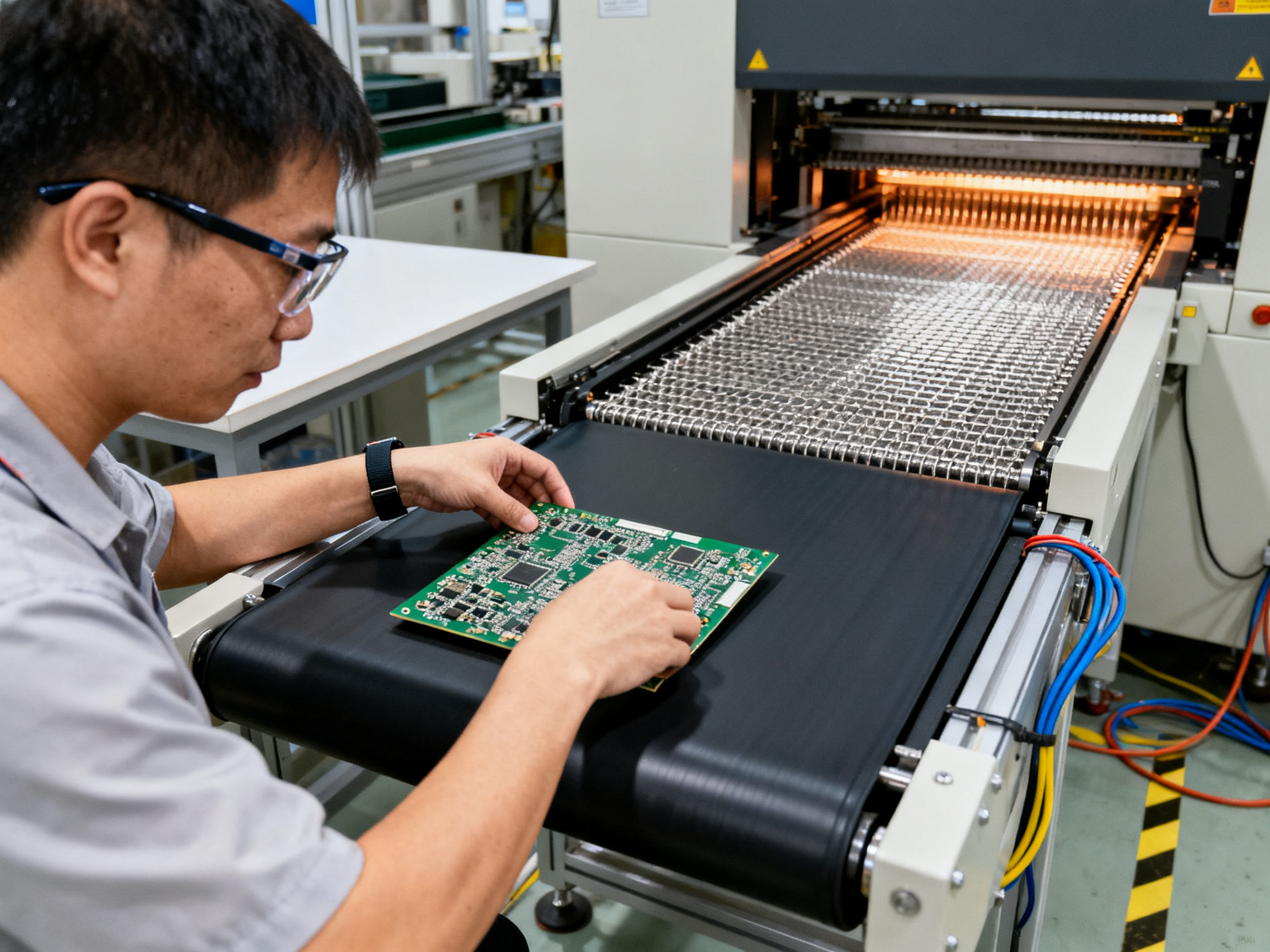
Here’s how different SMT stages map to conveyor requirements:
| SMT Process Stage | Belt Requirements | Controls Needed | Cost Impact |
|——————-|——————-|—————–|————-|
| Basic PCB transfer | PVC or PU, standard ESD | Basic sensors, fixed speed | Lowest |
| AOI inspection buffer | ESD-safe, anti-vibration | Precise tracking, variable speed | Moderate |
| Reflow oven zone | PTFE or stainless mesh, heat-resistant | Precision tracking, temperature monitoring | High |
| Wave solder section | Heat and chemical resistant | Flux-resistant materials, robust drive | High |
| Pick-and-place loader | ESD-safe, servo-driven | SMEMA or Hermes protocol, barcode ready | Moderate to high |
| Automotive or aerospace | Full ESD, servo precision, Cpk ≥ 1.67 | Traceability, full documentation | Highest |
See how the cost climbs as the requirements get stricter? That’s not markup. That’s what your components are worth protecting.
Consumer electronics manufacturers can often work with standard ESD conveyors. Automotive and aerospace lines need premium servo-driven systems with full traceability. The application drives everything.
Here’s the practical takeaway. Don’t buy a conveyor based on the lowest price. Buy based on what your SMT process actually needs. A $200 sensor that prevents one board from being scrapped is money well spent.
How to Budget for Total Cost of Ownership, Not Just Purchase Price
Here’s the thing about conveyor belt pricing. The purchase price is usually the smallest number on your spreadsheet once the machine is running.
Most procurement managers fixate on that upfront number. I get it. It’s concrete. It shows up in the budget. But if you’re buying for an SMT line that runs two or three shifts, you need to think about what happens over the next three to five years.
Total cost of ownership (TCO) is where smart buyers separate themselves from the ones who end up crying over rework bills and emergency belt orders at 2am.
What actually goes into TCO
When you’re building a realistic budget, you need to account for more than just the invoice. Here’s what a proper TCO model includes:
| Cost Category | What to Budget | Notes |
|—————|—————-|——-|
| Acquisition | Purchase price, freight, installation, commissioning | Get these broken out separately in quotes |
| Operating | Energy use, compressed air if applicable | Often overlooked but adds up over years |
| Maintenance | Scheduled PM, corrective repairs, calibration | Budget 3-7% of purchase price annually |
| Spare parts | Belt replacements, motor bearings, sensors, PLC modules | Keep 6-12 months of critical spares on hand |
| Downtime | Lost production per hour, overtime, missed deliveries | Calculate your actual downtime cost, not a guess |
| Replacement | Belt changes every 12-36 months depending on duty | Factor in planned belt swaps, not just emergency ones |
| Service support | Vendor SLA cost, travel charges, response time | Local support vs factory support can double your support budget |
Why the cheapest conveyor often costs the most
Let me tell you about a factory I visited in Northern Vietnam. They bought three basic SMT conveyors from a budget supplier to save money. The purchase price was 40% below market.
Six months later, they were replacing belts every six weeks instead of every six months. The tracking was off, so boards were skewing and causing jams. One jam wiped out a batch of automotive modules. The rework cost more than the difference between budget and quality conveyors would have been.
That’s not a unique story. Cheap motors burn out faster. Budget sensors fail. And when your SMT line stops because a $400 conveyor module died, you’re not just losing the repair time. You’re losing throughput on every downstream station.
A practical TCO comparison formula
When you’re comparing two supplier quotations, here’s what I recommend. Take each quote and project it over a 3-year ownership period:
TCO = Purchase Price + (Annual Maintenance x 3) + (Annual Spare Parts x 3) + (Downtime Hours x Cost Per Hour x 3)
Then add the estimated belt replacement costs. A belt that needs replacing every 6 months costs twice as much as one that lasts 12 months.
Do this for both quotes, and the numbers often flip. The supplier who quoted $2,000 more upfront sometimes wins when you factor in three years of ownership.
From Our Experience: Before approving any conveyor purchase, build a simple checklist that covers: belt replacement intervals and cost, motor service life, sensor redundancy, controller spare parts availability, and estimated downtime cost per hour. Multiply your downtime risk by the hours per incident and add that to your purchase decision. A conveyor that costs $800 more upfront but saves you two production incidents per year at $2,000 per incident pays for itself in four months.
The takeaway
When you预算 (budget) for conveyor belts, think in years, not invoices. The purchase price is just the entry fee. What matters is what that conveyor costs you over the life of your production line.
If you want a deeper look at how SMT line costs stack up beyond just conveyors, check out our full guide to SMT production line budgeting.
How to Request an Accurate Conveyor Belt Quotation
Here’s a hard truth from the trenches. Half the quotation problems I see come down to how the request was written in the first place.
When a buyer sends a vague inquiry like “price conveyor belt for project,” they get vague answers. Suppliers throw out ballpark numbers that exclude controls, installation, and customization because nobody told them what the project actually needs. Then both sides waste weeks going back and forth, and the buyer ends up comparing numbers that don’t mean the same thing.
A good RFQ takes 20 extra minutes to write and saves weeks of confusion. Here’s what you need to include:
The RFQ Checklist That Actually Works
| Information Category | What to Specify | Why It Matters |
|———————|—————–|—————-|
| PCB dimensions | Min/max length, width, thickness | Determines belt width and transfer geometry |
| Conveyor length | Overall length, infeed/outfeed sections | Affects frame cost and motor sizing |
| Belt speed | Fixed or variable, target FPM or m/min | Controls drive selection and pricing |
| Load capacity | Max board weight, units per hour | Motor and structure sizing |
| ESD requirements | Yes/no, resistance targets, grounding needed | Material and construction cost |
| Temperature exposure | Ambient or reflow-adjacent zones | Belt material selection (PTFE vs PVC) |
| Line height | Top-of-belt height, adjustability | Stand and frame configuration |
| Control protocol | SMEMA, Hermes, or custom | Electronics and integration complexity |
| Environmental | Cleanroom, dust, humidity, chemical | Sealing, materials, special construction |
| Voltage | Single/three phase, 220V or 380V, Hz | Motor and electrical config |
Along with the specs, send your supplier a line layout drawing, photos of the current setup, and any relevant PCB samples. The more context they have, the fewer assumptions they make.
I worked with a buyer in Karachi who finally figured this out. After two failed RFQ rounds where suppliers quoted incompatible conveyor widths, he attached his line AutoCAD file and a board sample to every request. Quote quality jumped immediately. The third round produced three accurate, comparable bids in under a week.
Vague requests get vague prices. Specific requests get specific solutions.
Common Mistakes That Make Conveyor Belt Projects More Expensive
Here’s something I see over and over. A procurement team finds what looks like a great deal on a conveyor, approves it fast, and then spends the next six months dealing with board jams, ESD damage, and emergency maintenance calls. The upfront savings vanished, and the headaches are just beginning.
Most of these problems come from two places. Procurement mistakes and engineering mistakes. Both are avoidable if you know what to look for.
Procurement mistakes that burn budget
Comparing only the per-meter belt price without checking what the total system costs. A PVC belt at $25 per meter looks cheap until you realize the frame, motor, and controls add another $1,500 per section. Some buyers skip ESD requirements entirely and then wonder why they’re seeing component damage on high-value assemblies. Others forget to budget for installation labor and end up with a conveyor sitting in the warehouse waiting for someone to figure out how to mount it.
And spare parts? Those almost never make the initial budget. When a sensor fails on a Friday afternoon, you either have a spare on the shelf or you shut down the line until Monday.
Engineering mistakes that cause real problems
Wrong belt width is surprisingly common. The conveyor fits the standard board, but not the larger assemblies your new product needs. Insufficient tensioning causes belt tracking problems and premature wear. Poor transfer alignment leads to boards skewing and components getting damaged during handoff.
For BGA and QFN assemblies, these errors are expensive. A single damaged BGA can cost more than the conveyor itself. I’ve seen fine-pitch components crack during transfer because the conveyor couldn’t handle the board weight without flexing.
The fix is simple: cross-functional review
Before you approve any conveyor purchase, have production, maintenance, quality, and procurement review the specs together. Production knows what the line actually needs. Maintenance knows what breaks. Quality knows what causes defects. Procurement knows what things cost. That cross-functional check catches most of these mistakes before they become budget disasters.
| Mistake | Why It Costs More | Quick Fix |
|———|——————|———–|
| Comparing only belt price | Misses frame, motors, controls, and installation | Ask for itemized quotes with total installed cost |
| Skipping ESD specs | Component damage, rework, customer returns | Require ESD-safe materials and grounding path documentation |
| No spare parts budget | Emergency orders, line downtime, overtime | Order 6-12 months of critical spares with initial purchase |
| Wrong belt width | Can’t handle product mix, forces manual handling | Verify max board dimensions with real product samples |
| Poor transfer alignment | Board skew, component damage, frequent jams | Test with actual boards before full approval |
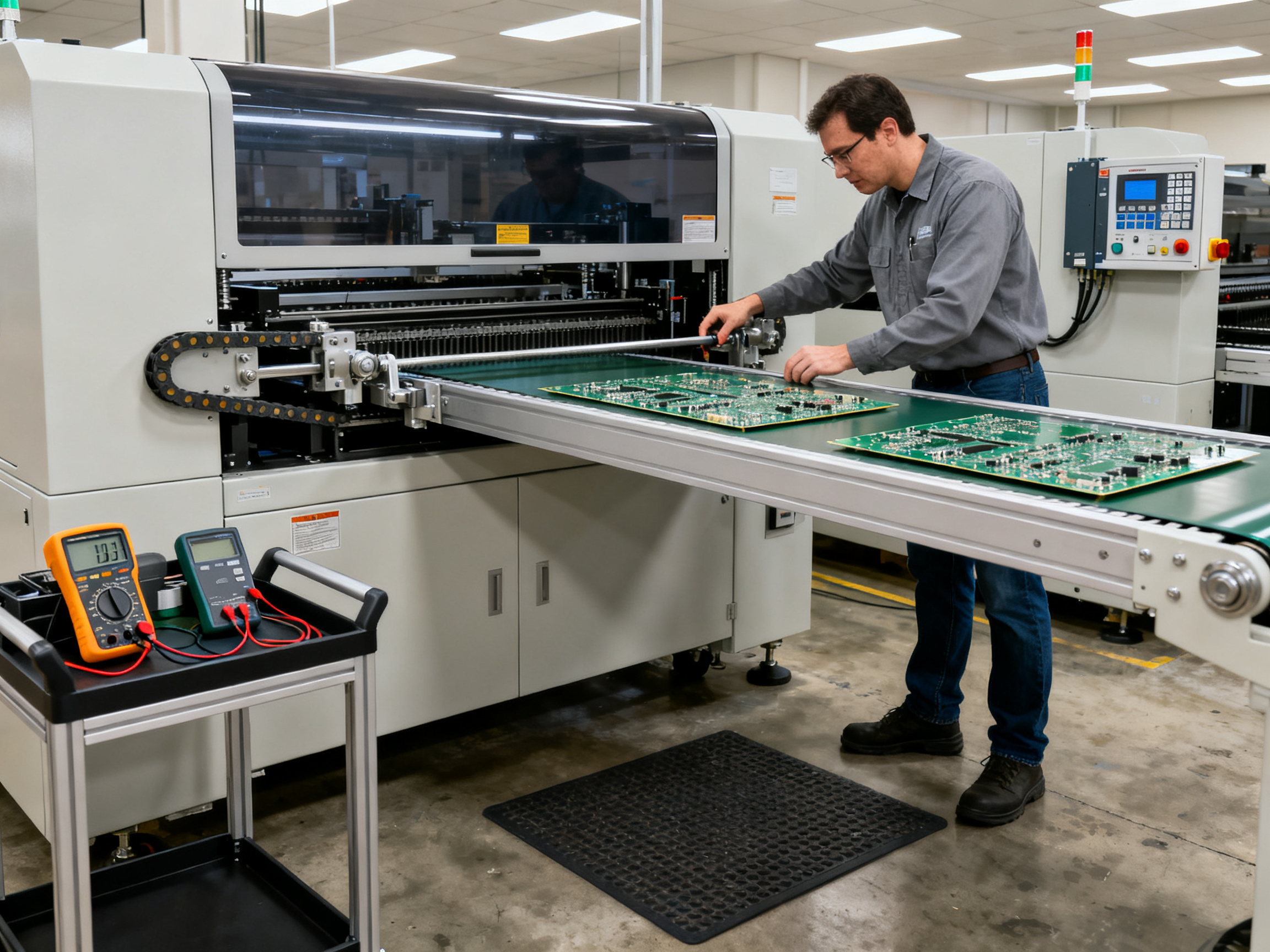
One more thing. Don’t skip the pre-purchase validation test. Run the conveyor with real boards and document the baseline performance. It’s much cheaper to find a problem during testing than after you’ve locked the system into your production line.
Conclusion: The Best Way to Compare Conveyor Belt Prices in 2026
So what’s the real answer to “how much does a conveyor belt cost”? It depends entirely on what you’re actually buying. A PVC belt by the meter might run you $15-25. A standard conveyor section for basic PCB transfer could hit $500-3,000. And a fully integrated SMT conveyor system with servo drives, ESD materials, and traceability features? That easily climbs to $15,000 or more per section.
The price range exists because these are different products solving different problems. Comparing them side by side without understanding what each one includes is like comparing the cost of a bicycle to a motorcycle because they both have two wheels.
The smart way to compare conveyor belt prices in 2026 isn’t about finding the cheapest option. It’s about finding the right fit for your production line at a fair price.
When you’re evaluating suppliers, look beyond the per-meter belt price. Ask about total landed cost. Calculate the three-year total cost of ownership. Check what the warranty actually covers. And most importantly, verify that the supplier has real experience supporting electronics manufacturing customers.
A supplier who understands your reflow oven requirements, your ESD protection needs, and your traceability goals will cost more upfront. But they’ll save you money on rework, downtime, and emergency purchases down the road.
Here’s your action checklist before you sign any conveyor purchase order:
Conveyor Purchase Checklist
| Step | Action Item |
|——|————-|
| 1 | Define your actual requirements (PCB dimensions, line speed, ESD needs, temperature zones) |
| 2 | Gather your line layout drawings and floor plan data |
| 3 | Request itemized quotes that break out belt, frame, motors, sensors, and controls separately |
| 4 | Calculate landed cost including freight, duties, installation, and commissioning |
| 5 | Project three-year TCO for each comparable quote |
| 6 | Verify supplier experience with electronics manufacturing, not just general industrial equipment |
| 7 | Test with real boards before full approval |
| 8 | Budget for spare parts and maintenance from day one |
If you need help putting together an RFQ or comparing quotes for a new SMT line build, reach out to a specialist who can walk you through the specs. Getting this right the first time costs more upfront. Getting it wrong costs a lot more over the life of your production line.
By Jace Liu. Jace covers SMT equipment procurement, reflow oven integration, and conveyor system sourcing for electronics manufacturers.