



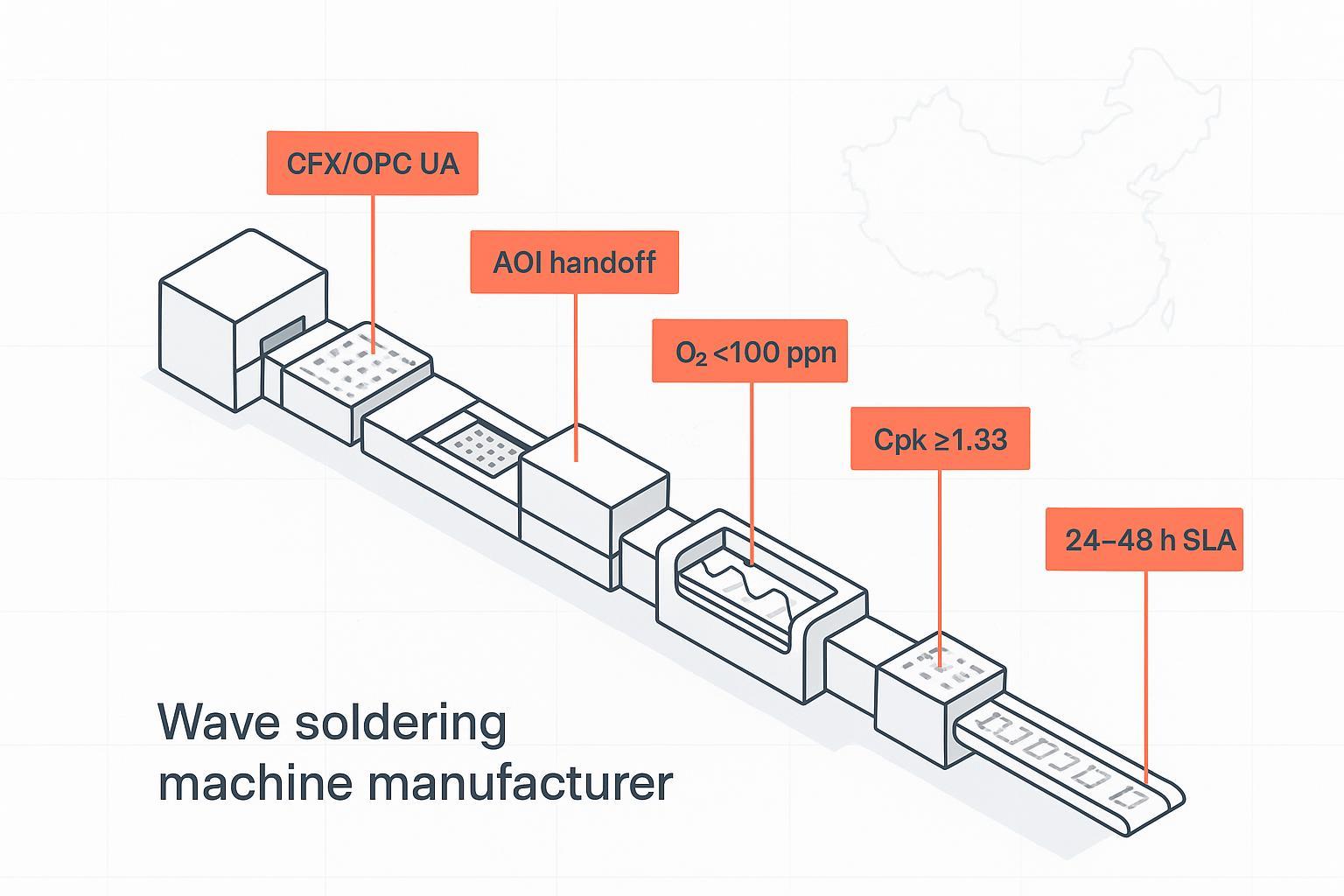
Selecting a wave soldering partner isn’t only about tin capacity or conveyor width. The hidden risks live in integration and maintainability: will the machine feed your MES with clean data, interoperate with AOI/AXI, stay within oxygen targets under nitrogen, and be supported with fast parts and enforceable SLAs? Here’s a verification-first checklist you can use to de-risk the decision in about ten minutes—and then drive a solid FAT/SAT.
Key takeaways
Prove integration in the factory, not on a brochure: require IPC-CFX/OPC UA or equivalent payloads and a live export during FAT.
Bind acceptance to measurable quality and capability: IPC-A-610 class, FPY baselines, and Cpk targets (≥1.33 capable, ≥1.67 preferred).
Model utilities before PO: log O2 ppm, nitrogen flow (m³/h), and kW at steady state; normalize to cost per board.
Service is part of TCO: insist on written SLAs, critical spares lead times, regional coverage, and remote diagnostics.
Executive scoring checklist
Score each line item 0–2 and multiply by the weight. 0 = No/Not provided; 1 = Partial; 2 = Yes/Verified with evidence. Target pass band ≥75%.
Category | Weight | 0 (No) | 1 (Partial) | 2 (Verified) |
|---|---|---|---|---|
Integration & traceability | 25% | No API/spec | One interface or sample only | Protocol proof + live log + AOI/AXI UID match |
Compliance & safety | 15% | Claims only | Draft DoC missing items | DoC + EN refs + test reports checked |
Process capability & quality | 20% | No data | One of FPY/Cpk/SPC | IPC-A-610 pass + FPY baseline + Cpk evidence |
Utilities & TCO | 15% | No logs | One metric logged | O2 ppm + N₂ m³/h + kW logs, cost/board computed |
Service & maintainability | 20% | Vague promises | Partial SLA or no spares list | SLA + coverage map + spares/lead times + PM plan |
Commercial & contractual | 5% | No metrics in contract | Informal targets | Uptime/penalties + metric-bound acceptance |
Integration and data traceability questions for a Wave Soldering Machine Manufacturer in China
Integration is the highest-impact risk reducer because it ties equipment behavior to yield, downtime, and audit trails. In 2026, buyers should expect open, documented interfaces and real-time telemetry.
Ask for protocol proof: a conformance or implementation statement for IPC-CFX (IPC-2591) or equivalent, with sample payloads for UnitsTested and process telemetry. The standard’s message families and QPL concept are described on the official IPC pages; see the IPC hub for the IPC CFX overview and FAQ (2024–2026 materials) at https://www.electronics.org/cfx-home-page and https://www.electronics.org/cfx-faq.
Require board handoff and line coordination compatibility: IPC-HERMES-9852 for conveyor and unit data across equipment; the v1.6 specification explains the data fields and transports at https://www.the-hermes-standard.info/wp-content/uploads/IPC-HERMES-9852-Version-1.6-HERMES-SITE.pdf.
Validate payload content by running your boards: at FAT, export 60–120 minutes of logs containing board UID/barcode, recipe and version, timestamps, preheat temperatures, solder pot temperature, conveyor speed, wave height setpoint/actual, flux parameters, O2 ppm (if inerted), alarms, and batch yields. Confirm AOI/AXI handoff preserves UID alignment.
Security matters: require role-based access, audit logging, and a network segregation note for the machine cell.
Practical micro-example (neutral): On a recent line audit, an S&M wave solder model exported CSV and JSON logs with board UIDs, recipe versions, and temperature streams every 5 seconds, which the plant’s MES parsed via a REST endpoint. Under nitrogen inerting, the unit held O2 below 100 ppm at steady state while logging analyzer readings; see model-class specs for context on export fields at the S&M Air/N₂ Wave page: S&M Air/Nitrogen Wave Solder product specs: https://www.chuxin-smt.com/products/air-wave-solder/.
Quality and process capability expectations buyers can verify
Quality acceptance should be anchored to current standards and statistically capable processes.
Use current acceptance and process standards: IPC-A-610J (2024) defines post-assembly acceptability criteria used for visual checks; see the publisher’s notes in the IPC-A-610J standard overview at https://www.soldertools.net/ipc-a-610-revision-j-standard-only-acceptability-for-electronic-assemblies/. IPC J-STD-001J (2024) governs process requirements; see the IPC release note for J revisions at https://www.electronics.org/news-release/ipc-releases-j-revisions-two-leading-standards-electronics-assembly.
Set capability targets: demand Cpk ≥1.33 on critical parameters (preferred ≥1.67) across stable runs; capability acceptance practices are summarized in the onsemi capability acceptance guidance at https://www.onsemi.com/pub/collateral/solderrm-d.pdf. Tie these to wave height, conveyor speed, pot temperature, and a representative defect set (bridging, icicles, non-wetting).
Establish FPY baselines: for stable, high-volume assemblies, ≥98% FPY at the wave step is a practical benchmark; for high-mix, set line-specific baselines and improvement goals. For process setup and common defect countermeasures, brief your team with S&M’s wave soldering process setup and troubleshooting guide at https://www.chuxin-smt.com/wave-soldering-process-setup-defect-troubleshooting-guide/.
Measurement credibility: require SPC packets and GR&R for gauges that measure wave height, temperature, and conveyor speed.
Here’s the deal: numbers without methods are just numbers. Bind every claim to a method, a device, and a time window.
Utilities and TCO modeling you should demand before PO
Utilities dominate operating cost variability. Model them with your boards, not vendor samples.
Nitrogen and oxygen control: inerted wave soldering typically targets low ppm oxygen to reduce oxidation and dross. Some industry guidance in reflow contexts points to achievable bands and benefits that translate to wave; for a process rationale and typical O₂ target bands, see S&M’s knowledge note on nitrogen usage in reflow at https://www.chuxin-smt.com/nitrogen-usage-in-reflow-oven-how-much-nitrogen-is-needed/. During FAT, log steady-state O₂ ppm alongside N₂ flow (m³/h) to demonstrate the tunnel design can hit your setpoint (for many high-reliability lots, buyers specify below 100–300 ppm) and to quantify consumption.
Energy: record total connected load by subsystem and steady-state draw during your throughput target. Class-based examples published by various vendors show wide ranges; you’ll validate the specific figure on-site.
Normalize to cost per board: capture 60–120 minutes of O₂ ppm, N₂ m³/h, kW, conveyor speed, and panel throughput. Convert to local utility rates and add consumables (flux, solder, dross disposal) to build a repeatable TCO line in your model. For lead-free temperature and preheat rationale that informs your energy assumptions, see S&M’s guide to the lead-free wave soldering profile at https://www.chuxin-smt.com/cs/slug-mastering-the-lead-free-wave-soldering-profile-a-comprehensive-guide/.
Think of it this way: if you can’t graph it, you can’t manage it—and you definitely can’t negotiate it.
Service and maintainability signals that predict uptime
Service quality often separates a good purchase from a costly one. Ask for verifiable signals and contractual teeth.
Written SLA with response and restoration targets by severity and region; remote diagnostics capability and a security note.
Coverage map and regional staffing; examples of MTTA/MTTR metrics from the past year.
Critical spares list with part numbers, stocked quantities, and lead times; require critical items to ship within 2–4 weeks.
Preventive maintenance calendar, training syllabus, and certification for operators and technicians.
FAT and SAT acceptance items most buyers miss
Your wave soldering FAT SAT checklist should force evidence, not promises. Require the vendor to:
Prove safety and function: e-stops, guards, interlocks, alarm tests.
Run your representative PCBs at target throughput and log continuously: preheat zone temperatures, solder pot temperature stability, dwell/contact time, conveyor speed, wave height setpoint/actual, flux parameters, O₂ ppm, alarms, and batch yields.
Export data in your chosen protocol (CFX/REST/OPC UA/CSV) and ingest to your MES; demonstrate AOI/AXI UID handshake across the line.
Meet acceptance metrics: IPC-A-610 class criteria on through-hole fill and solder quality; Cpk ≥1.33 on critical parameters over 30–50 consecutive panels; defect thresholds documented and signed.
Scenario notes for different buying contexts
New NPI lines: prioritize integration and recipe/version control plus rapid changeover procedures; accept slightly lower initial FPY with a ramp plan tied to SPC.
Capacity expansion: match data schemas to existing MES, and require spare parts alignment with your current inventory.
Replacement of legacy machines: plan for dual-running and data field mapping; insist on adapter services for Hermes/CFX if the old line used proprietary protocols.
Compliance checkpoints buyers should verify on paper
For EU-bound equipment, CE marking must reference applicable directives and harmonised EN standards on the Declaration of Conformity (DoC). See the Commission’s portal for how harmonised standards are listed in the Official Journal in the European Commission harmonised standards portal at https://single-market-economy.ec.europa.eu/single-market/goods/european-standards/harmonised-standards_en. DoC content elements (manufacturer details, directive references, standards, authorized EU rep, and the person authorized to compile the technical file) are summarized in independent explainers like the Machinery Directive 2006/42/EC DoC elements explainer at https://www.tecnosida.com/machinery-directive-2006-42-ec. For North America, align with UL/CSA as applicable and verify listing pages.
Next steps and resources
Download and adapt this scoring model into your RFI/RFP. Bind FAT/SAT acceptance to the metrics above and require a 30/90-day performance review with FPY, downtime, and utilities reports.
For practical setup and nitrogen guidance to brief your team before FAT, see S&M’s technical resources: start with the lead-free wave soldering profile guide linked above. For model-class specs useful in interface planning and utilities baselining, refer to the S&M Air/Nitrogen Wave Solder product specs linked above.