



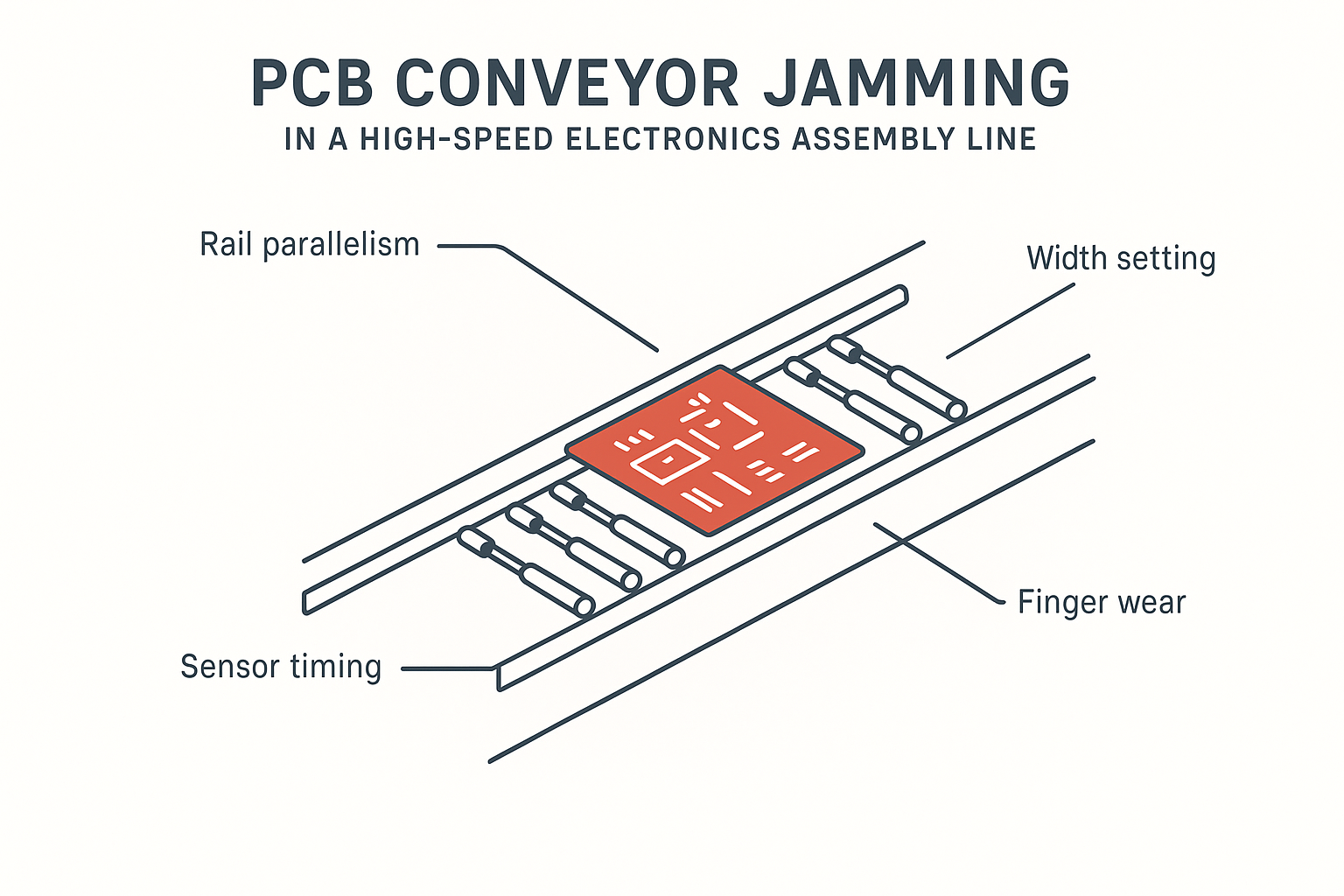
Key takeaways
Treat jams as a measurable reliability problem, not “random downtime”: track jam location, board/pallet ID, rail width setting, and time-to-recover.
Most “mystery jams” fall into three buckets: mechanical alignment/width, controls & sensing, and board/pallet conditions.
In wave solder, flux residue and finger/chain condition are often the difference between stable transport and recurring hang-ups.
Warpage matters for handling. Many IPC summaries cite 0.75% maximum bow/twist for SMT boards and 1.5% for non-SMT boards; excessive warpage increases the probability of skew and bind events. (Detailed reference is provided in the Warpage section.)
For decision-stage buyers, “jam resistance” is not one feature. It’s a system: width adjustment repeatability, rail parallelism, sensor logic, maintainability, and service/spares.
What “conveyor jamming” really costs in a high-speed line (and how to quantify it)
When a PCB conveyor jams, the visible cost is the stopped machine. The hidden cost is everything you do to recover: manual intervention, rework, scrapped boards, lost takt time, and the ripple effect across buffers.
To make jam reduction actionable for engineering, operations, and procurement, quantify it using a small set of line-reliability metrics:
Jam rate: jam events per hour (or per 1,000 boards)
MTTR (mean time to recover): time from stop to stable flow
MTBF (mean time between jam events): how often the jam mechanism recurs
Opportunity cost: boards not produced during MTTR (use your line’s boards/hour)
A simple rule: if you can’t answer “where does it jam and under what conditions?”, you can’t fix it permanently.
Key Takeaway: Don’t start by swapping parts. Start by making jams repeatable in your data.
Fast diagnostic flow for PCB conveyor jamming: locate, classify, record
In high-speed environments, “troubleshooting” often becomes guessing. Replace that with a short diagnostic flow you can run during live production.
Step 1: Pin down the jam location and mechanism
Record the first physical point of contact:
Board edge binding against a rail
Board corner catching a transfer interface
Pallet/fixture snagging a guide or finger
Stop gate or sensor logic stopping boards into a collision
Finger/chain failing to carry (slip, stall, inconsistent pitch)
Step 2: Capture the minimum data per jam event
Create a one-page jam log. For each event, capture:
Timestamp + line/section ID
Board ID (part number, size) and pallet ID (if used)
Conveyor speed setpoint (and actual if available)
Rail width setpoint (or measured width)
Sensor status at stop (which sensor, what state)
Visual note: skew direction, board warp, residue, damage marks
MTTR and the recovery action (clear debris, widen rails, reset sensor, replace finger)
This is enough to separate “random” from “pattern.”
Step 3: Classify the root cause bucket
Most jam mechanisms fall into one of these buckets:
Mechanical alignment / width / wear
Controls & sensing / timing / synchronization
Board/pallet conditions (warpage, edge clearance, contamination)
Once you know the bucket, you can apply the right fixes in the right order.
Mechanical root causes (rails, parallelism, finger/chain wear, sprockets)
Mechanical issues are the most common because they compound quietly: a slightly skew rail plus a slightly warped board plus residue becomes a jam.
Rail parallelism and width setting errors
A width setting can be “correct” at one end of the conveyor and wrong at the other. The failure mode is predictable: boards drift, rotate, then bind.
What to check:
Parallelism: measure the rail gap at the infeed, mid-point, and outfeed.
Repeatability: does the conveyor return to the same width after changeover?
Rail surface condition: nicks, solder/flux deposits, and wear grooves increase friction.
If you need a practical width-adjustment baseline, use your internal process plus a vendor guide such as Chuxin SMT’s PCB conveyor width adjustment best practices as a starting point.
Board support and edge clearance
Even if the conveyor is aligned, boards can hang if there isn’t consistent support.
Common failure patterns:
Heavy assemblies sag and “dip” into an interface
Edge components or protrusions reduce clearance
Inconsistent edge routing or burrs catch on rails
Corrective actions:
Standardize edge clearance rules in your DFM/DFA checklist.
Add or adjust support rails where the board transitions between sections.
Inspect board edges for burrs after depanelization.
Finger/chain wear in wave solder conveyors
Wave solder conveyors frequently rely on finger/chain systems. When fingers wear, pitch becomes inconsistent or grip changes, and boards/pallets can hesitate—especially at interfaces.
Focus checks:
Finger condition: bent, worn tips, missing fingers
Chain tension consistency (left vs right)
Sprocket wear and alignment
Evidence of rubbing: polished tracks, residue stripes, repeat wear marks
Cleaning is often the first “high-leverage” fix here because flux residue changes friction and can mask mechanical issues. In your PM documents, label this explicitly as conveyor chain finger cleaning and treat it as a controlled work instruction (chemistry, rinse, re-oil, prebake).
You don’t need a perfect model-specific spec to find the problem. You need two things: a repeatable inspection method, and a maintenance action that changes the condition (clean/lube/replace).
Control & sensing root causes (false stops, dirty sensors, timing windows, speed sync)
At high throughput, a “soft” control issue becomes a hard collision or a dead stop.
Sensor contamination and false trips
In electronics manufacturing, dust, flux aerosols, and general contamination can degrade photoelectric sensors and reflective targets.
What to check:
Sensor window cleanliness
Cable integrity and connector seating
Trigger threshold and debounce settings
Sensor placement relative to board/pallet geometry
Fix strategy:
Clean and re-verify sensors on a schedule aligned with line cleanliness.
If false trips correlate with a specific product, evaluate sensor placement and the reflectivity/geometry of that board or pallet.
Stop gates and accumulation logic
Jams often happen when control logic stops boards too close together—turning a minor hesitation into a collision.
Corrective actions:
Verify stop-gate timing and minimum spacing rules.
Check accumulation zones for “dead” boards (a board that isn’t detected but physically present).
Align upstream/downstream speeds to avoid push-into-stop conditions.
If your line uses multiple conveyors, ensure speed control and synchronization are treated as a system. Chuxin SMT outlines practical approaches for adjusting speed and synchronization in PCB conveyors that can be adapted into a formal validation checklist.
Acceleration/deceleration profiles and ramp time
Fast starts and stops can create micro-slips that become skew. If your conveyor uses a VFD or programmable drive profiles, validate ramp parameters against board/pallet mass and friction.
Verification approach:
Run a controlled start/stop test with the most jam-prone board or pallet.
Use slow-motion video at the interface where skew begins.
Adjust ramp settings and re-test.
Board & product root causes (edge clearance, warpage, pallets/fixtures)
Even perfect equipment will jam if the board and fixture conditions are unstable.
PCB warpage (bow and twist): why it becomes a handling problem
Warped boards are more likely to:
drift against rails
catch at transfer interfaces
rock on fingers/pallet supports and skew
Many IPC summaries cite a commonly referenced limit of 0.75% maximum bow/twist for SMT boards and 1.5% for non-SMT boards. Eurocircuits provides a clear explanation of how these limits are commonly interpreted and measured in its IPC‑6012 bow and twist guidance overview (2022).
Practical handling guidance:
Identify whether jams correlate with a specific board revision or supplier lot.
Measure warpage consistently (same temperature, same support method).
If warpage is near-limit, widen the process window: reduce aggressive handling interfaces, improve rail support continuity, and use carriers when appropriate.
Pallets/fixtures: interference, residue build-up, and deformation
In wave solder, pallets and fixtures add another variable. The jam mechanism is often not the PCB—it’s the pallet edge or underside catching a guide or residue build-up increasing friction.
Corrective actions:
Standardize pallet inspection criteria (edge damage, flatness, residue thickness).
Track pallet IDs in the jam log.
Replace or refurbish pallets that show repeat correlation.
Wave-solder-specific jam causes you won’t see in a reflow conveyor
Wave soldering introduces flux and thermal exposure that can change friction, residue, and mechanical condition over time.
Flux residue on fingers/chains and why cleaning is non-negotiable
Residue can make “normal” surfaces behave like adhesive at the wrong temperature and humidity.
KYZEN’s guidance on wave and selective solder maintenance cleaning (2019) explicitly calls out the need to clean, rinse, oil, and prebake conveyor chains on a schedule specified by the equipment manufacturer.
Practical program elements:
Define a cleaning frequency tied to flux type, throughput, and observed residue.
Treat cleaning as a controlled process (approved chemistry, rinse, re-oil, prebake).
Re-verify transport after cleaning (don’t assume “clean” means “aligned”).
Preventive maintenance checks that specifically mention conveyor condition
OEM maintenance training often includes conveyor inspection and lubrication in the preventive maintenance checklist. For example, ITW EAE’s Electra/Vectra preventative maintenance course (2024) lists conveyor and conveyor finger inspection and lubrication as part of routine checks.
Use that idea even if your OEM differs: the conveyor is not a “set and forget” mechanism.
Conveyor angle and stable transport
Wave solder process setup often involves conveyor angle (commonly a few degrees) to manage contact and drainage. If transport becomes marginal (skew, hang-ups), re-validate the angle and mechanical interfaces.
If you’re selecting or upgrading equipment, review the transport-related specifications in relevant machine families (transfer speed range, transport mechanism, accessibility). For example, Chuxin SMT’s Nitrogen/Air Wave Solder page lists transport speed ranges and provides a starting point for comparing machine capabilities.
Prevention: a wave solder conveyor maintenance + verification program that reduces jams
A useful program has three layers: daily quick checks, scheduled deep maintenance, and verification tests that confirm the problem is actually gone.
Daily checks (operator level)
Wipe rails and remove visible debris
Visual check of sensor windows
Confirm width setting matches product traveler
Quick check for abnormal noise/vibration
Weekly checks (technician level)
Verify rail parallelism at 3 points
Inspect finger/chain condition and tension symmetry
Confirm stop-gate spacing logic with a dry-run
Clean and re-verify key sensors
Monthly/quarterly checks (engineering + maintenance)
Verify width adjust repeatability after changeover
Check sprocket wear and alignment
Review jam log trends and identify top 2 recurring mechanisms
Run a controlled “worst-case board” transport test and record results
Pro Tip: If a jam fix can’t be verified (by a measurement, a repeat test, or a trend change), treat it as a hypothesis—not a solution.
Buyer’s checklist: how to spec and evaluate conveyors/transfer systems for jam resistance
If you’re making a decision-stage purchase (new line, upgrade, or replacement), use this checklist to avoid buying a conveyor that looks good in a demo but fails under production conditions.
A. Mechanical design and width control
Rail width adjustment is quick and repeatable (returns to the same width after multiple cycles)
Rail parallelism can be verified with clear reference points
Board support is continuous across interfaces (no “drop” at transitions)
Wear surfaces are accessible for inspection and replacement
B. Transport mechanism suitability (wave solder vs standard transfer)
Finger/chain system is designed for your board/pallet mix
Cleaning access exists where flux residue accumulates
Chain lubrication points are accessible and documented
Pallet/fixture compatibility is validated (clearances, weight, geometry)
C. Sensors, control logic, and jam detection
Sensors are shielded/placed to resist contamination in your environment
Stop-gate timing supports stable spacing at target throughput
Jam detection behavior is predictable (clear alarms, safe stops)
Speed synchronization is supported across connected modules
D. Integration, documentation, and serviceability
Interface height and transfer direction match your line standards
Spare parts strategy is clear (critical spares, lead times)
Preventive maintenance plan is provided (daily/weekly/monthly)
Remote support and on-site service coverage meet your downtime tolerance
E. Evidence to request from vendors (don’t accept “trust us”)
Ask for:
A maintenance checklist and recommended cleaning schedule
Demonstration of width repeatability (not just “it adjusts”)
A documented jam-recovery procedure and fault codes
References for similar board sizes, pallet usage, and throughput
If you want a broader conveyor system perspective for SMT lines (buffers, interfaces, and capacity planning), Chuxin SMT’s Complete Guide to PCB Conveyors can help you frame requirements beyond a single module.
When to escalate: what to ask your equipment supplier (and what evidence to provide)
Escalate to your supplier or OEM when:
The same jam mechanism repeats after two controlled corrective cycles
Jams correlate with a specific product but you can’t change the product (regulatory/locked design)
The conveyor requires frequent manual intervention to maintain stability
Provide evidence that speeds resolution:
Jam log (timestamp, location, board/pallet ID)
Photos of wear marks/residue
Short video capturing skew or hang-up behavior
Measured rail gaps at multiple points
A summary of what changed (new pallet, new flux, new board revision)
Next steps
If you’re upgrading a line or selecting new equipment, the fastest way to reduce risk is to run a structured conveyor/jam assessment before finalizing specs.
Request a practical interface checklist and jam-risk review from S&M (Chuxin SMT) via S&M Co.Ltd (Chuxin SMT) so you can validate width control, sensor logic, and maintainability against your actual boards and pallets.
If wave soldering is part of your flow, keep your process parameters and transport stable by aligning your setup and troubleshooting approach with a dedicated guide such as Chuxin SMT’s wave solder process setup and defect troubleshooting guide.