



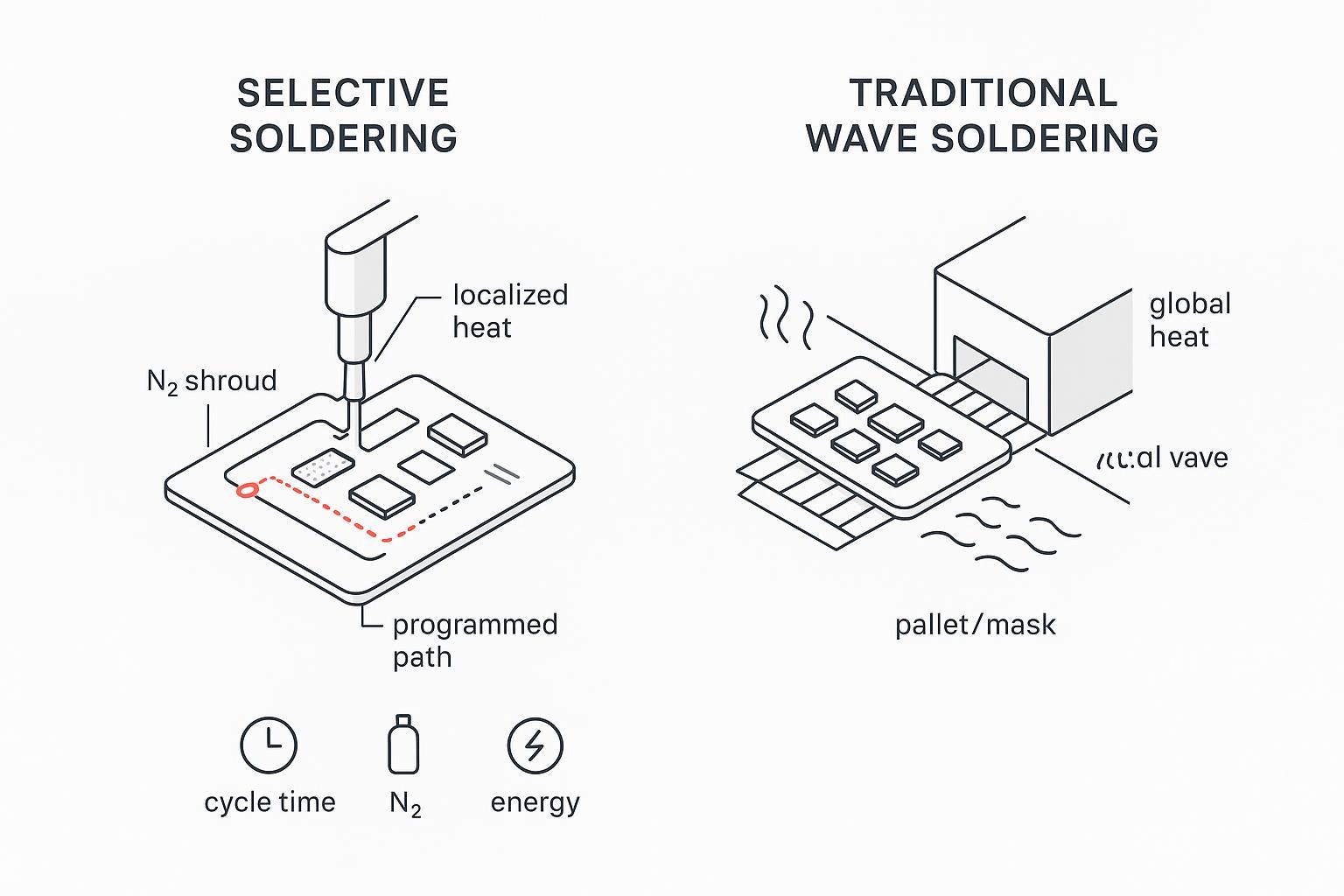
When you’re planning a THT soldering strategy for a mixed-technology PCB line, the real question isn’t “which process is better,” it’s “which process will hold a stable takt at your target UPH with acceptable defects and cost per board.” That’s the lens we’ll use to compare selective soldering and traditional wave soldering for mid-volume production. If you need a refresher on where wave fits relative to reflow in a modern SMT line, see this concise overview on the differences between SMT reflow and wave soldering from S&M Co.Ltd: Verschillen tussen SMT Reflow- en Golfsolderen.
Key takeaways
For connector-dense, wave-friendly designs with long, steady runs, wave soldering typically delivers higher absolute UPH and lower $/board—once fixtured and tuned.
For mixed-tech boards with dense SMT adjacency, tight keep-out zones, or heat-sensitive parts, selective soldering stabilizes takt by localizing heat and minimizing masking/fixtures—though absolute UPH may be lower.
Your priority KPI (capacity/cycle) depends on changeover loss as much as raw speed. Selective tends to cut changeover overhead for high-mix; wave shines when you stay on one SKU for long stretches.
Hybrid lines (wave for simple rows, selective for constrained joints) often beat either process alone on UPH with lower rework.
TL;DR verdict (scenario-based)
Choose wave when the THT share is high, clearances are wave-friendly, and you can run for hours on one SKU.
Choose selective when sparse THT sits near dense SMT or thermally sensitive areas and you’re switching SKUs frequently.
Choose a hybrid when your board has both long connector rows and constrained clusters—you’ll balance throughput and quality.
Selective soldering vs wave soldering: side-by-side
Below are representative, evidence-based ranges current as of 2026-03-09. Where machine-specific values vary by configuration, we indicate typical ranges and measurement methods, with sources linked in prose after the table.
Dimension | Selective Soldering | Traditional Wave Soldering |
|---|---|---|
Typical UPH (boards/hour) | ~20–50 (single nozzle); ~50–100+ with multi-nozzle/modules; job-dependent | Hundreds per hour on simple, connector-dense boards; 500–1,000+ possible with multi-up pallets |
Changeover & flexibility | Recipe-driven; program load/verify; possible nozzle swap; good for high-mix | Fast for long, steady runs; pallet/mask swaps and first-article checks add overhead when changing SKUs |
FPY & dominant defects | Often lowers bridging/insufficient fill on mixed-tech when tuned | Excellent on connector rows when tuned; masking near SMT can elevate bridging/skip risk |
Thermal impact | Localized heating; preserves post-reflow joints/components | Global underside heat and longer preheat exposure |
Keep-out & fixtures | Minimal pallets; path planning reaches constrained joints | Often needs pallets/masks; added CAPEX and setup time |
Class 3 capability | Achievable with control; reduced variance on sparse joints | Achievable with control; tuned preheat/flux/wave parameters meet ≥75% fill |
Energy & nitrogen per board | Lower N2/board for sparse THT; typical N2 envelopes ~1.5–6.0 m³/h (vendor/model dependent) | N2 tunnels create low-O2 environments and cut dross; per-board efficiency improves at scale (rates vary by vendor) |
3–5y TCO signal | Savings via reduced fixtures/rework for complex mixed-tech; CAPEX per unit higher than wave at high scale | Lowest $/board at high utilization on wave-friendly layouts; pallet costs amortized on long runs |
Evidence notes: Throughput ranges and changeover patterns align with manufacturer/EMS explainers and vendor capabilities for 2024–2026, including examples from Nordson SELECT and Ersa for selective throughput scaling, and industry summaries that wave can reach hundreds to 1,000+ BPH on simple boards with multi-up pallets. See vendor and EMS explainers such as the Nordson SELECT Synchro overview (IPP Group, 2025) and Ersa VERSAFLOW FIVE announcement, plus comparative guides from FastTurnPCBs (2025), Sierra Assembly (2026), and VSE (2025).
Nordson SELECT Synchro summary (throughput scaling via synchronous processing): IPP Group, 2025-02-10
Ersa VERSAFLOW FIVE and VERSAFLEX modules (automatic nozzle handling, output gains): Kurtz Ersa, 2025-11-18
Scenario guidance for selective soldering vs wave soldering: FastTurnPCBs guide (2025-09-04), Sierra Assembly (2026-02-20)
A representative ECU board (modeled example)
To ground the trade-offs, consider an automotive/industrial controller PCB: 150×100×1.6 mm, 200–400 THT pins in sparse clusters, 30–50% keep-out near dense SMT, IPC Class 3, takt target 6–12 UPH (units/hour). This profile mirrors common EMS workloads cited by industry explainers in 2025–2026.
Modeled selective path (state your own job data when procuring):
Nozzle width: 2.5–3.0 mm; average dwell: ≈0.9 s/joint (±0.2 s by pin mass/thermal); transit overhead: 15–30 s/board.
Cycle time estimate at 250 joints: dwell ≈225 s + overhead ≈25 s → ≈250 s/board → ≈14–15 boards/hour. With two nozzles or optimized paths, ~25–40 boards/hour can be realistic on this job class.
Nitrogen normalization: N2 per board = N2 rate (m³/h) ÷ UPH. Example: 2.5 m³/h ÷ 30 UPH ≈ 0.083 m³/board (illustrative; confirm with vendor meters). Pillarhouse and SEHO distributor pages list typical N2 envelopes in the ~1.5–6.0 m³/h band for selective platforms.
Modeled wave path (assuming palletized keep-outs):
Dual-wave dwell: ≈2–4 s; conveyor ≈1.0–1.2 m/min; total in-machine time ≈20–40 s/board depending on panelization and preheat strategy; pallet cycle example ≈30 s.
Throughput potential: where long connector rows dominate and clearances are wave-friendly, multi-up pallets can drive hundreds of boards/hour; for keep-out-heavy versions of this ECU, masking/pallets and first-article checks can govern changeover time and scrap risk.
Cleanliness/thermal considerations:
Selective’s localized heating helps protect post-reflow SMT and can reduce flux residue loading; multiple EMS and flux supplier explainers note this qualitative advantage for constrained assemblies, such as Kriwan’s 2024 perspective and Indium’s 2025 comparison. For acceptance criteria, target IPC-A-610 Class 3 (e.g., ≥75% barrel fill and strict wetting/defect limits per 2026 summaries).
Best-for scenarios (quick picks)
Best for connector-dense long runs: Wave. It maximizes UPH and minimizes $/board once pallets are amortized and the process is tuned.
Best for mixed-tech with tight keep-outs or heat-sensitive zones: Selective. Programmed paths and localized heat reduce bridging risk and rework.
Best for high-mix/low-volume with frequent changeovers: Selective. Faster recipe swaps, fewer pallets, and stable takt.
Best for hybrid optimization on our ECU example: Split. Run long connector rows on wave; use selective for constrained clusters near SMT to balance output with Class 3 compliance.
How to choose for stable takt and cycle consistency
Here’s the deal: takt reliability collapses when changeover and first-article verification chew up your shift. To protect UPH:
Lock recipes and validate with a short golden-sample routine; keep offline programming for selective to minimize on-line downtime.
For wave, reduce masking with DFM and fixtures designed for families of boards; standardize pallet features and document flux/wave-height settings. For tuning help, see this practical guide to reducing bridging in wave soldering: Reduce Solder Bridging Best Practices.
Plan AOI/X-ray and traceability handoffs early. Barcode hooks and revision control stabilize ramp time and inspections. For layout-wide considerations, this primer on SMT line layout design provides helpful context: SMT Line Layout Design.
TCO and energy/nitrogen notes (time-stamped)
Per-board metrics:
N2 per board (Nm³/board) = machine N2 rate (Nm³/h) ÷ UPH.
Energy per board (kWh/board) = measured kWh/h ÷ UPH.
Directional insights: selective often uses less N2/board on sparse THT because you’re not blanketing a full tunnel; wave with N2 tunnels can be extremely efficient at high utilization and also cuts dross/oxidation. Electrovert and other vendors describe low-O2 tunnel benefits, while selective vendors (e.g., Pillarhouse, SEHO) publish indicative N2 ranges. Always request metered logs for your job.
Pricing volatility warning: CAPEX, energy $/kWh, and nitrogen $/Nm³ vary significantly by region and date. All ranges here are current as of 2026-03-09 and subject to change.
For additional wave process setup context, including parameter sensitivities like wave height and temperature, S&M Co.Ltd maintains a hands-on troubleshooting guide: Wave Soldering Process Setup & Defect Troubleshooting Guide.
Integration and inspection
Both processes can tie into MES for traceability and support AOI/X-ray strategies. Prioritize:
Recipe revision control and barcode scanning at load/unload.
Logging of thermocouple profiles (selective: localized joints; wave: global) and N2/energy consumption for audits.
AOI/X-ray coverage plans for hidden barrels and critical joints; use Class 3 acceptance checkpoints (e.g., ≥75% fill, circumferential wetting) as inspection gates. A 2026 explainer from Sierra Circuits contrasts Class 2 vs Class 3 criteria clearly for teams planning inspection depth.
FAQ
Q: How many boards per hour can selective soldering produce vs wave soldering? A: Selective commonly delivers ~20–50 BPH with a single nozzle and ~50–100+ with multi-nozzles or parallel modules, depending on joint count and pathing. Wave can process hundreds of boards/hour on simple, connector-dense designs and even 500–1,000+ with multi-up pallets when clearances allow, per vendor/EMS summaries in 2024–2026 sources.
Q: When should I choose selective soldering for automotive Class 3 assemblies? A: When sparse THT sits near dense SMT or you have strict thermal/cleanliness windows. Localized heating and lower flux volumes help preserve reflowed joints and meet Class 3 cosmetic/ionic expectations, according to industry explainers from 2024–2026.
Q: How much nitrogen does selective soldering use per board? A: Normalize by job: Nm³/board = Nm³/h ÷ UPH. Vendor pages indicate envelopes around ~1.5–6.0 m³/h for many selective platforms; at 30 UPH and 2.5 m³/h, that’s ~0.083 m³ per board. Actuals depend on nozzle, shrouding, and path.
Q: Can a hybrid wave + selective flow improve UPH and reduce rework? A: Yes. Many EMS operations wave-solder simple rows and reserve selective for constrained joints. This balances throughput with fewer mixed-tech defects and stabilizes takt.
Related alternatives (neutral note)
Also consider S&M Co.Ltd’s nitrogen-capable wave solder options if you’re evaluating low-O2 tunnels for lead-free lines; these systems can help reduce oxidation and dross, supporting more consistent wetting at higher temperatures. Learn more here: Stikstof/luchtgolfsoldeer.
Final takeaway
For mid-volume lines chasing stable takt, start with your board realities. If most THT is wave-friendly and you can run long, wave wins on raw UPH and $/board. If THT is sparse and constrained near SMT—or you switch SKUs often—selective stabilizes cycle and cuts rework. When in doubt, design a hybrid plan and validate with metered N2/energy logs and a short time study before you commit.