



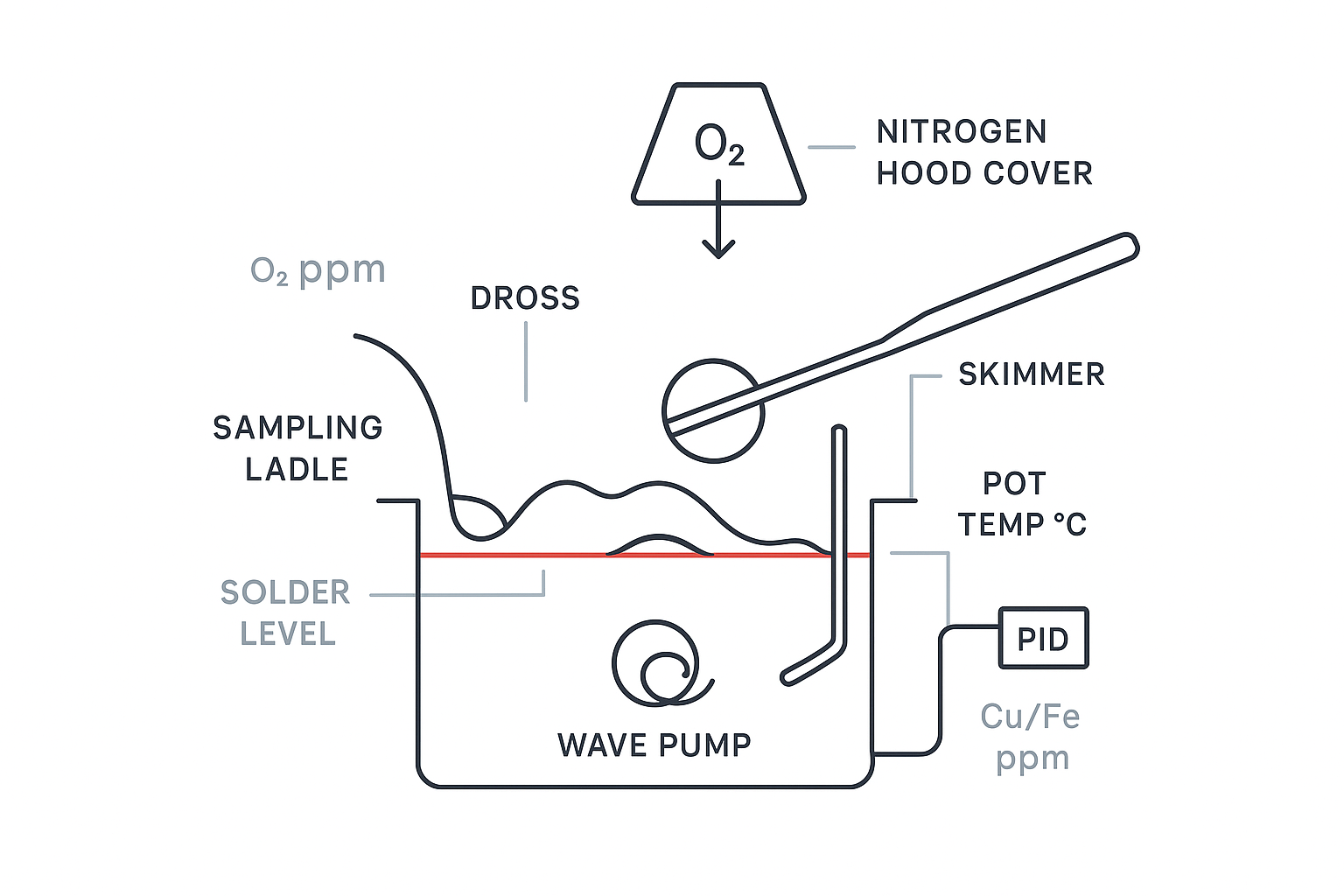
Wave soldering “tin barrel life” isn’t a marketing number. On the factory floor, it means something practical:
How long your solder bath stays chemically stable enough to deliver consistent wetting and hole fill.
How long you can keep dross generation predictable (and reclaimable) instead of turning into a daily fire drill.
How long you can run without chasing defects that look like “process noise” but are really bath quality drift.
If you’re in a decision phase—evaluating a new wave soldering machine, a nitrogen upgrade, or a support partner—this wave soldering solder pot maintenance guide is built to help you do two things:
Reduce dross at the source (oxygen + turbulence + temperature discipline).
Put solder bath quality on a control plan (sampling, analysis, and maintenance cadence).
Key takeaways
Dross is primarily an oxidation problem amplified by oxygen exposure + surface agitation. Reduce those, and you reduce dross.
“Long tin barrel life” is less about luck and more about discipline: stable temperature, stable solder level, stable wave, and disciplined handling.
Wave solder dross reduction improves fastest when you control oxygen, turbulence, and idle behavior before you fine-tune flux.
Solder pot contamination is normal over time (boards and components “wash” metals into the bath). The win is monitoring + action thresholds, not pretending it won’t happen.
A decision-ready wave soldering setup includes not just hardware, but repeatable SOPs, sampling access, and documentation.
What “tin barrel life” really means in wave soldering solder pot maintenance
Most teams only talk about solder pot life when something goes wrong: dross spikes, hole-fill drops, bridging increases, or the bath fails analysis.
A better way to define it is:
Tin barrel life = time-in-service while oxidation and contamination stay within a range that keeps wetting and defect rates stable.
Dross reduction and bath quality maintenance are linked because they share one root reality: molten solder is reactive. Expose it to oxygen, agitate it, overheat it, or feed it contaminants—and you accelerate the loss of usable alloy and process stability.
Why dross gets out of control (and why it matters)
Dross is insoluble solder oxide formed when the molten alloy is exposed to oxygen. The two variables that usually matter most are:
How much oxygen contacts the solder surface
How much that surface is disturbed (turbulence, splashing, wide wave, high wave height)
The painful part: dross isn’t “just waste.” Expert guidance often notes that dross can contain a high percentage of recoverable solder, which is why recovery systems and careful handling matter (see Circuitnet’s discussion of mechanically recovering solder from dross).
So when dross climbs, you feel it three ways:
Material cost: more solder added to keep level.
Maintenance cost: more skimming, more cleaning, more downtime.
Quality risk: oxides and debris can contribute to bridging, poor drainage, and surface contamination.
Wave solder dross reduction lever #1: control oxygen at the solder surface
If you want a single “most likely to work” lever, it’s oxygen control.
Nitrogen wave soldering (inerting): when it makes sense
Nitrogen hoods or inerting systems reduce oxygen near the wave and pot surface, slowing oxidation and often improving wetting.
If you’re evaluating whether nitrogen is worth it, ask two decision questions:
What’s your current dross cost (solder + labor + downtime) per week?
What oxygen level can the system realistically maintain during production?
Circuitnet’s experience-based discussion notes that nitrogen can strongly reduce dross formation when applied correctly (see what is the best way to reduce dross?).
If you don’t run nitrogen: reduce “unnecessary exposure” anyway
Even without inerting, you can reduce oxygen exposure by tightening behaviors and machine setup:
Keep covers/hoods closed when possible.
Avoid running the wave when no boards are present (idle oxidation is real oxidation).
Avoid unnecessary agitation on the surface (more on turbulence next).
Pro Tip: Treat “wave on with no boards” as a measurable waste category. Track it like you track downtime.
Dross reduction lever #2: control turbulence (wave energy is not free)
Dross formation rises when the solder surface is disturbed. A calm surface oxidizes; a violently disturbed surface oxidizes faster.
I-Connect007 summarizes turbulence, oxygen exposure, and temperature as key drivers in dross behavior (see Managing Dross in Soldering Processes).
Practical turbulence reducers
These tend to be the lowest-friction changes:
Use the lowest wave height that still achieves hole fill and wetting.
Minimize wave width to what the PCB requires.
Keep solder level stable and sufficiently high. Low level increases “fall distance” and agitation.
Only use a chip/turbulent wave when the assembly truly needs it.
If you’re selecting equipment, the “dual wave” conversation matters here. The first wave can drive penetration and wetting; the second (laminar) wave helps remove excess solder and reduce bridging/icicles. For background, see S&M’s explanation of turbulent vs laminar roles in the dual wave soldering machine guide.
Dross reduction lever #3: temperature discipline (oxidation vs wetting balance)
Higher solder temperatures can improve wetting—until they become a catalyst for oxidation, thermal stress, and process variability.
For lead-free wave soldering, you’ll typically run hotter than SnPb, which is one reason lead-free systems often see more oxidation pressure.
Two practices tend to extend bath stability:
Run the lowest pot temperature that still delivers acceptable wetting and barrel fill.
Use a defined standby behavior during breaks/idle periods (temperature reduction, wave off, cover on), based on OEM guidance and your quality constraints.
For lead-free optimization context and common process tradeoffs, Kester provides practical notes in its PDF Lead-free Wave: Insight on Optimization (2005).
Solder bath quality: why “good solder in” still becomes “different solder” over time
Even if you start with high-quality solder bars, the bath changes.
The simplest explanation is also the most accurate: everything that touches the molten solder contributes something back into it.
Kurtz Ersa describes this as a “washing action” effect: metals and residues from boards/components dissolve or wash into the pot over time (see Kurtz Ersa’s solder contamination overview). Circuitnet expert guidance similarly points to metals from boards/components as the most likely contamination sources (see Solder Contamination Sources).
Common contamination mechanisms you should plan for
Copper pickup from PCB copper and component leads
Iron erosion from pot hardware and contact surfaces
Oxide networks that trap metal and flux residues
Cross-contamination (e.g., running leaded-finish boards through a lead-free pot)
Foreign material from poor housekeeping (clips, screws, debris) or poor incoming discipline
One specific practice to avoid: dumping leftover solder paste into the pot
It’s tempting (it looks like “recycling”), but it’s usually a contamination risk because paste contains substantial flux volume. Circuitnet’s expert panel highlights operational and safety concerns with adding paste to a wave pot (see Can we pour left over paste into the solder pot?).
The maintenance system that extends tin barrel life
The teams with stable solder baths don’t have magic alloys. They have a maintenance system that makes drift visible early.
The AMS bulletin Wave set up to minimize dross (2020) is a good example of what “simple setup discipline” looks like in practice.
Below is a practical, audit-friendly control plan you can adapt.
Shift / daily control plan
Goal: keep oxidation and contamination from compounding invisibly.
Verify pot temperature is within your approved window (record setpoint + actual).
Verify solder level is within the defined band (record actual level or bar additions).
Verify wave height / wave condition (visual stability + measured height if applicable).
Skim with a defined method (avoid stirring; avoid pulling large volumes of shiny solder out with dross).
Record dross amount removed (weight or container volume) and the time.
Check for obvious contamination cues: unusual sludge, sticky/waxy dross, debris, unusual smell (investigate—not ignore).
⚠️ Warning: If the pot “looks different” but your numbers are unchanged, don’t assume it’s fine. A contamination event often shows up visually before it shows up in defect data.
Weekly control plan
Goal: prevent gradual drift from turning into a chemistry problem.
Inspect and clean the dross collection area and any skimming tools.
Inspect pump intake areas for oxide build-up.
Confirm flux delivery is stable (consistent application and density controls if used).
Review dross trend vs. product mix (new products often change oxidation load).
If you want a structured process reference for how wave parameters interact, S&M’s wave soldering process step-by-step guide and the operation guide (setup & safety) are useful internal baselines for teams building standardized work.
Monthly / quarterly control plan (bath chemistry)
Goal: make contamination measurable, not a surprise.
Pull a solder sample using a consistent method (same location, same procedure).
Send for solder pot analysis (your supplier/OEM typically supports this).
Trend results over time (SPC charts beat gut feel).
Define action triggers (what you do when results approach limits: partial dump, pot wash, hardware inspection, process changes).
To connect bath drift to defect behavior, keep a troubleshooting reference available. AIM’s PDF Wave Trouble Shooting Guide is a practical example of symptom-to-cause mapping for wave defects.
Buying/evaluation checklist: what to ask when choosing equipment or a partner
If you’re making a decision, you’re not just buying a wave soldering machine.
You’re buying your future ability to control oxygen, turbulence, and contamination—with documentation.
Use this checklist in RFQs and technical reviews.
Process capability questions (dross + bath stability)
Does the system support nitrogen inerting? If yes, how is O2 controlled and verified?
What features reduce surface agitation (stable wave design, wave control when idle, optimized nozzle geometry)?
How does the machine maintain stable solder level and stable wave height?
What is the dedrossing workflow (access, tools, recovery options)?
How easy is it to take a representative solder sample?
What maintenance tasks can be done quickly without major teardown?
Documentation + support questions (enterprise reality)
Can the supplier provide SOP templates (daily/weekly/monthly) and recommended log sheets?
Is there support for commissioning and parameter validation (preheat, contact time, temperature window)?
What is the service response model and spare-parts strategy?
Internal integration questions (line control)
Can the machine store and export process parameters and logs for traceability?
Can it integrate with your existing quality system or MES strategy?
If you’re comparing nitrogen vs air systems, it’s worth grounding the discussion in real machine configuration and capacity. For reference, S&M’s Nitrogen/Air Wave Solder equipment page provides a concrete spec baseline you can map to your throughput and pot size needs.
A practical next step (soft CTA)
If you want to extend tin barrel life, the fastest win is usually not a single parameter change—it’s a short audit that answers:
Where is oxygen exposure happening?
Where is turbulence being created?
What’s your current trend line for dross and contamination?
Which controls are missing from the daily/weekly routine?
S&M (Chuxin SMT) can support a wave soldering parameter review and solder pot health check as part of a maintenance or upgrade plan. A good starting point is aligning your current setup to a standardized baseline like the wave soldering process setup and defect troubleshooting guide.
FAQ: wave solder pot life and dross reduction
How often should we skim dross?
Skim often enough to prevent excessive oxide build-up from entering the wave, but avoid aggressive “stirring” that pulls usable solder out with the oxide. Use a consistent method and track dross removed per shift—trend changes usually matter more than the absolute number.
Does nitrogen always pay back?
Not always. Nitrogen tends to make the most sense when dross cost and defect sensitivity are high, and when the operation can maintain stable low-oxygen conditions without adding operational instability. Use a simple TCO model: solder consumption + labor + downtime + yield impact.
How do we know the solder bath is contaminated?
You’ll often see leading indicators (dross texture changes, unusual sludge, wetting behavior changes) before defects spike. The reliable method is periodic solder pot analysis plus trending so you can see drift early.
Can we mix alloys or run leaded boards in a lead-free pot?
Cross-contamination risk is real. If you must do it, treat it as a controlled event with defined actions (analysis and remediation), not a casual exception.
What equipment features most help with dross reduction?
Features that reduce oxygen exposure and surface agitation: nitrogen hood capability, stable wave control, good access for controlled skimming, and machine behaviors that reduce oxidation during idle times.