



Gepubliceerd: 01 September 2026
Leestijd: 11 minuten
Reviewer: Simon Scrapes, Founder
Introduction: What a Vertical Curing Oven Is and Why It Matters
If you work in electronics manufacturing, you’ve probably heard about vertical curing ovens. But what exactly are they, and why are so many SMT lines switching to this design?
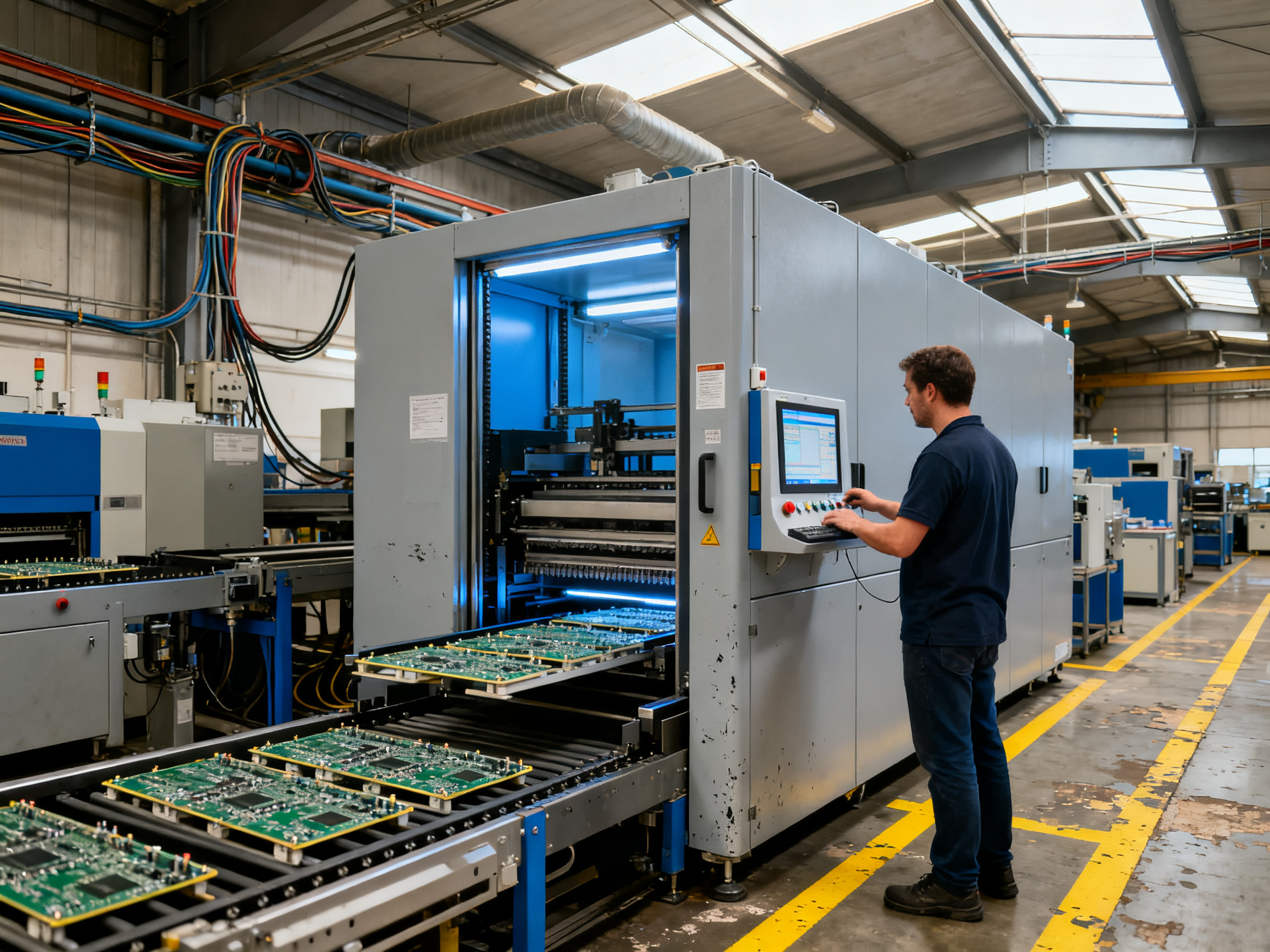
A vertical curing oven is a thermal processing system that cures adhesives, coatings, and encapsulants by moving products through heated vertical chambers. Instead of spreading out horizontally like a traditional tunnel oven, it stacks the process zones upward. This means it takes up much less floor space while still delivering consistent, repeatable heat treatment.
The key advantage? These ovens let manufacturers keep tight control over cure quality without sacrificing precious factory floor area. They work especially well for conformal coating curing, underfill processes, and PCB encapsulation where temperature uniformity matters.
In this guide, we’ll walk through how these ovens actually work, what temperature ranges you should target, where they show up most often, and how much space you can realistically save by adding one to your line. Whether you’re evaluating equipment upgrades or just trying to understand the options, we’ve got you covered.
Looking for SMT equipment that fits your space constraints? Explore vertical curing oven solutions from manufacturers serving high-volume electronics production lines.
About the Author
This article draws on insights from SMT process engineering specialists and thermal processing experts with hands-on experience in electronics manufacturing operations. The content reflects current 2026 industry practices for vertical curing equipment selection, process qualification, and line integration. Information was cross-referenced against OEM technical documentation, equipment specification guides, and real-world case studies from electronics manufacturing facilities running high-volume PCB and PCBA production.
How a Vertical Curing Oven Works
Picture a stack of heating zones, all working together in a tall, narrow chamber. That’s the basic idea behind a vertical curing oven. Instead of spreading out horizontally like a traditional tunnel oven, it uses vertical space to move products through heated zones one after another.
The chamber layout typically includes multiple independent heating zones stacked vertically. Products enter at the bottom or top, depending on the model, and travel upward or downward through each zone. A conveyor or carrier system moves products along a path that threads through these stacked zones, with each zone controlled to a specific temperature.
Here’s how it works step by step:
- Products load onto carriers or fixtures at the entry point
- The conveyor system moves products through the first heating zone
- Products continue through additional zones, each set to different temperatures based on the cure profile
- After passing through all zones, products exit the oven and move to cooling or the next production step
The core components driving this process include forced convection heaters that generate heat, temperature sensors that feed back readings to the control system, PID controllers that maintain precise thermal conditions, and recipe management systems that store and execute specific cure profiles.
Air circulation follows a controlled path. Makeup air enters through filtration, gets heated by the burner or heating elements, then recirculation fans push it through supply plenums and adjustable nozzles into each zone. Many industrial curing systems use about 80 to 92 percent recirculated air, which improves energy efficiency while maintaining temperature consistency.
The vertical downflow design is particularly effective for taller components because it minimizes stratification and helps keep top-to-bottom temperature differences tight.
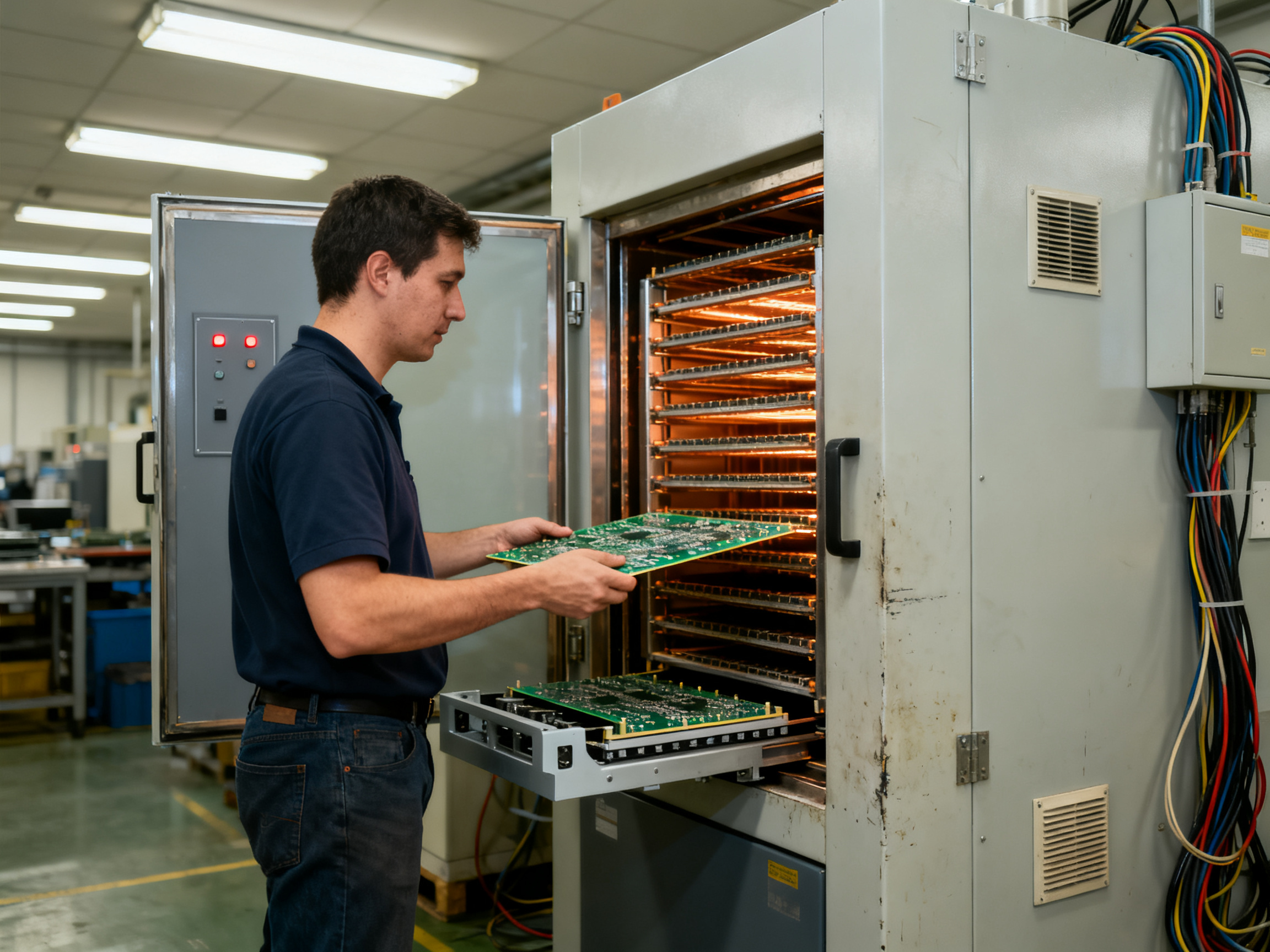
From Our Experience: Airflow uniformity, dwell time, and loading pattern matter more than raw chamber temperature in real production lines. We once spent two weeks chasing inconsistent cure results before realizing the loading operator had started stacking boards closer together. The fix took five minutes.
Three things affect cure consistency more than anything else. First, loading pattern: products spaced evenly through the vertical path heat more uniformly than unevenly loaded carriers. Second, dwell time: the conveyor speed must match the recipe requirements or parts won’t hit the target temperature long enough. Third, airflow balance: blocked nozzles or worn fan blades create hot and cold spots that show up as uneven cure across boards.
| Component | Function |
|———–|———-|
| Forced convection heating system | Generates and circulates heat throughout the chamber |
| Independent PID-controlled zones | Maintains precise temperature control at each heating stage |
| Vertical airflow nozzles/baffles | Directs heat downward and balances temperature across width and height |
| Thermocouples/RTDs | Provides temperature feedback for closed-loop control |
| Programmable controller | Stores and executes cure recipes with setpoint, ramp, soak, and hold profiles |
| Conveyor/carrier system | Transports products through the vertical heating path |
Most commercial vertical curing ovens target temperature uniformity of about plus or minus 5 degrees Celsius across the work envelope. You’ll want to validate this with a temperature uniformity survey using multiple thermocouples before releasing any critical process.
Typical Temperature Ranges and Cure Profiles
Here’s something most vendors won’t tell you upfront: there is no universal cure temperature for a vertical curing oven. The right setting depends entirely on your material system, and guessing wrong creates real problems.
Conformal coatings, underfills, and encapsulants all have their own cure windows. Some materials cure at room temperature over 24 hours. Others need a push to 80°C or 90°C for faster turnaround. And for high-strength bonding or lead-free processes, you might run 120°C to 150°C for 15 to 30 minutes.
The cure profile itself follows a sequence. First comes the ramp stage, where the oven heats up your board and the material transitions from liquid to gel. Then comes the soak, where you hold temperature long enough for the chemistry to fully react. Finally, you cool down gradually, because thermal shock creates stress cracks in coatings and encapsulants.
Rushing any of these stages causes trouble. Too-fast ramps lead to solvent popping and pinholes in coatings. Insufficient soak time gives you tacky surfaces and poor adhesion. And excessive heat or dwell time? That’s overcuring, which turns coatings brittle or yellows敏感的电子元件.
Most electronics adhesive systems in 2026 follow one of these common schedules:
| Application Type | Typical Cure Temperature | Typical Cure Time |
|——————|————————–|——————-|
| Room-temp cure coatings | 20 to 25°C (ambient) | 24 hours |
| Low-temp accelerated cure | 60 to 80°C | 30 to 60 minutes |
| Standard SMT adhesive | 125°C | 3 to 5 minutes |
| Conformal coating (heat cure) | 110°C | 60 minutes |
| Underfill (BGA stabilization) | 120°C | 30 minutes |
| High-strength encapsulant | 150°C | 15 to 30 minutes |
These are starting points, not gospel. Your material datasheet always wins.
Expert Tip: Validate cure temperature against the material datasheet instead of relying on a generic setpoint. We once watched a team chase adhesion failures for a week before someone thought to check the actual cure window on the coating datasheet. The oven was running 5 degrees hot, pushing everything into overcure territory.
The actual board temperature matters more than the oven setpoint. Heavy boards, dense component loads, and thick encapsulant deposits all create thermal lag. That means your parts might spend less time at temperature than you think, even when the controller shows the right number.
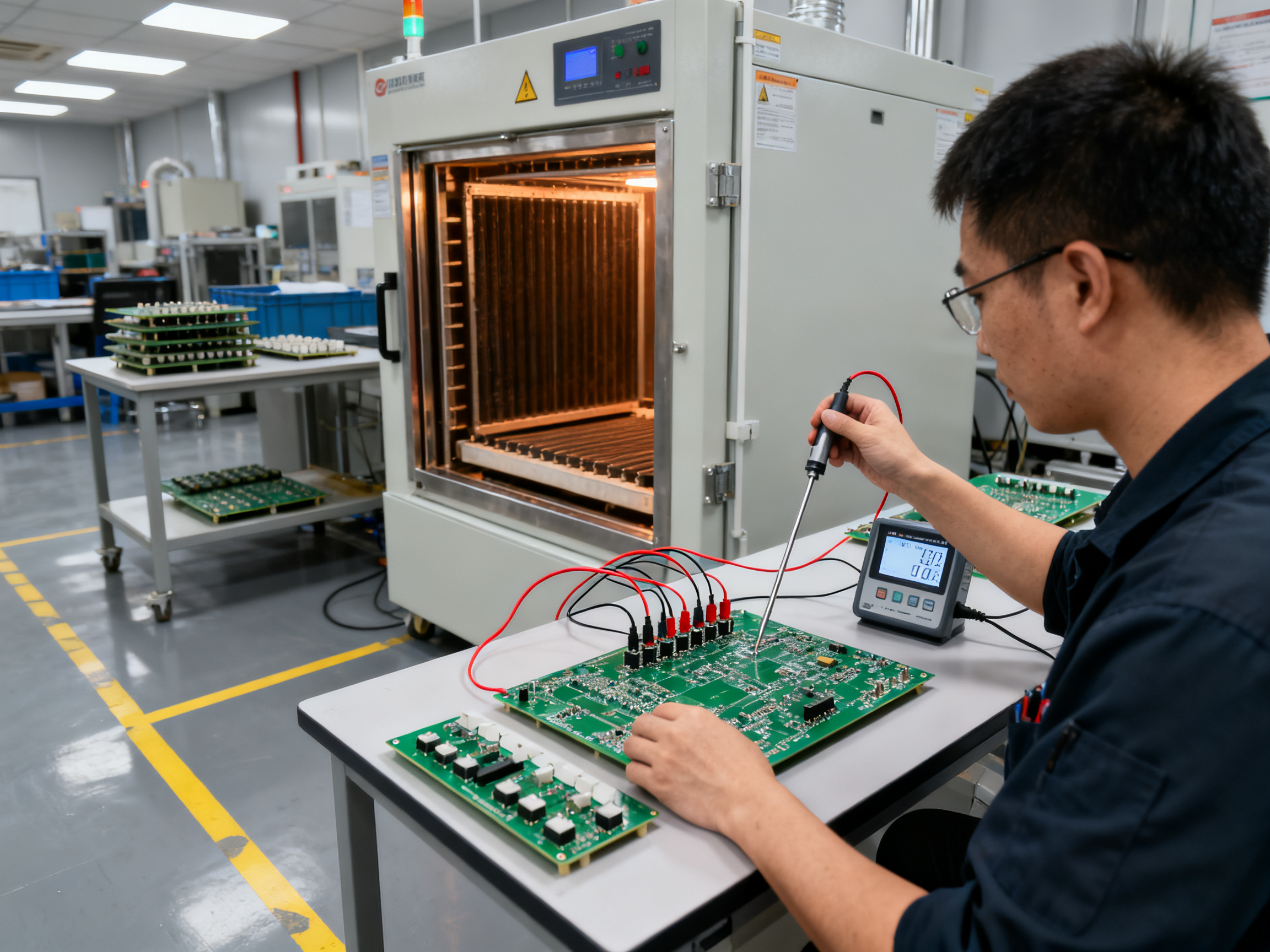
If you’re qualifying a new cure profile, run thermal profiling with thermocouples mounted on representative boards. Measure at the center, near edges, and on any thick deposits. Only then will you know whether your vertical curing oven actually delivers the cure the material needs.
Where Vertical Curing Ovens Are Used in Electronics Manufacturing
So where do these vertical curing ovens actually show up on the factory floor? Let me break down the main applications and the industries that rely on them most.
SMT Assembly and Adhesive Curing
The biggest use case is probably SMT adhesive curing. After components get placed on the board, temporary adhesives hold everything in place before the solder reflow step. Standard cure for most SMT adhesives means about 3 minutes at 125°C. Vertical ovens handle this continuously, moving boards through the profile without stopping. The fast turnaround keeps the line flowing, which is exactly what high-volume assembly shops need.
Conformal Coating Curing
Conformal coatings protect boards from moisture, dust, and chemicals. Most heat-cure coatings need around 110°C for 60 minutes to fully cure. This is one of the most space-sensitive applications because coating lines often run in tight spots near the coating station. A vertical oven slots in easily without eating up production floor space.
For automotive and aerospace boards especially, getting complete and uniform cure matters. These coatings often protect critical safety circuits, so partial cure or soft spots are not acceptable.
Underfill and Encapsulation
BGA packages and chip-scale packages benefit from underfill materials that stabilize components and reduce stress from thermal cycling. These materials typically cure at 120°C for 30 minutes, and the vertical downflow design helps keep temperature consistent across the whole board.
Encapsulation and potting take this further. Thick deposits of epoxy or polyurethane need more cure time, and the vertical path gives products longer exposure to heat without extending the physical footprint of the oven. One contract manufacturer reported cutting their potting cycle time by 30 percent after switching to a vertical inline system.
Industries That Need This Equipment Most
Consumer electronics manufacturers use these ovens for smartphones, tablets, and wearables where coating quality directly impacts product lifespan.
Automotive electronics, especially ECU and sensor modules, need proven cure consistency for safety compliance. The automotive industry also pushes for reduced rework because defect costs scale fast in high-volume production.
Military and aerospace applications demand the highest reliability standards. Traceability and repeatable thermal profiles are non-negotiable for avionics and defense electronics.
Semiconductor packaging operations also run vertical curing ovens for board-level underfill and encapsulation processes.
The common thread? All these industries need consistent cure quality, fast throughput, and minimal floor space consumption. A vertical curing oven solves all three problems at once.
| Application | Material Type | Typical Cure Goal | Primary Industry |
|————-|—————|——————-|——————|
| SMT adhesive | Epoxy, acrylic | Temporary bond before reflow | Consumer electronics, automotive |
| Conformal coating | Acrylic, silicone, urethane | Moisture and chemical protection | Automotive, aerospace, military |
| Underfill | Epoxy | Stress relief for BGAs and CSPs | Consumer electronics, semiconductors |
| Encapsulation | Epoxy, polyurethane | Physical protection, durability | Industrial, automotive, power electronics |
| Potting/pre-heating | Various | Thermal conditioning before soldering | EMS, contract manufacturers |
Space-Saving Benefits and Line Integration
Here’s where vertical curing ovens really shine. In 2026, factory floor space costs money, and floor space in electronics hubs costs even more. A typical vertical curing oven occupies about 2 meters by 1.7 meters of floor space, roughly the size of a small filing cabinet. That same oven can store 60 to 70 boards in a vertical stack while they’re curing.
Compare that to a horizontal tunnel oven doing the same job. You’d need around 40 meters of continuous floor space to match the throughput. Forty meters. That’s longer than most conference rooms you’ve probably sat through bored to tears. The vertical design uses height instead of length, which means you can slot it into existing production lines without stretching your factory across town.
For SMT lines especially, this matters. Most modern assembly floors aren’t expanding, they’re optimizing. You can’t just knock down walls to add equipment. But you can look up.
One EMS factory learned this the hard way when they tried to add a horizontal oven for their potting line. The space literally wasn’t there. Switching to a vertical curing oven let them cut cycle time by 30 percent without expanding the building. The cure quality stayed the same. The footprint didn’t.
So what should you actually verify before buying? Here’s a quick checklist for integration:
- Footprint fit: Measure your available space including clearance for operator access and maintenance doors
- Conveyor interface: Confirm the oven conveyor matches your line height and board transfer requirements
- Utility connections: Check power requirements, exhaust venting needs, and any compressed air demands
- Upstream compatibility: Make sure your coating or dispensing station feeds at the same rate the oven accepts boards
- Downstream handling: Plan how cured boards move to the next step without creating a bottleneck
Pro Insight: What procurement teams should verify before purchase: footprint, recipes, throughput, and process qualification. We recommend requesting a full thermal mapping report and running a pilot lot through the oven under actual production conditions before signing anything. The specs look good on paper, but your boards, your loading patterns, and your line speed tell the real story.
Getting this right means your new oven becomes an asset. Getting it wrong means you bought an expensive conversation piece.
| Consideration | What to Check |
|—————|—————-|
| Floor space | Available dimensions plus clearance requirements |
| Line height | Conveyor alignment with upstream and downstream equipment |
| Utilities | Power draw, exhaust capacity, compressed air needs |
| Throughput | Can the oven keep up with your line speed? |
| Maintenance access | Door swing radius and service point accessibility |
How to Choose and Implement the Right Oven
Picking the right vertical curing oven comes down to a few practical questions. What’s the biggest board you need to cure? How many boards per hour does your line run?
For product size and batch volume, match the oven’s work envelope to your actual parts. Too small means bottlenecks. Too big wastes energy and money. Temperature precision matters too, especially for coatings and encapsulants. Most high-end vertical ovens deliver plus or minus 5 degrees Celsius uniformity, which works for sensitive electronics. But if your materials need tighter control, you might need a premium model with better airflow design.
Controls and recipe management make or break day-to-day operations. Look for ovens with programmable profiles, password protection for recipes, and data logging. In 2026, most buyers expect Ethernet connectivity and the ability to pull historical data for quality audits. If you’re running multiple product variants, recipe storage and quick changeover become critical features.
Pro Insight: What procurement teams should verify before purchase: footprint, recipes, throughput, and process qualification. We recommend requesting a full thermal mapping report and running a pilot lot through the oven under actual production conditions before signing anything. The specs look good on paper, but your boards, your loading patterns, and your line speed tell the real story.
Compatibility with your existing line matters more than most vendors admit. Your coating station, conveyor height, and board transfer methods need to align with the oven’s interface. A beautiful oven that creates a bottleneck defeats the purpose. For larger manufacturers, validation workflows and documentation support become non-negotiable. If you run automotive or aerospace products, you’ll need calibration certificates, temperature uniformity surveys, and traceability records for every cure run.
Lead-free compliance drives higher cure temperatures in some cases. Make sure your oven can reach the temperatures your lead-free materials require. Most vertical ovens handle up to 200 degrees Celsius, which covers lead-free solder processes and high-temperature encapsulants. If you’re in regulated sectors, ask about IQ/OQ/PQ documentation packages and calibration traceability to national standards.
| Buying Criteria | What to Check |
|—————–|—————|
| Chamber size | Match to your largest product plus clearance |
| Temperature range | Confirm it exceeds your required cure temp |
| Uniformity spec | Plus or minus 5 degrees Celsius minimum for most electronics |
| Recipe management | Password protection, data logging, version control |
| Line integration | Conveyor height, transfer methods, line speed compatibility |
| Validation docs | TUS reports, calibration certs, IQ/OQ support |
| Service support | Response time, local support, spare parts availability |
This checklist covers the essentials. Run through it before requesting quotes. It separates serious buyers from browsers, and vendors respond accordingly.
Looking for SMT equipment that fits your production requirements? Explore vertical curing oven solutions from manufacturers serving high-volume electronics production lines.
Common Mistakes, Maintenance, and Troubleshooting
Let’s be honest. Most curing oven problems don’t come from the equipment itself. They come from ignoring the basics. I’ve watched teams spend weeks chasing cure failures when the answer was a thermocouple drifted 8 degrees off spec. Classic case of looking everywhere except the obvious place.
Three Mistakes That Cost Manufacturers Time
First up, uneven loading. When operators stack boards too close together or pile fixtures on carriers, hot air can’t circulate properly. The boards in the middle stay cooler than the ones near the edges. You get patchy cure every single time. The fix is simple: space products evenly and train operators on loading patterns.
Second mistake is ignoring calibration drift. Thermocouples and RTDs degrade over time. A sensor that was accurate last year might be reading 5 degrees off now. If you’re not running annual calibration checks, you’re basically guessing at your cure temperatures.
Third one is weak validation. Some plants validate the empty oven, call it good, and never test it under actual production loads. But real boards, real fixtures, and real product masses change everything. Thermal lag from heavy components means your boards spend less time at target temperature than you think.
Maintenance That Keeps Results Consistent
A few simple checks protect your cure quality. Every month, inspect heating elements for damage and check that airflow nozzles aren’t blocked. Every quarter, verify calibration on at least one thermocouple against a traceable reference. Keep the chamber clean, especially around vents and return-air paths. Dust buildup restricts airflow and creates hot spots.
One more thing. If your oven has a filter, replace it on schedule. Clogged filters reduce airflow velocity, and that directly impacts temperature uniformity across the work zone.
Pinning Down the Real Cause
When cure problems show up, you need to figure out if it’s the equipment or the material. Run a thermal profile first. If the oven is hitting its setpoints and uniformity is within spec, the material formulation or the recipe is probably the issue. If temperatures are off, start checking sensors, heating elements, and airflow systems.
Here’s a quick reference:
| Symptom | Likely Cause | What to Do |
|———|————-|————|
| Inconsistent cure across boards | Uneven loading or airflow blockage | Redistribute products, inspect nozzles |
| Tackiness after cure cycle | Insufficient dwell time or low temp | Check conveyor speed, verify setpoint |
| Overcure or yellowing | Temperature too high, dwell too long | Verify calibration, check for hot spots |
| Soft spots in specific locations | Shadowing or thick deposit thermal lag | Adjust recipe, reduce load density |
| Sudden drift in all results | Sensor failure or calibration shift | Run calibration check, replace sensors |
The fastest path to solving any cure problem is checking the oven first. Verify temperature, check airflow, confirm conveyor speed. Only after the equipment checks out should you start looking at material lots or recipe changes.
This approach saves time. Trust me, I’ve seen teams swap adhesive batches trying to fix a problem that turned out to be a failing contactor in the heating circuit. The adhesive was fine. The oven wasn’t.
Conclusion: What Matters Most When Evaluating a Vertical Curing Oven
Here’s what I want you to take away from all of this. The right vertical curing oven isn’t the one with the biggest temperature range or the smallest footprint. It’s the one that fits your actual production process.
Think about it. You can have a perfectly spec’d oven that creates bottlenecks because the conveyor speed doesn’t match your line. Or one that fits beautifully in your factory but runs 10 degrees off calibration, giving you adhesion failures every other batch. Neither outcome works.
The real tradeoffs come down to three things. Cure quality depends on temperature uniformity and airflow design, not just the setpoint on the controller. Line integration means your oven needs to talk to your upstream coating station and downstream handling without creating wait times. And space efficiency only matters if you don’t sacrifice throughput to get it.
My advice? Run a pilot lot with your actual products before you commit to anything. Thermal profile the oven under real production loads. Check the calibration on the sensors. Only then will you know if the equipment actually delivers what the vendor promises.
Quick Evaluation Checklist
| What to Check | Why It Matters |
|—————|—————-|
| Temperature uniformity | Ensures consistent cure across all boards |
| Conveyor speed range | Must match your line takt time |
| Chamber dimensions | Fit your largest product plus clearance |
| Recipe management | Easy changeover for multiple products |
| Calibration records | Proof of temperature accuracy |
| Thermal mapping report | Validates performance under load |
Use this checklist when comparing quotes. It keeps the conversation focused on what actually affects your production, not just specs on a page.
Ready to explore vertical curing oven options for your SMT line? Browse equipment solutions from manufacturers serving high-volume electronics production.