



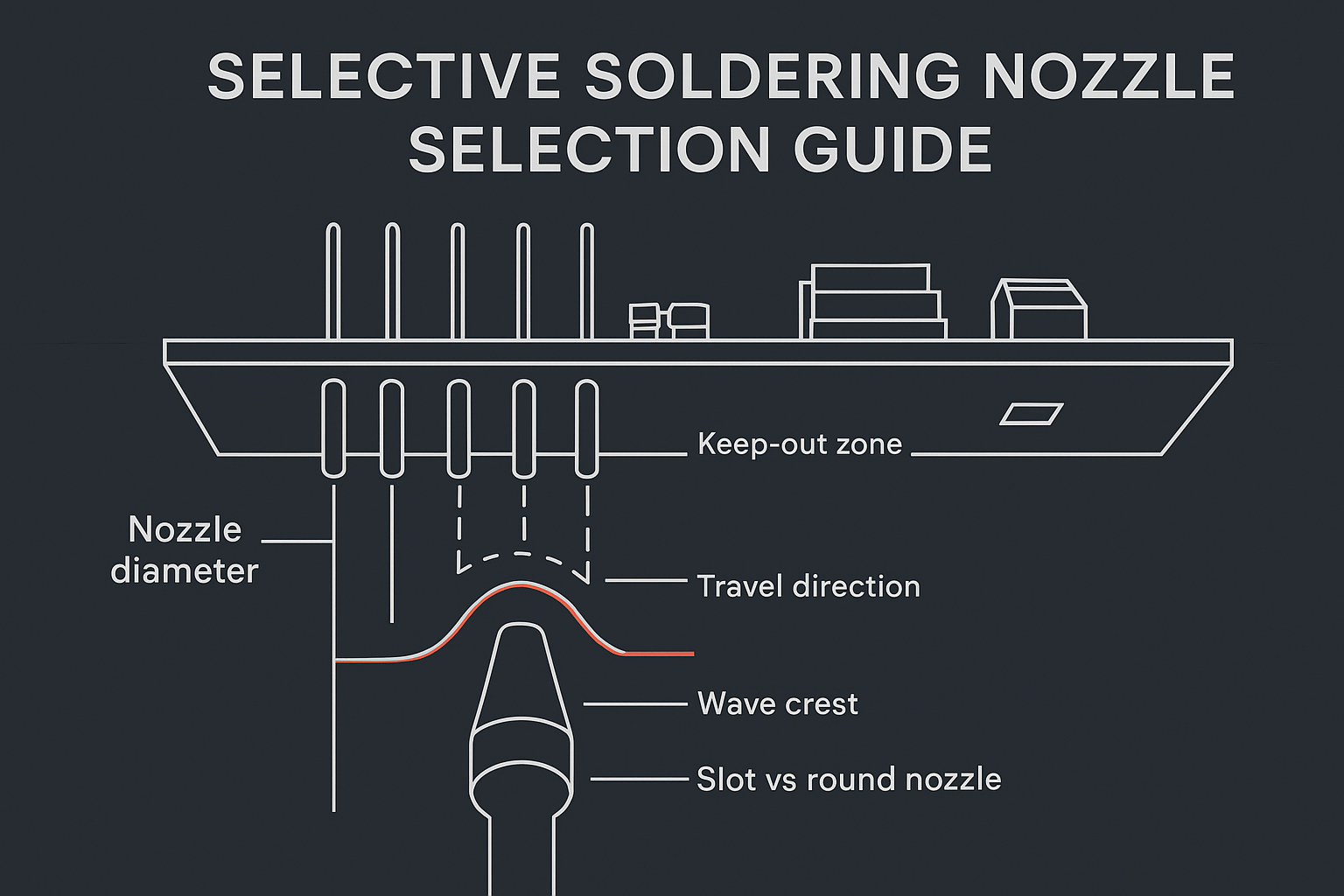
If you’re running selective wave soldering on high-mix boards, nozzle selection quickly becomes the hidden variable that decides whether you hit yield in . cycle time.
Choose too small, and you may fight weak hole fill and narrow process windows. Choose too large, and you may be one tight keep-out away from bridging or hitting adjacent SMT.
This guide is written for SMT engineering managers and operations leaders evaluating selective soldering nozzles across different PCB footprints. It focuses on practical selection criteria—size, shape, and material—and how those choices interact with clearance, thermal demand, defect risk, throughput, and maintenance.
Key takeaways
Start with clearance and access: the nozzle must physically reach the joint without splashing solder onto nearby SMT.
Nozzle diameter is heat delivery as much as it is precision. Smaller isn’t automatically “better.”
Uporabite nozzle shape (round vs slot/rectangular vs fountain/wide) to match the footprint geometry, not just the pin pitch.
When joints are close to SMT, wettable nozzles are commonly used for better control in tight areas; DDM Novastar’s overview of nozzle types is a useful starting reference for understanding those tradeoffs.
Treat nozzle choice as a system decision: it affects programming (dwell, travel direction, lift-off), nitrogen use, oxidation, cleaning frequency, and total cost of ownership.
A quick decision matrix for selective soldering nozzle selection (footprint → nozzle choice)
Use this table as your “first pass.” You’ll still tune parameters, but it keeps you from selecting a nozzle that’s mismatched to the footprint.
PCB footprint / joint type | Typical constraint | Nozzle size direction | Nozzle shape | Nozzle material / surface | Primary risk to manage |
|---|---|---|---|---|---|
Single pins, test points, isolated THT | Tight access, small target | Small-to-medium | Round/miniwave | Wettable if near SMT | Insufficient heat / weak meniscus |
Fine-pitch headers (e.g., 1.27–2.54 mm pitch) near SMT | Keep-out and bridging | Majhna | Round/miniwave; sometimes special geometry | Wettable often preferred near SMT | Bridging on exit side |
Through-hole connectors (rows, terminal blocks) | Thermal mass + many joints | Medium-to-large | Slot/rectangular or wide wave | Durable surface; manage oxidation | Throughput vs dross/oxide |
High thermal mass pins (transformers, power parts, heavy copper) | Heat delivery | Larger | Fountain/wide wave | Robust material/coating; nitrogen helps | Hole fill / insufficient wetting |
Mixed-tech boards with tall parts nearby | Collision + splash | Smaller + longer reach | Slim/extended nozzle | Wettable if very tight | Contact with adjacent components |
Pro Tip: If you find yourself increasing dwell time to “make a small nozzle work,” that’s a signal the nozzle may be thermally underpowered for the joint—not that your program is wrong.
Criterion 1: Clearance and access (keep-outs, height, and travel direction)
Clearance is the first filter because it’s binary: either the nozzle can operate without disturbing nearby features, or it can’t.
This is the moment to think in terms of selective soldering DFM clearance: not just whether the nozzle fits, but whether you have enough space for a stable wave, a clean drag-off, and predictable flux behavior.
Two practical realities drive most clearance failures:
The solder wave isn’t a laser. Even a stable miniwave has a crest and surface motion. If adjacent SMT pads are too close, you’ll see bridging, solder balls, or solder wicking where it doesn’t belong.
Drag-off matters. Many bridges happen when the nozzle exits the joint (surface tension pulls a solder filament). Exit-side clearance and travel direction often matter more than entry-side clearance.
A useful mental model is: keep-out is a function of nozzle diameter + wave stability + travel path. OEM guidance often frames keep-out as dependent on nozzle size and distance to adjacent SMT (for example, Ersa’s selective soldering layout guidance describes keep-out as driven by nozzle dimension and nearby SMT spacing; their nozzle overview is also a good definition reference: Kurtz Ersa “Selective Soldering Nozzles”).
What to do when clearance is tight
If your board is dense and you can’t simply “increase the keep-out,” you typically have three levers:
Switch nozzle type for better control: Wettable nozzles are commonly used for joints close to SMT because they enable controlled solder behavior and can be programmed with flexible motion. (For a plain-English overview of nozzle type differences, see the reference linked later in the article.)
Change the travel direction / exit strategy: Plan the nozzle’s path so the highest-bridge-risk pins are not on the final peel-off edge.
Reduce the required wave contact: If the joint is easy to wet, you may be able to reduce dwell and lift off sooner—but don’t treat this as a substitute for correct nozzle sizing.
⚠️ Warning: Don’t solve clearance problems by simply shrinking nozzle diameter. If you lose thermal headroom, you may trade “bridging” for “insufficient hole fill,” which is often harder to catch until reliability testing.
Criterion 2: Thermal demand and hole fill (why “smaller” can make quality worse)
Nozzle size changes prenos toplote as much as it changes precision.
In selective soldering, hole fill is influenced by:
joint thermal mass (lead diameter, connector body, copper planes)
board preheat and topside temperature
solder alloy and pot temperature
contact time (dwell) and wave contact area
A practical rule
If the footprint has high thermal mass or requires strong capillary action through plated through-holes, start with a larger or higher-energy nozzle configuration (often medium-to-large diameter or a shape that increases contact width).
If the footprint is low thermal mass but space is constrained, start with a smaller nozzle, and compensate with process tuning (preheat, nitrogen, stable wave height, careful drag-off).
When engineers “fight” hole fill by pushing dwell time up, they also increase risk:
overheating nearby SMT
flux over-activation / residue changes
solder balling
longer cycle time
A better approach is: pick a nozzle that delivers enough heat so dwell is a fine-tune, not a crutch.
Criterion 3: Defect risk by footprint (bridging, icicles, insufficient solder)
Nozzle selection should be connected to the defect you’re trying to prevent.
Bridging: most sensitive to exit behavior
Bridging is commonly driven by a combination of:
too much solder contact width for the pad spacing
exit-side peel-off pulling solder between pins
unstable wave height or turbulence
Mitigations that directly involve nozzle selection:
choose a nozzle that matches the pad “envelope” instead of exceeding it
use a wettable nozzle in tight areas where control is critical (DDM Novastar discusses wettable vs jet tradeoffs in their learning center)
tune path so the nozzle exits away from the highest-density pin group
Icicles and solder spikes
Icicles often correlate with exit dynamics and cooling. From a nozzle standpoint:
avoid overly aggressive lift-off that stretches solder
ensure the nozzle wave is stable (clean nozzle, correct flow)
For a practical internal reference on nozzle performance and stability, see S&M’s guide on how to improve selective wave soldering nozzle performance. (If you’re evaluating connector-heavy assemblies, this is also a good companion for selective soldering for connectors.)
Insufficient solder / poor hole fill
Insufficient solder is commonly a sign of insufficient thermal energy (not just “not enough solder”). If you consistently see weak hole fill on high-mass joints:
revisit nozzle diameter/shape selection
improve preheat strategy
validate wave height and dwell time are not at extremes
Criterion 4: Throughput and changeover (nozzle swaps are hidden downtime)
In high-mix environments, the time cost isn’t only “seconds per joint”—it’s also:
nozzle change time
validation time (first article checks)
program management and traceability
There’s a common throughput tradeoff:
Using a single “compromise nozzle” across many joints reduces changeovers.
Using multiple specialized nozzles can reduce cycle time per joint but adds setup and verification overhead.
A practical heuristic:
If your product mix changes daily and you’re running short lots, prioritize repeatability and minimal changeover.
If you run a stable product with high volumes, specialized nozzles (or custom geometry) can be worth it.
If you’re evaluating selective wave soldering equipment capability alongside nozzle strategy, S&M’s selective wave soldering machine buying checklist is a useful operational lens (quick-swap nozzles, poka‑yoke IDs, and realistic swap time):
Criterion 5: Nozzle shape selection by footprint (round vs slot vs fountain)
Diameter alone doesn’t describe what the wave actually contacts. Shape matters because it controls wave “footprint” on the underside.
Where miniwave nozzle size becomes the real constraint
When people say “we need a smaller nozzle,” they usually mean: we need a smaller wetting footprint and a more stable miniwave in a tighter space. In practice, miniwave nozzle size becomes the limiting factor when:
adjacent SMT is close enough that even a stable wave risks solder splash/bridging
tall parts restrict nozzle approach angle or travel path
the joint is fine-pitch and exit-side peel-off is the dominant defect mode
If you’re in this situation, don’t treat diameter as the only variable—shape (and whether the nozzle surface is wettable) often determines whether you can maintain control without sacrificing thermal headroom.
Round / miniwave nozzles
Best for:
isolated pins
small headers
fine-pitch areas where the solder contact must be narrow
Common failure mode:
underpowered heat delivery on high-mass joints, leading to dwell creep
Slot / rectangular nozzles
Best for:
connector rows or multiple pins where you want consistent contact along a line
improving throughput when spacing allows
Watch-outs:
larger contact area increases bridging risk near SMT unless keep-outs are generous
Fountain / wide-wave nozzles
Best for:
high thermal mass components
larger connectors
Watch-outs:
higher oxidation exposure if the wave is broad and poorly managed (nitrogen and maintenance become more important)
Criterion 6: Nozzle material and oxidation/wear (especially for lead-free)
Nozzle material and surface condition affect:
wetting behavior
oxidation rate
how quickly a nozzle degrades (and how often you need to clean or recondition it)
At a practical level, your decision is often between:
wettable surfaces that can improve control in tight spaces
materials/coatings optimized for durability in aggressive lead-free conditions
This is also where nitrogen strategy matters. For example, S&M’s SM-LⅡ selective wave soldering documentation includes nitrogen requirements and consumption—useful when you’re estimating operating cost and stability for different nozzle strategies (see SM-LⅡ Selective Wave Solder Technical Specifications).
For maintenance implications, link your nozzle choice to your cleaning plan:
How to maintain selective wave soldering nozzles (cleaning & inspection) (If you need a maintenance checklist and interval planning, this is a solid starting point.)
Criterion 7: Programming parameters that interact with nozzle choice
A nozzle is not “set and forget.” The same nozzle can produce good or bad results depending on how it’s programmed.
Key parameters to align with nozzle choice:
Wave height / nozzle-to-board height
You’re balancing:
enough contact to wet and fill
minimal excess solder to avoid bridging
Treat height as a controlled variable, not a “fixed setup.”
Čas mirovanja
Dwell should match the footprint thermal demand.
If dwell grows because the nozzle is too small, reconsider nozzle choice.
If dwell is low but bridges persist, reconsider exit path and nozzle control.
Travel direction and drag-off
Plan the exit so the highest-risk pins aren’t the final peel-off point. This is especially important for multi-row connectors.
Preheat and flux alignment
Nozzle performance often looks like a nozzle problem when it’s actually a preheat or fluxing problem.
If you want a process-level cross-check, S&M’s internal guide on optimizing selective wave soldering process parameters is a good complement.
Nozzle selection “by footprint” examples (what engineers actually do)
Below are common footprint-driven choices, with the reasoning you can use to defend the decision in an internal review.
1) Fine-pitch header near SMT
Constraint: tight keep-out + bridging risk
Typical direction:
smaller miniwave / controlled nozzle
wettable nozzle if joints are very close to SMT (control priority)
Program focus: exit strategy and stable wave height
2) Large multi-pin connector with generous spacing
Constraint: throughput + consistent hole fill
Typical direction:
medium-to-large nozzle, possibly slot/rectangular to cover more area
Program focus: minimize total passes and avoid excessive dwell per joint
3) High thermal mass pins (power connectors, transformers)
Constraint: thermal delivery / hole fill
Typical direction:
larger nozzle or fountain/wide wave
ensure preheat supports wetting and capillary rise
Program focus: heat balance and verification of hole fill across pins
4) Mixed-tech with tall components nearby
Constraint: collision risk + splash
Typical direction:
extended/slim nozzle with careful path planning
prioritize access and repeatability
A practical checklist (selection + validation)
Use this checklist as a repeatable internal standard—especially if multiple plants/programmers touch the same product families.
Classify the footprint (isolated pin / fine-pitch header / connector row / high thermal mass / constrained by tall parts).
Set clearance reality:
Can you maintain a meaningful keep-out from adjacent SMT?
If not, identify whether a wettable nozzle and travel strategy is required.
Choose nozzle size by thermal demand:
high thermal mass → increase contact capability
tight keep-out → minimize contact width, but verify heat headroom
Choose nozzle shape by geometry:
round for pinpoint
slot for rows
fountain/wide for high mass
Decide material/surface strategy:
lead-free oxidation sensitivity
cleaning frequency and wear expectations
Program with intent:
wave height control
dwell per joint type
drag-off direction
Validate with a failure-mode mindset:
check for bridging on exit side
confirm hole fill on high-mass pins
confirm no SMT reflow/disturbance nearby
Wettable vs jet nozzle: when each is the safer choice
This is a simplified decision rule you can use in reviews:
Choose a wettable nozzle when the joint is close to SMT, you need multi-directional movement, or the exit-side bridging risk is high.
Choose a jet nozzle when you have more space and want a directional, wave-like approach for throughput.
DDM Novastar’s overview summarizes this distinction and explains why wettable nozzles are commonly used for tighter clearances (see DDM Novastar’s “Selecting a Selective Soldering System” (2025)).
A neutral equipment example (S&M selective wave soldering, SM-LⅡ)
If you’re comparing machines as well as nozzles, it’s worth checking whether your system supports the nozzle strategy you’re planning (e.g., stable motion control, repeatable positioning, and nitrogen capability).
For example, S&M’s selective wave soldering lineup includes the SM-LⅡ model, with published technical specifications that can be used as a neutral checklist input for capability verification (positioning accuracy, nitrogen requirements/consumption, and nozzle configuration). (Referenced earlier in this article.)
This should be used as an evaluation input—not as a substitute for board-level trials.
Next steps
If you want to reduce trial-and-error, the fastest path is to review nozzle choice together with your footprint constraints and defect history.
If nozzle stability and defects are your main issue, start with S&M’s practical guide to improve selective wave soldering nozzle performance (search it on the S&M site).
If you want a structured review, compile your top 3 assemblies (connector types, pitches, keep-outs, and defect modes) and run a short nozzle/DFM evaluation with your process team.