



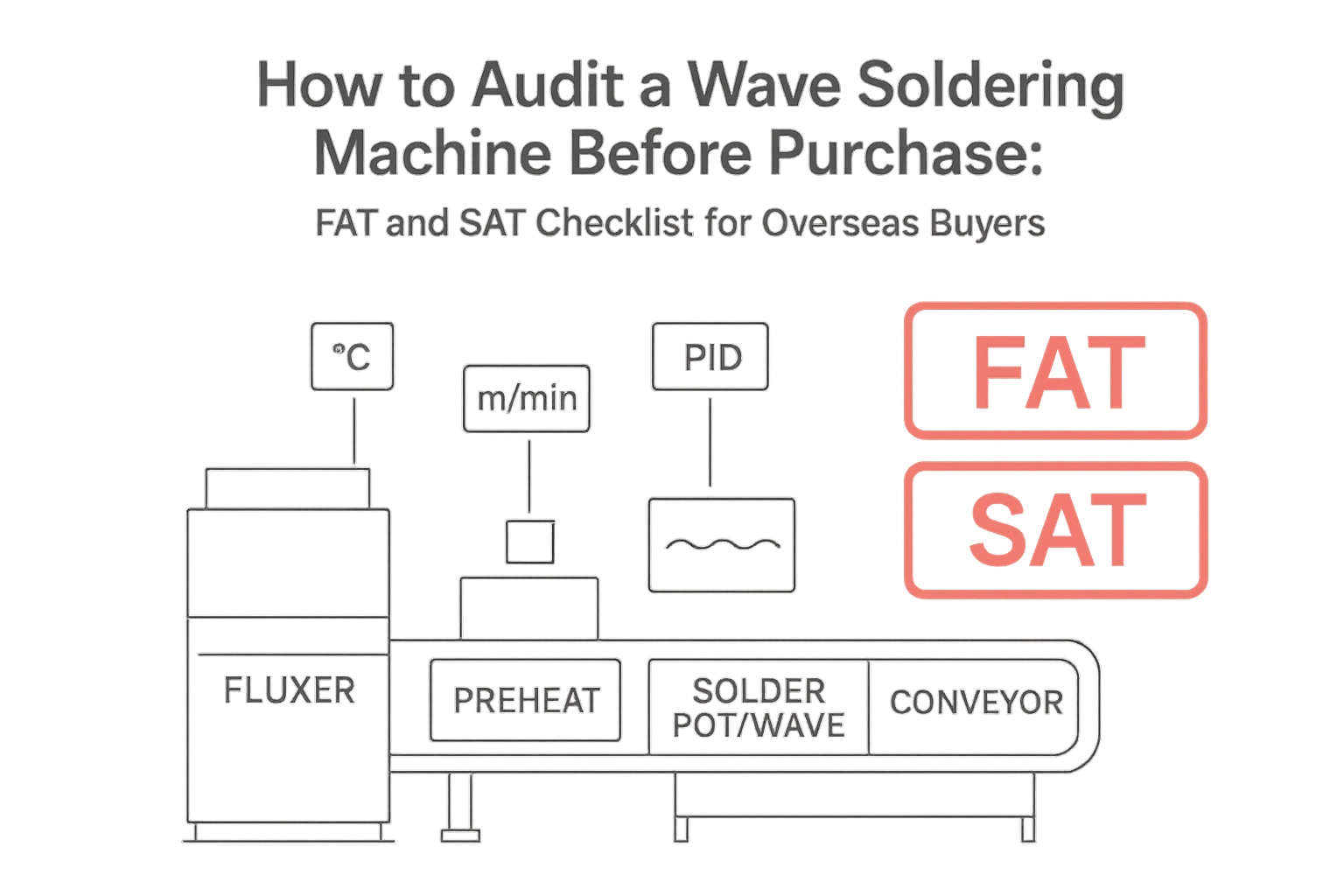
Buying a wave soldering machine overseas can be a smart CapEx move—or an expensive lesson. Most “bad purchases” don’t fail because the machine can’t solder. They fail because the buyer never turns requirements into acceptance criteria, never witnesses the right tests, and ends up discovering gaps only after the crate arrives.
A strong acceptance plan has two gates:
FAT (Factory Acceptance Test): a witnessed, protocol-driven test at the supplier’s site before shipment to confirm the build meets agreed requirements.
SAT (Site Acceptance Test): a validation at your facility after installation to confirm the machine performs correctly under your utilities, boards, flux, and production constraints.
Those definitions—and why both matter—are consistent across acceptance-testing guidance such as RealPars’ “Factory Acceptance Test (FAT) Explained” et PQE Group’s FAT vs SAT explainer.
This article gives you a practical, audit-ready FAT/SAT checklist tailored to wave soldering systems, with an emphasis on what evidence to collect so engineering, quality, and procurement can sign off confidently.
Key takeaways
Treat FAT and SAT as two different proofs: FAT proves the build; SAT proves the installed system in your environment.
Write acceptance criteria into the PO (what to measure, method, pass/fail, and what happens on deviations).
Collect evidence, not opinions: calibration certificates, temperature logs, profiling records, sample-board results, and a closed punch list.
Wave soldering acceptance must verify subsystems: fluxing, preheat, solder pot/wave, conveyor, controls/HMI, safety—and nitrogen if applicable.
What FAT and SAT should prove (in plain terms)
FAT: prove the machine is built right
FAT is where you confirm the supplier delivered what they promised—mechanically, electrically, and functionally—before you inherit the logistics risk. FAT is also where you can fix issues with the supplier’s tools, spare parts, and engineers on hand.
SAT: prove the process works on your boards
SAT is where you validate installation, utilities, training, and process stability using your boards (or a representative test vehicle), your flux, and your production constraints.
Key Takeaway: FAT reduces the risk of shipping the wrong machine. SAT reduces the risk of installing the right machine the wrong way.
Before you travel: bring the right inputs (and avoid “we’ll tune it later”)
Your FAT/SAT plan is only as good as the inputs you provide. Before the FAT date, request these items in writing:
Final machine configuration: options list, BOM, and drawings; confirmation of any revisions.
Process envelope: target alloy (e.g., lead-free), flux type, max board weight, max thermal mass, expected throughput.
Utility requirements: power, exhaust, compressed air, (optional) nitrogen flow/purity, clearance and floor loading.
Documentation package: manuals, wiring diagrams, PLC backups, spare parts list, maintenance schedule, calibration certificates.
And bring instruments (or verify the supplier has them and they’re traceably calibrated):
contact thermometer / thermocouple meter for spot checks
tachometer or conveyor speed verification method
level/straightedge and basic measurement tools
your acceptance test forms + punch-list template
If you need a baseline for workmanship expectations, use standards as reference points. In most electronics plants, process requirements are anchored to documents like IPC J-STD-001 (soldering requirements) and IPC-A-610 (acceptability). Overviews such as this J-STD-001 soldering requirements explainer help align stakeholders on what those standards are used for.
Wave soldering machine FAT checklist (factory acceptance test)
Think of FAT as five buckets: documentation, safety, mechanical, controls, and process subsystems. Your checklist should read like a series of pass/fail items with evidence captured.
1) Documentation & traceability (don’t skip this)
Verify and collect:
Machine nameplate matches the PO (model, voltage, serial number).
Manuals, electrical schematics, pneumatic diagrams, and maintenance schedule provided.
PLC/HMI program backup delivered (and version recorded).
Calibration certificates provided for temperature sensors, flow meters, oxygen sensor (if nitrogen), and conveyor measurement system.
Spare parts list and recommended wear parts (pumps, filters, belts, nozzles).
Evidence to capture: PDF pack + photo of nameplate + software/firmware versions.
2) Safety & compliance checks
E-stops function and are accessible.
Door/cover interlocks function as designed.
Heater over-temp protection and alarms verified.
Fume/exhaust connections are labeled and safe.
Evidence: video clips of E-stop/interlock/alarm tests + alarm list export.
3) Mechanical build & serviceability
Conveyor rails and width adjustment are smooth and repeatable.
Board support, fingers, and fixturing points match your board sizes.
Access panels allow maintenance without full disassembly.
Flux reservoir/pump access is service-friendly; filtration is present if specified.
Evidence: photos + recorded measurements + list of required tools.
4) Electrical / controls / data integrity
Power-on self-test passes.
Alarms are meaningful (not generic) and include actionable causes.
PID temperature control shows stable behavior at steady state (no hunting/overshoot that causes process drift).
Data logging works (temperature trends, conveyor settings, alarms) and can be exported.
Evidence: screenshots of trend data + exported log file + alarm history.
5) Process subsystem acceptance (wave-specific)
This is the heart of wave soldering machine acceptance. Use profiling guidance and repeatable measurement methods.
Fluxing system
Flux application is uniform across board width at defined conveyor speed.
Spray/foam system is adjustable and settings are repeatable.
Flux consumption rate can be recorded and controlled.
Preheat system
Each preheat zone reaches setpoint and holds temperature steadily.
Top-side temperature ramp is controllable (avoid thermal shock and flux burnout).
Thermal profiling practices for mass soldering are commonly documented in materials such as IPC-7530A temperature profiling guideline (PDF) and the solder-industry guide AIM Solder’s wave solder profile supplement (PDF).
Solder pot / wave system
Solder pot reaches setpoint and holds stability over time.
Wave height is adjustable and repeatable.
Pump function is stable; no unusual cavitation/noise.
Dross removal method is workable and safe.
For high-reliability workmanship expectations, standards like NASA-STD-8739.3 soldering standard (PDF) are often referenced as a benchmark for disciplined soldering process control.
Conveyor system
Conveyor speed matches setpoint across multiple speeds.
Speed repeatability is confirmed after stop/start.
PCB transport is stable (no vibration-induced movement on fingers).
Nitrogen system (if specified)
Oxygen level monitoring is installed (if required) and alarms are functional.
Nitrogen flow and purity requirements are documented and measured.
(For example, Chuxin SMT notes selective-wave nitrogen requirements such as 0.3–0.5 MPa, ≥ 5 m³/het ≥ 99.998% purity in its product knowledge base—use your own process needs to set the contractual acceptance threshold.)
FAT “trial run” you should insist on (even for an Awareness-stage buyer)
At minimum, require a controlled trial that generates objective evidence:
Run the machine to thermal steady state.
Execute a profiling run (representative board or test vehicle).
Run a small batch of sample boards through (even if components are limited).
Record defects and rework notes using your standard defect taxonomy.
If you want practical setup guidance to cross-check against what you’re seeing during FAT, Chuxin SMT’s Wave Soldering Machine Operation Guide is a useful reference for typical setup and safety items.
Shipping handover checklist (the part that prevents “it worked at FAT”)
Between FAT sign-off and shipment, your goal is to freeze the accepted configuration.
Final configuration photographed (critical settings screens + hardware options).
Punch list status: closed items verified; open items documented with deadlines.
Packing list matches shipment; spares and tools are included.
Shock/tilt indicators added (recommended for overseas shipping).
Crate labeling and documentation pouch present.
Pro Tip: Require the supplier to export the final parameter set and software backups after FAT and include them inside the crate and in your digital handover folder.
Wave soldering machine SAT checklist (site acceptance test)
SAT is where integration and repeatability get proven.
1) Installation & utilities
Incoming power matches spec; grounding verified.
Exhaust, air, and (if used) nitrogen are connected and stable.
Machine leveling and clearance meet the supplier’s installation spec.
No shipping damage; sensors/cables inspected.
2) Commissioning & profiling
Temperature profiling completed and saved (baseline “golden profile”).
Conveyor speed verified at your operating setpoints.
Flux coverage confirmed with your flux and environmental conditions.
3) First production run (repeatability proof)
Run a defined lot; record FPY, rework rate, and key defect modes.
Verify hole-fill / wetting acceptability against your inspection standard.
Confirm drift checks: pot temp stability, preheat stability, alarms.
4) Training, spares, and maintainability
Operator training completed; sign-off by your process owner.
Maintenance training completed; daily/weekly/monthly schedule agreed.
Critical spares onsite; reorder lead times confirmed.
How to write acceptance criteria into the PO (so FAT/SAT isn’t subjective)
If your PO says “machine must be in good condition,” you’ve created a dispute. Instead, define:
What to test: subsystems + trial run + documentation.
How to test: instrument, method, and sampling.
Pass/fail criteria: what values or conditions constitute acceptance.
Evidence required: logs, calibration certificates, exports, photos/videos.
Deviation handling: punch list rules, retest responsibility, and timeline.
For buyers still selecting the right equipment type (traditional wave vs selective vs hybrid), Chuxin SMT’s selective vs wave soldering comparison can help scope what your acceptance test must cover.
Next steps (template + engineering review)
If you’d like, you can use this article as a starting point and turn it into a formal, signable FAT/SAT protocol.
If you need a supplier who can support lead-free wave soldering and controlled thermal zones (plus selective wave options when your boards demand tighter keep-outs), you can explore S&M Co.Ltd (Chuxin SMT) resources such as their wave soldering machine buyer’s guide et selective wave soldering solutions overview.
CTA (low-commitment): Request a FAT/SAT checklist template and a 30-minute pre-FAT review with an engineer—so your test plan is aligned before you get on a plane.