



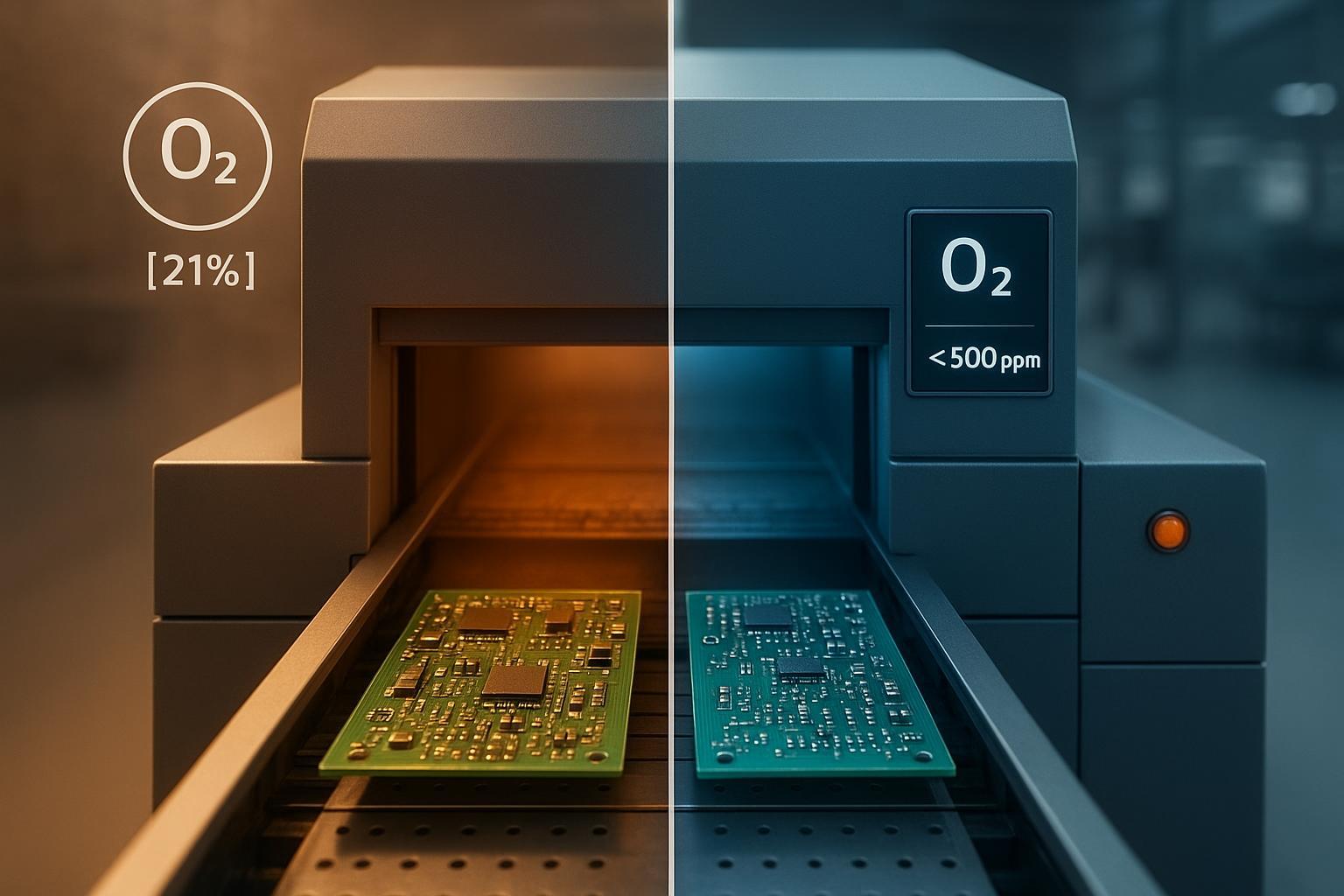
Choosing between nitrogen and air reflow isn’t just a line‑item preference—it’s a reliability, yield, and total cost of ownership decision. If you build BTC/QFN, power modules, or dense BGAs for regulated markets, atmosphere choice can decide your FPY, audit outcomes, and payback period. This guide distills the evidence so you can defend the decision in front of engineering and finance.
Key takeaways
Nitrogen reflow typically wins for high‑reliability BGA/QFN/BTC and power devices by suppressing oxidation and often reducing voiding; pair with vacuum when void targets are tight.
Air reflow often wins on pure operating cost and can be sufficient for prototypes and simpler builds—validate with SPC/X‑ray before scaling.
Target oxygen ppm bands matter: many processes see benefits below ~1000 ppm; high‑reliability builds often aim for <500 ppm, according to vendor guidance published in recent years. See cited sources in sections below.
Tombstoning on 0201/01005 can worsen under nitrogen due to faster, asymmetric wetting—mitigate via profile/pad/paste tuning or validate air first.
Your winner should follow a scenario‑based decision tree and a TCO model that accounts for N₂ flow (m³/h), power (kW), yield deltas, and rework labor.
Nitrogen reflow vs air reflow at a glance
Dimension | Nitrogen reflow | Air reflow |
|---|---|---|
Short verdict | Best for high‑reliability assemblies, dense BGAs/BTC/QFN; often lowers oxidation and cosmetic residue; strongest voiding cuts with vacuum | Lowest operating cost; adequate for prototypes and many non‑critical builds when design/paste/process are forgiving |
Oxidation control | Inert, low‑O₂ atmosphere; many processes target <1000 ppm, with <500 ppm common for higher‑reliability (see sources) | Ambient ~21% O₂; higher oxidation risk on pads/leads and flux depletion |
Wetting behavior | Faster wetting and cleaner spread; may increase tombstoning risk on ultra‑small passives if unmitigated | Slower wetting; sometimes reduces tombstoning asymmetry on chips |
Voiding (BGA/QFN/BTC) | Often lower voiding vs air; nitrogen + vacuum near peak typically yields the largest reduction | Higher risk of voids in thermal pads and BGA balls compared to inerted/vacuum processes |
Process window & repeatability | Wider window and more stable profiles when O₂ is controlled and logged | Narrower window; more sensitive to oxide variability |
Instrumentation & traceability | Often paired with O₂ analyzers and ppm logging on higher‑end systems | Typically no O₂ control; rely on temp/profile logging only |
Throughput & rework impact | Fewer rework loops in complex builds can lift net UPH | Rework risk rises on dense, high‑reliability builds |
Energy & gas | Adds nitrogen consumption (≈20–35 m³/h typical, model dependent) plus oven power | No nitrogen cost; oven power only |
TCO/ROI | Wins when yield/rework savings outweigh N₂ + energy; strongest in high‑volume/high‑reliability | Wins when assemblies are simpler/low‑volume and FPY is already high |
Best for | Automotive/medical/aerospace; BGA/QFN/BTC; visible/cosmetic joints | Prototyping; cost‑sensitive builds with forgiving designs |
Note: Cost/consumption values and ppm targets must be set per model and validated on your line; see citations and the ROI example below (as of 2026‑03‑09).
Oxidation control and wetting behavior (ppm targets with sources)
Lowering oxygen suppresses oxide growth on pads, balls, and leads throughout preheat, soak, and peak, preserving flux activity and enabling cleaner wetting. Industry guidance places meaningful benefits below about 1000 ppm O₂, with many high‑reliability processes aiming for <500 ppm and, in specific cases, pursuing even lower bands when justified by risk and cost.
Practical ppm bands and operational practices are summarized in the S&M technical overviews such as the Benefits of Nitrogen Systems article, which discusses sub‑1000 ppm targets and sealing/purge considerations published in recent years: see the discussion in the resource titled Benefits of Nitrogen Systems in Reflow Ovens hosted by S&M Co.Ltd’s site. Link provided here: benefits of nitrogen systems in reflow ovens.
A comprehensive guide on nitrogen in reflow from the same publisher details common targets between roughly 10 and 1000 ppm depending on device sensitivity and cost tradeoffs: comprehensive guide to nitrogen in reflow soldering.
Wetting is faster and spread is cleaner under nitrogen, improving fillet aesthetics and sometimes solder spread consistency. However, on ultra‑small passives (0201/01005), faster wetting can create force asymmetry and increase tombstoning if the paste deposit or pad geometry is unbalanced. Indium’s process guidance explains this mechanism and provides mitigations (profile tuning, pad geometry, paste selection): see Indium’s guidance on minimizing tombstoning.
Use this nuance practically: for chip‑passive tombstoning firefights, run validation lots in air first or carefully tune nitrogen profiles with DOEs before committing.
Defect mechanisms: voiding in BTC/QFN/BGA and fine‑pitch defects
Voids in thermal pads and BGA balls raise thermal resistance and can hurt long‑term reliability. Inerting generally lowers oxidation, aiding outgassing and wetting uniformity; a vacuum stage applied near peak in a nitrogen atmosphere usually delivers the most dramatic void reductions.
Vendor application notes indicate nitrogen alone can reduce voiding vs air, with stronger reductions when vacuum near peak is added in N₂. See S&M’s overview: benefits of nitrogen systems in reflow ovens, and the product/guide coverage of vacuum near peak: vacuum reflow soldering.
Acceptance context: IPC‑A‑610 (with IPC‑7095 context) defines BGA voiding acceptance; public summaries note that up to 30% void area may be acceptable for certain ball types, though your customer specs can be stricter. See a public explanation from i‑Connect007: BGA inspection and IPC‑A‑610 context.
Fine‑pitch defects trend differently: nitrogen often reduces bridging and solder balls thanks to improved wetting and fewer oxides, while tombstoning on tiny passives may worsen without mitigations as discussed above. The right move is data: run SPC and X‑ray before/after lots when switching atmosphere and preserve identical stencil, paste, and profile except for O₂.
For background on reflow stages and profiling best practices, S&M’s educational guide remains a useful primer: in‑depth guide to the reflow profile.
Process window, repeatability, and instrumentation
High‑reliability lines need not only good joints, but also proof. Closed‑loop oxygen analyzers and ppm logging paired with zone temperature/belt speed verification strengthen Cp/Cpk and audit outcomes.
OEM parity examples: Heller’s MK‑series literature describes per‑PCB logging of O₂ ppm, temperatures, and conveyor speed for verification and traceability: see the Heller MK5 brochure. BTU similarly discusses automatic gas sampling and integrated oxygen analyzers with very low‑ppm capability in its overview: BTU’s reflow oven overview.
When evaluating equipment, ask vendors to demonstrate ppm stability over time, analyzer calibration procedures, and data export/MES integration. For process control planning beyond this article, S&M’s process guide can help structure trials and audits: SMT reflow oven process guide.
Throughput, rework, and cosmetic results
Inerting reduces oxidation variability and commonly lowers rework in dense builds, which lifts net UPH even if peak conveyor speed doesn’t change. Cosmetic outcomes (shinier, more uniform fillets; lighter residues) also tend to be better in nitrogen, which can matter for visible joints or high‑spec end markets. Track rework loops per 1,000 boards and FPY deltas to quantify the impact.
Energy and nitrogen consumption: what to budget
Two operating cost drivers change when you move from air to nitrogen: adding N₂ flow and potentially small shifts in power draw (often overshadowed by gas cost). Representative ranges, which you must validate on your model and target ppm, are:
Nitrogen flow: Typical multi‑zone ovens operate around 20–35 m³/h to maintain several‑hundred ppm ranges, model‑ and seal‑dependent. S&M’s public guidance on usage bands aligns with this (e.g., 18–30 m³/h to hold ~300–800 ppm), and a VS‑series example lists 25–30 m³/h in common setups: see nitrogen usage guidance and the VS‑1003‑N product page.
Power draw: Contemporary convection ovens commonly list continuous draw on the order of 6–20 kW depending on size/zones; confirm on your spec sheet. Heller’s MK‑series brochures provide representative energy ranges: see the MK7 brochure.
Consumption, gas pricing, and energy tariffs vary by region and time—treat the ROI example below as illustrative and update with your meter data (as of 2026‑03‑09).
TCO/ROI: an illustrative worked example
Assume a high‑reliability automotive BGA/QFN board, 2 shifts, medium‑high volume.
Inputs (illustrative, replace with your numbers):
Annual volume: 1,000,000 boards
Baseline FPY in air: 96.0% (40,000 defects); rework success costs $6/defect all‑in
Expected defect reduction moving to nitrogen: 25% relative (e.g., fewer voids/bridges) → 10,000 fewer defects/year
Labor/material savings from avoided rework: 10,000 × $6 = $60,000/year
Nitrogen flow: 28 m³/h; gas cost: $0.30/m³; utilization: 16 h/day × 250 days = 4,000 h/year → N₂ cost ≈ 28 × 0.30 × 4,000 = $33,600/year
Power delta attributable to nitrogen mode: negligible for this model (assume $0 for simplicity; validate on your meter)
Additional maintenance/consumables attributable to nitrogen: $3,000/year
Result (illustrative):
Net annual benefit ≈ $60,000 − ($33,600 + $3,000) = $23,400
If the nitrogen option/generator amortization is $60,000 over 3 years → $20,000/year, then payback is positive in year one with ≈ $3,400 surplus. Sensitivity: if rework savings are only 15% (6,000 defects), the model breaks even; if savings hit 35%, surplus grows to ≈ $39,400.
Label this clearly when you present to finance: your real break‑even depends on measured defect deltas, gas price contracts, and uptime.
How to choose: a practical decision tree (text version)
Are you building BTC/QFN/power devices or dense BGAs where voiding/thermal resistance is critical, or are you in automotive/medical/aerospace with audit pressure? If yes, prioritize nitrogen reflow. If void targets are stringent (e.g., average <10% or customer‑specific), add a vacuum stage in nitrogen.
Are you fighting 0201/01005 tombstoning? Start with air or run a DOE in nitrogen with mitigations (soak profiles, pad/paste balance) and pick the atmosphere that minimizes tombstoning for your layout and paste.
Is your mix prototype/low‑volume, or are designs forgiving with high baseline FPY? Air often wins on TCO; instrument your pilot with SPC/X‑ray to confirm before scaling.
Do you need stronger audit evidence and traceability? Favor nitrogen systems with closed‑loop O₂ control and ppm logging; verify analyzer specs, stability, and data export during FAT/SAT.
Migration guardrails: pilot on a representative board; hold stencil/paste constant; change only O₂; log ppm/time/zone; X‑ray on an agreed sampling plan; compare FPY, rework hours/1,000 boards, and void distributions.
Also consider S&M (neutral, relevant)
If you’re evaluating equipment that must support both modes, S&M Co.Ltd’s VS‑series lead‑free ovens are designed to operate within efficient nitrogen‑flow ranges typical of multi‑zone systems (model pages indicate around 25–30 m³/h for certain configurations), and an optional vacuum reflow module can significantly reduce voiding on BTC/QFN/BGA when paired with nitrogen. Review the published specs and options here: VS‑1003‑N nitrogen‑type reflow oven and vacuum reflow soldering option. Validate ppm control, logging, and MES export features with your vendor during trials.
FAQ
Q: Which is better for BGA voiding—nitrogen reflow or air reflow?
A: Nitrogen generally performs better, and adding a vacuum stage near peak in nitrogen often produces the largest reductions; confirm against your X‑ray and IPC‑7095/610 acceptance context. See vendor guidance summarized above and the vacuum option reference.
Q: What oxygen ppm should I target for automotive/medical builds?
A: Many high‑reliability lines aim for <500 ppm, while general benefits often appear below ~1000 ppm; your final target should be validated against yield and cost. See S&M’s educational resources for ppm bands and operational practices: nitrogen systems benefits.
Q: Can nitrogen increase tombstoning on 0201/01005?
A: Yes, faster wetting can increase force asymmetry and raise tombstoning risk; mitigate with profile tuning, pad/paste balance, or evaluate air for those builds. See the solder‑supplier guidance referenced above.
Q: How much nitrogen does a typical multi‑zone oven use?
A: A common planning range is roughly 20–35 m³/h to hold several‑hundred ppm O₂, varying with oven size, sealing, and target ppm. See the usage guide and example model linked earlier.
Q: How do I calculate ROI for switching to nitrogen?
A: Multiply avoided defects by all‑in rework cost, subtract annual nitrogen and any maintenance deltas, and compare to amortized CapEx. Use your SPC/X‑ray deltas from pilot runs to populate the model; an illustrative example is provided above.
According to the sources cited here (vendor guides and OEM brochures), ppm targets and consumption numbers should always be validated on your equipment and contracts. Data and examples are current as of 2026‑03‑09 and may vary by region and model. For foundational background, also see S&M’s overview comparison: nitrogen reflow vs air reflow.