
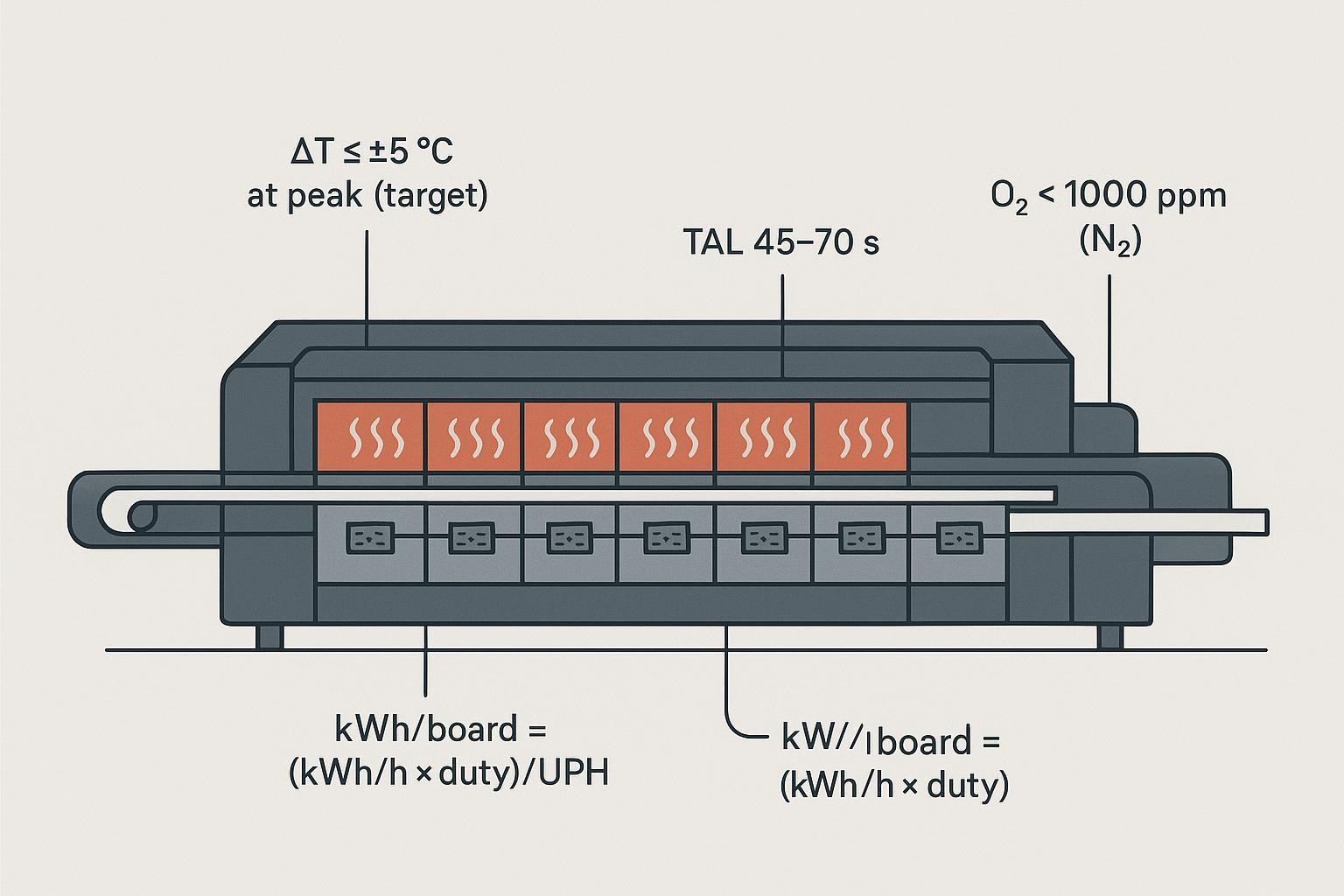
Choosing the right partner for your next reflow oven isn’t just a spec sheet exercise. In high-mix EMS and industrial programs, the winner balances total cost of ownership (TCO), delivery and service readiness, thermal capability, atmosphere control, and integration without adding risk to audits or schedules. This guide gives you a buyer’s rubric that maps each shortlisting criterion to an acceptance test and an audit artifact—so you can defend your decision with data, not gut feel.
Key takeaways
Treat shortlisting as evidence collection: tie each claim to a test (profile ΔT, O2 ppm, vacuum voiding, changeover timing) and archive the artifacts.
Model TCO over 5–10 years using measured kWh/h, Nm³/h, PM intervals, and downtime risk—not brochure promises.
For high-mix EMS, prioritize recipe governance, rapid changeovers, and MES/traceability handshakes over peak UPH alone.
Validate nitrogen and vacuum options with on-your-product A/B runs; quantify void area by X-ray and log O2 ppm.
Favor a reflow oven partner that can demonstrate stable ΔT on representative boards, clean data export, and local service SLAs you can audit.
Buyer’s jobs and a shortlisting rubric for a reflow oven manufacturer China
Your job isn’t to find the flashiest spec—it’s to reduce operational risk while meeting takt, quality, and audit obligations. When you evaluate any reflow oven manufacturer China, convert their claims into verifiable checks:
Thermal capability on your products. Verify ΔT across a loaded, representative panel using on-product thermocouples per the scope of IPC‑7530B temperature profiling guidelines. Target windows for SAC305 builds typically include soak ~170–190 °C for 60–120 s, time above liquidus (TAL) 45–70 s, peak 235–245 °C, and cooling 2–4 °C/s. Bind acceptance to your profiler data and defect outcomes.
Atmosphere control. If nitrogen is required, confirm O2 ppm logging capability and achievable setpoints during representative takt; if vacuum is specified, require X-ray quantification of void area with vacuum on/off.
Changeover speed and governance for high-mix EMS. Evaluate recipe libraries, permissions, interlocks, and MES handshake; measure time to a stable profile after a product change.
Data, traceability, and export. Require recipe IDs, TAL/peak summaries, conveyor speed, O2 ppm (where equipped), alarms, and barcode association to be exportable for SPC/CPK.
Service coverage, spares, and ramp-up plan. Score local response times, spare parts availability, installer capacity, and a day-by-day ramp plan to rate production.
Keep the narrative buyer-centric: what you can verify on-site and what artifacts you will bring to audits. That’s how you defend the shortlist.
TCO and service: the deciding edge
Here’s the deal: two ovens may hit the same peak temperature on paper, but over 5–10 years the better choice is the one that costs less per board to run, changes over faster, and recovers quicker from faults. Build a TCO model that you can update during FAT/SAT and pilot runs.
How to compute per-board energy
Per-board energy ≈ (measured oven kWh/h × duty factor) ÷ UPH. Duty factor (0.7–0.9) reflects gaps/eco modes during high-mix schedules. Meter real kWh/h under representative takt; don’t rely on connected-load.
Nitrogen costing in practice
Measure Nm³/h with an inline flowmeter during representative runs; compute Nm³/board by dividing by UPH. Price against your gas contract and model sensitivity to O2 setpoint and purge strategy. Track dew point or analyzer ppm logs concurrently for correlation.
Service and SLA scorecard
Ask for staffed service locations, spare parts depots, and typical response/repair times. Require a preventive maintenance (PM) schedule by hours-run and a list of recommended on-hand consumables.
A compact input table you can lift into your spreadsheet:
Input | How to measure/use | Notes |
|---|---|---|
Purchase price + options | Vendor quote | Include N2/vacuum/analyzer options |
Installation & training | SOW + quote | Travel, rigging, hookup |
Energy (kWh/h) | Power meter over shift | Compute per-board with duty × UPH |
Electricity price ($/kWh) | Facility tariff | For a benchmark, see the U.S. industrial average in the EIA STEO table (2026) |
Nitrogen (Nm³/h) | Inline flowmeter | Convert to Nm³/board via UPH |
Gas price ($/Nm³) | Gas contract | Include generator/compressor costs if onsite |
PM labor & consumables | Vendor PM plan | Filters, seals, analyzer calibration |
Downtime risk | Historical MTBF + SLA | Weight with line balancing assumptions |
Residual value | Finance policy | Depreciation/overhaul estimates |
Keep the model living: update with your FAT/SAT readings and first 90 days of stabilized production.
Thermal capability and profiling you can audit
A stable profile on your highest-risk assemblies is the single best predictor of downstream quality. For lead-free SAC305 as a common baseline, cross-checked explainers align on typical windows: soak 170–190 °C for 60–120 s, TAL 30–90 s, peak 235–250 °C (often targeted 235–245 °C), and cooling ~1.5–4 °C/s. See triangulated ranges in these neutral explainers: PCBONLINE’s reflow basics and FastTurn’s profiling guide. Bind all of this to on-product thermocouples per IPC‑7530B scope.
Acceptance targets for high-mix EMS (starting point; tighten per risk):
ΔT ≤ ±3 °C during soak and ≤ ±5 °C at peak across a 300–400 mm panel.
Ramp 1–2 °C/s; cooling 2–4 °C/s within paste/component limits per JEDEC J‑STD‑020F context via OSRAM LED guidance.
Archive artifacts
Profiler run files (native + CSV), oven recipe export (versioned), O2 ppm traces (if equipped), alarm history, and inspection evidence (e.g., X‑ray void area on BTCs). For defect linkage and profiling best practices, see this internal deep dive on temperature profiling and defect solutions.
Atmosphere control: nitrogen vs air vs vacuum
Nitrogen reflow can improve wetting and reduce oxidation on sensitive finishes and fine-pitch packages. What matters is not the brochure claim but the logged O2 ppm you can achieve at your takt and the cost per board to maintain it.
O2 ppm and purity: Advanced packaging references discuss single-digit ppm in specialized chambers; as a practical EMS baseline, confirm that your oven can log and hold your target ppm during the profile. See context in BTU’s advanced packaging reflow page.
Nitrogen consumption: Vendors often avoid publishing Nm³/h; plan to measure with your flowmeters and correlate with O2 ppm logs. Some software suites log consumption alongside energy, as shown in Rehm’s ViCON brochure.
Vacuum reflow: Useful when voiding drives reliability concerns (e.g., BTCs, power pads). Require on/off A/B runs and X-ray quantification. Vendor literature shows strong void reduction trends (see Ersa overview), but your acceptance must be based on your parts and paste.
For broader N2 fundamentals and tradeoffs, see: nitrogen usage optimization and nitrogen benefits for solder quality.
Integration and traceability that survive audits
High-mix EMS lives and dies by recipe governance and traceability. Specify the events and fields you expect the oven to log and export.
Recipe governance: Centrally managed, versioned recipes with controlled download/handshake; interlocks on conveyor speed and setpoints reduce mismatches.
Barcode association: Ensure a board/panel barcode is read upstream and associated with the oven’s process record.
Data logging: TAL, peak temperatures, conveyor speed, zone setpoints vs measured, O2 ppm (if equipped), alarms, and user sign-ons should be retained and exportable (CSV/JSON) for SPC/CPK.
Standards alignment: Use risk-based traceability scope per IPC‑1782A overview, and treat IPC CFX as the target framework for messaging. During pilot, request actual payload samples.
FAT/SAT: make every promise testable
Factory and site acceptance tests should mirror your production reality:
Documentation and calibration: Collect calibration certificates (thermocouples, conveyor speed), user manuals, software/firmware versions, CE/UL declarations, and a PM schedule linked to hours-run.
Mechanical and controls: Verify conveyor planarity and width, speed accuracy, zone counts, independent top/bottom control, and cooling capacity. Confirm role-based access and recipe library behavior.
Performance tests: Start with empty-oven stability/uniformity, then run your DOE profiling on loaded boards. Log O2 ppm and energy; verify throughput at specified takt. Execute two starkly different product changeovers and measure time-to-stable profile.
Vacuum and voiding: If applicable, run vacuum on/off comparisons and quantify void area by X-ray against your acceptance limits. Align cosmetic outcomes with IPC‑A‑610J acceptability context.
Data integrity and MES: Demonstrate reliable export of recipe parameters, profiler summaries, O2 ppm, and alarms; reconcile barcodes for every serialized unit/panel. Align delivered fields with your IPC‑1782A annex.
Real EMS case structures (how to collect evidence without hype)
If you don’t have public case data yet, design your pilots so improvements are auditable later. Two example structures to emulate:
FPY/OEE improvement study
Method: Baseline 4–8 weeks on legacy oven; post-install window 8–12 weeks after stabilization. Keep products constant where possible. Log ΔT, O2 ppm, recipe IDs, and changeover times.
KPIs: FPY (panel level), OEE components (availability, performance, quality), defect pareto (bridging, opens, voids), and rework hours.
Evidence pack: Profiling files, MES extracts, X-ray sample plan, control charts. Link outcomes back to your control plan.
Operating cost study (energy and nitrogen)
Method: Meter kWh/h and Nm³/h across representative shifts and changeovers; compute per-board values using actual UPH and duty factor. Record analyzer ppm/O2.
KPIs: kWh/board, Nm³/board, $/board energy and nitrogen, and any downtime linked to maintenance or alarms.
Evidence pack: Power meter logs, flowmeter logs, analyzer traces, and calculation worksheet with assumptions.
These structures let you publish credible before/after metrics with methods and time windows, building confidence internally and with customers.
Practical micro‑example: a high‑mix validation workflow
Scenario: You’ve narrowed your shortlist to two vendors. You run the same validation on both systems using your 300 × 400 mm mixed‑mass PCB.
Steps (vendor-agnostic):
Attach 6–9 thermocouples per IPC‑7530B (corners, center, hot‑mass parts, shadowed areas, and a fine‑pitch device). Run DOE profiles to target peak 235–243 °C, TAL 45–70 s, cooling 2–3 °C/s.
Record ΔT during soak and at peak; target ≤ ±3 °C and ≤ ±5 °C respectively. Capture profiler files.
Log O2 ppm (if inerting) and N2 flow (Nm³/h) alongside conveyor speed and energy (kWh/h). Note time-to-stable after a changeover.
If equipped with vacuum, run vacuum on/off passes and X-ray sample BTCs/QFNs to quantify void area.
Export recipe data and process logs; reconcile with upstream barcodes via MES. Archive evidence.
How this looks on a modern system: For example, an oven from S&M can be configured to execute the same validation—profile with on‑product thermocouples, log O2 ppm (when analyzer option is present), export recipe and alarm data, and demonstrate changeover behavior. The same checks should be possible on any comparable system; use this parity to compare vendors objectively.
For extended reading on feature-level selection, see this neutral guide on must‑have reflow features for SMT production.
Next steps and an RFP template you can adapt
Build your 5–10 year TCO model with the table above, then instrument your FAT/SAT to feed it with real kWh/h, Nm³/h, and UPH. For background on electricity pricing trends as you forecast, reference the EIA’s industrial price data.
Draft an acceptance checklist mapped to IPC‑7530B, IPC‑1782A, and IPC‑A‑610J context. Require payload samples for MES handshakes during pilot.
If nitrogen and vacuum are in scope, brief your team with primers on N2 usage math and why vacuum reflow matters, then define X‑ray sampling.
Want a ready-made starting point? Adapt your own RFP/RFQ annex from the sections above (TCO inputs, profiling protocol, MES fields, service SLA scorecard) and bring it to vendor calls.
FAQ: quick answers for evaluators
How many zones do I need for high‑mix EMS? Most high‑mix lines shortlist 8–10 top/bottom heat zones with 2–3 cooling zones to cover the widest window of board masses without extreme conveyor speeds; validate with your products.
What O2 ppm should I target? There’s no one number. Use your product/paste/finish risk to set a target and verify the oven can hold it at takt with logged data.
Should I always specify vacuum? No. Use it when voiding is a proven yield/reliability limiter on your QFNs/BTCs or power pads; verify benefits with on/off X‑ray comparisons.
A shortlist built on repeatable tests, cost math, and exportable data will survive audits—and keep your ramp on schedule. Ready to put numbers behind your decision? Let’s dig in.