
Published: October 29, 2026
Last updated: October 29, 2026
Reading Time: 13 minutesIntroduction: Why Conveyor Selection Affects the Entire SMT Line
Most SMT lines do not lose money on the placement machine. They lose money on the parts that quietly hold it back, and the conveyor is usually one of them.
Here is the scene we see repeatedly. A line was specified from machine brochures alone. The belt conveyor arrived with a nominal speed that looked fine on the spec sheet, then a wide, heavy, warped board came out of the reflow oven, slid sideways on the transfer, and jammed the AOI downstream. The placement head kept working. The line kept losing money.
A conveyor is not a transport accessory. It decides whether a PCB arrives flat, square, on time, and in the right orientation. Get that wrong and you add defects, starvation, blocking, and operator strain across every stage you own.
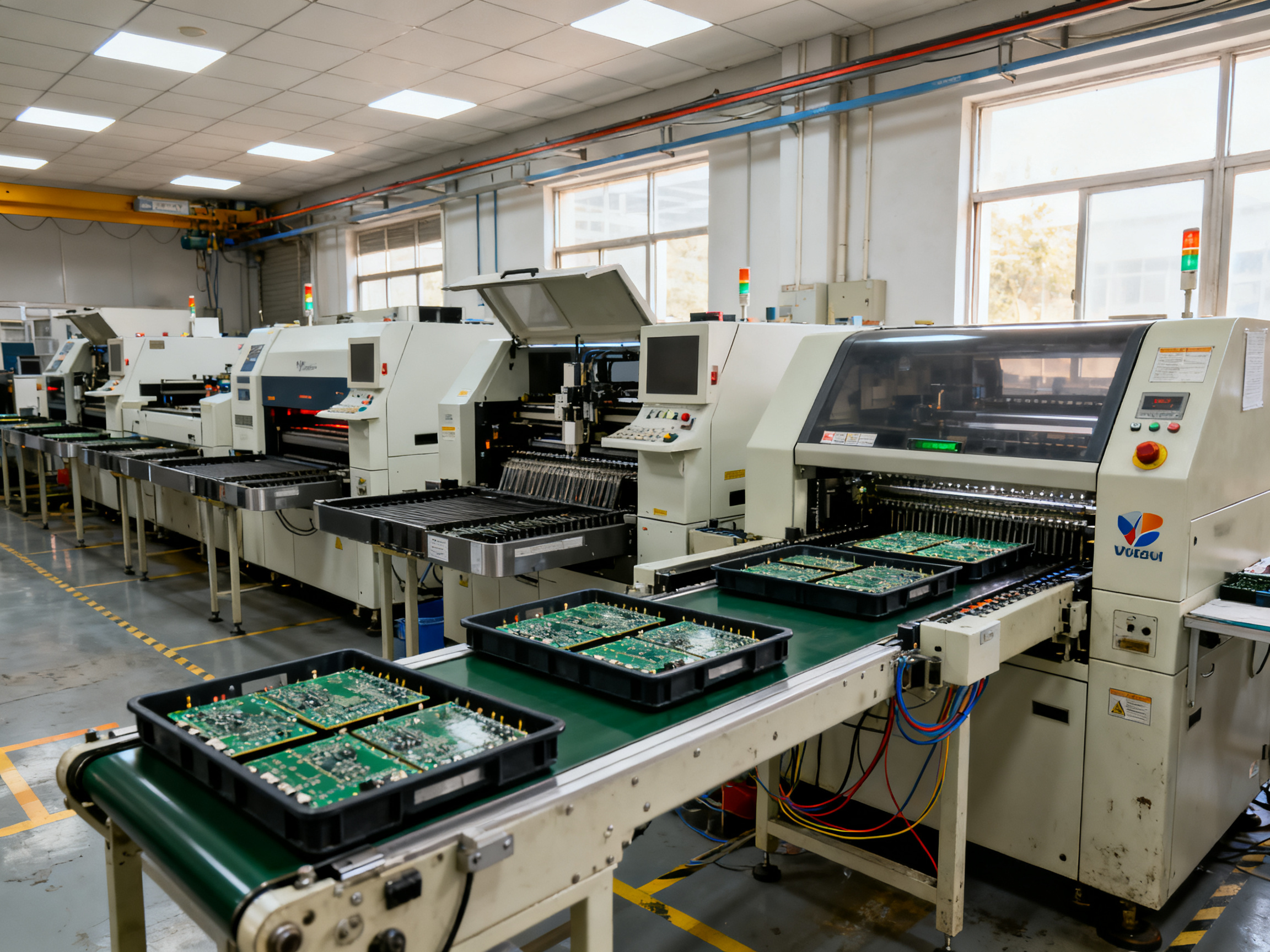
This guide is a practical selection framework for production, procurement, and engineering teams choosing a belted conveyor for SMT in 2026. It covers mechanical specs, ESD-safe handling, throughput and buffering, SMEMA and Hermes interface requirements, safety, and supplier capability.
Print  ->  SPI / Inspection  ->  Placement  ->  Reflow Oven  ->  AOI  ->  Divert / Stack
   ^                                                                       |
   |________________________  PCB belt conveyor segments  _________________|
Note: As of 2026, the legacy electrical handoff is still IPC-SMEMA-9851 Rev 1.1, with IPC-HERMES-9852 serving as the recognized successor for networked machine-to-machine communication. Your interface spec needs to name the exact document and revision.
The takeaway is simple. A conveyor is a production control component, so treat its selection with the same care you give the oven and the placement machine.## About the Author
[Author name] is a [verified role or credential] with documented experience in SMT equipment, electronics manufacturing, and production-line engineering.
That background is the reason this guide reads the way it does. Every specification below comes from line-floor conversations, equipment documentation, and commissioning work, not brochure language. The author has spent [X] years in [SMT equipment implementation / process optimization / electronics manufacturing], including [one verified achievement: a completed line integration project, a standardization effort, or a relevant certification].
[Headshot placeholder: 400 x 400 px image, linked to a verified company or LinkedIn profile.]
Editorial note: this bio publishes only after S&M Co. Ltd. supplies the approved author name, role, and supporting achievement. Do not publish placeholder details.## 1. Define the Conveyor’s Role Before Comparing Models
Most spec sheets start with belt width and speed. Both are the wrong place to start.
Before you compare conveyor models, decide what job the unit actually does on your line. A simple transfer between a printer and a placement machine has very different requirements from an inspection conveyor with a stop-and-scan station, a cooling conveyor after reflow, a buffer that absorbs placement machine cycle time, or a reject diverter that routes bad boards to a rework shelf.
We have learned this the hard way. On one line, a conveyor was quoted as “the transfer type” and nothing more. The line map showed it sitting between the oven and AOI, so it also needed to cool boards, hold a queue during AOI review decisions, and hand boards to a manual operator for coding. Three functions, one part number, zero margin. It was underspecified at the RFQ stage, and the fix landed as a change order six weeks later.
So map it before you quote it. Here is a simple decision tree to start from:
START: What does this segment need to do?
  |
  +-- Move boards only ............ Simple transfer / inter-stage conveyor
  +-- Pause boards on purpose .... Buffer / accumulation conveyor
  +-- Hold for operator scan .... Inspection / manual work conveyor
  +-- Separate good from bad ..... Divert / reject / sorting conveyor
  +-- Cool boards after reflow ... Cooling conveyor (consider oven exit profile)
  +-- Match takt to a slow step .. Line balancing conveyor
Then capture the pre-RFQ data every supplier needs. Without it, quotes are guesses, and the cheapest quote is usually the one that misses a requirement:
- Upstream and downstream machine models, plus PCB flow direction and travel orientation
- Handoff heights, transfer positions, and the gap or overlap your machines need
- Smallest and largest PCB length, width, thickness, and any warped or heavy board types
- Cycle time per board, plus takt time for the segment
- Board weight, component side, and whether boards travel component-side up or down
- Communication needs: SMEMA 1.1, Hermes, or a vendor-specific I/O list
- ESD control requirements and floor grounding points
- Overhead clearance, service access, and the space the conveyor actually has
Get that list right and comparing the best belt conveyor options becomes a much shorter conversation. Get it wrong and you are negotiating a fix later, at a higher price.
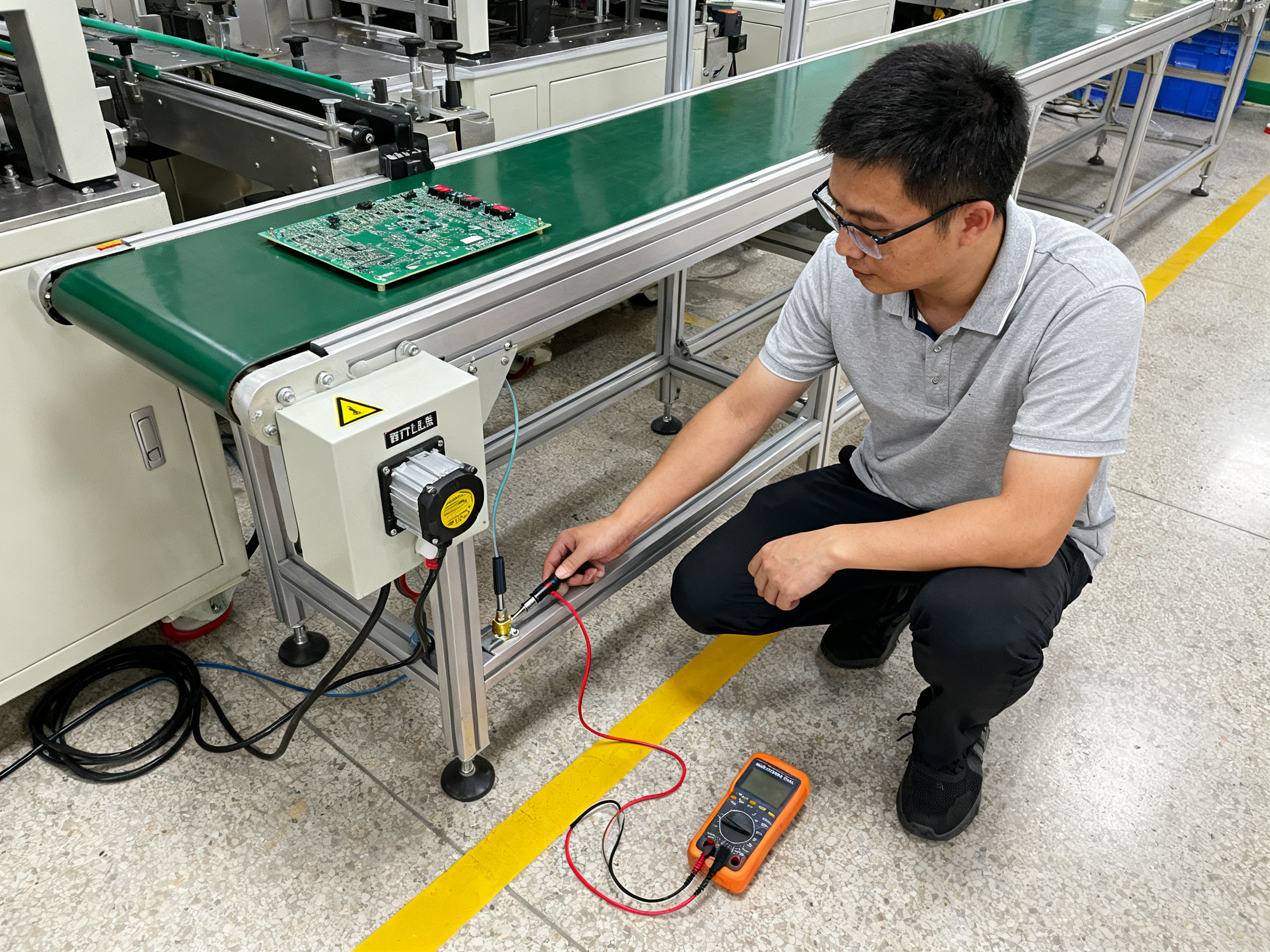
Next up, we get into the mechanical specifications that decide how a board actually behaves on the belt.## 2. Calculate Throughput, Buffering, and Line-Balancing Requirements
Speed is the number everyone asks about first. It is also the number that causes the most grief.
A conveyor does not deliver boards. It delivers space. The real capacity question is how many boards fit in a given length of belt while still leaving the gap your downstream machine needs to stop, index, and transfer.
Here is the working formula we use on every line:
Capacity (boards/hr) = 3600 / board cycle time (sec)

Conveyor-limited rate = (PCB length + required gap) / transfer speed
Take a typical segment: 250 mm boards with a 25 mm gap, running at 300 mm/min. That gives 275 mm of belt per board, so about 65 boards per minute. Compare that to the placement machine at 42 boards per minute and the conveyor has plenty of headroom. Now drop the speed to 150 mm/min and the conveyor becomes the bottleneck at roughly 33 boards per minute, below what the machine can place. The line starves downstream no matter how fast the placement head moves.
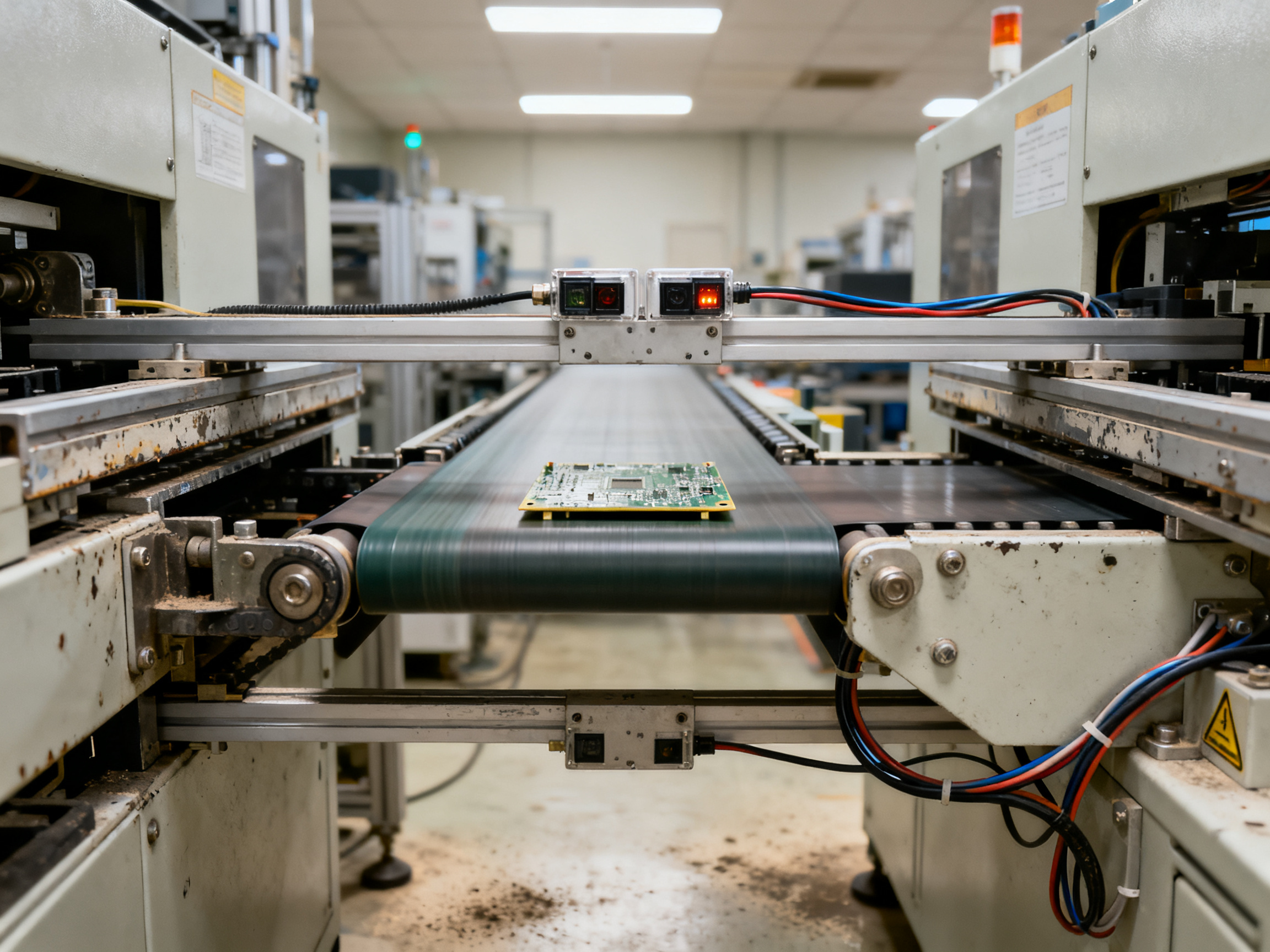
Now the inverse problem. Speeding the conveyor up does not create free capacity, it creates queues. A conveyor running far faster than its slowest neighbor dumps boards into a machine that cannot accept them yet, and the buffer grows until boards back up onto the transfer. That is blocking, and it is usually worse than starvation because a starved line looks idle while a blocked line jams.
Expert Tip: Designing to nominal conveyor speed alone is the single most common cause of starvation and blocking on new SMT lines. Always model the segment against the slowest downstream cycle time plus transfer dwell, and confirm the buffer position can absorb a full product changeover without the upstream machine stopping.
Dwell time matters as much as speed. An inspection conveyor that stops for a 4 second scan, 6 times per board, adds 24 seconds of dwell. No amount of belt speed fixes that; the buffer or the scan rate has to change.
So set capacity headroom based on your product mix:
| Line profile | Typical headroom | Buffer strategy |
|—|—|—|
| High volume, low mix (single SKU, 20k+ boards/day) | 15 to 20% | Small accumulation conveyor at the oven exit |
| High mix, low volume (many short runs, frequent changeover) | 30 to 40% | Accumulate-and-release buffer with sensor-driven release |
| Build-to-order, variable operators | 40% or more | Dual-lane or FIFO buffer with pre-sequencing |
Changeover frequency is the hidden factor. A line running one SKU for two weeks can live with a tight buffer. A line running six SKUs a day needs storage between machines, because each changeover drains the queue for several minutes.
One more note for anyone shopping for a used belted conveyor. Check the controller and encoder model before assuming the speed spec is real. We have seen units quoted at 600 mm/min that were configured, from the factory, at 250 mm/min with the high speed range locked out. If a used SMT conveyor system comes with a retrofit quote, ask for the parameter file, not the brochure.
Set the numbers before the RFQ goes out, not after. Every speed number written into a spec sheet is a promise your line has to keep.
Next, we look at the mechanical details that decide how a board actually behaves once it is on the belt.## 4. Match Controls, Connectivity, ESD Protection, and Safety
A conveyor that carries a board correctly can still stop production if its controls cannot communicate with the line or if safety systems are treated as optional accessories. Before accepting the mechanical design, confirm that the conveyor is an integrated part of the process rather than a standalone piece of equipment.
Controls and machine interfaces
The conveyor should receive commands from the line controller and report its actual status. At minimum, the interface must support conveyor run, stop, and reset commands, along with feedback for board presence, belt movement, fault conditions, and readiness to transfer. Depending on the line architecture, useful additional signals include upstream and downstream availability, jam detection, accumulator status, and confirmation that the transfer has completed.
Do not rely on a vendor-defined interface without a written signal list. The supplier should provide:
- A complete electrical and communication diagram
- A list of every input and output, including its voltage or protocol
- PLC tag names and descriptions
- Treatment of timeout, disconnection, and communication-loss conditions
- Firmware-update responsibilities and recommended change-control procedures
- Remote diagnostic access, if supported
SMEMA remains common on SMT lines because it provides a defined physical interface for board transfer and machine-to-machine communication. Newer production environments may use the Hermes networked protocol to exchange more detailed process information. The selected method should match the installed equipment; otherwise, a gateway may be required. Confirm whether the conveyor can operate locally during network or server outages, and define how automatic restart is prevented after an interruption.
Board detection and process synchronization
The transfer sequence should be deterministic. A downstream machine must not attempt to index while the upstream conveyor is still releasing the board. Conversely, the conveyor should not release a board into a machine that is unavailable.
A typical sequence is:
- The upstream machine confirms that its exit is clear.
- The conveyor confirms that its entry sensor is clear.
- The conveyor indexes the board to the transfer position.
- The conveyor confirms board presence and stops.
- The downstream machine confirms that it has accepted the board.
- The conveyor moves to the next available position.
Use separate sensors for entry, exit, and transfer position where practical. A single sensor may provide basic operation, but it cannot distinguish a correctly positioned board from one that stopped short, shifted, or jammed against a guide. Photoelectric sensors are usually appropriate for detecting bare PCBs, although dark boards, transparent components, and reflective hardware can affect performance. The supplier should verify sensor response with representative product.
ESD protection
ESD requirements should be specified based on the product and production environment, not reduced to the word ESD-safe on a quotation. Confirm the belt, rails, fixtures, sensors, motor, and nearby metalwork are connected through a verified grounding or equipotential-bonding system. The surface resistance of conveyor components must remain within the limits required by the facility’s ESD control plan.
Avoid synthetic belts or coatings that generate static, attract particles, or contaminate exposed pads. If a conveyor sits close to an automated placement machine, consider ionizers and their airflow characteristics as well. Grounding points should be labeled, accessible, and connected to the same protective-earth network specified for the line.
Safety and access
Safety devices must function as a system rather than as isolated components. Check the presence and arrangement of emergency-stop devices, access covers, interlocks, guards, and restart controls. A belt that continues moving while a cover is open, or restarts automatically after an emergency stop, is not acceptable for normal industrial operation.
The supplier should provide risk documentation, applicable declarations, electrical schematics, and instructions for testing each safety function. If the conveyor operates next to a robot, verify the safety-rated control path and coordinate muting with the robot system. If operators can reach moving parts, physical guarding or sufficient separation should prevent access during operation.
Also consider secondary hazards:
- Crushing points at belt transfers and pulleys
- Shear points at guide rails and adjustment mechanisms
- Pinch points during width adjustment
- Drop hazards from elevated sections or transfer gaps
- Slipping and trip hazards near maintenance areas
- Unexpected movement after power restoration
The transfer height, overlap, and gap between machines must remain safe without requiring operators to reach into the product path. Lockout and tagout procedures must allow motors, adjustments, and nearby pneumatic or electrical energy sources to be isolated before maintenance.
Factory acceptance test
Do not accept the conveyor based only on a running demonstration. Use real or representative PCBs and test it under the intended production conditions.
| Check | Acceptance requirement |
|—|—|
| Straight-line transfer | Board remains square and does not contact the rails or equipment |
| Width adjustment | Minimum and maximum settings are secure and repeatable |
| Board flatness | No visible lift or twist after transfer |
| Mixed product | Small, large, heavy, and awkward boards run without intervention |
| Sensor detection | Every position is detected reliably without false triggers |
| Hand-off | Gap or overlap prevents drops and collisions |
| Controls | Every command and feedback signal operates as documented |
| Interlocks | Equipment cannot create an unsafe transfer sequence |
| Emergency stop | Stops the conveyor and prevents unintended restart |
| Power loss | Board position and recovery behavior are predictable and documented |
| Maintenance | Covers, adjustment points, and isolation methods are accessible |
Run several cycles at the intended speed. Include boards with heavy copper areas, tall components, exposed connectors, and irregular edges. A single successful demonstration does not prove repeatability.
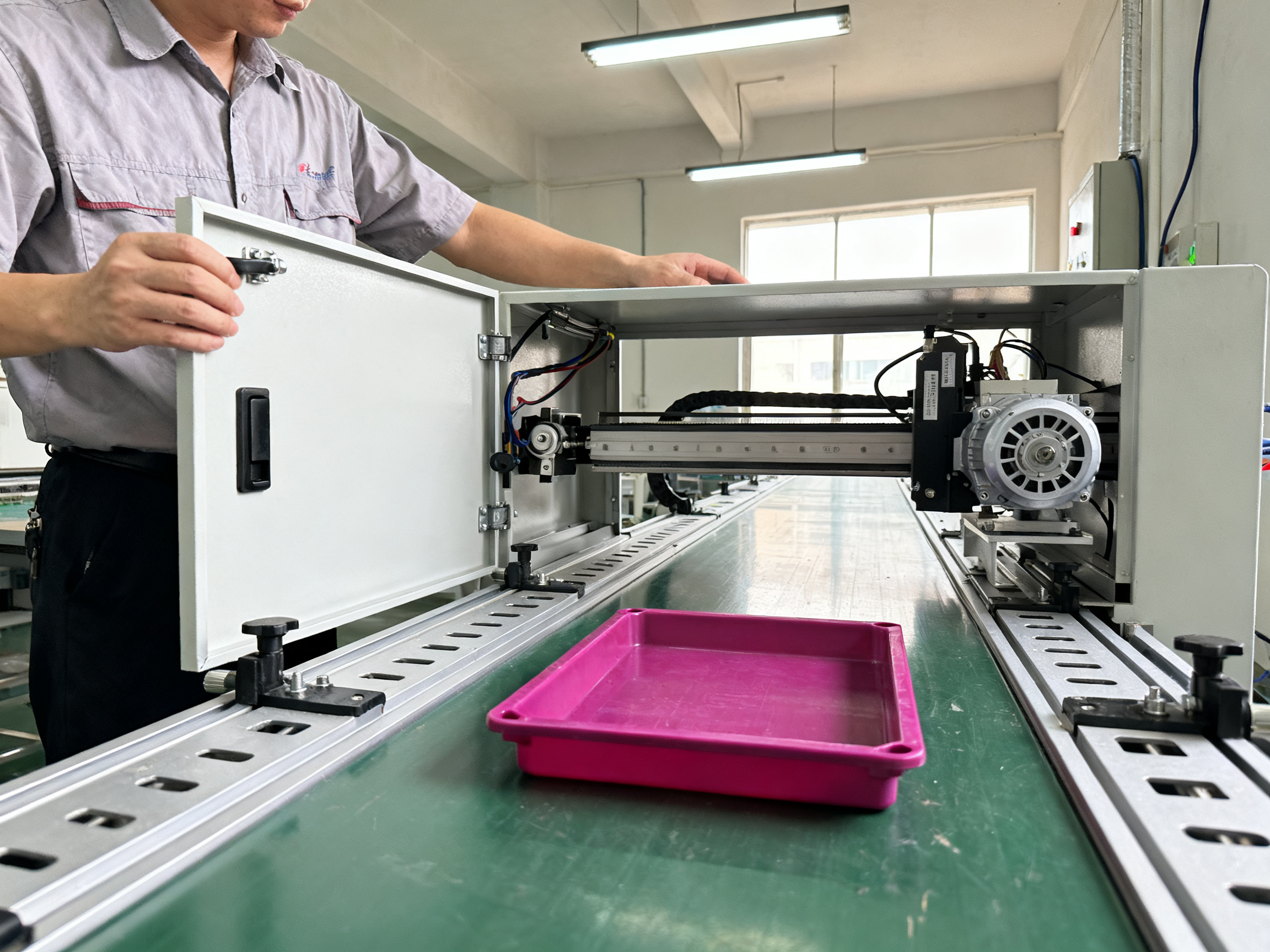
The factory acceptance test should prove that a real board enters cleanly, reaches the correct position, transfers without collision, and remains stable after the conveyor stops. Everything else is an assumption.
Finally, require the supplier to deliver the mechanical drawings, electrical drawings, I/O list, manuals, spare-parts list, software versions, safety documentation, and test results with the equipment. A conveyor that moves a PCB from one point to another is only half the specification. The complete requirement is a board that arrives flat, square, correctly oriented, synchronized with the process, electrically safe, and ready for inspection.## 4. Verify Controls, SMEMA Connectivity, ESD Protection, and Safety
A conveyor can carry a board perfectly and still wreck your shift if its controls cannot handshake with the line, or if its safety chain was treated as an accessory. So before you accept any mechanical design, treat the conveyor as part of the process, not as a standalone box on the floor.
Name the interface standard and the revision
SMEMA is still common on installed lines. As of 2026, the authoritative document is IPC-SMEMA-9851 Rev 1.1, and its recognized successor, IPC-HERMES-9852, moves the handoff onto Ethernet and XML so machines can exchange board ID, dimensions, and conveyor data. IPC describes Hermes as the next-generation replacement for the electrical SMEMA interface.
Watch the labels. Terms like “SMEMA 2.1” or “3.1” are usually vendor documentation or equipment generations, not IPC revisions. Ask for the issuing body, the document number, the connector pinout, voltage, polarity, and isolation method, then write those into the purchase order.
Define every signal explicitly: Board Available, Machine Ready, Line Ready, Board Present, Board Accepted, conveyor home, conveyor commanded, conveyor running, jam or transfer timeout, and bad-board disposition. Line Ready is generally a supervisory or vendor-defined signal, so treat any “standard SMEMA signals” claim with a raised eyebrow.
Upstream machine          Conveyor                Downstream machine
[Board Available]  --->  entry sensor / PLC  --->  [Machine Ready]
[Board Present]    <---  transfer position     <---  [Transfer Complete]
[Jam / Timeout]    <---  fault relay           --->  [Line Stop]
[Emergency Stop]   <---  safety chain, hardwired and separate from I/O
Required documents versus optional features
| Mandatory at handover | Optional smart-factory extras |
|—|—|
| Electrical and communication drawings | MES or CFX connectivity |
| Full I/O list with voltages and active states | OEE and downtime analytics |
| PLC tag list plus timing diagram | Predictive maintenance sensors |
| Safety declarations and schematics | Remote diagnostics over the internet |
| Spare parts list and software versions | Cloud dashboards and mobile alerts |
Buy the left column. The right column is nice, but it never excuses a missing I/O list.
ESD, grounding, and safety
Require the belt, rails, fixtures, sensors, motor, and nearby metalwork to sit inside one verified grounding or equipotential bonding network. Surface resistance must match your facility ESD control plan, not a generic “ESD-safe” label on a quotation. Avoid synthetic belt materials that build static or shed particles onto exposed pads, and plan ionizer placement plus airflow when the conveyor runs close to a placement machine.
Safety has to work as a system. Check emergency stop devices, interlocks, access covers, guards, and restart control. The emergency stop chain should be hardwired and kept separate from ordinary control I/O, and a power interruption must never trigger unexpected movement. Look for crushing points at pulleys, shear points at guide rails, pinch points during width adjustment, and drop hazards at transfer gaps.
Pro Insight: During factory acceptance testing, witness three things yourself instead of reading a checklist: grounding continuity from the frame to the facility protective earth, the emergency stop stopping the belt with restart blocked, and the transfer sequence under an induced jam. Those three checks catch more real problems than a ten-minute demo with a single small board.
Finally, insist on the documentation package with the equipment: drawings, I/O list, manuals, spare parts, software versions, safety files, and test results. If you want help mapping a conveyor to an existing line, S&M Co. Ltd. builds complete SMT production lines and reflow systems with standard assembly line protocols, so ask them to model the handoff against your actual machine mix.
One last thought. Write the exact standard and revision into the contract, not just the marketing sheet. It costs nothing on day one and saves an argument in month six.## 5. Evaluate Reliability, Maintenance, and Total Cost of Ownership
The quote is the smallest number on the spreadsheet. It is also the number most likely to be wrong by the time the line has been running for two years.
A conveyor has few moving parts, but it sits in the path of every board you build. When it stops, the oven cools, the placement head idles, and operators stand around. Reliability is not a nice-to-have spec on an SMT line conveyor; it is a throughput decision.
Here is a rough five-year cost model for a single segment, using typical mid-range figures:
| Cost line | Year 1 | Years 2 to 5 | Five-year total |
|—|—|—|—|
| Purchase price | $18,000 | $0 | $18,000 |
| Belt replacement (2 per life) | $0 | $1,200 | $4,800 |
| Motor and gearbox service | $0 | $500 | $2,000 |
| Sensor replacement | $200 | $300 | $1,400 |
| Preventive maintenance (quarterly, 4 hrs) | $1,600 | $4,800 | $6,400 |
| Spare parts holding and calibration | $800 | $1,600 | $7,200 |
| Energy (roughly 0.4 kW running) | $350 | $1,050 | $1,400 |
| Total | | | $41,200 |
Now the part people hate. Run a downtime calculator. If an unplanned stop costs you $3,000 per hour and your line loses 12 hours a year to conveyor faults, that is $36,000, nearly the purchase price of the conveyor, every year. A cheaper conveyor that jams more often can be the most expensive box on the floor. Numbers like this are why you should evaluate the supplier around lifecycle cost and production risk, not the lowest initial quotation.
Pro Insight: Ask every supplier for the belt part number, the motor model, and the sensor manufacturer before you ask for price. If they answer with “no problem, we have spare parts for everything,” ask where those parts are actually stocked and how long a lead time takes. Parts availability is the single clearest predictor of a conveyor’s real downtime record.
Maintenance access checklist
Walk the machine with the technician who will own it, not the salesperson:
- Belt tension and tracking adjustments reachable from one side, without removing guards
- Tool-free width adjustment where product mix changes often
- Wear parts visible through a window or under a quick-release cover
- Grease points and motor terminal boxes accessible without moving the machine
- Enough clearance to pull a motor with a pallet jack, not by hand
- Controller mounted at chest height with a visible I/O list
- Documented preventive maintenance schedule with estimated labor hours per task
- Standardized components (common servo and PLC brands across your other machines)
- Remote support and spare parts ordering through the supplier, so a technician can diagnose from the plant floor
Smart-factory monitoring is now standard on new builds, and networked diagnostics are becoming normal on mixed-vendor lines as suppliers move toward Hermes-style machine-to-machine communication. But treat analytics as a bonus, not a reason to skip a physical maintenance walk.
If you want a conveyor and a reflow oven specified together so the handoff speeds match, S&M Co. Ltd. builds complete SMT production lines and reflow systems with standard assembly line protocols, and they can size the conveyor against your actual machine mix.
Reliability is not a feature you inspect at the factory. It is a habit you design into the purchase order.
6. Decide Between a New Conveyor and a Used Belted Conveyor
Let’s be honest about this. Half the “best belt conveyor” searches end up in a used equipment listing, and half the time that is the wrong answer. New buys you custom width, a warranty, clean documentation, and someone who answers the phone when the controller faults. Used buys you a cheaper box, but the wear history comes with it, hidden or unknown.
| Factor | New SMT conveyor system | Used belted conveyor |
|—|—|—|
| Cost | Higher up front, predictable later | Lower entry price, unknown repair exposure |
| Lead time | Weeks to months | Often available now |
| Customization | Built to your width, height, and interface | Modifications cost time and money |
| Warranty | Full supplier coverage, usually 12 to 24 months | None or expired, parts bought separately |
| Documentation | Drawings, I/O list, manuals, spare parts | Often incomplete or lost |
| Integration support | Supplier configures signals with your line | You work it out |
| Compliance | Current safety and grounding to code | Unknown, may need rework |
| Best use case | High mix, regulated work, high precision | Low risk transfers, backup, spare unit |
Used conveyor inspection checklist
If a used unit is still on your table, walk it with a technician, not a salesperson:
- Belt wear, glazing, cracking, and tracking
- Rail alignment and side guide squareness
- Bearing condition and pulley runout
- Motor, gearbox, and brake wear
- Sensor type, age, and clean operating condition
- Controller make, model, and firmware version
- Grounding continuity and equipotential bonding
- Guard and interlock presence, plus emergency stop function
- Interface signals, confirmed live at each connector
- Spare parts availability for that exact model
Where used makes sense
A used belted conveyor is fine for low risk transfer between two stable machines, for backup duty, or for a spare unit on the shelf. It stops making sense when your line handles high density or heavy warped boards, when you build to regulated specs, or when the interface must match newer equipment exactly.
If you want a conveyor sized and interfaced against your actual machine mix, S&M Co. Ltd. builds complete SMT production lines and reflow systems with standard assembly line protocols, so ask them to quote the new build and a used option side by side.## 7. Assess the Supplier’s Integration and Customization Capability
Buying a conveyor off a catalog page takes an afternoon. Living with one for twelve years is a different skill, and the difference comes down to the supplier’s engineering depth.
Here is a customization request translated into measurable specifications, which is the format a good supplier works in. A customer asked for an adjustable-width PCB conveyor with an integrated inspection station, a reject gate, and room to expand later. The written spec became: width range 50 to 300 mm adjustable in 10 mm steps, repeatable within 1 mm; station footprint 1,200 mm long by 600 mm deep at 15 kg load; Code 128 barcode read at 60 mm/s with a 99.9% read rate; reject gate cycle under 2 seconds on 24 VDC pneumatic; and 500 mm of unused rail length at the infeed, with the spare control points shown on the drawing. That request is now testable. A vague request is not.
| Scorecard area | What to ask | What good looks like |
|—|—|—|
| Application engineering | Do they survey your line before quoting? | Drawings arrive with the quote, not after the PO |
| Interface validation | Will they sign off on the I/O list and timing diagram? | Delivered as a controlled document with revision numbers |
| FAT | Do they test with your boards? | Full test record, not a demo video |
| Installation | Who installs, and who commissions? | Named engineer, documented SAT criteria |
| Training | Is operator and maintenance training included? | Hands-on session on your machine |
| After-sales | Parts, response time, on-site support | Spares stocked locally, written SLA |
Sample FAT and SAT criteria, so nobody argues about pass or fail later: board transfers square with no rail contact at minimum and maximum width, sensors detect every position without false triggers, every documented I/O signal functions live, the emergency stop stops the belt and blocks restart, and the transfer sequence holds under an induced jam.
From Our Experience: Placeholder for a verified customization or commissioning example from an approved author. Until S&M Co. Ltd. supplies a confirmed reference, do not publish invented project details here. The lesson to carry into this section is simple: a supplier who cannot describe a nonstandard build in numbers has not engineered it.
Ask for two customer references from comparable applications, consumer electronics, semiconductor, automotive, aerospace, or military electronics, where disclosure is allowed. If they hesitate, ask for a site visit instead. A supplier unwilling to be checked is telling you something.
One last check. Confirm the supplier can support the interface you are running, including the current IPC Hermes specification for networked handoff on mixed-vendor lines, and that the connector pinout and revisions are named in the contract.
If you want a conveyor specified alongside the reflow oven so the transfer speeds actually match, S&M Co. Ltd. builds complete SMT production lines and reflow systems with standard assembly line protocols. Ask them to model the handoff against your real machine mix rather than a catalog sheet.
The right supplier does not just deliver a conveyor. They deliver a conveyor that fits your line on day one and your roadmap in year three.## 8. Use a Weighted Scorecard to Select the Best Belt Conveyor
By now you have walked through the specs, the math, and the risks. Now put the decision on paper, because “it felt like the better machine” is not a procurement record.
Build a weighted matrix. Give each criterion a weight that matches your line, score every candidate supplier 1 to 5, and multiply. The score outranks the price tag.
| Criterion | Consumer electronics, high volume | Aerospace / military | What you are scoring |
|—|—|—|—|
| Process fit and takt match | 25% | 20% | Can it hold your cycle time with headroom |
| Mechanical compatibility | 15% | 15% | Width range, height, guide adjustment |
| Throughput and buffering | 15% | 10% | Speed range, accumulator positions |
| Controls and interface | 10% | 10% | SMEMA or Hermes-ready I/O, fault feedback |
| Safety and ESD | 10% | 15% | Interlocks, grounding, surface resistance |
| Reliability and support | 10% | 10% | Spare parts, response time, service reach |
| Documentation and FAT | 10% | 10% | Drawings, I/O list, witnessed test |
| Lead time and total cost | 5% | 10% | Delivery, 5 year cost |
Do not let one department own this sheet. Production signs off on takt and access. Engineering checks mechanical fit. Quality looks at repeatability and inspection stations. Maintenance looks at access and parts. EHS checks safety and ESD. Procurement checks commercial terms.
Then run the top model with your worst board. The heaviest one, the widest one, the one that warps. Write down the acceptance thresholds before the purchase order, so nobody argues about pass or fail in month six.## Conclusion: Make the Conveyor a Controlled Part of the Process
Seven steps get you to the right answer, in this order:
- Define the segment’s role before comparing models.
- Calculate throughput, dwell, and buffering against your slowest downstream step.
- Match the mechanical design to your worst board, not your average one.
- Verify controls, interface standard, ESD grounding, and safety as a system.
- Price the five year lifecycle cost, not the purchase order.
- Compare new against used belted conveyor options with a weighted scorecard.
- Qualify the supplier with sample boards, a witnessed FAT, and named references.
The best belt conveyor is not the fastest unit or the cheapest box. It is the one that holds stable flow and gives you measurable quality results, square transfers, clean hand-offs, and documented recovery when something goes wrong. Speed follows from that. It never comes first.
So do this next. Write a one page specification sheet for the segment, including board sizes, cycle times, interface standard with revision, and safety requirements. Then ask each supplier for a documented line-integration review against that sheet before you compare final quotations. A written review costs nothing and settles most arguments before they reach the floor.
Need help building that specification? S&M Co. Ltd. builds complete SMT production lines and reflow systems with standard assembly line protocols, so request a technical consultation or a conveyor configuration assessment and have the handoff modeled against your actual machine mix.## Research Priorities
Before trusting any recommendation in this guide, we checked the standards, the safety rules, and the ESD practice against primary sources rather than vendor marketing. Four priorities shaped the research.
Priority 1: Standards and interface documents. We confirmed that IPC-SMEMA-9851 Rev 1.1 is still the authoritative electrical handoff in 2026, and that the so-called “SMEMA 2.1, 3.1, 4.1” labels floating around are usually vendor generations, not IPC revisions. We also verified the successor document, IPC-HERMES-9852, which IPC describes as the next-generation replacement for the electrical SMEMA interface.
Priority 2: Real production data. Throughput examples, dwell math, and lifecycle cost figures come from how lines actually run, not from brochure cycles. We leaned on published guidance on networked machine-to-machine communication, such as this piece on how the Hermes standard changes the economics of mixed-vendor SMT lines.
Priority 3: Supplier and project evidence. Customization examples, FAT criteria, and commissioning lessons come from build records and supplier documentation where disclosure was permitted.
Priority 4: Maintain a source log. Every claim in this guide should be traceable. Keep a log with publication date, author credentials, evidence type, geography, and the exact claim supported, so any reader can check the thinking.
| Source | Type | Date | Claim supported |
|—|—|—|—|
| IPC-Hermes-9852 Basic Summary | Standard body summary | 2026 | Hermes is the recognized successor to the SMEMA electrical interface |
| IPC shop listing for IPC-HERMES-9852 | Primary standards catalog | 2026 | Current document number and revision for networked handoff |
| Hermes standard flyer | Industry body flyer | 2026 | SMEMA remains in use on installed lines; Hermes is the upgrade path |
| Rehm Hermes overview | OEM technical paper | 2026 | Practical machine-to-machine data exchange in mixed-vendor plants |
| Sick on the Hermes standard | Vendor engineering article | 2026 | Hermes as an investment path for smart SMT lines |
One gap worth naming. We could not verify a public, authoritative source for the “SMEMA 2.1 / 3.1 / 4.1” nomenclature as an IPC revision set, so treat those labels as unverified until a supplier hands you the issuing body and document number.
Next, section 8 shows how to turn all of this into a weighted scorecard.## Keyword and Supporting-Elements Map
This section is a working reference for anyone updating the guide. It shows where each target term lives in the article and what visual carries each part. The goal is natural coverage. A reader should never notice the map, but a writer updating the piece should always be able to find it.
Primary keyword placement
| Target keyword | Where it appears | Why there |
|—|—|—|
| best belt conveyor | Title, introduction, section 8 scorecard, conclusion | Frames the whole guide as a selection decision, not a catalog browse |
| used belted conveyor | Section 6 new-versus-used comparison, plus one FAQ-style passage in section 5 | Matches buyer intent at the point where purchase history matters most |
Variations such as “best belt conveyor options,” “belting conveyor for SMT,” “best belted conveyor,” and “belt conveyor options for SMT” carry the same intent without repeating the exact phrase. Sections that already carry a heavy keyword load should lean on the semantic list instead.
Semantic keyword distribution
| Semantic term | Primary home | Supporting mention |
|—|—|—|
| SMT conveyor system | Introduction, section 7 | Section 2 capacity discussion |
| PCB belt conveyor | Section 1 role definition, section 3 mechanical specs | Section 8 |
| SMT line conveyor | Section 4 interface and controls | Conclusion |
| PCB handling equipment | Section 6 new versus used | Section 3 |
| ESD-safe conveyor | Section 4 ESD subsection | Section 8 safety weighting |
| adjustable-width PCB conveyor | Section 3 mechanical, section 7 customization example | Section 6 checklist |
| SMT conveyor specifications | Section 1 pre-RFQ list, section 8 | Section 5 |
| PCB transfer conveyor | Section 2 throughput math | Section 4 |
| SMT production line automation | Section 7 supplier capability | Section 8 |
Supporting elements and media plan
| Planned element | Placement | Purpose |
|—|—|—|
| SMT line-position diagram | After the introduction | Shows where conveyor segments sit in the flow |
| Decision tree for segment role | Section 1 | Turns a vague request into a spec-able job |
| Throughput worked example | Section 2 | Proves the conveyor, not the machine, can be the constraint |
| Specification table for pre-RFQ data | Section 1 | The single list buyers copy into an RFQ |
| Compliance checklist for controls, ESD, and safety | Section 4 | Used during factory acceptance testing |
| TCO table | Section 5 | Shows the real five-year number |
| New versus used comparison | Section 6 | Frames the purchase decision |
| Supplier scorecard | Section 7 | Weighs engineering depth, not catalog pages |
| Weighted selection matrix | Section 8 | The decision record for procurement |
| Recap graphic, seven steps | Conclusion | Shareable summary for internal meetings |
Each element should be built as a standalone image with alt text that repeats the relevant phrase naturally. Alt text is accessibility markup and search surface at the same time.
FAQ-style passages worth keeping
Short question-and-answer blocks work well under headings that match how people actually type into a search bar. Three that already fit this guide:
- Is it worth buying a used belted conveyor for an SMT line? Yes for low risk transfers, backup duty, or a shelf spare. Not for high density boards, regulated work, or a strict interface match.
- What is the current SMEMA standard for conveyors in 2026? IPC-SMEMA-9851 Rev 1.1 remains the electrical baseline, with IPC-HERMES-9852 as the recognized successor for networked handoff.
- How fast should an SMT conveyor run? Set it against the slowest downstream cycle time plus transfer dwell, then add headroom based on your product mix.
Keep these answers to two or three sentences, then point readers back into the body of the guide for the detail. That structure gives the piece search coverage without turning it into a list of stubs.