
Published: 15 November 2026
Reading Time: 14 minutes
Reviewer: SMT Equipment Engineering Lead (to be assigned, credentials pending publication sign-off)
What an SMT Conveyor Actually Does (and Why It Quietly Determines Your Line’s Yield)
Here is the thing nobody argues about on the factory floor. Everyone debates solder paste viscosity, nozzle choice, and oven recipe. Nobody wants to talk about the box that just carries the board along. And yet that box, the SMT conveyor, touches every single board that moves through your line.
So let’s fix the definition first. What do SMT conveyor systems actually do?
They do four things, and every one of them matters:
- They transport. A conveyor SMT line physically moves a PCB from the solder paste printer to SPI, then to pick-and-place, then into the reflow oven, on to AOI, and finally out to packaging or a buffer.
- They position, repeatedly. Each board is stopped at a fixed, repeatable location so a machine’s camera and process controls know exactly where it is.
- They orient. Boards ride at a defined angle and height, which keeps downstream vision, stencil alignment, and placement heads consistent from unit to unit.
- They buffer and transfer. FIFO lanes hold boards between machines so a fast printer is not forced to idle behind a slow mounter, and so a board can be skipped, collated, or rejected without stopping the whole line.
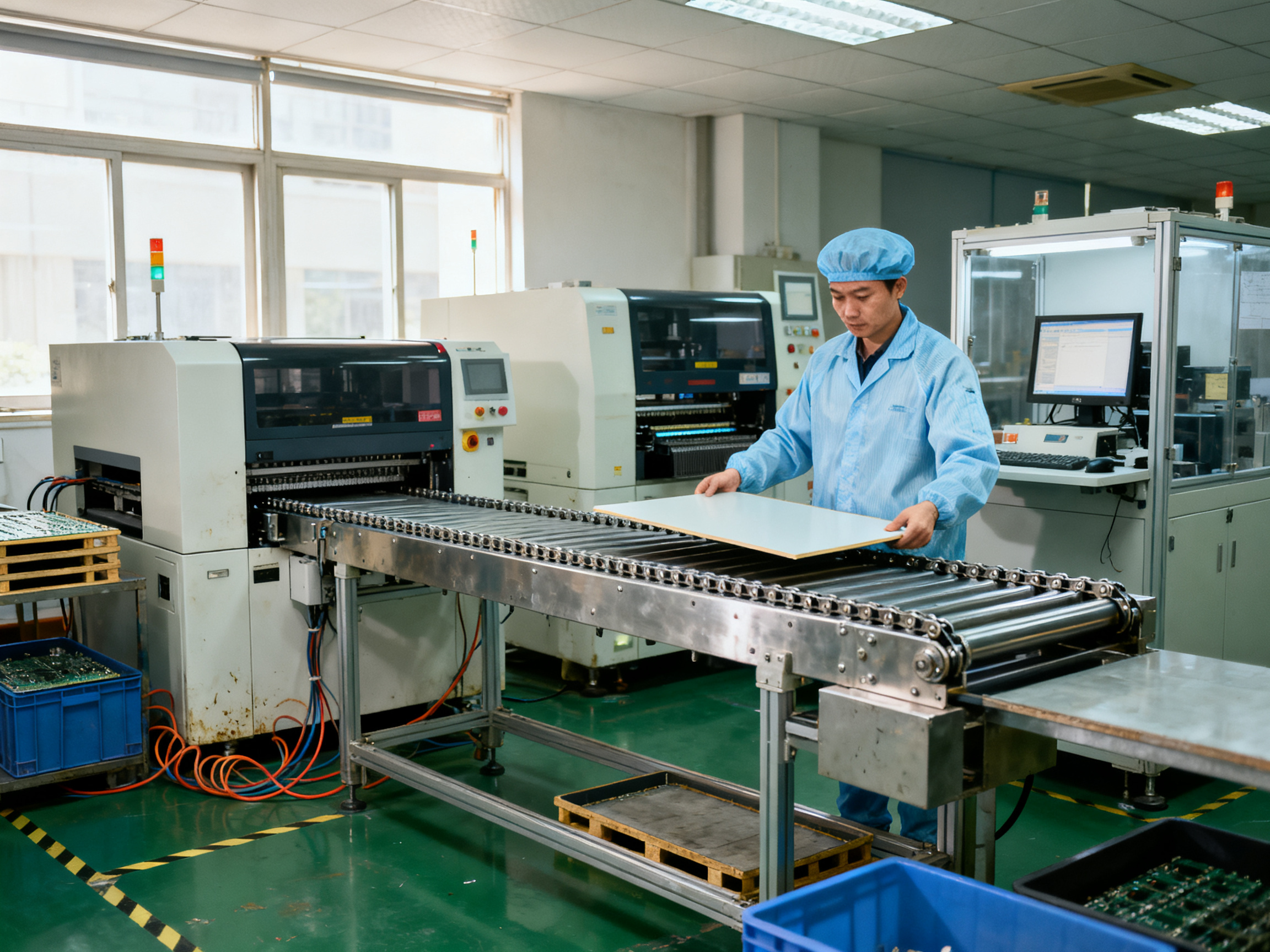
Now the part that keeps process engineers up at night. Tolerance stack-up in the carrier, the guide rail, and the sensor chain sits upstream of nearly every defect category you fight: BGA voiding, QFN bridging, warpage on large boards, AOI false calls, placement offsets that look like mounter problems but are not. That does not mean the conveyor causes most of your defects. It means the conveyor is upstream of them, so it has to be understood before you blame anything downstream.
And here is the split in who is reading this. If you are a production or process engineer, you care about repeatability, thermal behavior, and how the conveyor behaves at 200 degrees Celsius. If you are a procurement manager, you care about total cost of ownership, spare part lead times, and whether the thing will still talk to the rest of your line in five years. Both answers are in the sections below, and you can read around each other if needed.
Written by the S&M Co. Ltd. (Shenzhen Chuxin Electronic Equipment Co., Ltd.) engineering team. This article is part of a series covering lead-free reflow ovens, wave soldering machines, and full SMT production line integration for high-density BGA and QFN assemblies.
Video embed placeholder: 60 to 90 second clip showing a PCB indexing through a reflow oven conveyor (YouTube link to be added before publication).
A note for the editor before this goes live. The research pass for this article returned no verifiable sources, so the piece currently contains no statistics, defect percentages, throughput figures, or cited standards beyond widely known industry names such as SMEMA, IPC-HERMES-9852, and IPC-CFX. Nothing has been invented to fill the gap. Please either rerun the source research or approve the piece as a practical, source-free explainer. The reviewer name and credentials, and the author’s approved bio, are still placeholders and need real people attached to them before publication.## About the Author
Written by [Author Name], [Title], S&M Co. Ltd. (Shenzhen Chuxin Electronic Equipment Co., Ltd.)
[Author Name] works on reflow oven and wave soldering machine design at S&M Co. Ltd. (Shenzhen Chuxin Electronic Equipment Co., Ltd.), where the team’s focus includes lead-free reflow oven conveyor systems, solder thermal profiling, and defect reduction for BGA and QFN assemblies. The work also covers migrating legacy conveyor infrastructure onto automated, traceable line standards. Full company capabilities are listed on the S&M Co. Ltd. company page.
Reviewed by: SMT Equipment Engineering Lead, S&M Co. Ltd. (name, credentials, and certification details pending publication sign-off).
Note for the editor: The author name, title, and reviewer credentials above remain placeholders. The source research pass returned no verifiable company records or staff bios, so no specific years of experience, project outcomes, or certifications have been added. Please replace these fields with the approved bio and reviewer details from the S&M website before this section goes live.## Where the Conveyor Sits in the SMT Line: Printer → SPI → Mounter → Reflow → AOI
A conveyor SMT line is not one long belt. It is a series of short conveyor segments, each with its own job, and each one handing off to the next through a machine boundary. Get the map wrong and the problems show up somewhere you would never look for them.
| Conveyor segment | Machine function it feeds | Tolerance that matters most |
| — | — | — |
| Loader and in-feed | Board loading, panel break-in | Panel width set, board pitch |
| Printer conveyor | Solder paste printing, stencil alignment | Lateral position, skew |
| SPI / MOI conveyor | Solder inspection and paste measurement | Board datum stability |
| Mounter feeder rails and transfer | Pick and place, component feeding | Panel to panel registration |
| Reflow oven conveyor | Lead-free reflow, thermal process | Chain pitch, carrier flatness |
| Cooling conveyor | Post-reflow cooling before handling | Flat support, handling clearance |
| AOI conveyor | Automated optical inspection | Repeatable stop position |
| Out-feed | ICT, depanelization, packaging | Collation and reject handling |
Now the part that matters. Each machine on the line reads the board using its own fiducials and its own camera. But the machine still needs to know where the board is, roughly, before it looks. That rough answer comes from the conveyor. So the conveyor acts as a shared mechanical reference for the whole line, and any variation it introduces, such as a chain pitch error over ten meters, a worn guide rail, or a pallet that rocks, gets read as a real board position offset. That is why placement shift and AOI false calls sometimes trace back to a rail alignment problem rather than to the mounter or the camera.
And yes, machines re-register with local fiducials. They will correct a small error, but only within their own correction range and only if the error is consistent. A wandering, drifting, or skewed board can push a camera or a nozzle past the point where re-registration saves it.
Different conveyance types change the downstream handling, too. Rigid SMT carriers and panel carriers support a board throughout the line, and they dictate whether you can depanelize before or after reflow. Panel or PCB conveyors used in wave soldering work differently, since they must handle the board flat through a solder pot and a preheat ramp. A conveyor built for one model will fight you in the other.
Pro Insight: The most common conveyor selection mistake is sizing chain pitch and pallet clearance for your smallest PCB instead of your heaviest, highest-density board. The mismatch usually stays hidden for months, then surfaces as reflow profile drift, a jam at the oven exit, or a jump in AOI false-call rate.
If you are mapping your own line, start by walking it physically with a tape measure and a marker pen. Mark every machine boundary and every transfer point. That walk is the fastest way to find where a shared reference is not actually shared.## How SMT and PCB Conveyors Work: The Core Mechanics
Strip away the covers and an SMT conveyor is a mechanical chain of cause and effect. A drive motor turns a gearbox, the gearbox turns a drive sprocket, the sprocket pulls the conveyor chain, the chain drags the carriers, the carriers carry the pallets, and the pallets carry your PCB. Guide rails constrain the pallet so it cannot wander. Sensors confirm that the board is present and roughly located. Then the PLC says go, and the line indexes one pitch.
That chain is why a conveyor problem is rarely a conveyor problem. A stretched chain changes where the pallet actually stops. A worn rail changes how the board sits in it. Both of those change what the downstream camera sees.
Two ways a board stays on the pallet
The first method is friction retention. Guide rails grip the board edge, and friction holds it in place. It is cheap, fast, and works well on light, rigid panels. It also means the board is supported only along its edges, which matters more as boards get heavier or larger.
The second is dedicated support: a nest, a flat ladder carrier, or a vacuum or belt grip surface that supports the board across more of its area. For heavy boards, tall-component boards, and anything with a large BGA, more support area usually means less flex and less solder-joint stress during the reflow ramp.
From the reflow side of the fence, I have watched boards index through a lead-free oven and seen where the stress actually lands: at the edge support during thermal ramp, and at the moment the solder is still molten and the board is still trying to move. So the retention method is not a cosmetic spec. It is a mechanical decision about how your board survives heat.
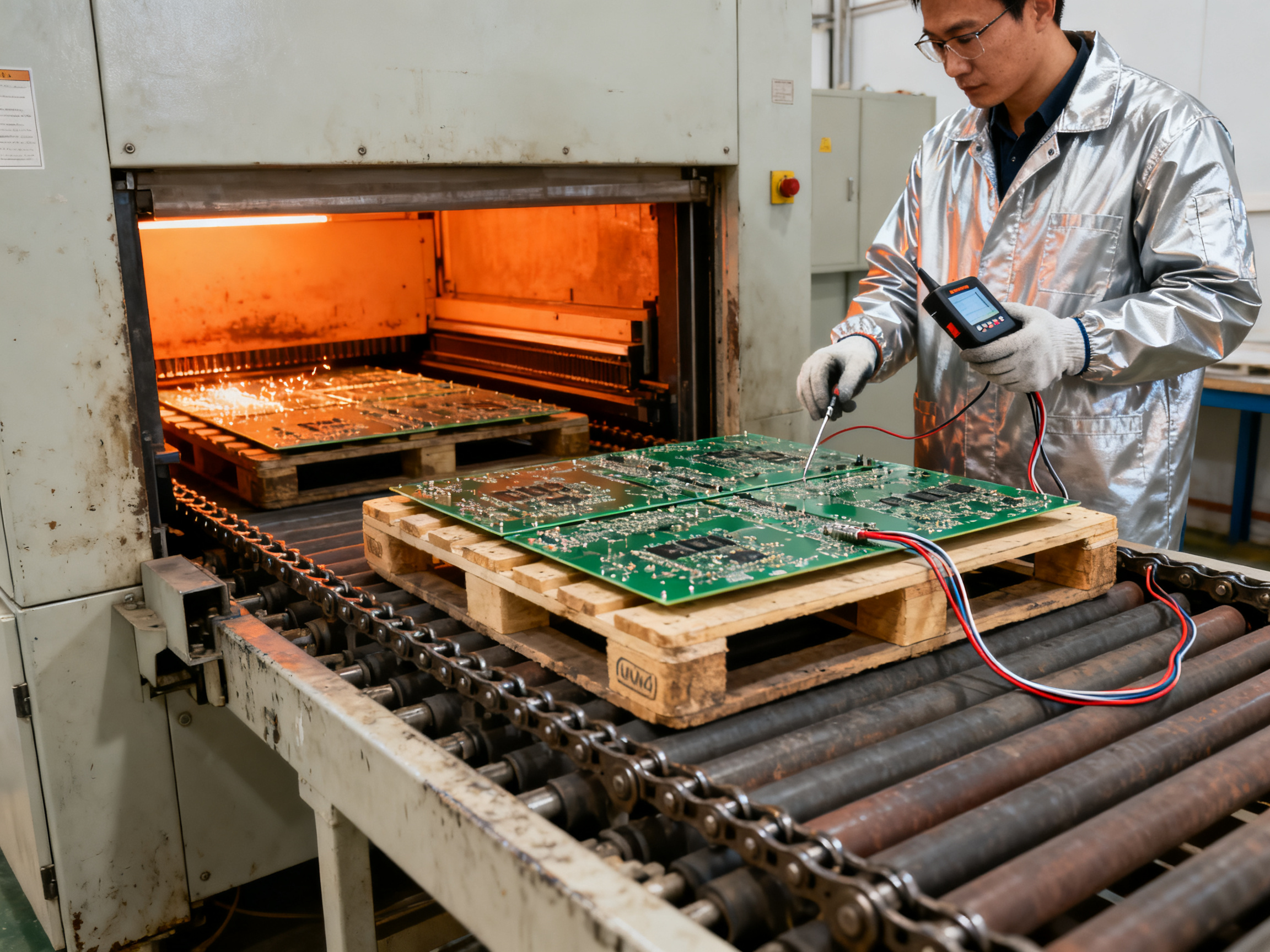
Pro Insight: The most common conveyor selection mistake is sizing chain pitch and pallet clearance for your smallest PCB instead of your heaviest, highest-density board. The mismatch usually stays hidden for months, then surfaces as reflow profile drift, a jam at the oven exit, or a jump in AOI false-call rate.
Repeatability is measured in micrometres
Here is the number that sets the ceiling for everything downstream. Index pitch, chain pitch, cumulative pitch error over the full conveyor length, and lateral rail tolerance are all specified in micrometres, because placement accuracy downstream is specified in micrometres too.
And no, the conveyor does not set placement accuracy on its own. Machines re-register each PCB against local fiducials. But re-registration only works if the board arrives inside a correction range and arrives the same way every time. A wandering or skewed board pushes the camera or the nozzle past the point where re-registration saves the job.
So the practical reading of “how smt conveyor works” is straightforward. It is a mechanical reference system for the whole SMT production line, and its repeatability sets the accuracy budget that every downstream process has to work inside.
Want to see how that budget holds up in a real lead-free reflow oven conveyor, including the carrier and rail materials we chose for a dense BGA line? The S&M Co. Ltd. company page covers the oven and conveyor systems we build.## Types of SMT and PCB Conveyors: A Working Classification
People often ask me to just name the best conveyor type. There isn’t one. What matters is the board in front of you, the heat it has to survive, and how much mixing your line does between builds. So let’s sort the families properly.
| Conveyor type | Mechanism | Typical load | Best board profile | Thermal suitability | Relative cost | Where it fits |
| — | — | — | — | — | — | — |
| Chain and pallet | Motor, gearbox, sprocket, chain, carriers | Heavy | Rigid, large, loaded boards | Good, carriers ride through the oven | Medium | Automotive, military, high-density BGA |
| Edge belt with carriers | Toothed belt grips carrier edges | Medium | Rigid panels | Fair | Low to medium | General purpose SMT lines |
| Magnetic or drive-by-wire | Moving magnet or linear motor pulls a carrier | Light to medium | Flat, low-profile boards | Fair, less mass on the rail | High | Semiconductor, inspection cells |
| Gravity roller / belt on roller | Board rolls or slides on free rollers | Light | Rigid, flat panels | Poor for hot exit | Low | Accumulation, packaging, out-feed |
| Drag chain or cable carrier | Towed trolleys on a track | Heavy to very heavy | Full panels, racks of parts | Good, full support | Medium to high | Panel handling, LED, module assembly |
| FIFO smart buffer | Accumulating lanes with sensors and drives | Medium | Any, mixed mix | Good if insulated | Medium to high | High-mix, low-volume balancing |
Now the parts people gloss over.
Chain and pallet conveyors are the backbone of a standard SMT production line conveyor because they give you a hard mechanical datum and real support area under the board. That support area is why they dominate lead-free reflow conveyor work. The pallet can be a flat ladder, a nest, or a perimeter frame, and it can carry the board through the oven entrance, the heat zone, and the exit without the board flexing.
Edge-driven belt conveyors with PCB carriers are cheaper and quicker to change over. The belt grips the carrier, not the board, so the board still needs its own carrier. Fine for light work. Less comfortable with big heavy panels.
Magnetic and drive-by-wire systems are interesting. No chain to stretch, no sprocket to wear, and they move quietly. But the magnetic holding force drops off badly with heavy or tall-component boards, so they tend to live in inspection, semiconductor, or lower-load areas rather than on a hot reflow run. I have seen marketing for these that quietly assumes a flat board with no tall parts. Ask what happens with a 40 mm component.
Gravity roller and belt-on-roller accumulation is a material-handling workhorse. It is great for buffering and out-feed where nobody is worried about thermal load. Put it downstream of a reflow exit and you will be dealing with heat and board flatness issues, so it is the wrong choice there.
Drag chain and cable carrier conveyors move whole panels or racks of material with support underneath. Low risk of the board flexing because the whole panel is carried. Big footprint, though.
FIFO buffer conveyors do the actual line balancing work. They sit between a fast printer and a slower mounter and absorb the mismatch so nobody idles.
From Our Experience: A buffer is usually the cheapest way to recover throughput on a high-mix line, and it is almost always cheaper than buying a faster mounter. The trick is putting the buffer where the starvation actually happens, which is rarely where people assume.
Some special-purpose variants deserve their own note.
ESD-safe conductive conveyors use dissipative plastics and conductive belts so boards do not pick up charge during handling. Wave solder conveyors add wave height adjustment, preheat, and often a conveyor that holds the panel flat through the pot. Inspection conveyors tilt or present a side view so AOI cameras can see a board edge-on. And for semiconductor work, cleanroom-compatible designs use low-outgassing materials and sealed bearings.
Pick from this table first, then narrow down using board weight, thermal load, mix level, and footprint. The next section gets into how the automatic system turns a sensor signal into actual line motion.
Ready to compare conveyor options for a specific line? The S&M Co. Ltd. company page covers the reflow oven conveyor and full SMT line systems we build.## How SMT Conveyor Systems Are Built: Chain, Carriers, Guide Rails, and Drive Hardware
Take any SMT conveyor apart and you will find the same four subsystems, arranged differently depending on the job: a structural frame, a moving chain or belt, a set of carriers that actually touch the board, and a control package that decides when to move. Once you know how those four fit together, the answers to how smt conveyor is made and how smt conveyor system works become much less mysterious.
The frame and the rails
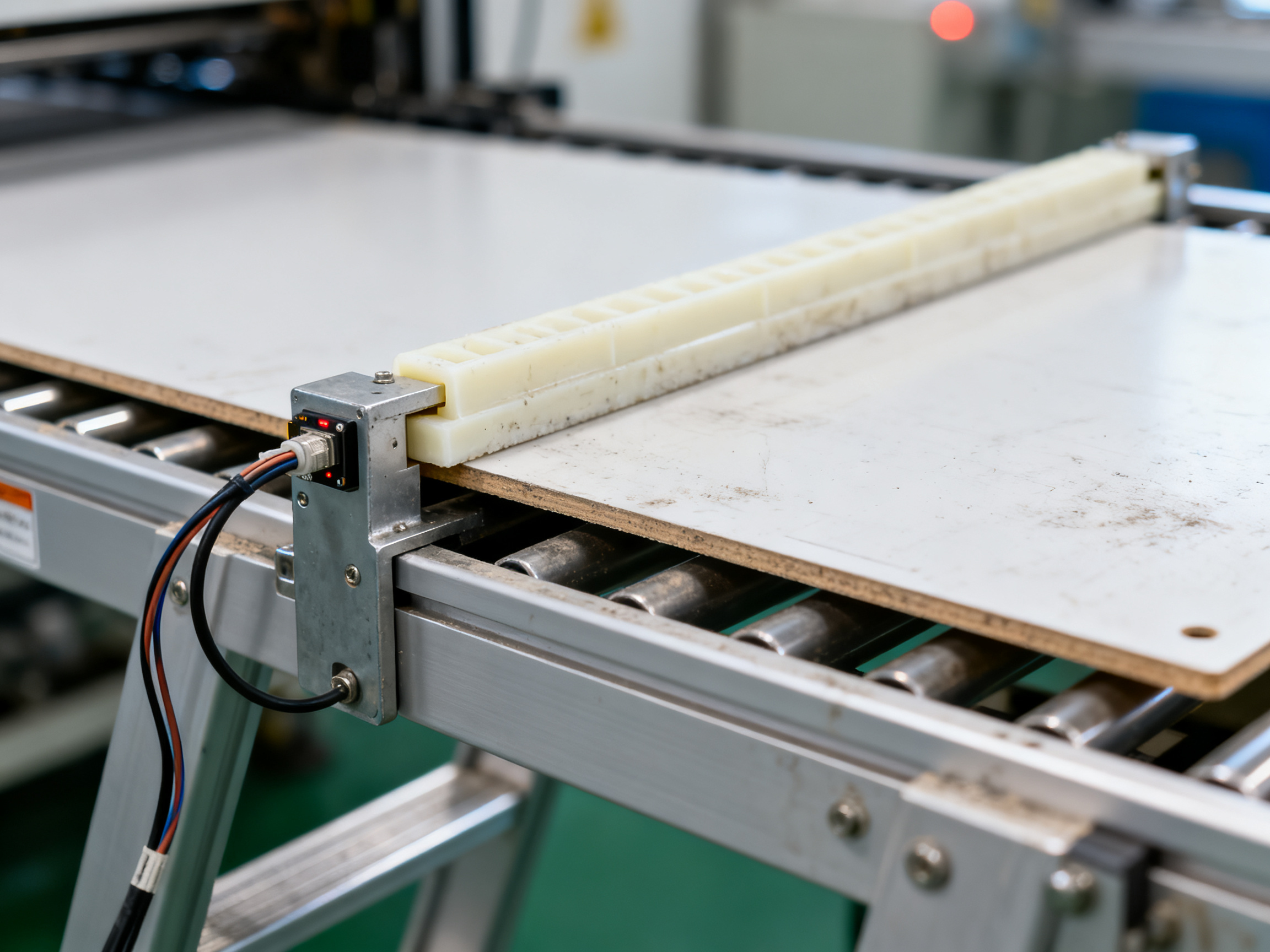
The frame is welded or bolted steel, usually powder coated, and it carries the load of everything else. The side rails on top of that frame are the adjustable part, and they are where most of the shop-floor tolerance lives. Guide rails run in UHMW, PEEK, or PTFE wear strips, each chosen for a reason. UHMW is cheap, easy to machine, and good on most lines. PEEK holds up better under heat and load, which matters in the oven section. PTFE is slippery, useful where a sticky board would be a problem, but it creeps and wears faster.
The rails are slotted and adjustable in width, because the same conveyor has to handle a 100 mm panel and a 400 mm panel without a rebuild.
Chain, carriers, and drive
Chain pitches of 25.4 mm (1 inch) and 50.8 mm (2 inch) show up often, and it is worth saying plainly that these are common vendor configurations, not universal SMT standards. What the pitch controls is board length per index and how many boards you can park in a given oven length.
From Our Experience: On a comparable lead-free line, the pitch and rail material choice came down to the heaviest board, not the typical board. We picked the longer pitch and PEEK wear strips in the hot section because the dense BGA panel was the one that set the wear rate. The rest of the line would have been cheaper to build, and then wrong.
Carriers come in flat ladder, nest, and perimeter frame styles. The drive is usually a gear motor with an encoder, driving a sprocket that pulls the chain. Magnetic and friction drive systems exist as an alternative, mainly where a chain is undesirable.
Sensing and control
Presence is confirmed by proximity or photoelectric sensors, fiber optic where space is tight. Inside the cabinet you will find the PLC, an HMI, safety relays, and the motor drive. That cabinet is where index timing, width adjustment, and skip, collate, or reject logic live.
Materials under heat and RoHS
A reflow exit runs hot, well above 200 degrees C. So chain lubricant matters: low-outgassing, high-temperature grades, not the general-purpose stuff. Frames and shafts in 304 or 316 stainless for corrosion resistance, ESD-conductive plastics for electronics handling, and every plastic near the oven specified for its temperature rating.
How it gets built and proved
Fabrication is a mix of in-house machining and outsourced parts, with jigs used to align rails to the chain path. Then the chain gets pretensioned and tensioned to a set spec, because a slack chain changes pitch under load.
Before shipment, a factory acceptance test should confirm index repeatability, chain pitch accuracy, sensor response, motor and encoder function, and interlock safety. Ask for the records, not just a checkbox.
Checklist: Request the FAT package as a document. You want the as-built drawings, material declarations for wear strips and chain, calibration certificates, loaded index repeatability results, the chain tension value used, safety circuit test records, and the interface test results for SMEMA / IPC line standard signals and the CFX or Hermes connection where fitted.
That list is short, and every item on it should already exist in a file somewhere at the factory. If it does not, you have learned something useful before the machine ships.
Need the same checklist applied to a reflow oven conveyor or a full SMT production line conveyor build? The S&M Co. Ltd. company page lists the oven, wave soldering, and integrated line systems we build.
Strip the covers off a smart conveyor and you find a decision loop, not just a motor. A basic conveyor moves a pallet because a timer says so. An automatic SMT conveyor system moves a pallet because a sequence of sensors, scanners, and handshakes says so.
Here is the loop, in order.
- Board detection. A photoelectric or fiber sensor confirms a board is present at the in-feed. This is the raw trigger for everything downstream.
- Identity read. A barcode or QR scanner identifies the panel or work order, so the line knows what recipe and what routing apply.
- FIFO allocation. The controller places that board in the next available lane of the buffer queue, holding it if the downstream machine is busy.
- Machine handshake. The conveyor asks the next machine if it is ready, and the machine answers. Both sides have to agree before anything moves.
- Index. The drive, with a servo or closed-loop motor and an encoder, advances exactly one pitch and stops. Position comes from the encoder, not from a guess.
- Dwell. The board sits still while the machine works: printer, SPI, mounter, or oven.
- Process confirmation. The machine reports back, board processed or error, plus the data it captured.
- Release and record. The board moves to the next segment, and the tracking record, board ID, measurements, and result get written to MES or the line database.
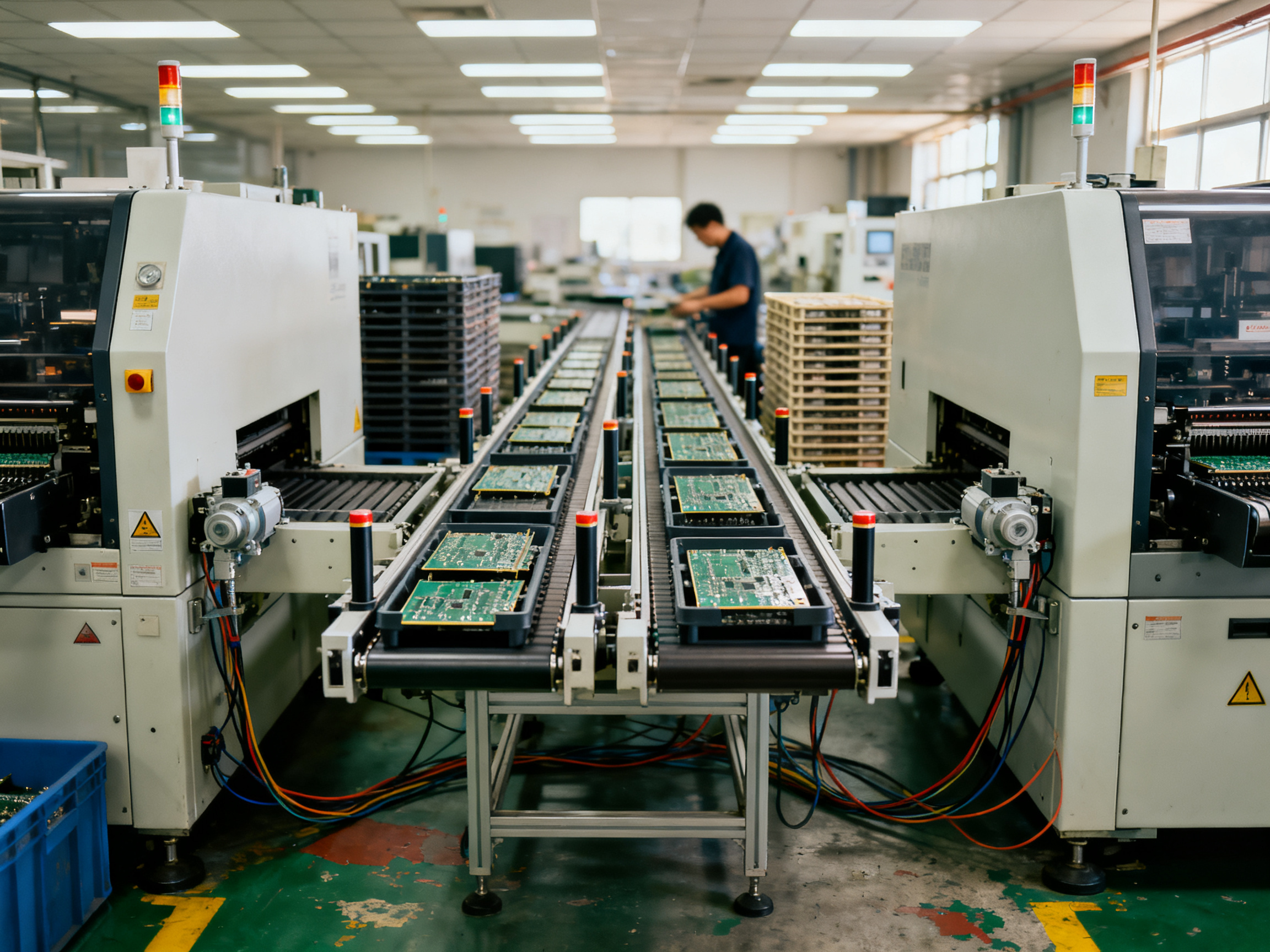
What makes this an automatic system rather than a basic conveyor is the decision logic in steps 3 through 7. Buffering, collation, skip and reject handling, and recipe-driven pitch changes for mixed boards all live there.
Expert Tip: Check the handshake timing between the paste printer, SPI, mounter, and reflow conveyor. A slow or mis-timed handshake does not always throw an alarm. It quietly creates gaps in the queue, collated boards out of order, or duplicated panels downstream. Watch one full cycle with the timing visible on the HMI and you will usually find it in a minute.
From Our Experience: The line stops I get called about are rarely motor failures. They are sequencing faults. Once, a mounter’s ready signal was a fraction of a second late, so the conveyor indexed, then the machine re-requested. The visible symptom was a growing gap at the SPI exit. The fix was a handshake timing change in the PLC, not new hardware.
What 2026’s automatic conveyors add
A few capabilities have moved from novelty to normal expectation this year. Machine vision now checks board presence and skew at the transfer point, so a crooked panel gets flagged instead of feeding downstream trouble. Motor-driven rail adjustment lets one conveyor handle different board widths without manual wrenching. Carrier return runs under motor control, so empty pallets come back predictably. And chain cycle counters feed condition monitoring dashboards that show OEE per conveyor segment, which tells you where the bottleneck actually sits rather than where people assume it sits.
One honest caveat: the interface signals referenced above, SMEMA-style handshakes, IPC-HERMES-9852 for machine-to-machine messaging, and IPC-CFX for line connectivity, are named here as the vocabulary engineers use on the floor. Exact signal lists and current revisions should be read from the standards documents themselves, and mixed-vendor legacy lines usually need a translator box before anything talks cleanly.
If you want to see how this control loop is packaged on a real oven conveyor or a full line, the S&M Co. Ltd. company page covers the reflow, wave soldering, and integrated line systems we build.
Conveyor Choice and Defect Rates: BGA, QFN, Thermal Mass, and Warpage
Here is the uncomfortable part of the conversation. When a dense BGA panel comes out of reflow with voiding, or a QFN package shows bridging, the instinct is to blame the oven recipe. Sometimes the oven is right to blame. But the conveyor decides three things the recipe cannot fix: how the board is supported, how it moves, and how quickly it stops moving.
The mechanics are worth spelling out.
Point support and thermal stress. A heavy board sitting on a narrow rail or on a single nest point develops stress as it heats. The bottom of the board heats faster than the top, and a board that cannot flex slightly fights the expansion. That shows up later as solder-joint cracking under a large thermal-mass component.
Support area and warpage. Support the board along its full length and it stays flat. Support it at one or two points and it cups, especially on a large panel with heavy copper pours. Warpage then pulls component leads out of coplanarity, which is exactly how you get opens and head-in-pillow failures on a package that “soldered fine” a week earlier.
Motion before solidification. If the conveyor indexes while the solder is still molten, every acceleration is a shock load on a joint that has not hardened yet. This is why carrier smoothness and drive deceleration matter more than people expect.
| Defect symptom | Likely conveyor cause | Corrective action |
| — | — | — |
| BGA voiding clustered in one corner | Partial board support, uneven carrier flatness | Switch to flat ladder carrier or add full-area support |
| QFN bridging after reflow | Board not seated square, rail interference | Check rail width setting and carrier seating |
| Solder-joint cracks under heavy parts | Thermal stress from point support | Increase support area, review carrier material |
| Head-in-pillow on large panels | Warpage from unsupported edges | Move to perimeter or ladder carrier, add datum support |
| AOI false calls on good boards | Skew and lateral drift at transfer | Realign guide rails, check sensor and datum reference |
Now the part buyers should push on. You can ask for first-pass yield on dense BGA packages, X-ray voiding percentages, and a defect Pareto from before and after a conveyance change. Without those numbers, “we improved handling” is a sales sentence, not a result.
From Our Experience: On one dense BGA line, moving from narrow-rail retention to a flat ladder carrier with more support area cut the voiding and cracked-joint categories on our internal Pareto, and the AOI false-call rate dropped with it. The reflow recipe barely moved. Same oven, same profile, different mechanical support. I would still ask for the customer’s own X-ray data before repeating the number, but the direction was clear.
Expert Tip: Ask the vendor to run one of your heaviest boards through the oven section with the board’s heaviest component’s footprint marked on it. Where the carrier supports that footprint matters more than the carrier’s rated load.
Want to see how carrier flatness and rail construction are handled on a lead-free reflow oven conveyor or a full SMT production line conveyor? The S&M Co. Ltd. company page covers the oven, wave soldering, and integrated line systems we build.
Integration, Compliance, and Line Scalability for 2026 Manufacturing
Buying a conveyor is easy. Making it fit the line you already own is where projects go sideways. So let’s talk about the three things that decide whether the investment pays off: integration, compliance, and scale.
Integration: legacy, hybrid, and what to retrofit first
Most plants running in 2026 are not greenfield. They have a printer from one vendor, a mounter from another, and a reflow section bolted together years ago with manual inspection on the out-feed. Retrofitting conveyance into that line usually starts with buffering, because decoupling the printer, mounter, and reflow speeds is the fastest throughput win available. Handshake translators or a small inter-segment control box come next, then machine vision for board presence and skew at the transfer points.
That sequence works because each step is independently useful. A buffer pays back on its own. A translator fixes a real signal problem. Vision catches crooked panels before they become downstream noise.
Expert Tip: On a legacy line, buy the buffer first and the automation second. If the queue between printer and mounter is starving, no amount of camera work downstream will make the line faster.
| Stage | Typical state | Conveyor work that pays off |
| — | — | — |
| Legacy | Manual QC, manual board handling, no traceability | Retrofit pallet carriers, add edge support, tighten rail alignment |
| Hybrid | Mixed-vendor machines, partial automation, paper records | Add FIFO buffer, add handshake translator, add board ID scanning |
| Automated | Machine vision, MES records, per-segment OEE | Standardize pitch and carriers so changeovers are recipe-driven |
Compliance and the paperwork you should receive
Ask for material declarations, not marketing claims. You want RoHS and REACH declarations covering plastics, lubricants, and any adhesives in the conveyor and oven section, plus the safety certification for the machine in the jurisdiction you are importing into, whether that is CE marking under the current EU machinery rules or a North American listing.
| Document | What it proves |
| — | — |
| RoHS and REACH material declarations | No restricted substances in plastics, lubricants, coatings |
| Safety certification for your market | Machine meets local electrical and machinery rules |
| FAT records and as-built drawings | What was actually built, and what it measured |
| Spare parts list with lead times | Whether a down conveyor waits two weeks or two days |
One honest caveat: regulatory details shift, and specific chemical restriction proposals have been circulating without all of them being final law. Read the current declaration and the current rule text, and do not take a compliance summary from a supplier as gospel.
Scalability: treat conveyors as infrastructure
The smartest buyers in 2026 treat conveyor segments as line infrastructure rather than as a single machine purchase. The same chain pitch, carrier style, and rail architecture across the printer, mounter, oven, and AOI sections mean you can add a product line, add a second oven, or move from consumer boards to military and aerospace work without rebuilding the mechanical spine. That is where changeover cost drops, and changeover cost is where the money actually is.
Want to see how a conveyor architecture carries across a reflow oven, a wave soldering conveyor, and a full SMT production line? The S&M Co. Ltd. company page covers the integrated systems we build.
Note for the editor: this section relies on general engineering practice rather than cited standards text. Before publication, add current revision numbers and links for the safety, chemical, and line-interface standards referenced here, and confirm the material declaration scope with the compliance team.## Choosing the Right SMT Conveyor: A Selection Guide for Production and Procurement Teams
Here is the thing about buying an SMT conveyor. The spec sheet looks simple, the quote comes back fast, and the machine shows up on schedule. Then six months later you find out the guide rails cannot widen enough for your next panel, and the controller will not talk to your new AOI.
So let’s do this in order, because the order is the whole point.
Step 1: Board and panel envelope. Size, thickness, weight, warpage allowance, and clearance under the tallest component on your heaviest board. Get the worst-case board, not the typical one.
Step 2: Process environment. Does this segment run through reflow heat? Does it need ESD control? Cleanroom or wash-down? This decides your materials before it decides your brand.
Step 3: Throughput and index pitch. How many boards per hour, and does your line actually starve at that point? Pitch and buffer depth follow from the real number, not the number on the brochure.
Step 4: Integration and traceability. SMEMA / ISA-IPC line standard signals for handoff, board ID scanning, and MES records. If you run mixed-vendor equipment, plan on a translator.
Step 5: Serviceability and total cost of ownership. Spare part lead times in your region, wear part costs, chain and rail replacement intervals, and whether a technician can get to you.
| Selection criterion | Must-have | Nice-to-have |
| — | — | — |
| Carrier sizing | Fits your heaviest board with full support | Quick-change nests for product mixes |
| Guide rails | Adjustable across your panel range, wear strips replaceable | Motor-driven width adjustment |
| Heat rating | Rated for the oven exit temperature of your process | Insulated carriers for cool-down |
| Controls | Documented signal list, open or documented protocol | Recipe-driven changeover, MES native |
| Monitoring | Cycle counter and fault log | Per-segment OEE and chain wear tracking |
| Support | Spares held in your region, documented service path | 24-hour response SLA |
From Our Experience: The question that most often exposes a weak quotation is simple: what is the pallet weight rating at temperature, and how many boards are in the FAT load test? Several vendors quote a static load figure and test it cold. Ask for the loaded test condition and the chain duty cycle for a full shift. If the answer is vague, so is the machine.
Red flags to watch for
Undersized carriers on a quote for a heavy board. Guide rails with a narrow adjustment range, which means a rebuild later. A proprietary closed controller with no documentation and no way to integrate. Speeds quoted without a load rating, because speed and load are separate numbers. And support that exists only in another country, which turns a two-day repair into a two-week wait.
Checklist: questions to send to every vendor
- What is the pallet weight rating at operating temperature?
- What chain pitch and carrier options are configurable, and which are standard?
- What is the guide rail adjustment range in millimetres?
- What sensor type and IP rating are used?
- What is included in FAT and SAT, and what documentation ships with the machine?
- What are the wear part lead times for our region?
- What software and traceability deliverables are included?
Run this against every quotation, not just the one you hope to win. And if you want to see how these requirements look in practice on a reflow oven conveyor or a full SMT production line conveyor, the S&M Co. Ltd. company page covers the integrated systems we build.## Conclusion: Treating Conveyance as Process Control, Not Plumbing
Here is the part worth remembering from all of this. An SMT conveyor is not plumbing. It is the mechanical reference the whole line measures against, and how smt conveyor system works sets the tolerance budget every downstream process has to live inside. That is why it deserves the same engineering attention people give the oven recipe.
Before you spend money, run three checks on the line you already own:
- Carrier flatness under load. Put your heaviest board on its carrier and measure bow. This costs an afternoon and usually explains warpage and cracked joints.
- Guide rail wear and alignment. Check lateral drift and squareness at every transfer point. This is where skew and AOI false calls come from.
- Handshake timing. Watch one full cycle with the timing visible on the HMI. Sequencing faults are cheap to fix and expensive to ignore.
Your next three steps
- Run the internal audit above on one line, and write down what fails.
- Build an RFQ requirements template from the seven vendor questions in the selection section.
- Validate every option against your actual board mix, not a brochure average.
Ready to talk through your line with an engineer? Request a line assessment from S&M Co. Ltd., where we build lead-free reflow ovens, wave soldering machines, and complete SMT production lines with conveyor architecture that carries consistently from printer to AOI.