
Published: 08 October 2026
Last Updated: 08 October 2026
Reading Time: 14 minutes
Reviewer: [Reviewer attribution pending verification]
Why PCB Handling and Storage Directly Affect SMT Yield
You just finished a big reflow run. Boards look good on the AOI. Then, 48 hours later, customers start reporting failures. BGAs opening up. QFNs losing continuity. Fine-pitch joints cracking.
The culprit? Often it is not the soldering profile. It is what happened to the boards before they ever reached the paste printer.
Scratches, contamination, oxidation, moisture absorption, and ESD events all silently degrade high-density assemblies. A single invisible zap during handling can partially damage a BGA, and it will pass initial test, only to fail in the field weeks later. Moisture locked inside a laminate during storage can drive delamination or measling the moment the board hits peak reflow temperature.
This guide walks production, procurement, and engineering leaders through the complete decision path for PCB handling and storage. You will learn how to classify your boards, control the storage environment, select the right equipment, manage moisture exposure, and verify every handoff from incoming inspection to line-side delivery.
The goal is simple: fewer defects, less rework, and boards that arrive at the reflow oven in the same condition they left the fabricator.
About the Author
No specific author information was provided with this article brief. The author bio placeholder below describes the type of credentials that should be verified before this section is finalized.
This article was prepared by a content team with documented experience in SMT manufacturing, electronics assembly quality control, and IPC standards compliance. Specific author names, titles, certifications, and organizational affiliations will be added once credentials are independently verified against primary sources such as IPC certification records, ESD Association professional registries, employer bios, or standards committee profiles.
Until verified, no individual names, certifications (such as Certified IPC Trainer or ESD Coordinator), facility details, or outcome claims should be attributed to this article.
PCB Handling Fundamentals: What Can Go Wrong and Why It Matters
PCB handling covers every step where a bare board moves between hands, shelves, trays, machines, or stations. That starts at the receiving dock and runs all the way through kitting, machine loading, in-process movement, rework, and finished-goods staging.
Here is the thing though: most defects traced back to handling do not come from a single dramatic mistake. They stack up quietly. A board gets set down on a static-generating surface. Someone touches the contacts without grounding. A tray sits open in the stockroom for a few hours too long. Individually, each event seems minor. Together, they create the conditions for failures that show up days or weeks later.
Five damage categories matter most for high-density assemblies:
- Physical damage includes edge chips, scratches, bent panel tabs, and flex cracks from improper stacking or dropping.
- Electrostatic discharge (ESD) causes latent damage that components can carry through assembly, pass testing, and then fail in the field.
- Contamination from oils, dust, flux residue, or ionic contamination creates leakage paths and reliability problems.
- Moisture absorption in the laminate can drive delamination or measling during reflow when that moisture turns to steam.
- Traceability failures mean you cannot pinpoint which lots were affected when something does go wrong.
Now, you might have seen warnings about “why is PCB dangerous” and wondered what that means. For bare boards, the board itself is not inherently hazardous to people. The real risks are more specific. Soldering creates fumes. Some finishes use chemicals that need proper ventilation. Boards with sharp edges or heavy components can cause cuts or crush injuries if dropped. And energized assemblies, which this guide is not about, carry their own electrical hazards.
The goal of good PCB handling procedure is protecting the board, the components that go on it, and the people working around it.
Quick glossary:
- ESD (Electrostatic Discharge): sudden transfer of static charge that can damage sensitive components
- MSL (Moisture Sensitivity Level): classification defining how long a moisture-sensitive board can be exposed to open air
- Floor life: the time a board can spend outside dry storage before it needs to be baked or disposed of
- Traceability: ability to follow a specific lot from incoming material through to finished goods
Pro Insight: Physical damage and ESD damage often look identical under visual inspection. That is why documented handling controls and handoff records matter more than you might expect.
PCB Storage Layout: ESD, Environment, and Traceability Controls
Your storage area is doing a lot more work than you probably think. Temperature drifts, humidity spikes, dust buildup, and static buildup all happen quietly, and they add up to failures you will only see after reflow.
Here is what your environmental controls need to cover:
Temperature should stay stable enough to prevent condensation on boards as they move between spaces. Most fabs recommend 20-25 degrees Celsius for stockrooms, and you want to avoid placing storage near heat sources, direct sunlight, or areas with big temperature swings. A thermometer log or automated sensor reading every few hours catches problems before they become batch-level issues.
Relative humidity is where most of the risk lives for moisture-sensitive boards. IPC-1601 recommends stabilizing between 30 and 50 percent RH. Anything higher than that for extended periods means boards are pulling in moisture, and that sets you up for delamination or measling during reflow. Dry cabinets run much lower, sometimes below 5 percent RH, which is what you want for boards that have been opened or are waiting to go to the line.
Dust and contamination are easy to overlook. Open shelving works for some environments, but enclosed cabinets or dry cabinets keep boards cleaner and safer from accidental contact. If your facility runs near metalworking or painting operations, you need tighter controls.
Stacking pressure matters for panelized boards and anything with heavy components already attached. Too much weight on thin boards causes bow, warp, or flex cracks. Use rack systems that support panels evenly rather than piling boards in tall stacks.
Access controls keep unauthorized people from walking into storage and grabbing the wrong lot or disturbing conditions without a record. Key cards, locked cabinets, or at minimum clear signage all help.
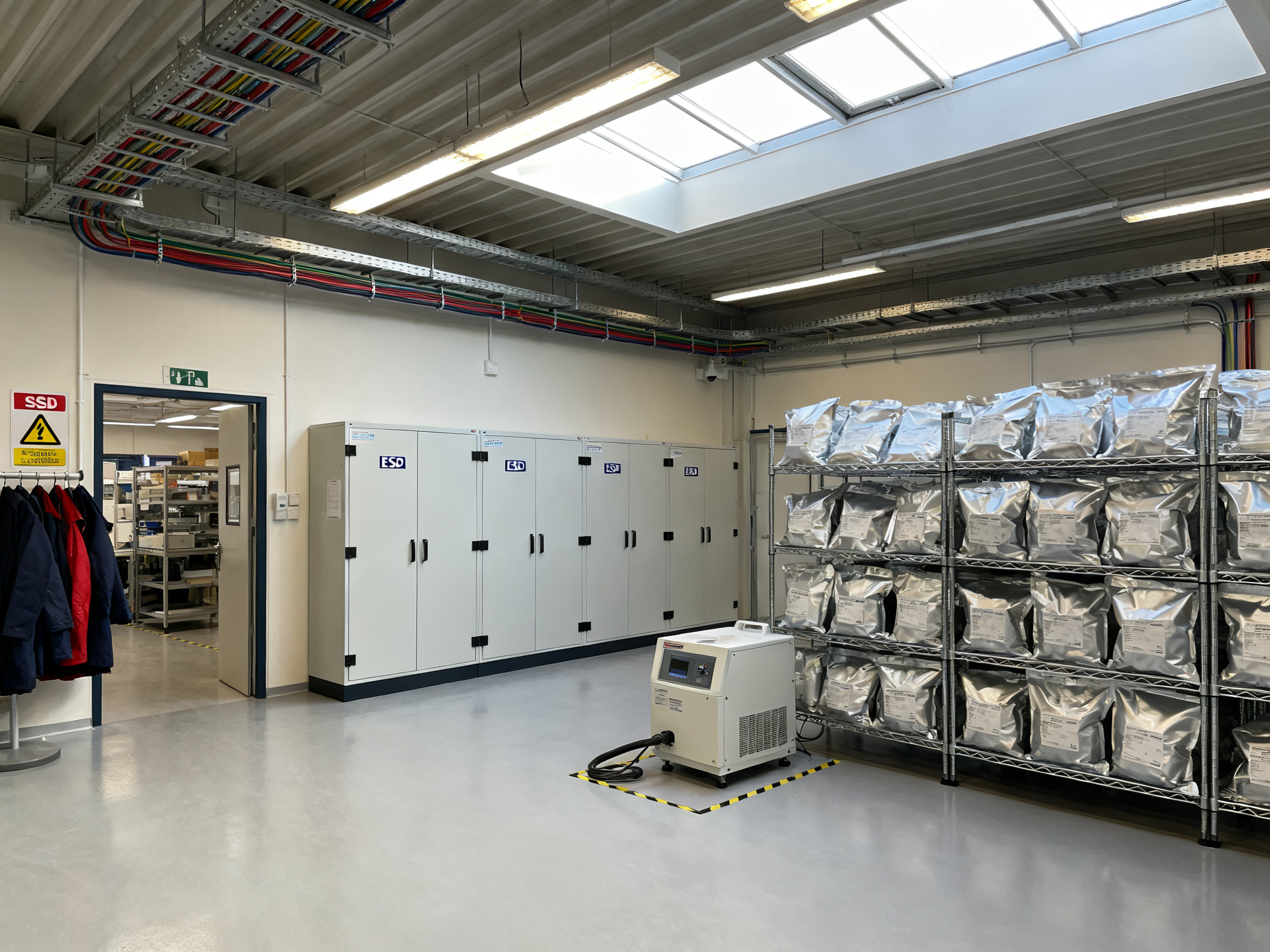
Comparing Your Storage Options
Not every board needs the same level of protection. Here is how the main options stack up:
| Storage Type | Best For | ESD Protection | Visibility | FIFO Control | Moisture Control |
|————–|———-|—————-|————|————–|——————|
| Sealed moisture-barrier bags | Long-term storage, shipping | Depends on bag type | Low | Manual tracking | Excellent when sealed |
| ESD-safe boxes or totes | Intralogistics, kitting, WIP | Excellent | Good | Built into material flow | Limited |
| ESD-safe racks or shelves | Line-side staging, open stock | Good with grounding | Excellent | Easy to organize | None on its own |
| ESD-safe cabinets | Secure stockroom storage | Excellent | Good | Depends on labeling | Moderate |
| Dry cabinets | Moisture-sensitive opened boards | Excellent | Good | Depends on organization | Excellent |
| Controlled room storage | High-volume buffer inventory | Requires flooring and EPA controls | Excellent | Challenging without automation | Requires active humidity control |
Moisture-barrier bags win for keeping moisture out during long storage and transit, but they only work if you keep them sealed with fresh desiccant. Once you open a bag, the clock starts on floor life, and dry cabinets become your best friend for keeping those boards safe until you can run them.
Zoning for Traceability
Treat your storage like a mini supply chain with clear zones and status labels. Separate boards by their current disposition:
- Incoming zone: Boards waiting for inspection or verification
- Inspected and released zone: Boards that have passed QC and are ready for kitting
- Moisture-sensitive zone: Boards with active floor-life timers, stored in dry cabinets or sealed bags
- Baked zone: Boards that have completed a bake cycle and need to cool before use
- Line-side zone: Boards currently in production or staged for the next run
- Quarantine zone: Boards with unknown history, damage, or questionable status
- Rejected zone: Boards that have failed inspection and are awaiting disposition
Every location should carry a label with part number, revision, lot number, date received or baked, operator initials, and current status. Barcode or RFID tags connect those physical locations to your MES or WMS so you can trace any board backward or forward in seconds.
Expert Tip: A practical storage-zone design separates incoming, approved, moisture-sensitive, baked, and rejected boards while preserving lot traceability. Use physical dividers or separate cabinets for each zone, and require operators to scan boards in and out of every handoff. This sounds like extra work, but it eliminates the guesswork that leads to accidentally running a board that should have been baked first.
ESD-Safe PCB Handling: People, Workstations, and Transport
ESD damage is sneaky. You cannot see it, smell it, or feel it. A board can take a static zap, pass every test you run, and then fail in a customer’s hands six months later. That is why ESD control is not optional for high-density assemblies, and why it has to cover every link in the chain, from the floor your operators stand on all the way to the tray the board sits in.
The ESD control chain has five main elements:
First, you need an ESD Protected Area, or EPA. This is a defined zone where all conductive and dissipative materials are kept at the same electrical potential. The EPA boundary is marked, access is controlled, and everyone who enters knows the rules. You will see warning signs, grounding points, and regulated behavior inside these zones. Think of it like a cleanroom for static.
Second, personnel grounding keeps your operators at the same potential as everything else. Seated workers wear wrist straps connected to ground. Standing or mobile workers use ESD footwear with ESD flooring so they stay grounded as they move. The connection has to be continuous during handling, not intermittent.
Third, work surfaces like mats, benches, and shelving are made from dissipative materials and bonded to the same ground as everyone else. Dissipative means charge bleeds off slowly rather than jumping all at once. This is different from conductive, which drains charge fast and can cause its own problems.
Fourth, ESD packaging stays with the board whenever it leaves the EPA. Boards in ordinary plastic bags can zap themselves on the way to the assembler down the hall. Anti-static bags, conductive totes, and shielded containers keep the protection going even when the board is in transit.
Fifth, ionization handles insulators and isolated conductors that cannot be grounded. Some board materials, some packaging, and some components generate charge that has nowhere to go. Overhead ionizers neutralize that charge before it builds up enough to arc.
How to Actually Handle Boards
The basics are simple. Touch boards only by the edges or designated handling areas. Never drag a board across a surface. Never touch copper features, pads, or connector contacts with bare hands. Use approved trays, carriers, or panel rails rather than stacking boards loose.
Prevent flexing by supporting thin boards fully and avoiding sharp bends during loading and unloading. For panelized designs, handle the panel edges and tabs, not the breakout tabs or scoring. Uncontrolled sliding causes micro-scratches that hide problems until they show up under AOI or in the field.

| Material Type | Surface Resistance | Charge Decay | Best Use |
|—————|——————-|————–|———|
| Conductive | Less than 1 x 10^4 ohms | Very fast | Shelving, trays, bins |
| Dissipative | 1 x 10^4 to 1 x 10^11 ohms | Controlled | Work surfaces, flooring, packaging |
| Insulating | Greater than 1 x 10^11 ohms | None | Avoid in EPA unless neutralized |
Verification and What to Do When Controls Fail
Daily checks keep the system honest. Wrist straps get tested every time someone sits down. Mat resistance gets logged periodically. Ionizer balance gets verified monthly. Records show your auditor and your customers that you are running a real program, not just checking boxes.
When an ESD control fails, the affected boards go on hold. You do not assume they are fine. You investigate, test if possible, and document the event. A failed wrist strap tester means the operator stops work until the strap is replaced or repaired. A drift in ionizer balance means you pull the unit, service it, and verify it before putting it back.
From Our Experience: A line-side handoff method that reduces ESD exposure, edge damage, contamination, mixed lots, and unexplained soldering defects includes these steps: operators keep boards in ESD totes between stations, scanner guns stay grounded or dissipative, and handoff records capture the from-station and to-station with operator ID and timestamp. This sounds like bureaucracy but it is how you catch the one board in a thousand that would have caused a warranty return.
Personnel training covers why ESD matters, how the controls work, what to do when something fails, and what is not allowed inside the EPA. New operators get trained before they touch a board. Refresher training happens annually or whenever you find a gap. Training records belong in your quality system just like everything else.
4. PCB Handling Equipment: Types, Selection Criteria, and Line Integration
Here is where the rubber meets the road, or more accurately, where the board meets the conveyor. Once you have your storage sorted and your ESD controls in place, you need to actually move boards through the line without damaging them. The equipment you choose affects throughput, defect rates, changeover time, and operator safety all at once.
Equipment Types and What They Do
Think of your line as a pipeline with different sections handling different jobs. Each piece of equipment has a role:
Trays and carriers protect boards during transport and storage between stations. JEDEC-style trays and J-boats work well for thicker or warped panels that need extra edge support. The tray material matters too. You want dissipative or conductive inserts to keep static charge from building up during handling.
Magazine racks, loaders, and unloaders feed boards into the line and collect them after each step. These decouple the processes so one station does not hold up the whole line. Modern loaders can hit around 10-second cycle times and handle up to 400 boards at 0.6 mm thickness.
Conveyors are the backbone of any SMT line. They move boards between printers, placers, reflow ovens, and inspection stations. Positioning accuracy of plus or minus 0.1 mm is standard for precision assembly. Most conveyors accept board sizes from 50 by 50 mm up to 460 by 460 mm, with rail widths that adjust to fit different panel formats.
Buffer systems absorb takt time mismatches between machines. If your placer is faster than your reflow oven, buffers catch the excess so you do not starve the downstream process.
Turn units and flip conveyors handle orientation changes for double-sided assembly or non-linear line layouts.
Automated storage and retrieval systems (AS/RS) manage WIP buffering and lot segregation for high-mix operations where traceability matters more than raw speed.

What to Evaluate Before You Buy
Not every piece of equipment fits every line. Here is a scorecard approach to evaluating options:
| Evaluation Criteria | Why It Matters | What to Check |
|——————–|—————-|—————|
| Board size and thickness range | Determines what you can actually run | Minimum and maximum dimensions, rail adjustment range |
| Warpage tolerance | Prevents jams and edge damage on bowed boards | Extended conveyor options for warped panels |
| Throughput and cycle time | Drives line capacity | Cycles per minute, transfer latency, buffer capacity |
| Changeover time | Affects downtime between jobs | Adjustable rails, software recipes, tool-free settings |
| ESD rating | Protects boards from latent damage | Conductive or dissipative materials throughout |
| Cleanability | Prevents contamination drift | Smooth surfaces, accessible debris removal |
| Barcode and traceability support | Enables MES integration | Built-in readers, carrier tagging, genealogy tracking |
| Protocol compatibility | Connects to your existing equipment | SMEMA, HERMES 9852, IPC-2591 CFX, SECS/GEM |
| Ergonomics | Protects operators and reduces fatigue | Handle height, lift aids, anti-fatigue features |
Protocol Compatibility Matters More Than You Think
Your equipment needs to talk to your existing machines. SMEMA remains the most common legacy interface, but newer standards like IPC-HERMES-9852 and IPC-2591 CFX carry richer data. If you are running semiconductor-style equipment or need deep factory integration, SECS/GEM might be necessary.
Before signing any purchase order, verify that the equipment speaks your language. A conveyor that cannot communicate with your placer creates a bottleneck you will not fix without replacing it.
Line Balance and Scalability
The best individual equipment choice is not always the best line decision. Think about your bottleneck. A faster loader does not help if your reflow oven cannot keep up. Model your takt times across the entire line before adding capacity.
Also consider where you might be in three to five years. If you are adding product lines or moving into automotive or aerospace work, you will need stronger traceability, better edge protection, and probably tighter protocol integration. Equipment with MES connectivity built in costs more upfront but saves you from a full replacement later.
For production managers evaluating complete PCB material handling solutions, the checklist includes line balance optimization, operator ergonomics during loading and unloading, maintenance access points and service intervals, spare parts availability and lead times, software recipe management and changeover automation, and headroom for future expansion without rearchitecting the entire flow.
The goal is not to buy the most expensive equipment. It is to buy the system that fits your current products, grows with your roadmap, and does not introduce new failure modes into your process.
IPC-1601, Moisture Sensitivity, and PCB Baking Decisions
Moisture and printed boards have a complicated relationship. Laminates naturally absorb humidity from the air, and that moisture gets trapped inside the material. When the board hits peak reflow temperature, that water turns to steam and tries to escape. The pressure can push layers apart, creating delamination. It can crack the gaps between traces, causing measling. Or it can create bubbles under the surface, which is blistering. None of those outcomes are good for your assembly.
The fix for moisture damage sounds simple: just bake the boards before reflow. But it is not that straightforward. Baking is a controlled engineering decision, not a setting you apply the same way every time.
Building Your Bake-or-No-Bake Decision
Before you schedule a bake cycle, gather the evidence. You need answers to several questions:
- What does the board supplier recommend in their datasheet or processing guidelines?
- Is the moisture-barrier bag still sealed with fresh desiccant and a readable humidity indicator card?
- What is the humidity indicator showing: safe, borderline, or trip-out?
- How long has the board been outside sealed packaging?
- What is the board made from, and what is its glass transition temperature (Tg)?
- What surface finish is on the pads: OSP, ENIG, Immersion Silver, Immersion Tin?
- What reflow profile will the board actually see?
OSP finishes are the tricky one here. Baking degrades OSP coating, so you generally want to avoid baking boards with this finish unless the supplier specifically says it is safe. ENIG and Immersion Silver boards handle baking better, but the time and temperature still need to match the board construction.
What to Collect Before Baking
| Evidence | Why It Matters | Where to Find It |
|———-|—————|——————|
| Supplier bake guidance | Sets the baseline recipe | Data sheet, processing notes |
| Packaging condition | Sealed bags with desiccant buy you time | Visual inspection on receipt |
| Humidity indicator status | Shows actual moisture state | HIC card inside the bag |
| Exposure time outside dry storage | Tracks cumulative floor life | MES or logbook entry |
| Board laminate and Tg | Determines safe temperature range | Supplier documentation |
| Surface finish | Some finishes degrade with heat | Manufacturing record |
| Reflow profile peak temperature | Higher peaks need drier boards | Process engineering |
Once you have this information, you can make an informed call rather than just running every board through a bake cycle automatically.
Baking Temperature and Time: Not One Size Fits All
Here is where people get into trouble. They pull a generic bake recipe off the internet and apply it to everything. The board supplier spent time qualifying their product, so their guidance should be your starting point.
That said, practical ranges do exist. Most manufacturers cite 105 to 125 degrees Celsius for 2 to 6 hours depending on board thickness and finish. Thicker boards need longer times. OSP and Immersion Tin might only need 1 to 2 hours at the lower end of that range. ENIG boards often run 4 to 6 hours at 150 degrees Celsius to drive moisture out thoroughly.
For boards with higher Tg materials, you need to stay below that transition temperature. Baking too close to or above the Tg can introduce new stresses into the laminate.
Forced-air convection is the preferred method. It circulates heat evenly and avoids the hot spots that can damage boards in static ovens. You also need adequate spacing between boards on the rack so air flows freely around all surfaces.
After baking, boards cool in the open air before going back into dry storage. Do not stack hot boards or seal them immediately into bags, because condensation will form on the cooled surfaces.

Board Baking Is Not Component MSL Handling
One mistake I see a lot is people applying component moisture sensitivity level tables to bare PCBs. They are different things.
Component MSL handling is about packaged ICs and their floor life, dry-packing requirements, and reflow exposure limits. Those rules come from the component manufacturer and are specific to the package construction.
Bare PCB moisture control is about the finished board itself: the laminate, copper, solder mask, and surface finish. The risks are different. The solutions are different. A board can be dry and ready to run even if some of the components on it have MSL constraints that require different handling.
Keep the two disciplines separate in your process documentation and your operator training.
Pro Insight: How to avoid automatic baking: confirm the board’s moisture sensitivity, packaging history, floor life, laminate requirements, and supplier guidance before selecting temperature and time. If the humidity indicator is still showing safe levels and the bag is sealed, baking might be unnecessary. Wasted bake cycles cost time, energy, and potentially degrade the board unnecessarily.
Recording the Bake
Every bake cycle needs a log entry. Record the board part number and lot, the start time and end time, the oven used, the temperature setting, the operator who started and completed the cycle, and whether the board cooled properly before storage. If you are re-sealing boards into moisture-barrier bags, document the bag lot number and desiccant lot number too.
This documentation proves to auditors and customers that you are running a controlled process. It also helps you trace back problems if a board that was supposed to be baked shows moisture damage after assembly.
The goal is simple: bake when necessary, skip it when it is not, and always know why you made that call.
6. The End-to-End PCB Handling Procedure for Production
Most handling failures happen at the transitions. A board sits in the stockroom looking fine, gets handed off to kitting, then sits in a tray for a shift before anyone notices the packaging tape came loose. By then, contamination, moisture, or ESD exposure has already done its work.
The fix is a controlled handoff procedure that checks the same things every time, at every step.
A Step-by-Step Handoff SOP
Every time a board moves between stations or operators, run through this checklist:
- Identity verification scans the barcode or reads the label to confirm part number, revision, and lot code match the traveler or work order.
- Packaging inspection checks that ESD shielding, moisture-barrier bags, or trays are intact with no tears, holes, or unsealed seams.
- ESD status check confirms the board is still inside its protective packaging or on a grounded surface within the EPA.
- Moisture exposure review looks at the humidity indicator card status, the time since the bag was opened, and any floor-life records.
- Physical condition check looks for edge chips, scratches, contamination, or warpage visible without magnification.
- Quantity and orientation confirm the count matches the documentation and that boards are facing the correct direction for the next operation.
- Carrier compatibility verifies the tray, magazine, or fixture matches the board format and that ESD inserts are in place.
- Traceability scan logs the handoff in the MES or handwritten log with from-station, to-station, operator ID, and timestamp.
If any check fails, the board does not move forward until the issue is resolved or formally dispositioned.
RACI for Production, Quality, Warehouse, and Engineering
| Task | Production | Quality | Warehouse | Engineering |
|——|:———-:|:——-:|:———:|:———–:|
| Receiving inspection | R | A | I | C |
| Quarantine decisions | I | R/A | C | C |
| Bake authorization | I | A | R | C |
| Line-side handoff | R | I | C | I |
| NCR initiation | C | R/A | I | I |
| Rework disposition | C | A | I | R |
| Audit of records | C | R/A | C | C |
R = Responsible, A = Accountable, C = Consulted, I = Informed
When to Stop and Escalate
Some conditions require immediate quarantine and escalation to quality or manufacturing engineering.
Dropped boards go to quarantine regardless of visible condition. Hidden cracks or internal delamination may not show up until reflow or later testing.
Damaged packaging breaks the ESD or moisture barrier. Treat the contents as exposed until proven otherwise.
Exceeded floor life means the board has been outside dry storage longer than its MSL allows. It needs a moisture assessment or bake before production use.
Failed ESD checks on personnel equipment, work surfaces, or ionizers mean the affected boards need evaluation for latent damage.
Suspected moisture damage from failed humidity indicators, blistered soldermask, or delamination visible at incoming inspection requires MRB review.
Unknown lot history with no traceability records cannot be released for high-reliability programs without investigative work and formal disposition.
From Our Experience: A line-side handoff method that reduces ESD exposure, edge damage, contamination, mixed lots, and unexplained soldering defects includes these steps: operators keep boards in ESD totes between stations, scanner guns stay grounded or dissipative, and handoff records capture the from-station and to-station with operator ID and timestamp. This sounds like bureaucracy but it is how you catch the one board in a thousand that would have caused a warranty return.
Nonconformance Decision Tree
When a board fails any check, follow this path:
- Is the defect cosmetic or does it affect form, fit, or function? If cosmetic, apply IPC-A-610 acceptability criteria. If functional, proceed to step 2.
- Is the defect contained to one board or does it affect the whole lot? Quarantine the affected unit and assess the lot status.
- Does the defect trace back to handling, storage, ESD, moisture, or incoming damage? Document the probable root cause.
- Can the board be reworked, used as-is with acceptance, or does it require scrap? Engineering and quality sign off on disposition.
- Does the issue indicate a systemic gap in your procedure? If yes, update the SOP, retrain operators, and close the CAPA.
Traceability is what makes this decision tree work. Without accurate lot records, you cannot scope the affected population or prove to a customer that the problem is contained.
7. Implementation, Auditing, and Continuous Improvement
Rolling out a PCB handling program across your facility is not a weekend project. It is a process change, and process changes take time to stick. The companies that get lasting results treat implementation like a project with clear phases, not a memo that goes out and gets ignored.
A 90-Day Rollout Roadmap
Days 1 through 30 are for baseline work. Document your current defect rate, handling-related scrap, and material flow from receiving to line side. Watch where boards sit too long outside ESD packaging. Notice where traceability breaks happen. This gives you the before numbers to prove your program worked later.
Days 31 through 60 focus on one line or one shift as a pilot. Classify your board inventory by risk level. Set up your storage zones. Train operators on the new handoff checklist. Start logging every board movement in your MES or at minimum on paper with supervisor sign-off.
Days 61 through 90 validate the controls. Did handling scrap drop? Did ESD audit failures go to zero? Did moisture incidents stop? If yes, document the results and train the rest of your teams. If not, troubleshoot before you scale.
What to Track
Your KPI dashboard should show these numbers at a glance:
| Metric | Target | How to Measure |
|——–|——–|—————-|
| Handling-related scrap | Down 50% in 6 months | Scrap log by root cause |
| ESD audit failures | Zero per quarter | EPA compliance audit records |
| Moisture incidents | Zero escapes to reflow | HIC failures and bake logs |
| Board damage reports | Down 75% in 90 days | NCR log cross-referenced to handling |
| Traceability exceptions | Less than 1% | MES handoff completion rate |
| Line stoppages from material issues | Down 40% | Downtime log by category |
Audit Checklist Basics
Your internal audits need to cover five areas: ESD controls and equipment calibration, storage zone discipline and access logs, moisture management and floor-life tracking, handoff procedure compliance, and operator training currency.
Set up a calendar. Weekly checks on ESD equipment. Monthly checks on storage conditions. Quarterly audits on procedure compliance. Annual reviews of your written instructions against actual practice.
Change Control
When you change board suppliers, switch carrier types, modify storage conditions, or bring in new equipment, treat it as a process change. Validate that your handling controls still work. Update your SOPs. Train anyone affected. Do not let a quiet change undo months of discipline.
Suppliers matter too. Ask your board vendors for their current IPC-1601 compliance documentation. Get their bake guidance in writing. Review desiccant and packaging specs annually.
The companies that hold their quality gains are the ones that keep measuring, keep auditing, and keep fixing small problems before they become big ones.
A Practical PCB Handling and Storage Checklist
OK, here is the condensed version for your production floor. These are the non-negotiables that actually move the needle.
Before Reflow, Every Board Needs:
- ESD-safe behavior everywhere in the EPA
- Verified ESD containers and racks in place
- Temperature and humidity logged daily
- Lot barcode or RFID on every board location
- Moisture assessment before any bake decision
- Equipment matched to board format and thickness
- Handoff scan at every station change
Risk vs Control vs Owner vs Evidence
| Risk | Control | Owner | Evidence |
|——|———|——-|———-|
| ESD damage | Wrist strap testing | Production | Daily test logs |
| Moisture damage | Dry storage and HIC checks | Warehouse | Bake records |
| Physical damage | Approved containers and racks | Production | Incident log |
| Traceability break | Scan at every handoff | Quality | MES transactions |
| Contamination | Enclosed storage or cabinets | Warehouse | Environmental logs |
| Wrong board used | Identity scan at kitting | Production | Traveler match |
What to Do Next
Pick one material flow. Watch where boards sit outside ESD packaging. Check if humidity records exist. Count how many handoffs happen without a scan. That one audit tells you more than any document ever will.
Once you find your biggest gap, fix it with a real control. Measure the result. Then copy that fix to your other lines.
Expert Perspective Placeholder
Specific recommendations on PCB handling and storage best practices will be added here once the author’s credentials and documented first-hand experience are verified and attributed through IPC certification records, employer verification, or standards committee profiles. No individual names, certifications, or outcome claims should be attributed to this article until primary source verification is complete.
Ready to Audit Your Setup?
Run a storage and handling audit on one line this week. The results might surprise you.