
Published: 17 November 2026
Reading Time: 12 minutes
Introduction: Why Reflow Oven Choice Decides Your Whole SMT Line’s Yield
Here is the pattern I see over and over. A factory buys a new printer, new placement machines, and a shiny new AOI camera. Then the reflow oven gets whatever budget is left. Six months later the line is running at full speed and still missing first-pass yield targets, and everybody points at the placement machine. It is almost never the placement machine. It is the oven.
That is because the reflow oven is the one piece of equipment on the line that touches every single board. A bad placement pass damages maybe one board. A bad thermal profile damages every board that goes through the machine, all day, in ways that look like component problems, solder problems, or paste problems. Operators end up changing paste, adjusting stencil apertures, and swapping components that were never bad in the first place. I have walked into that exact argument in factories in Shenzhen, Ho Chi Minh City, and Ontario. It is a very expensive misunderstanding.
So this guide is a buying framework, not a catalogue. Eight factors, and for each one: the questions to ask a vendor, the numbers to get written into the quote, and the failure mode that factor prevents. There is no universal “best” SMT reflow oven. The right machine is a function of your board mix, your alloy, your target throughput, and what your defect data has been telling you.
A useful note before we start: the figures and thresholds in this guide come from our own commissioning and troubleshooting work at S&M Co. Ltd., plus published IPC and J-STD practice. They are our recommended acceptance criteria for buyers, not claims about every oven on the market. Always measure your own panels.
The 8 Factors at a Glance
|
| Factor | The question it answers | Failure mode it prevents |
|—|—|—|—|
| 1 | Application and board mix fit | Is this oven built for my work? | Buying a desktop oven for 0.4 mm pitch BGA work |
| 2 | Heating technology and thermal uniformity | Does every board in the panel see the same heat? | Cold-spot soldering defects, tombstoning |
| 3 | Reflow profile capability and process control | Can it hold and repeat a valid profile? | Over-melting, insufficient soak, voiding |
| 4 | Throughput, capacity and oven types | Can it keep up, and at what load? | Line starvation and queue backup |
| 5 | Solder paste, alloy and lead-free compliance | Will it run SAC305 and SnPb cleanly? | Poor wetting, pad fall, RoHS failures |
| 6 | Process monitoring, AOI and defect detection | Can you see what happened inside the oven? | Invisible process drift, no root cause |
| 7 | Energy use, maintenance and total cost | What does it really cost to run for 5 years? | Surprise utility bills and downtime |
| 8 | Integration, automation and after-sales support | Will it fit your line and stay supported? | Bottlenecks, no spares, no service |
Caption: a typical SMT line with the reflow oven at the tunnel exit, between the pick-and-place and AOI stations.
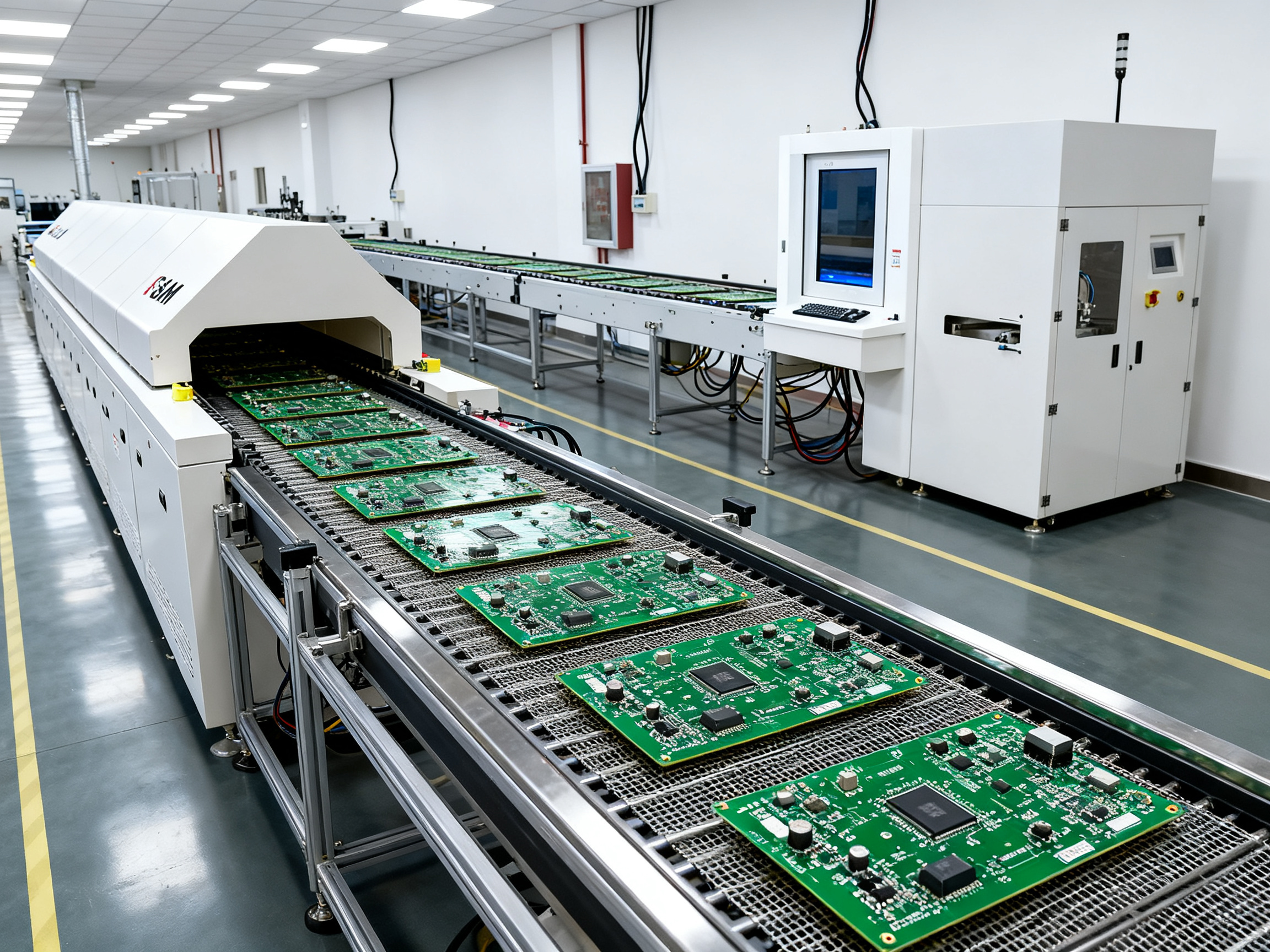
Factor 1: Reflow Oven Types — Convection, Infrared, Hybrid and Vapour Phase
Before you compare zone counts or cycle times, you need to know how the heat gets to the board. There are four main reflow oven types on the market in 2026, and they behave very differently on dense assemblies.
| Type | How it heats the board | Sweet spot | Watch out for |
|—|—|—|—|
| Multi-zone forced-air convection | Recirculated hot air across zones | High-density SMT, BGA/QFN, mixed production | Heavier panels shift zone balance |
| Infrared | Radiant lamps heat the assembly from above | Thin, low-mass boards, lower volume, heat-sensitive parts | Uneven heating on tall or shielded components |
| Hybrid convection + IR | Air for the soak, IR for the spike | Lead-free work needing fast ramp and sharp peak | More knobs, more demanding recipe work |
| Vapour phase | Condensing inert vapour in a sealed chamber | Specialist high-mix, low-volume, aerospace-grade work | Expensive, small panel sizes, slower changeover |
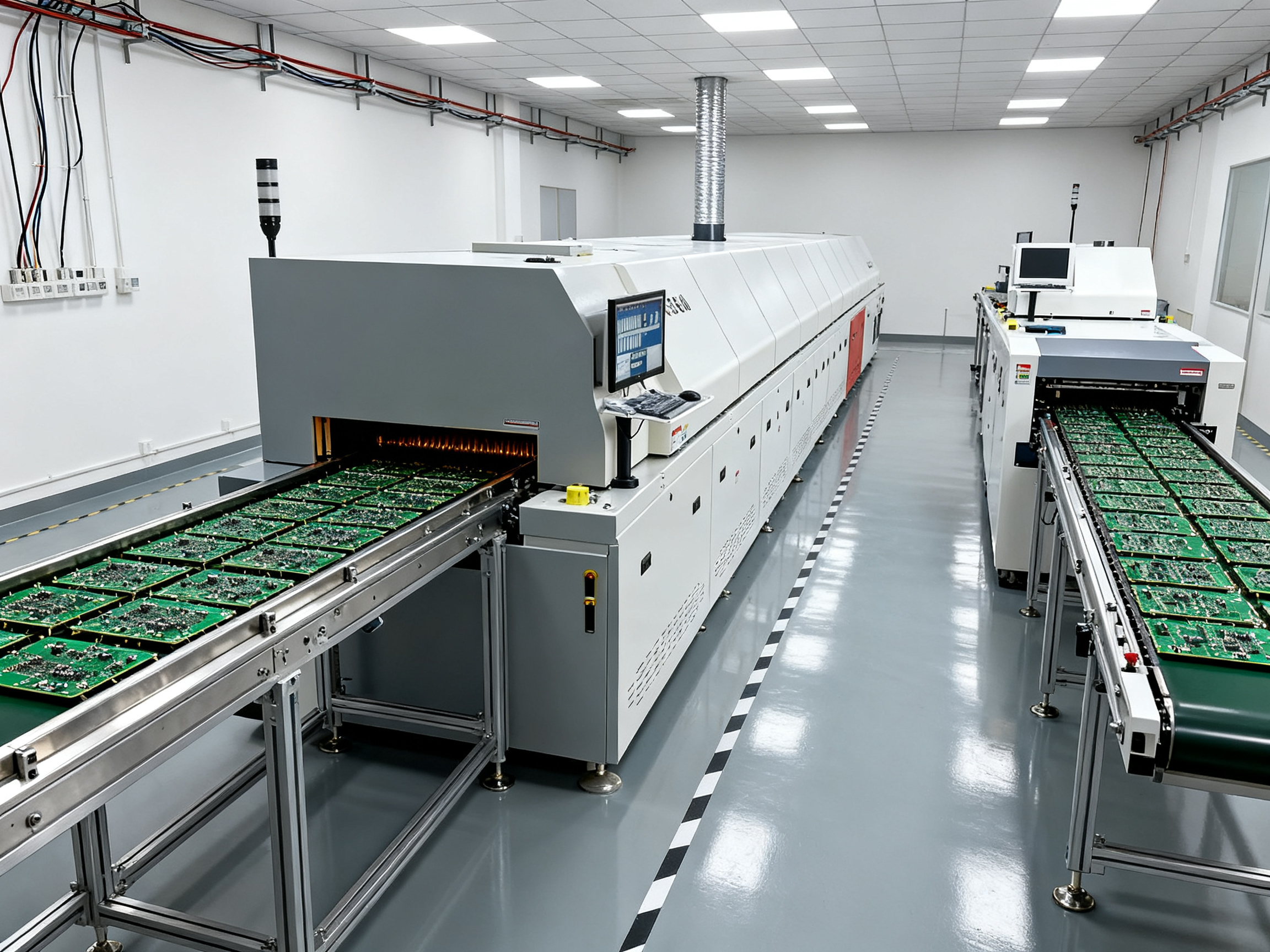
Here is the honest take from our application team. Most high-density SMT lines in consumer electronics and semiconductor work should run a convection-dominant multi-zone oven. Forced air gives you the control you need to soak a 0.4 mm pitch BGA evenly, and convection is far more forgiving when your board mix changes every week. Infrared still has a place, usually in simpler or lower-volume cells, but it struggles once components stand tall enough to shade the board underneath. Vapour phase? Still niche in 2026. Excellent results, but the price and panel constraints keep it out of most volume lines.
And here is the question that settles most comparisons:
Vendor question: “Show me delta-T across the working area for a board of my size and weight, with my paste and alloy, at the throughput I need.”
If the answer is a brochure rather than a measured panel, keep shopping. Comparing an industrial reflow oven on catalogue specs alone is like buying a car by looking at the badge.
Want to see how these mechanisms behave in a real production tunnel? The lead-free reflow oven pages on the S&M Co. Ltd. site walk through multi-zone convection setups and full SMT production line configurations, and our applications team will run your panel mix through a commissioning profile on request.
Factor 3: Profile Control and Repeatability
Uniform heating is only useful if the oven can reproduce the same thermal profile on every board. A process that works on the first panel can still fail on the tenth if the ramp is too aggressive, the soak is too short, or the peak temperature changes from one load to the next. For mixed production, the key question is not simply whether the oven can reach a peak temperature. It is whether the oven can repeat a valid profile across different board sizes, load configurations, and production cycles.
A reflow profile is commonly described in four stages:
| Stage | What the board experiences | What to verify |
|—|—|—|
| Ramp | Temperature rises toward the soak region | Ramp rate is appropriate for the package, paste, and board construction |
| Soak | Soldering temperature is approached gradually | Dwell time is sufficient for paste activation without excessive component heating |
| Spike | Temperature briefly rises above the melting point | Peak temperature and time above liquidus support complete wetting |
| Cooling | Temperature falls in a controlled manner | Cooling does not create thermal gradients, voids, or handling problems |
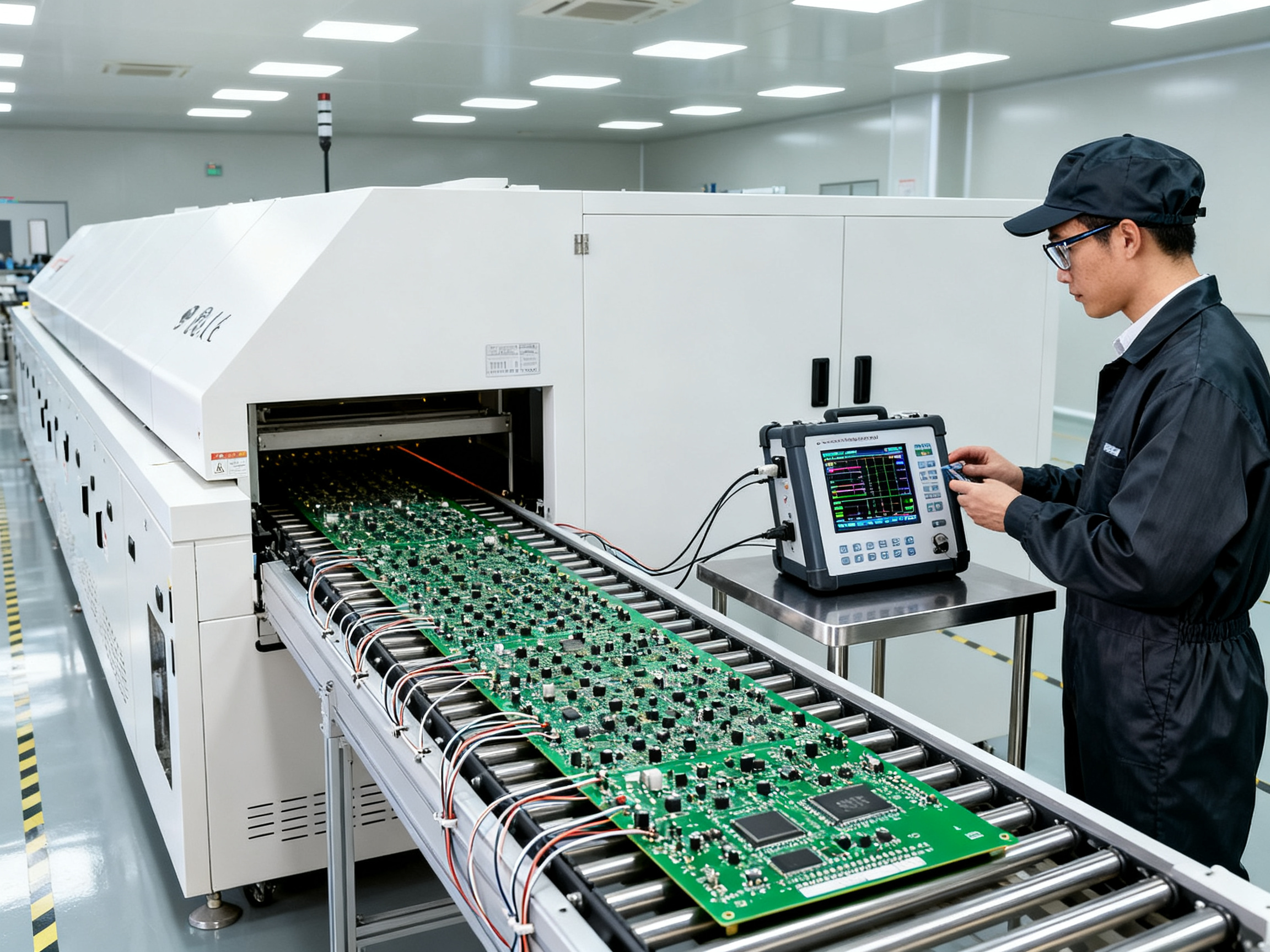
Ask the oven supplier for a complete profile, including ramp rates, soak temperature and time, peak temperature, time above liquidus, and cooling behavior. A single peak-temperature figure is not enough to qualify a machine. The profile should be measured on a board representative of the work, preferably at the locations most likely to expose defects: the centre of a large ground plane, a dense component area, a board edge, and the coldest point identified during thermal-uniformity testing.
Thermocouple placement is where many profile measurements become unreliable. A sensor attached only to a small component may show the temperature of that component rather than the board profile. A sensor placed loosely on the board can shift during handling or read a different load condition. For reliable results, use a fixture that holds the thermocouple against the board in a repeatable position, and document the board material, copper coverage, component population, and oven loading.
Repeatability is a process capability
A profile should be repeatable, not merely achievable. During qualification, run multiple loads through the same recipe and compare the results. For high-density mixed production, look for tight variation in ramp rate, soak time, peak temperature, and time above liquidus. If the profile changes significantly when the oven is empty, partially loaded, or fully loaded, the recipe is compensating for poor process control rather than controlling the process.
Useful acceptance checks include:
- Running the intended recipe with representative boards at the intended throughput.
- Comparing profiles at the centre, edge, and thermally sensitive areas of the load.
- Repeating the cycle after opening the oven door or handling a debug board.
- Measuring the profile again after the heater, fan, or airflow configuration has been serviced.
- Recording recipe changes instead of relying on an operator’s memory.
From Our Experience: The most common profile problem we encounter is not a bad oven setting; it is a recipe that was qualified on a small test board and then used on a completely different load. A small panel heats quickly and spends little time near the soak temperature. A large, copper-heavy panel behaves differently and may never reach the intended soak conditions. The oven may still report that it reached the setpoint, but the board did not receive the same thermal history.
Store approved profiles by board family, not by a generic product name. For example, separate recipes may be needed for small rigid boards, large multilayer panels, metal-core assemblies, and mixed loads. Give each recipe a revision number and define when it must be re-qualified. A change in paste, solder alloy, stencil thickness, board construction, panel loading, or component population can change the required profile even when the oven hardware has not changed.
The qualification data should become part of production control. Keep the profile file, thermocouple drawing, board load configuration, paste specification, and measurement results together. Record oven serial number, date, operator, and any deviations. This makes it possible to distinguish a paste problem from a heating problem and to prove that a process is stable over time.
Vendor question: “Show me measured ramp, soak, peak, and cooling data for my board type at production loading. How much does the profile change between consecutive cycles, and what recipe controls do you provide for different board families?”
Finally, validate the profile against the actual board, not only against the oven display. After the thermal profile is stable, inspect joints and measure process outcomes such as solder-ball incidence, wetting time, voiding, and component-shift rate. A profile can look excellent on a chart and still be wrong for the assembly. The correct profile is the one that produces repeatable joints within the paste and component specifications, while keeping the entire work zone within its qualified temperature range.
Factor 3: Reflow Profile Capability and Process Control
Even perfect heating means nothing if the oven cannot repeat the same thermal history on every board. This is where budget pcb reflow ovens get exposed fast, because the spec sheet rarely tells you how well the profile holds up under real loading.
The controls to demand in 2026:
- Independent PID setpoints per zone, with real ramp-rate and soak-time programming rather than a fixed recipe
- Closed-loop or profiler-based compensation, so the oven corrects for board load rather than just holding air temperature
- Multi-board profiling with multiple thermocouples, measuring centre, edge and cold-spot positions in one run
- Profile storage and retrieval keyed to product or board family, with recipe lock for production mode
- Recipe-level logging per cycle, not just a pass or fail record
What must be tuned for each paste and alloy. Ramp rate, soak time and soak temperature, peak temperature, time above liquidus, and cooling profile all shift when you change solder paste or move to SAC305 from SnPb. The paste datasheet gives you a starting window, but the oven and the board decide the real process window. A lead-free reflow oven running a 63/37 recipe without a proper ramp will outgas the paste and print defects that look like paste problems.
Then there is the software layer, which is where most buying decisions get skipped.
From Our Experience: We once commissioned a profile library for a plant running four board families on one line. The first three weeks went into separating recipes by board family, because the original single recipe was qualified on a small test coupon and reused for everything. Splitting it by board family, then by paste type, cut profile-related defect tickets by more than half without touching the placement machines.
Here is what to ask a supplier about the software before signing:
- Real-time profile view alongside the running cycle
- Deviation alarms when ramp, soak or peak drifts outside the qualified window
- Downloadable process logs in a format your SPC or MES team can actually parse
- Remote and multilingual support if you run more than one site
Vendor question: “Show me measured ramp, soak, peak and cooling data for my board type at production loading, tell me how much the profile changes between consecutive cycles, and show me the log format my QA team will receive.”
Honestly, a supplier who cannot answer that last question on the spot probably does not have the logging depth you need for audit work.
Factor 4: Board Size, Weight, Throughput and Conveyor Configuration
Here is where buyers get caught. The oven they chose is fine, but its working envelope was specified for 200 mm panels, and the plant now runs 600 mm backplanes with heavy copper and leaded backplane components. The oven was never the problem. The sizing was.
Do the throughput maths before you shortlist anything
Do not rely on the cycle time printed in the brochure. Work out your own number:
Effective boards per hour = (oven width ÷ board width) × (oven length ÷ board length) × load factor × (3600 ÷ cycle time)
The load factor is the honest part. Real loading rarely hits 100 percent, because of board skew, spacing, carrier rails, and mixed product families sharing a panel. We usually plan at 0.80 to 0.90 and leave the rest as headroom.
| Panel and board mix | Oven working envelope | Calculated UPH | Lanes needed for 350 UPH |
|—|—|—|—|
| 100 × 150 mm boards, 3 mm FR4 | 340 mm wide, single lane | ~230 UPH | 2 lanes |
| 200 × 250 mm boards, 1.6 mm | 500 mm wide, single lane | ~180 UPH | 2 lanes |
| 400 × 500 mm backplane, 2.4 mm, leaded | 600 mm wide, dual lane | ~120 UPH | 3 lanes or longer cycle |
Capacity table: illustrative figures based on our own commissioning method, not vendor benchmarks. Recalculate with your actual panel dimensions and cycle time.
If the number falls short of your takt, you have two choices. Add a second lane, or lengthen the cycle. And be honest about which one you need, because a longer cycle on a board with a heavy bottom side may create problems the speed was meant to avoid.
The conveyor has to talk to the rest of the line
A reflow oven does not stand alone. It sits between the pick-and-place and the inspection station, and every millimetre of interface matters.
[Printer] --> [Placement] --> [Reflow Oven] --> [AOI] --> [ICT / Test]
                          |                    |
                          |                    +-- Deburr / Clean
                          +-- Support rail, pallet or conveyor transfer
                              (SMEMA height match, buffer, cooling)
Check rail height, belt versus mesh versus pallet conveyor, cooling capacity downstream of the exit, and whether the upstream machine can feed the oven without starving it. And add buffer capacity, because a starved oven and a blocked oven both cost you the same shift.
Double-sided boards need a real answer
For a double sided PCB reflow oven setup, ask whether the bottom side gets its own heating process or depends on top-side preheat alone. On heavy bottom-side boards, single-process reflow often leaves cold joints and insufficient wetting underneath. Double-process reflow fixes that, but it costs cycle time, so run the capacity maths again.
Also check support rail spacing for large or heavy assemblies, and confirm the oven can handle board thickness and component mass without sagging carriers or disturbing placement.
Expert Tip: Before signing, ask the supplier to load your heaviest board at your target throughput and show you the resulting profile at the centre, edge, and bottom of the panel. If they cannot, they are guessing at your process.
Got a board mix you want checked? Send the panel dimensions and target UPH to the S&M applications team through the lead-free reflow oven pages, and they will run the working envelope against it.
Factor 5: Solder Paste, Alloy Support and Lead-Free Compliance
The alloy you run decides the process window your oven has to hit. So this is where the “reflow oven for PCB” conversation gets specific. You are not buying an oven, you are buying a range of temperatures the machine can hold accurately.
| Alloy | Melting point | Typical peak target | Wetting behaviour |
|—|—|—|—|
| SnPb 63/37 | 183 °C | 215 to 225 °C | Easy to wet, but dull grey joints if overheated |
| SAC305 (SnAgCu) | 217 °C | 235 to 245 °C | Needs longer soak; narrower window, higher oxidation risk |
| SAC305 + Bi or Cu additions | 217 to 220 °C | 235 to 250 °C | Wider or shifted window, still lead-free |
| Low-temp pastes (Bi-based, SnBi) | 138 to 150 °C | 160 to 190 °C | Low heat load, but weak joints and poor rework tolerance |
Those figures are the working windows we qualify against in-house, so treat them as a starting point for your own paste datasheet, not as a substitute for it.
Compliance matters just as much as temperature. A lead-free reflow oven for defence and aerospace work usually needs nitrogen capability with oxygen monitoring down to ppm level, plus exhaust handling designed for flux residue rather than a simple extraction fan. RoHS and REACH-ready materials, and airflow design that clears outgassing, all come back to the same place: residue and outgassing show up later as solder balls and bridging.
From Our Experience: We moved a customer from SnPb to SAC305 and the first two trial runs produced heavy pad fall on the 0402 and 0603 pads. Nothing was wrong with the paste. The old recipe had a slow ramp and a long soak that protected the leaded joints, and the same recipe on SAC305 dried the paste too fast before the solder could wet the pad. We rebuilt the ramp and soak for the new alloy, and pad fall went away without touching the paste spec.
Vendor question: “What is the maximum peak temperature your zones can hold, can you run a nitrogen atmosphere with oxygen monitoring, and what exhaust and airflow design do you use for high-flux lead-free pastes?”
Worth asking for the defect-to-cause mapping in writing too, so your operators stop guessing:
| Defect | Likely link to oven settings |
|—|—|
| Tombstoning | Ramp too fast, insufficient soak, or uneven heat on small terminations |
| Solder balls | Outgassing from too-rapid heating or weak airflow extraction |
| Bridging | Paste slump from long soak at high temperature, or excessive airflow |
| Poor wetting | Peak too low, soak too short, or a cold spot in the load |
One last practical note. Most paste and alloy questions are really stencil questions wearing a disguise. Airflow, exhaust design, and zone balance decide how quickly the board cools and how much residue settles, and those two effects shape a surprising share of what your operators will blame on the paste. Get the alloy window right first, then tune the rest.
Want that checked against your actual paste and board stack? Send the paste datasheet and panel layout to the S&M applications team through the lead-free reflow oven pages, and they will run it through a commissioning profile on request.
Factor 6: Process Monitoring, AOI and In-Process Defect Detection
Here is the framework our application engineers use. There are three separate inspection layers, and most buying mistakes happen when a plant expects the oven to deliver what the AOI station actually delivers.
Layer 1: Inside the oven. Thermal logging, load or weight sensing, atmosphere and oxygen monitoring. This tells you what the board experienced, not what the board ended up looking like.
Layer 2: Post-reflow AOI at the line exit. Optical inspection of solder shape, missing parts, bridges and offset. This is where most defect counts come from.
Layer 3: Offline failure analysis. X-ray for hidden BGA voids, cross-sections, and then the root-cause work. This is where the truth usually comes out.
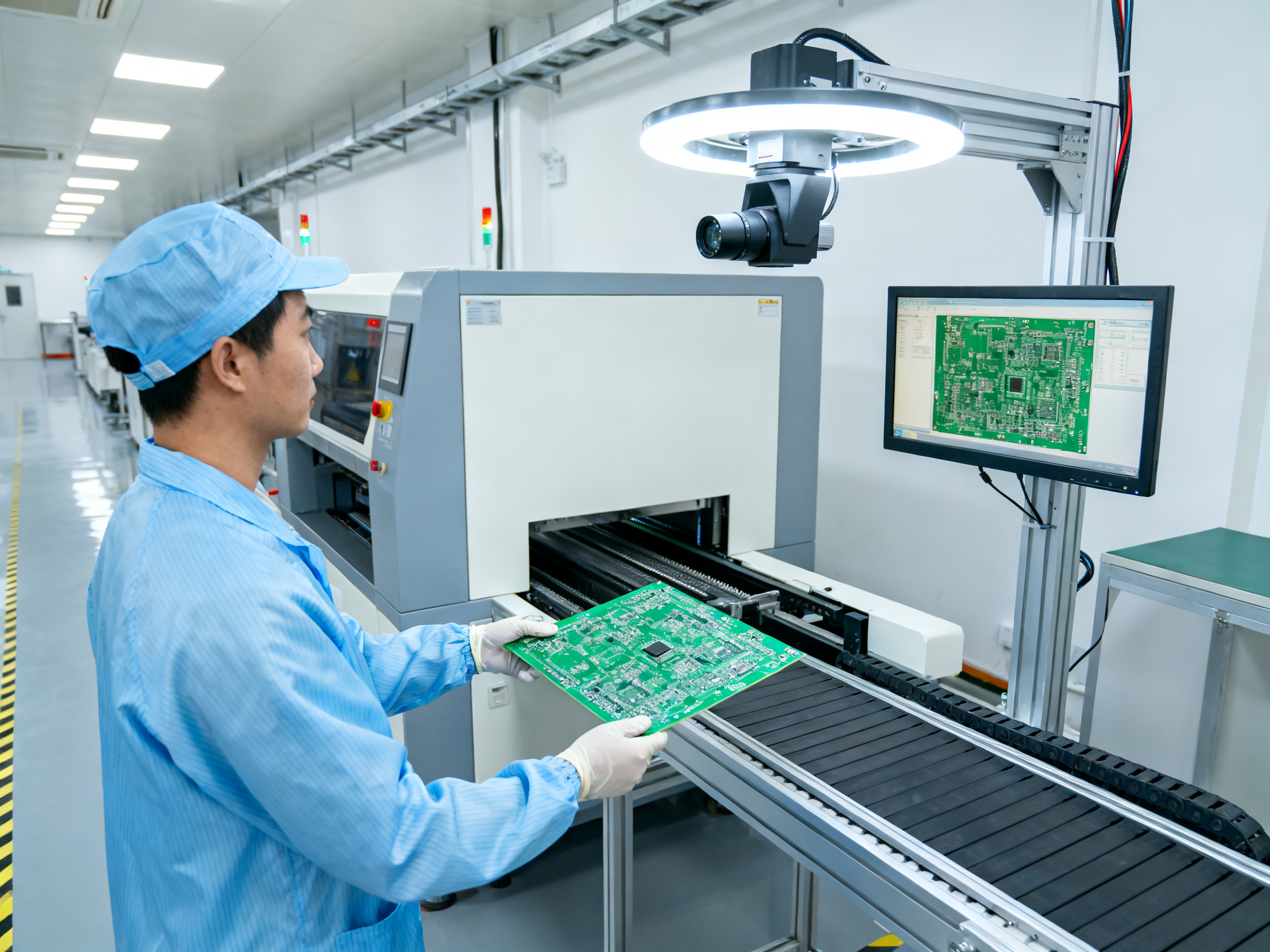
Pro Insight: Read the oven’s logging output as a diagnostic tool, not a pass or fail record. Soak-time drift tells you the paste or board is outgassing too early. Ramp-rate deviation points at the recipe, not the board. Peak-temperature margin shows how much headroom you have before components start taking heat damage. Pull that data next to your AOI and X-ray results and the correlation is usually obvious within a week.
Traceability is what makes that correlation possible. Ask whether the oven can capture a board ID, assign a profile per board, raise deviation alarms, and export logs in a format your SPC or MES team can parse.
[Oven] --board ID + profile log--> [AOI] --defect counts--> [ICT / X-Ray]
   |                                    |                        |
   +------------> [SPC / MES database] <--+------------------------+
One more thing. On hybrid lines with wave soldering, teams constantly blame reflow for defects that the wave process created. Insufficient wetting on through-hole joints and large thermal-mask voiding are almost always wave solder issues. Keep the two defect sets in separate logs.
From Our Experience: We once pulled oven thermal logs against a batch of AOI and X-ray failures and found the pattern was not temperature at all. It was a paste lot that had been sitting near the end of its shelf life. The oven log showed a normal ramp and peak, which sent everyone looking at the wrong machine entirely.
Vendor question: “Can the oven capture a board ID, export SPC-ready logs, and record which profile ran on each board, and does your wave soldering line come with the same traceability?”
Want your defect data mapped against a thermal log? Send a sample failure report to the S&M applications team through the lead-free reflow oven pages, and they will run the correlation with you.
Factor 7: Energy Efficiency, Total Cost of Ownership and Maintenance
The purchase price is the part everyone looks at. It is also the smallest part of what the oven costs you over its life. An industrial reflow oven runs hot for eight, ten, sixteen hours a day, and it does that for five to seven years before replacement. Energy and consumables quietly outrun the capital cost.
Here is how we build the TCO view with customers. All figures below are illustrative assumptions from our own commissioning work, so replace them with your own utility rates and duty cycle.
| Cost line | Capex (year 0) | Yearly opex | 5-year total |
|—|—|—|—|
| Oven purchase and installation | High | | 1.0x purchase price |
| Electricity for heat and fans | | High | 1.5 to 3.0x purchase price |
| Nitrogen consumption, where used | | Medium | 0.1 to 0.3x purchase price |
| Heater cartridges, fans, thermocouples | | Medium | 0.3 to 0.5x purchase price |
| Filters, boards, belts, consumables | | Low | 0.1 to 0.2x purchase price |
| Service, travel, technician time | | Medium | 0.2 to 0.4x purchase price |
| Total | | | Roughly 3 to 5.5x purchase price |
So divide by the boards produced, and the number that matters is energy per cycle. A modern oven with high-efficiency blowers, insulated chambers, standby modes and heat recovery between jobs can run a large share below a legacy ten-zone machine on the same board. We have seen plants cut kWh per cycle by roughly 30 to 40 percent on a zone-count-neutral upgrade. Nobody publishes a universal number, because it depends entirely on the board and the cycle.
Maintainability is the other half. Ask specifically about modular heater cartridges instead of a sealed heating assembly, and about spare-part lead times. A cartridge you can swap in an hour is a scheduled maintenance item. A sealed element is a line-down event, and in a plant with one oven that risk sits directly on your delivery date.
Then check the boring but decisive stuff. CE, UL and EMC documentation. Operator lockout and door safety interlocks. Local service coverage and the response time your contract actually promises. And the calibration and documentation regime, because if you build to ISO 9001 or IATF 16949 expectations, somebody is going to ask for calibration certificates, spare-part traceability and maintenance logs during an audit. Better to know now which supplier can produce those documents on request.
Vendor question: “Give me the kWh per cycle for my board at my throughput, the heater and fan service life, the spare-part lead times for my region, and the calibration documentation you can hand an auditor.”
Want this modelled against your own line? Send your duty cycle, utility rate and board mix to the S&M applications team through the lead-free reflow oven pages, and they will build the TCO comparison for you.
Factor 8: Line Integration, Automation and After-Sales Support
The oven you install has to live inside a line, not on a showroom floor. In 2026, buyers are asking fewer questions about peak temperature and more about how the machine talks to the rest of the line and who shows up when it breaks.
Here is the integration picture we design against:
[Printer] --> [Placement] --> [Reflow Oven] --> [AOI] --> [ICT / Test]
                   |               |              |
                   |               |              +-- Barcode / MES write-back
                   |               +-- Board ID read, profile auto-select
                   +-- Line control signals: start, stop, ready, fault
Ask a supplier about SECS/GEM and IPC-CFX Factory I/O connectivity, about automatic recipe change when the board barcode changes, and about semi-automatic or fully automatic load and unload. If the oven cannot accept a board ID and bind it to a profile record, your traceability stops at the line entrance.
Then judge the supplier the way you would judge a partner on site, not like a catalogue.
| Scorecard item | What good looks like |
|—|—|
| Commissioning | On-site profile qualification on your boards, not a demo coupon |
| Training | Operator and engineer sessions, recorded, in your language |
| Spare parts | Published lead times for heaters, fans, thermocouples, boards |
| Response time | Contracted on-site window, with a named local technician |
| Documentation | Manuals, application notes, calibration certificates, log formats |
Expert Tip: Send any supplier this five-line checklist before you ask for a quote: profile data format, Factory I/O or MES connectivity, spare-part lead times for your region, on-site response time, and exactly what training is included with commissioning. The answers separate suppliers who ship machines from suppliers who support lines.
From Our Experience: On one retrofit, the oven was not the constraint at all. The placement machine could feed twice what the conveyor lane configuration could handle, so the bottleneck moved downstream and the fix was a lane and rail change, not a bigger oven. Do the line balance before you size the tunnel.
For multi-site and defence or aerospace buyers, add four things: reference sites in the same industry, a written FAT/SAT protocol, calibration certificates and data retention that survive an audit, and the vendor’s roadmap for line-level factory solutions.
Want a line balance checked against your board mix? Send your panel dimensions, target UPH and machine list to the S&M applications team through the lead-free reflow oven and wave soldering product pages, and they will run the throughput and interface numbers with you.
Reflow Oven Selection Summary Table: 8 Factors at a Glance
Print this one. It is the procurement checklist we walk through with buyers before anyone signs a purchase order.
|
| Factor | Key question | Minimum acceptable spec | Failure mode prevented |
|—|—|—|—|—|
| 1 | Oven type | How does heat reach the board? | Multi-zone forced-air convection for dense SMT | Buying a desktop oven for 0.4 mm pitch BGA work |
| 2 | Thermal uniformity | Does every board in the panel see the same heat? | Loaded-zone delta-T of 3 °C or less at target throughput | Cold spots, tombstoning, uneven wetting |
| 3 | Profile control | Can it repeat the same profile every cycle? | 6 zones or more, per-zone PID, multi-board profiling | Over-melting, insufficient soak, voiding |
| 4 | Throughput | Can it keep up with your takt? | Measured UPH at your real board and load factor | Line starvation and queue backup |
| 5 | Alloy support | Can it run SAC305 and SnPb cleanly? | Peak capability to 260 °C, nitrogen option with ppm monitoring | Poor wetting, pad fall, RoHS failures |
| 6 | Monitoring | Can you see what happened inside the oven? | Per-cycle logging, board ID capture, SPC-ready export | Invisible process drift, no root cause |
| 7 | Cost of ownership | What does it cost over 5 years? | kWh per cycle quoted for your board, modular heaters, published spare-part lead times | Surprise utility bills, line-down events |
| 8 | Integration and support | Will it fit the line and stay supported? | SECS/GEM and IPC-CFX readiness, on-site profile qualification, contracted response time | Bottlenecks, no spares, no service |
Printable checklist: Before you request quotes, write your panel dimensions, heaviest board weight, target UPH, solder alloy, and required peak temperature on one sheet. Every candidate oven gets measured against those five numbers, not against a catalogue page.
Numbers above are our own recommended acceptance criteria from S&M commissioning work. Confirm them on your own boards before you commit.
Conclusion: The 5 Questions That Should Decide Your SMT Reflow Oven Purchase
Eight factors is a lot to remember in a supplier meeting. Here are the five that actually decide the purchase.
- What is the measured delta-T across my working zone, with my boards at my throughput? Anything less than a loaded figure of 3 °C is a cold-spot risk.
- Can you show me ramp, soak, peak and cooling data for my board type, at production loading, cycle after cycle? Reachability is easy. Repeatability is the real question.
- Does the machine hold my alloy window, with nitrogen and ppm monitoring if I need it?
- What does it log per cycle, and can my QA team parse the export? No board ID and no SPC-ready file means no root cause.
- What are the spare-part lead times, the on-site response time, and what training comes with commissioning?
Next steps by role. For a head of production, the priority is a sample profile trial on your own boards and your own paste, in your own panel loading, before a purchase order exists. For a procurement manager, insist that the quote states peak capability, zone count, working envelope, kWh per cycle and the warranty terms in writing, so you are comparing like with like rather than brochure to brochure. For a technology officer, require SECS/GEM and IPC-CFX Factory I/O readiness plus a board-ID to profile binding, because traceability has to survive your next audit, not just your next shift.
Looking ahead to 2026 and 2030. Our view, from commissioning work rather than market reports: lines keep automating, environmental rules keep tightening, defence and semiconductor work keeps raising the traceability bar, and energy budgets keep shrinking. Those four pressures reshape oven specifications long before any new heating technology does.
Takeaway: Do not sign a purchase order until a supplier has run your heaviest board, with your paste, at your takt, and shown you the resulting profile.
Ready to check your board mix against a working envelope? Send your panel dimensions, target UPH and paste datasheet to the S&M Co. Ltd. applications team through the lead-free reflow oven and wave soldering product pages, and they will run it with you. Related reading: our guides on wave soldering and SMT line layout.