
Published: November 17, 2026
Last Updated: November 17, 2026
Reading Time: 23 minutes
Commercial disclosure: This guide includes equipment recommendations that may include supplier-provided products. Where a manufacturer supplied equipment, travel, discounts, or other consideration, that relationship is stated in the relevant section. Nothing here should be read as an independent laboratory result. All specifications, protocol versions, and price ranges come from dated supplier materials and public listings, so confirm everything in a written quotation and during factory acceptance testing before you buy.
2. Introduction: Choosing the Right PCB Buffer in 2026
Buying a PCB buffer sounds simple. Put a box between two machines, and the line stops starving or blocking. Done.
It is not that simple. Get the buffer wrong and you create a new problem: work in process stacking up, boards rattling in a magazine, a reflow oven cooling too fast, or a reject board quietly joining the good board stream. Downtime you added is worse than the downtime you were trying to cover.
So what PCB buffer machine is best? Honestly, the answer depends on your line, not on a brand list. Your takt time, board sizes, defect segregation logic, thermal requirements, traceability needs, and whatever sits upstream and downstream all push the decision in different directions. A high-volume plant running mixed lots wants FIFO and traceability. A single-machine job shop mostly needs a compact pass-through buffer and quiet simplicity.
What this guide does is break the market down into 8 real machine types, then gets into the specs, the price bands, buying versus renting, and the integration questions that decide whether a machine actually works on your floor.
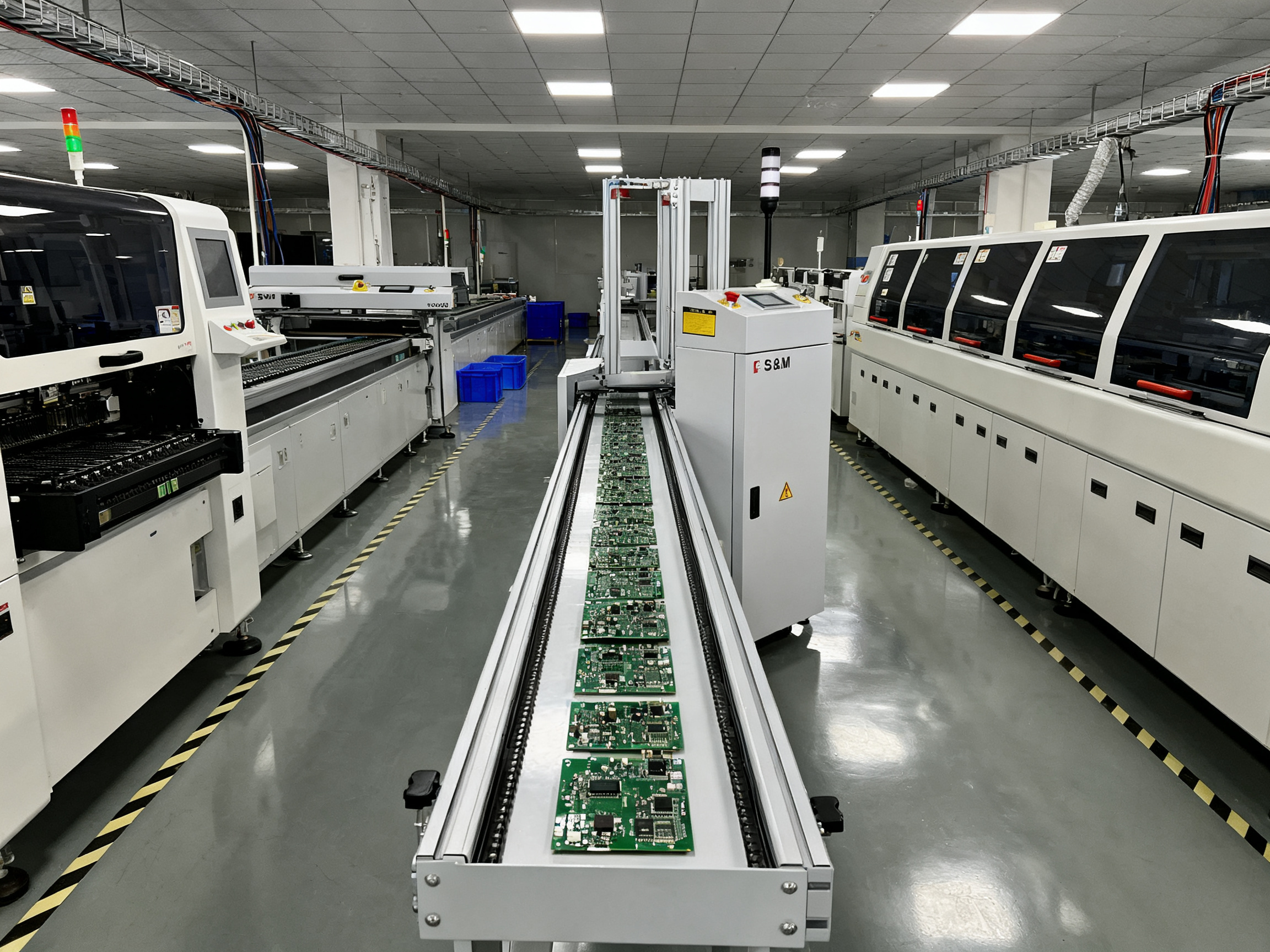
Figure 1: Where buffers sit in a typical SMT line, between printer, SPI, pick-and-place, reflow, AOI, and downstream handling or testing.
4. Quick Answer: What PCB Buffer Machine Do You Need?
Start with the question you should actually be answering: where does the line stop today? Everything else is detail.
| Your situation | Buffer type to look at | Why |
|—|—|—|
| Downstream starves during reflow or a printer refill | Magazine or vertical buffer | Most accumulation per meter of floor space |
| Rejects must never reach the good-board stream | NG/OK buffer | Separates defect boards from accepted ones |
| Boards come off the oven too hot to handle | Cooling buffer | Fan banks and airflow over the exit path |
| Lot order and genealogy matter | FIFO buffer | Preserves entry order, release order stays predictable |
| Short hiccups only, tight floor space | Compact pass-through buffer | About 5 to 10 slots, covers roughly a minute or two |
| Large, heavy, or warped panels | Heavy-duty buffer | Stronger lifts, rails, and drive support |
Now the decision tree, in order:
- Do boards leave the reflow hot? If yes, start with a cooling buffer. Handling a board at peak temperature is how you crack solder joints.
- Can a bad board ever be mixed into a good one? If the answer is even slightly yes, you need NG/OK separation and a defined source of truth for status.
- Does release order carry meaning? Traceable, mixed-lot work wants FIFO. Temporary accumulation where order does not matter can use LIFO.
- How long do your stops actually last? Measure them, do not guess. That number sets capacity.
- What space and budget do you have? That trims the list down to the finalists.
Before you request a quotation, confirm the board sizes, thickness, weight, and component clearance in writing, and check the line hand-off protocol on both sides. The Hermes standard site lists the current protocol versions, and legacy SMEMA signalling still shows up on older machines, so ask for a compatibility matrix, not a vague “Industry 4.0 ready” line.
Expert Tip: Size the buffer using takt time and realistic stoppage duration, not nominal magazine capacity alone. A 25-position magazine sounds generous until your effective takt is 12 seconds and the downstream stop lasts 8 minutes. Capacity you cannot use is floor space you are paying rent on.
And one honest caveat. Suppliers publish capacity bands, and “compact” usually means 5 to 10 positions while “standard” means roughly 15 to 25. Those are supplier conventions, not industry standards. Verify position count, board size limits, and cycle time on the quotation sheet before you compare two machines on price.
5. How We Evaluate the Best SMT PCB Buffer Conveyors
There is no lab test for a “best” buffer, so we built a weighted scorecard and applied the same set of questions to every machine we looked at. Each category gets a score against your line, not against a marketing page.
| Criterion | Weight | What we actually check |
|—|—|—|
| Throughput | 20% | Sustained cycle time at your takt and recovery rate after a stop |
| Usable capacity | 15% | Positions you can really fill with your board size, not catalogue positions |
| Board size range | 12% | Length, width, thickness, weight, component clearance, warpage |
| Line interface | 8% | Transfer height, rail style, pitch, and match to neighbours |
| Reliability | 12% | Duty-cycle evidence, jam history, MTBF, warranty terms |
| Controls and traceability | 12% | Barcode handling, MES reporting, protocol version matrix |
| Safety and compliance | 8% | ISO 12100 risk assessment, IEC 60204-1, ANSI/ESD S20.20-2021 |
| Serviceability | 8% | Spare parts lead time, response time, training and documentation |
| Total cost of ownership | 5% | Purchase, options, freight, install, spares, and downtime |
Specs Are a Claim, Not Proof
Every datasheet number we used came from dated supplier material, including listings for units like the Shenzhen Chuxin cooling buffer that states position count, pitch, and per-board weight. Those figures are useful starting points. They are not endurance results, and we never present them as if they are.
So we cross-check each one against four things: a live demonstration with your board size and thickness, named customer references you can call, warranty and spare-parts terms in writing, and a factory acceptance test that you define.
From Our Experience: On networked buffers, ask for a written protocol version matrix. The Hermes standard publishes its current revision and lists what a buffer must carry across the hand-off. If a supplier answers “Industry 4.0 ready” instead of naming versions, that is your first red flag.
What We Will Not Claim
Here is where we draw a hard line. We are not going to name one universal winner machine, because the same buffer that wins on a high-mixed, traceable automotive line can be wrong for a small contract job shop. Sizing, board handling, and segregation logic decide this, not brand ranking.
We also will not publish a single average 2026 price. Public listings range from roughly US$2,500 for basic direct-import units to about US$27,000 for supported NG/OK systems, and those figures are not like for like.
Finally, disclosure. Some equipment discussed here was supplied by manufacturers, and where that is true it is stated in the relevant section. The FTC Endorsement Guides require material connections to be clear and close to the claim, so treat any figure in this guide as a starting point for quotation and FAT validation, not as a tested conclusion.
6.1. Vertical Magazine Buffers: Best for High-Capacity Accumulation
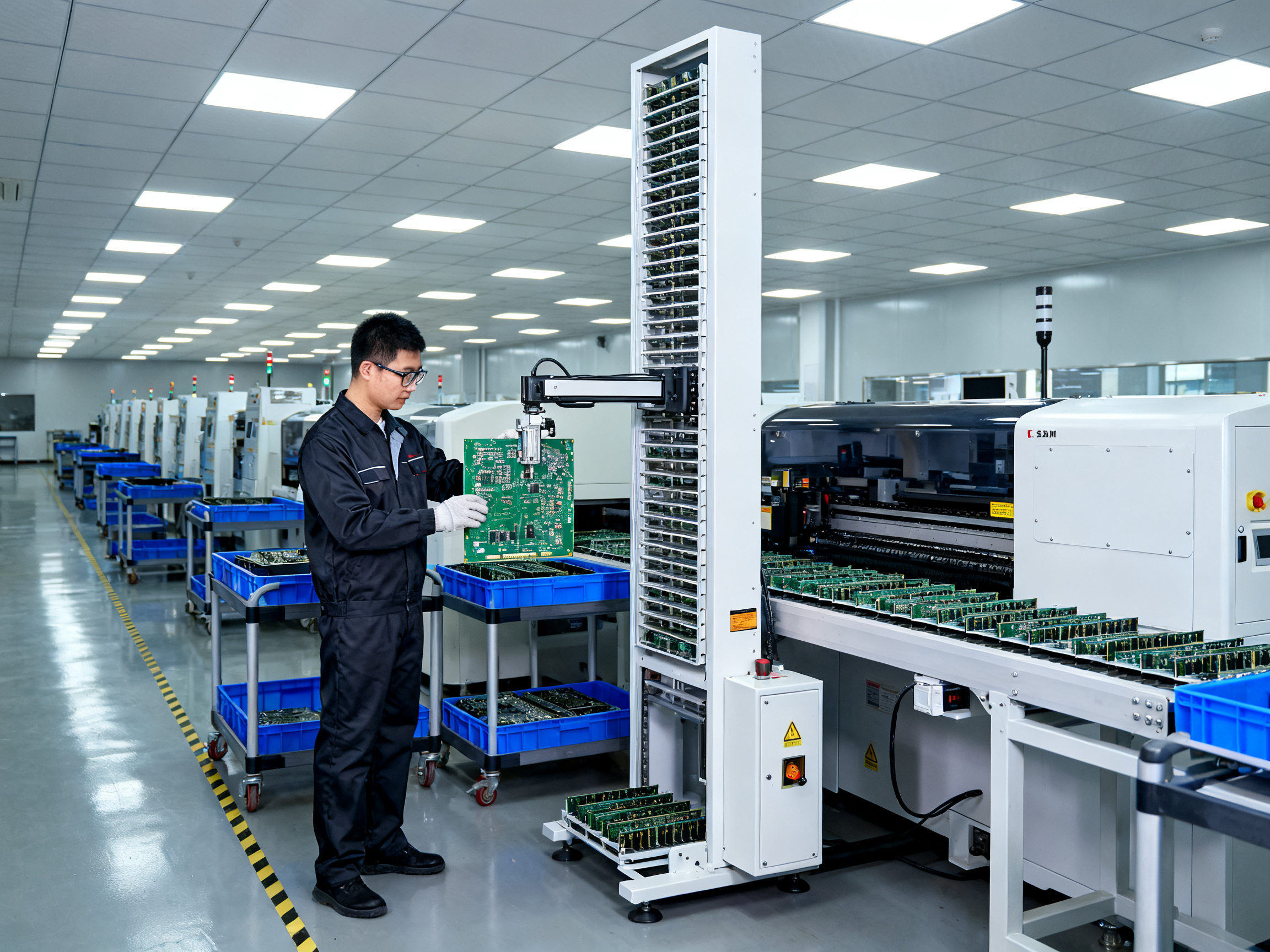
A vertical magazine buffer stacks boards straight up, like files in a filing cabinet. That single design choice buys you the most accumulation per meter of floor space of any buffer type, and it is why this style keeps showing up on high-throughput lines.
The idea is straightforward. Instead of sliding boards along a flat rail into a queue, a lift (or a pair of rails with a pusher) indexes each board into a slot inside a magazine. When the downstream machine wants a board, the buffer retrieves it in order and hands it off. You get a queue that is tall and narrow rather than long and wide, which matters a lot in a plant where floor space is measured in meters you can actually use.
Where it fits best
Smartphone and consumer electronics plants love these, and so do multi-machine lines where a printer change or a placement head replacement can stop upstream flow for a few minutes. If you need surge protection rather than pure pass-through, a vertical magazine buffer is the tool. The current AdoptSMT catalogue describes vertical systems in the 24 to 25 board range with roughly 15 second loading cycles, which gives you a useful yardstick when you compare machines.
| Spec point | Typical supplier claim | What to verify |
|—|—|—|
| Positions | 24 to 25 boards per magazine | Usable slots at your board size |
| Board size | Up to around 530 x 460 mm on common units | Your longest and widest panel |
| Board weight | About 2 to 3 kg per board | Your heaviest assembly |
| Loading cycle | Roughly 15 seconds | Sustained rate, not idle spec |
| Interfaces | SMEMA, some with Hermes or CFX | Protocol matrix for your line |
The tradeoffs nobody mentions in the brochure
Magazine handling is work. Somebody has to swap magazines, and if a full magazine waits on a rack next to the machine, you have created a second storage problem instead of solving the first. Changeover time for a fresh magazine should be on the FAT list, timed.
Board support matters more here than in a flat queue. Boards hang or rest on fewer contact points, so thin, warped, or heavy assemblies can shift or sag. Check edge support width and how the buffer handles a board with tall components on the underside.
And thin boards can be sensitive to vibration during retrieval. Ask for a jam rate on your actual board, not a demo sample.
Expert Tip: Size the buffer using takt time and realistic stoppage duration, not nominal magazine capacity alone. A 25 position magazine sounds generous until your effective takt is 12 seconds and the downstream stop lasts 8 minutes. Capacity you cannot use is floor space you are paying rent on.
If you want to see the mechanics before you shortlist, watch a magazine exchange video from a supplier and time the swap yourself. Then ask whether a magazine-type buffer listing like this one matches your board geometry and lane height.
7. 2. NG/OK Buffers: Best for Defect Segregation After Inspection
This is the buffer type that protects you from the worst possible outcome on a quality line: a bad board walking straight into the good-board stream with nobody noticing.
An NG/OK buffer takes a pass or fail result from your SPI, AOI, or ICT step, then routes the two outcomes down different paths. Accepted boards keep moving or park in a FIFO queue. Rejected boards get lifted into a dedicated slot or sent to an upper inspection conveyor where an operator can pull them, tag them, and route them to rework or scrap. The line keeps running. You do not.
That matters most where a defect is invisible to the naked eye. BGA and QFN packages hide solder voids, insufficient solder, and bridging under the component. Nobody catches those by eye. So in automotive, aerospace, and military work, the buffer becomes part of your quality containment system, not just a queue. The SDG-SMT Vego NG/OK configuration shows the standard architecture, where the reject is diverted to its own storage lane while good boards continue.
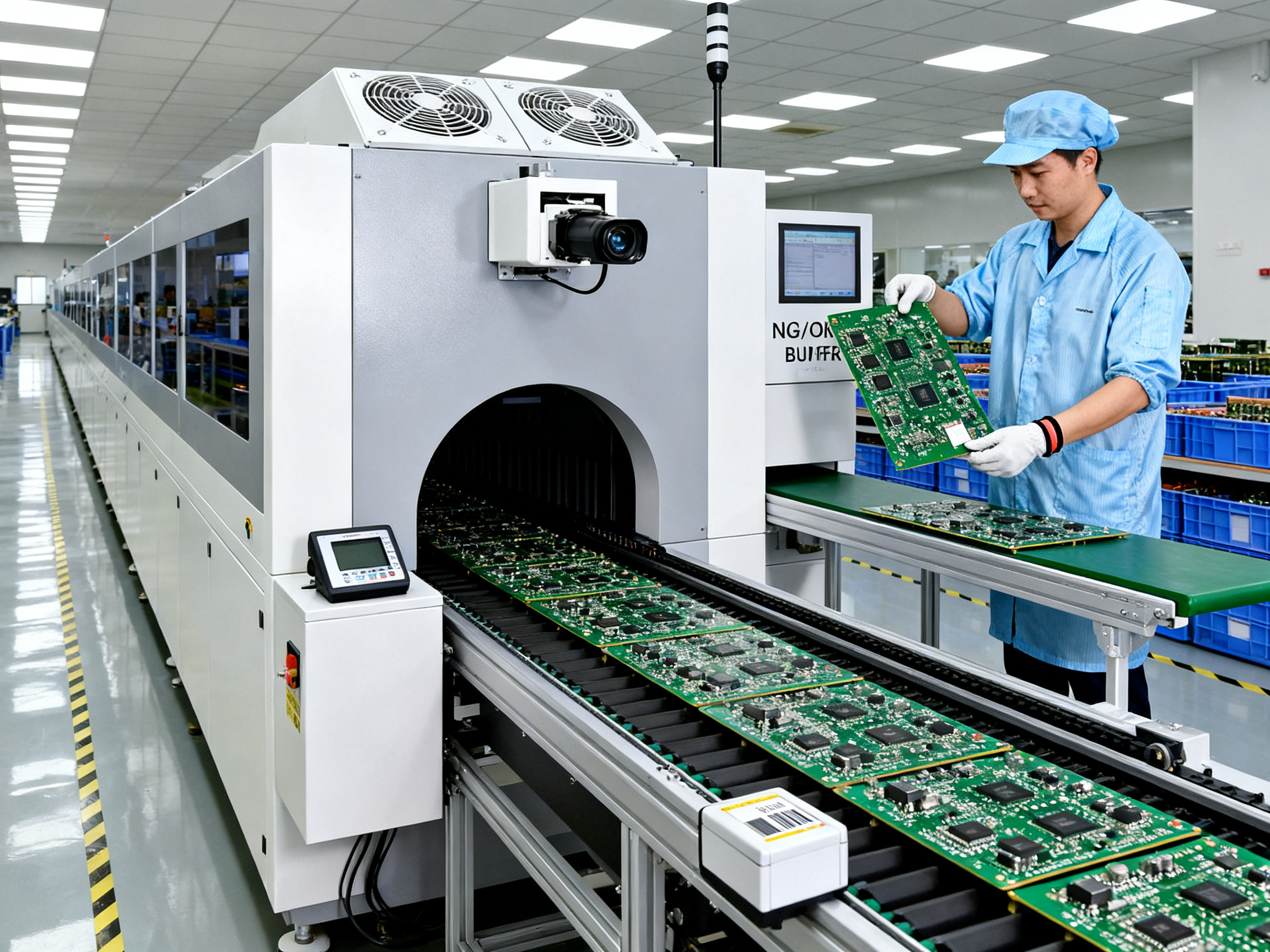
Here is the traceability record you should be able to pull for every board that touches the machine:
| Field | Example value |
|—|—|
| Board ID | PCB-4471-A2 |
| Source station | AOI-02 |
| Result | NG |
| Failure code | Solder bridge, J12 |
| Capture time | 2026-11-17 09:42:18 |
| Disposition | Held for rework |
| Operator | R. Mendez |
Pro Insight: Test communication-loss behavior during FAT. If the AOI stops sending results, the buffer must default to a contained state and never release an unverified board into the OK stream. Watch what happens on network loss, duplicate barcodes, missing reads, a delayed result, an emergency stop, and a controller restart. Also confirm what manual override is allowed and who can trigger it.
One more thing buyers often miss. Ask who owns the source of truth for board status: the AOI software, the line controller, or the MES. If the answer is unclear, you will get genealogy arguments six months later.
Want to see the routing options on a broader scale? Compare against a general-purpose FIFO conveyor and buffer listing, then ask the supplier what changes when the OK and NG paths are enabled.
Next up, section 8 looks at FIFO and LIFO buffers, where release order is the whole point.
8. 3. FIFO Buffer Conveyors: Best for Preserving Production Sequence
A FIFO buffer, which stands for first in, first out, does one simple thing well. The board that entered the queue leaves the queue first. That sounds obvious, but on a busy SMT line it is the difference between a traceable product and a guessing game.
Look at how boards move through a FIFO queue:
| Entry order | 1 | 2 | 3 | 4 | 5 | 6 |
|—|—|—|—|—|—|—|
| Exit order | 1 | 2 | 3 | 4 | 5 | 6 |
No board passes another. Lot 44 does not come out behind Lot 45, even if Lot 45 finished printing first.
Why sequence matters more than people think
Mixed-model plants run several work orders at once. A medical device board, an automotive controller, and a phone bracket can share one line. If the release order scrambles, the operator pulling boards at AOI or ICT pulls them out of sequence, the MES genealogy gets messy, and traceability claims become arguments.
FIFO is the right pick when you have lot control rules, cure windows, first-expiring material, or ordered downstream test sequences. It is also the right pick when every board carries its own unique ID and you want that ID linked to a real sequence. For short accumulation where order does not matter, LIFO works fine and takes less room.
Sizing it with real numbers
Here is a worked example. Assume your effective board takt is 12 seconds, your downstream machine stops for 8 minutes (480 seconds), your recovery factor is 1.25, and you hold 2 spare positions. The planning equation from production line capacity research gives:
Required usable positions = CEILING((480 / 12) x 1.25) + 2 = 52 positions
That is a much bigger machine than most people budget for. And this is the risk people miss: a queue that is too small does not fail loudly. It just stops covering the stoppage, so the upstream machine blocks anyway and your buffer becomes an expensive shelf.
Three things to check before ordering
- Queue visibility. Can an operator see how full the queue is, and which board is next out? Blind queues cause overfilling and jams.
- Maximum dwell time. How long can a board sit? Some boards cannot wait that long before the next step.
- Real capacity. Ask for usable slots with your board size and pitch, not catalogue positions. Current FIFO conveyor and buffer listings show a spread of slot counts and board limits, so verify your own geometry.
FIFO is not the fastest buffer. It is the one that keeps your records and your lot rules intact. Next up, LIFO buffers, where order genuinely does not matter.
9. 4. LIFO and Stack Buffers: Best for Compact Temporary Storage
A LIFO buffer, short for last in, first out, works like a stack of plates. The newest board lands on top, and the next board out is the one that went in most recently. No board passes another, but the order is the reverse of arrival.
That reversal is the whole trade. You give up strict sequence, and in exchange you get tight accumulation in a small footprint with fewer moving parts than a FIFO queue or a magazine system. For short buffers (say, 30 seconds to 3 minutes of coverage) on a line where order carries no quality meaning, that is a good swap.
Here is the side-by-side view:
| Factor | FIFO buffer | LIFO buffer | Magazine buffer |
|—|—|—|—|
| Release order | Entry order preserved | Reverse of entry | Entry order, by slot |
| Footprint | Longer, wider queue | Short and narrow | Tall and narrow |
| Board access | Sequenced, easy to trace | Top board only | Needs magazine swap |
| Complexity | Medium | Lower | Higher (lift, pusher, rack) |
| Relative cost | Mid | Lower | Mid to high |
| Genealogy fit | Strong | Weak | Strong |
Supplier examples describe LIFO units in a similar band to other standard machines. One current catalogue lists a stack buffer handling 25 boards from 75 to 510 mm long, 50 to 510 mm wide, and 0.6 to 6 mm thick, up to 3 kg per board, in a floor envelope of 600 x 1050 mm, with optional heavy-duty drives and Hermes or CFX connectivity (AdoptSMT full catalogue).
When LIFO is the wrong answer
Skip it when lot sequence matters, when material has a first-expiring rule or a maximum wait, when downstream testing must run in order, or when every board needs its own traceable position. Those are medical, automotive, and military line conditions, and there you want FIFO.
One more trap. A LIFO buffer can look full while holding a board that has already been waiting too long. Ask for a maximum dwell alarm, not just a full alarm.
Next up, section 10 covers cooling buffers, where the board leaves the reflow oven hot enough to matter.
10. 5. Cooling Buffers: Best After Reflow for Thermal Control
Bodies come out of a reflow oven hot. Around 220°C at peak, still above liquidus for a while, and by the time the board exits it is on its way down to room temperature. Sometimes that is fine. Sometimes the next step is AOI, or conformal coating, or a test fixture that cannot tolerate a warm board, or an operator whose gloved hand has to touch it in 30 seconds.
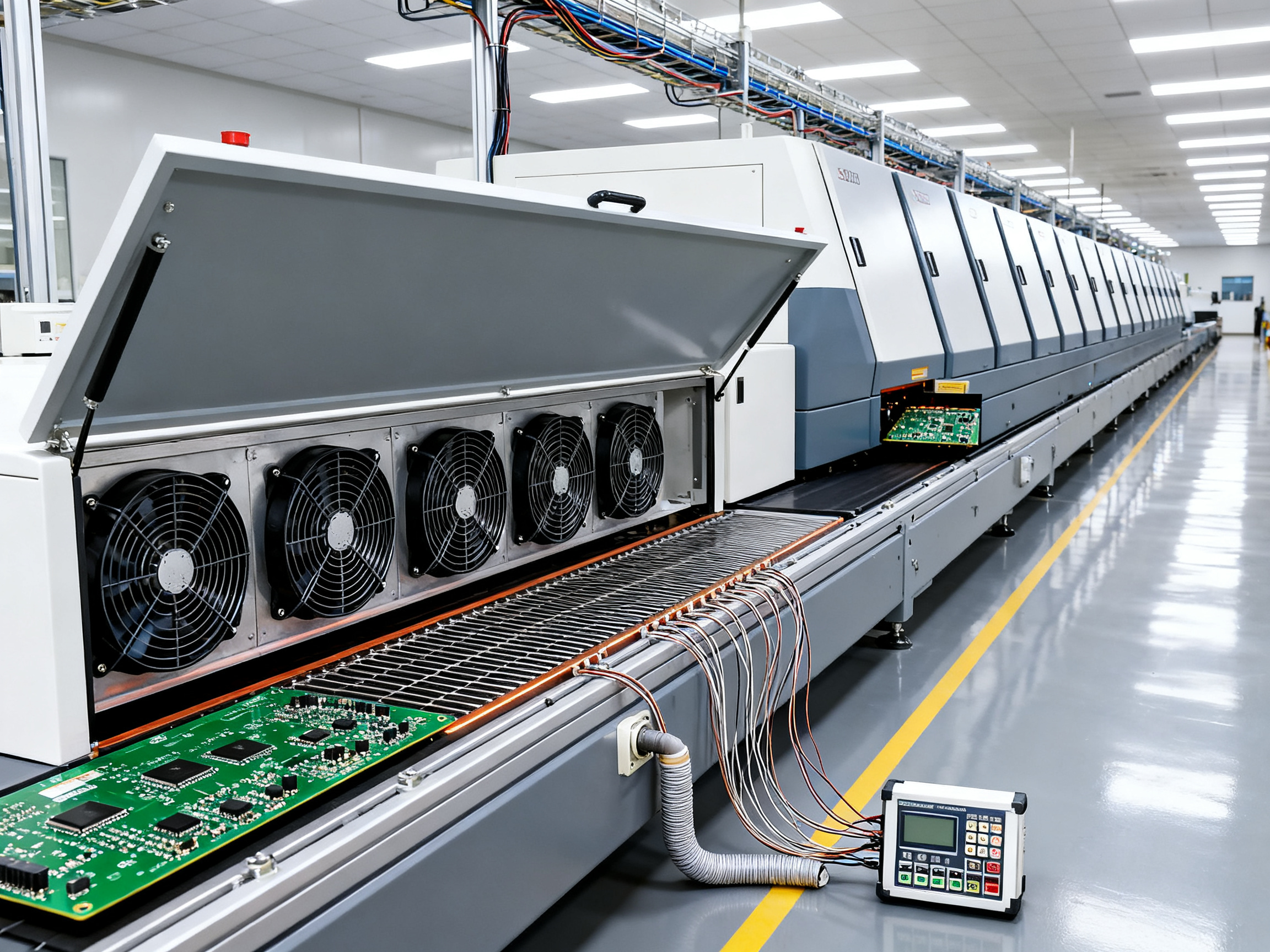
That is where a cooling buffer earns its place. Instead of pushing boards straight onto the next conveyor, it holds them in an airflow zone with fan banks so the assembly sheds heat before it moves on. Dwell time and airflow together set the exit temperature.
| Board type | Why cooling matters |
|—|—|
| Heavy copper or thick boards | Long thermal mass, slow to shed heat on its own |
| Dense BGA and QFN products | Package stress rises with thermal gradient |
| Automotive, medical, military work | Tight handling windows, plus a downstream step that sets a limit |
| Panels and carrier-based loads | Large flat surfaces that trap heat on the bottom side |
Here is the honest part. There is no universal safe exit temperature for a PCB leaving reflow. Component guidance such as J-STD-020 is a classification and preconditioning envelope, not a production temperature spec, and profiling guidance warns that overly aggressive cooling can create its own problems, including gradients and warpage. So what you do is define the limit that your downstream machine or coating process actually imposes, then validate against it.
A current cooling buffer datasheet, such as the Shenzhen Chuxin ZCLC-3XL, describes 20 positions, 30 mm pitch, roughly 12 second cycling, and boards from 80 x 50 mm up to 700 x 550 mm. Useful numbers, but no thermal curves attached. Fan count, airflow direction, ambient temperature, filter condition, board spacing and recirculation all change the result.
From Our Experience: Validate actual board temperature with representative high-thermal-mass assemblies before you approve dwell time and fan settings. A fan-only spec sheet tells you nothing about your product. Bring three worst-case boards, thermocouple them, and run the profile.
How to test it properly
- Instrument a worst-case assembly with thermocouples on the hottest components, not just the board surface.
- Run the machine at the dwell time the supplier proposes, with the enclosure closed and filters in normal condition.
- Log exit temperature across a full magazine, first board to last. The first board out is rarely the last.
- Compare against your downstream limit, not against a generic target.
Then set the FAT criteria accordingly. A cooling buffer that meets its rated dwell time but still hands you a 95°C board at the AOI in front of it has failed, even if every spec on the quotation matched.
Figure: recommended temperature-versus-time curve for a representative assembly, measured at the board surface and component level during the cooling buffer dwell.
Disclosure: Equipment referenced here was supplied by, or listed by, manufacturers. Where a supplier provided material, it is stated above.
Next up, section 11 looks at compact pass-through buffers, the smallest and cheapest way to cover short hiccups.
11. 6. Compact Pass-Through Buffers: Best for Space-Constrained Lines
Sometimes the honest answer is that you do not need a big machine. Compact pass-through buffers handle short accumulation, give you a bypass lane, and let you balance a line without dedicating a square meter of floor space to a magazine rack. Current small-footprint systems from suppliers like ASYS and SDG-SMT sit in the 5 to 10 slot range with FIFO cycles around 10 to 15 seconds.
Here is the catch, and it is arithmetic. A 5 position buffer at a 10 second takt stores about 50 seconds of output. A 10 position buffer stores about 100 seconds, and that is before you subtract safety margin and unusable slots. So you are covering a coffee break, not a printer change. That is fine, as long as you buy it for that job.
Expert Tip: Do not judge a compact buffer by footprint alone. The published envelope usually covers the machine frame, not the service zone. Ask for the maintenance clearance dimension and the footprint with the cabinet door open, then mark it on your floor layout before you sign.
Access and guarding matter more on small machines, not less. A tightly packed frame with a hard to reach jam means the operator is dismantling the buffer on the line. So ask about tool-free access to the transport, the sensor positions, and where a technician can stand. Ergonomic service zones are worth paying for; the money you save on floor space gets eaten by a longer mean recovery time every single time a board sticks.
Checklist before you commit:
- Bypass lane included, or lane swap by hand only?
- Interlocks on every accessible opening, checked at FAT against ISO 12100 risk assessment?
- Width change manual or motorized, and how long does it take?
- Noise level at the operator position, since it sits close to the line.
From Our Experience: Put the machine footprint on your layout and the service clearance on a second layer. If the two drawings do not fit your floor, the quotation is fiction.
Next up, section 12 covers heavy-duty buffers, built for large, heavy, and warped panels.
12. 7. Heavy-Duty High-Throughput Buffers: Best for Automotive and Industrial Production
Some lines punish a weak buffer. Automotive, industrial, semiconductor, aerospace, and military plants run three shifts, handle panels that weigh real kilograms, and treat an escaped defect or a stopped line as a serious cost, not a bad afternoon. This is where heavy-duty buffer conveyor systems earn their higher price tag.
What separates them is the hardware underneath. Heavier frame sections, wider rails and support arms, stronger lift motors, more drive margin, and guides built for warped or oversized panels. The optional heavy-duty configuration in the current AdoptSMT catalogue lifts the per-board limit from 3 kg to 10 kg, and that is the number to test against your heaviest assembly, not the marketing headline.
But here is the thing. Belt speed is not the metric. A buffer that runs 10 m/min and holds 6 minutes of boards is worth more than one that runs 25 m/min and trips every twenty minutes.
| Reliability scorecard | What to request in writing |
|—|—|
| Sustained cycle time | Measured at your takt over a full endurance run, not idle spec |
| Mean time between failures | Field history from comparable boards and duty cycles |
| Jam rate | On your actual panel size, thickness and component clearance |
| Mean recovery time | From jam to running again, including the reset |
| Critical spares | Lead time and price for drives, sensors, boards, motors |
| Warranty and response | Terms plus on-site service coverage in your region |
Now, the downtime math, because this is where heavy-duty pricing gets justified. Take a plant running 16 hours a day at US$180 in contribution margin per good board. A 20 minute unplanned stop wipes out roughly 320 board opportunities, or about US$57,600 of contribution, before you count the backlog, the expedite freight, and the customer conversation that follows. One such stop every two weeks costs you about US$150,000 a year. A buffer that costs three times as much as a light-duty unit but cuts stops in half pays for itself quickly. A buffer that jams just as often does not, no matter how strong its frame.
So ask for supplier test reports where they exist, and if they do not exist, write an endurance requirement into the contract. Ask also for the maintenance side. Heavy frames need space to work on, and a technician who cannot reach the drive without dismantling half the machine will take longer to fix every single fault.
If you want a starting point for comparison, current supported distributor listings show an XL heavy-duty buffer around US$19,750, well above a mini vertical unit, which tells you the price spread you are navigating in the market.
Next up, section 13 covers smart connected buffers, where motorized width, recipes, and Hermes or CFX reporting change the buying question.
13. 8. Smart Industry 4.0 Buffers: Best for Traceability and Automated Line Control
Here is the honest truth about “smart” buffers. Most of them are a normal mechanical buffer with a barcode reader bolted on and a colour touchscreen on the side. That is fine, and in some cases it is exactly enough. The real question is whether the machine can exchange meaningful data with the line you already have.
What connectivity should actually deliver:
- Board tracking. Barcode or RFID read at entry, read again at exit, and a record that ties both reads to one board ID.
- Recipe management. Product changeover by name instead of by hand, with the width setting and conveyor parameters stored per product.
- Automatic width adjustment. Motorized rails that move to the recipe value, so the operator does not guess.
- OEE data. Occupancy, cycle counts, jam events, and queue level exported on a schedule.
- Remote diagnostics. Fault codes you can read from a laptop instead of waiting for a technician to fly in.
- Predictive alerts. Warnings for a jam-prone board size, a failing sensor, or a queue that is filling faster than it drains.
Here is the catch. Connectivity you cannot use is just a line item on the invoice.
Expert Tip: Ask for a protocol version matrix in the RFQ, not a sentence about Industry 4.0. Named versions, ports, and message fields. If the supplier cannot list them, the feature probably does not work with your line.
| Requirement | Ask for this | Why it matters |
|—|—|—|
| Line handoff | IPC-SMEMA-9851, IPC-HERMES-9852, or both | Hermes version 1.7, released June 2026, is the current revision (Hermes standard) |
| MES and factory messaging | IPC-2591 CFX | Carries performance, materials, quality, and product tracking messages upward |
| Board data | Unique board ID, barcode, length, width, thickness, state | Without these, traceability is guesswork |
| Network | IP and port topology, segmentation, named IT owner | Hermes warns that unstable networks cost cycle time (IT success factors) |
| Security | Role-based access, log retention, update and rollback plan | Use an OT framework like NIST SP 800-82 |
One warning from the Hermes documentation that most buyers miss. The board ID can be lost and regenerated when a non-Hermes machine interrupts the chain. If you have legacy SMEMA equipment in the middle of the line, test that hand-off during FAT.
So, is a smart buffer worth it? If your MES expects real genealogy data, yes. If nobody on your team reads the exported files, you are paying for a screen with a logo on it.
Next up, section 14 looks at what PCB buffer machine for sale, rental, and used options actually cost in 2026.
14. PCB Buffer Machine Comparison Table
Here is the whole market on one page. Read the “Not ideal for” column first, because it removes options faster than anything else.
| Buffer type | Best used for | Usable capacity (supplier bands) | Footprint | Release order | Thermal control | Traceability | Relative cost | Not ideal for |
|—|—|—|—|—|—|—|—|—|
| Vertical magazine | Surge protection, high-volume lines | 24 to 25 boards per magazine | Tall and narrow | FIFO by slot | None | Strong | Mid to high | Small floors, frequent changeovers, very light boards |
| NG/OK | Separating defects after AOI or SPI | 20 to 25 positions plus a reject lane | Medium | FIFO on OK path | None | Strong, per board status | Premium | Lines with no inspection step, very small shops |
| FIFO | Mixed-model, lot-controlled work | 15 to 25 positions | Long and wide | Entry order | None | Strong | Mid | Sites where floor space is the binding constraint |
| LIFO and stack | Short temporary accumulation | 15 to 25 positions | Short and narrow | Reverse of entry | None | Weak | Lower to mid | Medical, automotive, military work with lot rules |
| Cooling | Post-reflow thermal control | 20 positions at 30 mm pitch | Medium | FIFO | Fan banks and dwell | Basic | Mid | Lines where the next step tolerates a warm board |
| Compact pass-through | Short hiccups, tight spaces | 5 to 10 positions | Smallest | FIFO | None | Basic | Low | Covering printer changes or long stoppages |
| Heavy-duty | Large, heavy, warped panels | 15 to 25 positions, 10 kg per board option | Largest | FIFO | Optional | Strong | Premium | Light mixed-model work with a small budget |
| Smart connected | MES genealogy, recipe control | Same as mechanical base | Same as base | FIFO or LIFO | Optional | Strongest | Highest | Plants where nobody reads the exported data |
Implementation complexity follows a simple order: compact pass-through and cooling buffers are the least involved, FIFO and LIFO sit in the middle, and NG/OK, magazine, heavy-duty, and smart buffers carry the most setup, programming, and training.
On price bands, think in three tiers rather than one number. Basic direct-import units start near US$2,500, configured factory machines run roughly US$9,000 to US$15,000, and premium supported or connected systems reach US$19,000 to US$27,000. These are USD figures from public listings and distributor pricing, quoted on FOB or delivered basis from Asia and North America, and they exclude freight, duties, rigging, installation, training, and any options. Compare like for like only. Send one RFQ to every finalist and demand the same configuration, then read the incoterm on the page.
Pro Insight: Price bands are a screening tool, not a quotation. Use them to drop machines that cannot fit your budget, then let your written RFQ and factory acceptance test decide.
Next up, section 15 covers new, used, rental, and leasing options for a PCB buffer machine for sale, plus the landed cost nobody puts on the invoice.
15. How to Size and Specify an SMT PCB Buffer Conveyor
Start with arithmetic, not a catalogue. Any supplier will happily sell you a machine with more slots than you need, and a slot you never fill is floor space paying rent on your floor.
Use this first-pass equation:
Required usable positions = CEILING((target interruption coverage in seconds ÷ effective board takt in seconds) × recovery factor) + reserved positions
It is a planning adaptation of Little’s Law, and you should sanity-check it against real stoppage history. Academic work on buffer sizing in serial production lines shows that repair rate, machine reliability, variability, and line length all move the optimum, so the equation starts the conversation rather than ending it.
| Input | Where to get it |
|—|—|
| Effective board takt | The slower of your required production takt and the actual upstream release interval |
| Interruption coverage | Your own stop log, last 3 to 6 months, not a guess |
| Recovery factor | Your demonstrated recovery rate after a stop; anything above 1.0 needs evidence |
| Reserved positions | 2 to 3 for changeovers, rework returns, and manual handling |
Worked example: 12 second takt, 480 second stop, 1.25 recovery factor, 2 reserved positions gives 52 usable positions. That is a large machine, and it is the number you should quote.
Now the specification. Put these on the RFQ sheet in writing, because verbal answers evaporate fast:
- Board envelope: minimum and maximum length, width, thickness, mass, edge clearance, component height above and below the board, and warpage tolerance
- Transfer: direction of flow, fixed rail or moving rail, conveyor height, pitch, and how it mates to the machines on both sides
- Interface: SMEMA, Hermes, or both, with the protocol version matrix
- Utilities: power supply, air pressure, exhaust and filtration, and noise level at the operator position
- Order logic: FIFO, LIFO, or NG/OK, plus maximum dwell time and the alarm that fires when it is exceeded
- Compliance: ESD plan to ANSI/ESD S20.20-2021, ISO 12100 risk assessment, IEC 60204-1
From Our Experience: Buyers who skip the recovery factor are the ones who end up with a queue that looks full and cannot actually absorb the stop. We always ask for the post-stop recovery rate measured on a comparable line, because a buffer that drains at the same speed it fills will not save your throughput.
Factory Acceptance Testing
Acceptance belongs in the contract, not in a conversation after the invoice. Run the FAT with your boards, including your worst-case recipe, and a practical SMT loader and unloader FAT/SAT checklist is a good starting structure to adapt.
Test this list before sign-off:
- Sustained cycle time at your takt, measured over an endurance run
- Alignment and repeatability across the full width range
- Jam rate on your actual panel size and thickness
- Full and empty behaviour, plus clear alarm messages
- FIFO order integrity and NG/OK containment, including communication loss
- Duplicate barcode, missing read, and delayed result handling
- Emergency stop, power loss, and controller restart recovery
- Recipe and width changeover timing
Then repeat the critical ones at SAT with the machine in the live line.
Expert Tip: Write the acceptance criteria into the purchase contract as measurable numbers. Catalogue capacity is a claim; a witnessed endurance run is evidence.
Next up, section 16 looks at new, used, rental, and leasing options, plus the landed cost that never appears on the invoice.
16. PCB Buffer Machine Price: Buy, Used, or Rental?
Here is the part nobody quotes you a number for. The machine price is the smallest line in a real budget.
What the price actually includes
A buffer quotation usually covers the machine, a few options, and a shipping term. Everything else lands later, usually after the invoice.
| Cost line | What it covers | Typical surprise |
|—|—|—|
| Base machine | Frame, transport, drive, controller | Cheapest part of the deal |
| Options | Auto width, dual lane, barcode readers, cooling, Hermes/CFX | Can add 30 to 50 percent |
| Magazines and racks | Spare magazines for vertical systems | Often left off the quote |
| Freight and crating | Sea or air, insurance, delivery to dock | Peaks every shipping season |
| Duties and broker fees | Tariff on the landed value | Depends on your origin mix |
| Rigging and install | Moving it into position, line modification | Often excluded from “delivered” |
| Validation and training | FAT support, SAT, operator training | Frequently unbudgeted |
| Spares and service | Sensors, drives, boards, travel, warranty | Deferred until something fails |
| Downtime during commissioning | Line stops while the machine is installed | Rarely written down |
Public listings show the spread clearly. A basic magazine-type unit sits near US$2,500, marketplace automatic and cooling buffers run US$4,100 to US$9,600 FOB, and supported distributor listings reach from about US$15,100 for a mini vertical buffer to roughly US$26,500 to US$27,000 for NG/OK systems (buffer distributor listings). Those are not like-for-like numbers, so treat them as screening bands only.
Five-year cost of ownership
| Route | Year 1 | Years 2 to 5 | 5-year total | Best fit |
|—|—|—|—|—|
| New, supported | Purchase plus install and FAT | Spares, service contract, updates | Highest, most predictable | Full-time production use, 5 years or more |
| New, direct import | Purchase plus freight, duties, install | Parts bought as they fail | Lower total, higher risk | Buyers with their own engineers and spares |
| Used | Purchase plus refurbishment and recommissioning | Spares, occasional repair | Low to mid, condition dependent | Budget lines, pilot and trial work |
| Leasing | Monthly payments, maintenance often included | Residual at the end | Mid, capped | Spreading cost over a known run length |
| Rental | Daily or weekly rate, freight each time | Same rate, plus transport | Highest per hour of use | Temporary capacity and bridge periods |
The rental reality check
Rental gets interesting when you need a buffer for four months while your new line is installed, or when a peak season needs surge capacity you do not want to own. Specialist SMT lessors do exist (SMT renting services), and they are more realistic than a consumer rental counter.
But custom geometry kills rental. A buffer built for 700 x 550 mm panels with Hermes and a cooling section is not sitting on a rental shelf. Same for used. A used FIFO buffer listed around US$6,500 sounds attractive (used buffer listings), but you inherit the condition, the software, the missing sensor, and the question of who still supports the controller.
So the rule is simple. Buy the machine you will run every day. Rent the machine you need for a while. And put the used option on the table only if you have someone on staff who can recommission it.
Expert Tip: Send one RFQ to every finalist, including the rental houses, and ask each to state region, currency, Incoterm, tax and duty assumptions, installation scope, and warranty. Comparing a FOB machine against a delivered rental on a headline price is comparing two different purchases.
Next up, section 17 looks at the integration checklist to work through before you place an order.
17. Integration Checklist Before You Place an Order
The buffer is never a standalone purchase. It bolts into a line that already exists, and it inherits every constraint the line already has. So the last stretch of this guide is about the handover: the checks that stop a good machine from becoming a bad install.
Here is the checklist we work through with buyers, with an owner column so nothing falls between departments. Print it, fill in the names, and hand it to the supplier as the attachment to the RFQ.
|
| Check | Owner | Evidence to sign off |
|—|—|—|—|
| 1 | Mechanical fit: transfer height, rail style, pitch, direction of flow | Production | Approved layout drawing with dimensions |
| 2 | Board handling: min/max length, width, thickness, mass, clearance, warpage | Engineering | Trial run with representative and worst-case boards |
| 3 | Electrical and utilities: power, air, exhaust, filtration, noise at operator position | Maintenance | Utility data sheet and noise reading |
| 4 | Line handoff: SMEMA and/or Hermes, with the protocol version matrix | IT/MES | Written ICD and interoperability test |
| 5 | Software and data: recipe storage, board ID fields, CFX messages, export format | IT/MES | Data mapping document and sample export |
| 6 | Safety: interlocks, guarding, e-stop, ISO 12100 risk assessment, IEC 60204-1 | EHS | Signed risk assessment and category data |
| 7 | ESD: ANSI/ESD S20.20-2021 plan, grounding, wrist straps, material handling | Quality | Verification records from the ESD plan |
| 8 | Environment: temperature, humidity, dust, cleanroom class, exhaust route | EHS | Supplier environmental limits in writing |
| 9 | Documentation and training: manuals, wiring, spare parts list, operator and maintenance training | Procurement | Delivered package and training sign-off sheet |
| 10 | Warranty, spares, escalation: coverage terms, critical spares, response path, named contacts | Procurement | Contract terms with named escalation contacts |
Three documents you should demand, not request nicely
The approved layout. Your drawing and the supplier’s drawing, side by side, with the service clearance marked on a second layer. If those two do not fit the floor, the quotation is fiction, no matter how good the machine is. Ask for the footprint with the cabinet door open, because the published envelope rarely covers the service zone.
The interface control document. This names the protocol versions on both sides of every hand-off, the message fields, the timeout behaviour, and what happens when a legacy SMEMA machine interrupts the chain. The Hermes specification notes that the board ID can be lost and regenerated at that interruption point, so test it, do not assume it.
The trial record. Boards you actually build, through the actual machine, with the results logged. Ask for thermocouples on worst-case assemblies if a cooling section is in scope, and ask to see the exit temperature, not just the dwell time.
Expert Tip: Get every one of those ten owners to sign the same page before you issue the purchase order. A buffer that satisfies production but breaks the MES data model is a six-month problem you paid full price for.
Phased commissioning and the baseline you capture first
Commission in phases rather than all at once. Mechanical install and power-up first, then single-board transfer, then mixed boards at takt, then a full endurance run, then live SAT with the neighbouring machines actually running. Each phase gets a written pass or fail.
Then measure the baseline before the machine touches anything. You cannot prove improvement without a “before”.
| Metric | How to capture it | Target after install |
|—|—|—|
| Availability | Planned production time minus unplanned stops | Measurable gain, agreed in advance |
| Blocking and starvation minutes | Line event log, per machine pair | Fewer minutes at the covered station |
| Buffer occupancy distribution | From the machine or the MES | Peaks stay below usable capacity |
| Unplanned stops | Downtime log, 3 to 6 months prior | Fewer events, shorter duration |
| Mean recovery time | Jam to running again, including reset | Same or better than the current workaround |
| Throughput | Boards good per hour | No regression on the covered station |
| Defect escapes and false rejects | Quality records before and after | No increase, then improvement |
| Genealogy exceptions | Reconciliation between buffer, AOI and MES | Zero unexplained mismatches |
| Changeover duration | Timed product change, including width setting | Faster and repeatable |
Hold the baseline for at least a full shift before install and keep the same measurement method afterwards. Academic work on serial production lines shows buffering helps throughput only up to a point, after which extra capacity adds marginal benefit while WIP and floor space costs keep climbing (buffer sizing research). Your own numbers will tell you where that point sits. If you would like to see how cooling buffers are specified inside a real reflow and handling package, the cooling buffer documentation from Shenzhen Chuxin is a useful reference for the utility and interface data you should be requesting from any supplier.
One last thing, and it is the one that gets skipped. Agree who owns the machine after go-live. Production owns uptime, maintenance owns spares and response time, IT owns the network and the protocol version, and quality owns the disposition logic. Write those names on the handover sheet. A buffer with four unassigned owners will have nobody to answer the phone at 2am on a night shift.
Next up, section 18 gives the expert recommendation: how to match the buffer type to the bottleneck you actually have, plus the questions worth asking a supplier in the first call.
18. Expert Recommendation: Match the Buffer to the Bottleneck
So, what PCB buffer machine is best? The honest answer is that the best buffer is the one that covers your actual stoppage, respects your sequence rules, handles your board geometry, and fits the floor you have left. There is no universal winner, and anyone selling you one is selling you their catalogue.
Pick from this shortlist based on the constraint that hurts most. Starving downstream? Vertical magazine. Untraceable defects? NG/OK. Lot sequence? FIFO. Hot boards? Cooling. Short hiccups and no floor? Compact pass-through. Heavy or warped panels? Heavy-duty. MES genealogy? Connected.
Then shortlist two or three configurations and put them through the same test: your boards, your takt, and a fault scenario or two. That comparison will tell you more than any spec sheet.
Your five next steps:
- Document the requirement. Board sizes, mass, component clearance, takt, stoppage history, sequence rules, temperature limits.
- Calculate capacity. Use the sizing equation, then sanity-check against three to six months of your own stop log.
- Send one RFQ to every finalist. Same configuration, same incoterm, named protocol versions, written warranty terms.
- Run a structured FAT. Your boards, your worst-case recipe, an endurance run, and a deliberate communication-loss test.
- Baseline before install. Availability, blocking minutes, jam rate, genealogy exceptions. Measure before and after, the same way.
Expert Tip: If a supplier cannot give you a protocol version matrix, an endurance result, and a service response commitment in writing, treat the quotation as a starting point, not a decision.
Want a technical line assessment? Request a buffer quotation with your board data, takt, and layout, and ask for the capacity calculation, the FAT protocol, and the interface control document alongside the price. Those three documents separate real suppliers from catalogue resellers.
Commercial disclosure: equipment referenced in this guide includes manufacturer-supplied and listed products. Supplier relationships are stated where relevant. Confirm all specifications, prices, and protocol claims in writing and during factory acceptance testing before purchasing.