
Published: 23 October 2026
Last updated: 23 October 2026
Reading Time: 20 minutes
Author: Editorial Team, S&M Co. Ltd. (author credentials pending verification)
Reviewer: Pending assignment. No qualified reviewer has been confirmed for this guide yet, so no reviewer name or credentials are published at this time.
Editorial Trust Signals
How to read this guide. Every equipment example in this guide is illustrative. Nothing here is a factory acceptance test, and no oven pictured or described has been validated on your specific product mix. Where we mention S&M Co. Ltd. products, including lead-free reflow ovens and complete SMT production lines, that is a commercial connection and we say so plainly.
Standards note. This guide references IPC J-STD-001, IPC/JEDEC J-STD-020, and IPC-7530 for process guidance, plus RoHS, REACH, and applicable CE, UL, and OSHA routes for equipment conformity. Standard revisions do change. Check the current edition in the official IPC status listing and the IPC product catalog before you commit to a purchase, and confirm EU obligations in the European Commission RoHS pages and ECHA legislation collection.
Read more
- Editorial policy and how we source claims
- Commercial disclosure for vendor-supplied evidence
- Our SMT case studies, including the Foxconn Vietnam deployment record
- Methodology and source list for defect, yield, and energy figures used in this guide
Expert Tip: If a supplier cannot show you a current IPC/JEDEC standard edition number, a profiler calibration record, and a declaration of conformity for the exact model you are buying, slow the decision down. Paperwork gaps tend to show up later as an audit finding, not on the delivery date.
Introduction: The Oven Is a Process Decision, Not Just an Equipment Purchase
Ask a production manager what a reflow oven costs and you get a number. Ask what a bad reflow oven decision costs and you get silence. That’s the problem. An undersized chamber or a weak heating system doesn’t fail loudly on the delivery date. It shows up three months later as cold joints on the same connector, then as a line that can’t keep takt time when you load a new product mix, then as an engineering meeting about why the next launch slipped.
SMT production, which stands for surface mount technology, puts every component on one side of the board and solders them in a single pass through the reflow oven. That makes the oven the one machine where thermal mistakes touch every single assembly on the line. Get it right and the rest of your SMT production line equipment gets easier. Get it wrong and you’re debugging solder defects that actually originate 20 feet upstream.
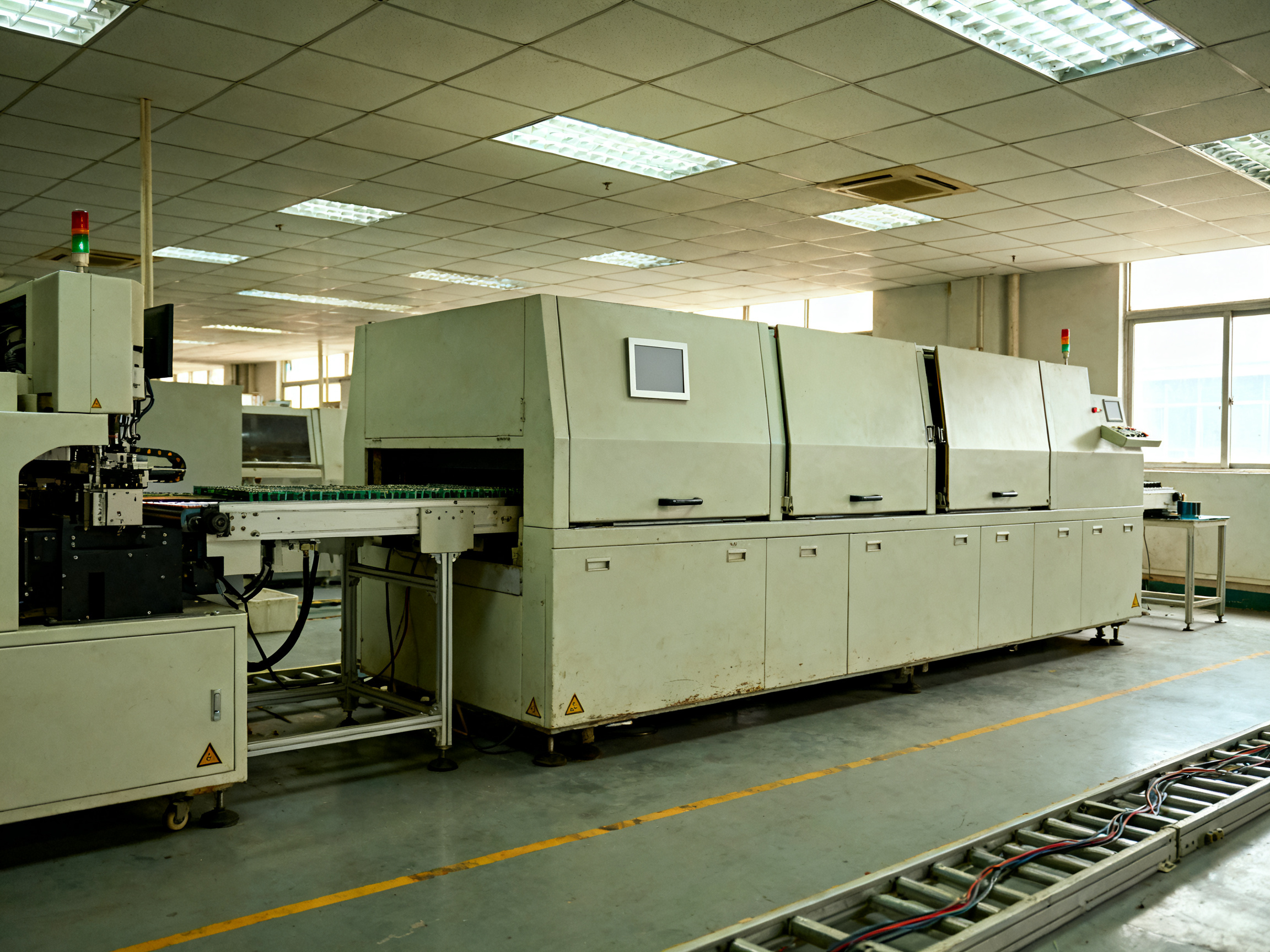
The scale of the problem shows up in the data, even the sparse data. In a 2025 production study at Atma Jaya Catholic University, inspectors reviewed 2,664 boards and rejected 69 of them, a 94.51% yield, with the failures traced largely to solder insufficiency on warped boards (Atma Jaya research article). Warping plus a weak thermal profile is exactly the kind of interaction a careless oven purchase creates.
Decision in one sentence: A reflow oven for SMT production should be chosen by matching thermal capability and profile control to your real product mix and takt time, then proving it with measured profiles and a defensible total cost of ownership, not by comparing spec sheets feature for feature.
This guide is for production leaders, process engineers, procurement managers, and technology officers who are selecting or replacing an oven. It covers requirements, oven types, specifications, profile validation, line integration, compliance, supplier support, and cost of ownership, so you can answer one question with confidence: how to choose reflow oven for an SMT production line that runs for the next five years.
Author and reviewer details for this guide are pending verification. We publish reviewer credentials only after a qualified reviewer confirms them in writing.### About the Author and Technical Review
This guide was prepared by the Editorial Team at S&M Co. Ltd., which builds lead-free reflow ovens, wave soldering machines, and complete SMT production lines under the Shenzhen Chuxin Electronic Equipment Co. Ltd. brand.
We are not publishing a named author or reviewer for this guide yet. Author credentials, direct profiling and line commissioning experience, and reviewer sign-off are pending verification, so we have left those details blank on purpose. Every claim in this guide links to a source you can check, and our editorial policy explains how we handle vendor-supplied evidence.## 1. Define Your SMT Production Requirements Before Comparing Ovens
Here’s the trap most buyers fall into: they open three supplier quotations, start comparing heating zones and conveyor speeds, and treat the oven as a standalone purchase. Six months later the oven is installed, and it turns out it cannot hold takt time on a 12-layer board, or it needs nitrogen the building doesn’t have, or it sits in the wrong spot in the line.
The oven is the only machine on the SMT production line where a thermal mistake touches every single assembly. So specifications come second. Requirements come first.
Start with volume and takt
Write down target units per hour or panels per shift, number of shifts, changeover frequency, and expected growth over the next three to five years. Then convert that into conveyor speed and work-in-process load. A 350 mm conveyor running at 90 cm per minute gives you roughly 13 seconds of board in a zone. Multiply that by your zone count and you have your process window before the oven even heats up.
Board dimensions and conveyor direction matter just as much. A machine specced for 650 mm panels will not help you if your largest assembly is 320 by 180 mm and you run it diagonally. Also note conveyor side, since left-to-right and right-to-left layouts decide where the oven physically sits.
Characterize the thermal load
This is where product mix decides the oven. Capture PCB layer count and mass, largest components, heat-sensitive parts, alloy (SAC305, SAC305 plus additions, or SnAgCu), BGA and QFN density, double-sided assembly, and whether you are running high-mix low-volume or high-volume high-repeat.
Massive multilayer boards with large thermal-mass components need soak time and thermal mass headroom. Dense BGA and QFN parts with small pitch need uniform heating and low ramp gradients. Heat-sensitive parts such as some sensors and large electrolytic capacitors set your upper temperature limit. You cannot have everything, and the product mix decides which trade-off you make.
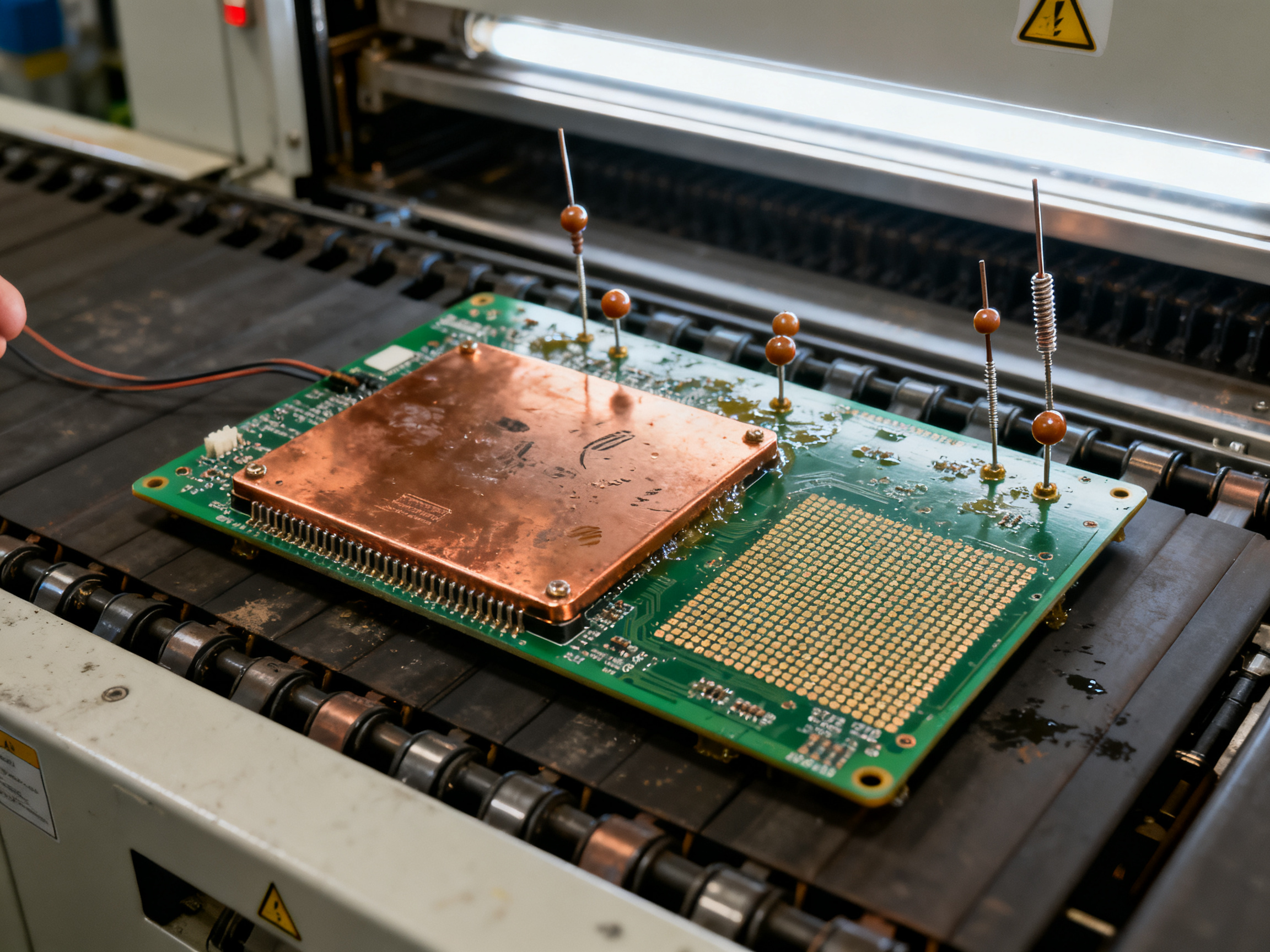
Set acceptance criteria before you shop
Write measurable targets: first-pass yield, allowed defect classes, process capability, traceability, uptime, atmosphere control, and the standards that apply to your market. For process guidance, use IPC-7530, listed as IPC-7530B in the IPC catalog, alongside IPC J-STD-001 and IPC/JEDEC J-STD-020.
Use our SMT process flow chart to locate reflow. It sits after placement and before inspection, and it is the only step where the whole board shares one thermal history.
| Product family | Panel size | Board mass | Layers | Alloy | Target takt | Risk components |
|—|—|—|—|—|—|—|
| Consumer controller | 320 × 180 mm | 85 g | 4 | SAC305 | 8 s | QFN, Li-ion holder |
| Automotive ECU | 250 × 200 mm | 210 g | 8 | SAC305 | 14 s | QFN, MCU, connector |
| AI accelerator board | 320 × 180 mm | 340 g | 12 | SAC305 | 18 s | BGA, VRM, heat spreader |
| Sensor module | 120 × 90 mm | 22 g | 2 | SAC305 | 5 s | MEMS, small passives |
We built this table for a customer once that ran all four families on one SMT production line. The single biggest change was not the oven itself. It was realizing that the AI accelerator board set the nitrogen requirement and the automotive ECU set the soak time, so those two drove the spec, and the consumer controller just came along for the ride.
Pro Tip: Download the requirements worksheet from our SMT production resources and fill it in before requesting a quotation. A supplier who cannot answer your worksheet questions line by line is telling you something useful early.
Now that you have requirements on paper, the next section compares the actual reflow oven types and heating technologies you can buy.## 2. Compare Reflow Oven Types and Heating Technologies
Now that your requirements are on paper, you can compare ovens without getting lost in the spec sheet. The four main reflow oven types are batch, inline forced convection, vapor phase, and vacuum-assisted. Each one solves a different problem.
Batch ovens: fast, cheap, and limited
A batch oven processes a whole panel at once in a single chamber. Boards go in, the chamber heats and cools through a profile, and the panel comes out. For prototype work, pilot runs, and low-volume job shops, batch ovens still make sense. They cost less, they need less floor space, and changing a recipe takes seconds.
The limits are obvious once you see them. One chamber means one profile per cycle, so every board in the panel has to share a single thermal history. If you mix board sizes and masses in one load, you will get profile drift across the panel. Cycle time is also fixed by the slowest board in the load. Batch ovens do not scale to volume.
Inline forced-convection ovens: the volume workhorse
Inline ovens move boards on a conveyor through separate heating, soak, and cooling zones. Each zone has its own heater and blower, so you can shape the profile zone by zone. This is the standard choice for high-mix and high-volume SMT production lines because you get repeatability, recipe storage, and automated loading.
Where a batch oven runs one profile per cycle, an inline oven can hold different profiles for different product families by changing the recipe at the conveyor. That flexibility is exactly what you need when the AI accelerator board needs 18 seconds and the sensor module needs 5.
The tradeoff is footprint and operating burden. Inline ovens take more floor space, they use more energy, and they need exhaust venting. Some models also need nitrogen. Budget for a gas or electric supply, fume extraction, and somewhere for the exhaust to go.
Vapor phase and vacuum-assisted options
Vapor phase reflow uses a heated liquid, typically a fluorinated or hydrocarbon fluid, to transfer heat. It gives very uniform heating across the entire board, which is attractive for dense BGA and QFN work. The tradeoff is cost, fluid consumption, maintenance, and the fact that many modern buyers avoid halocarbon fluids for environmental reasons.
Vacuum-assisted reflow reduces voiding by pulling air out of the solder joint during reflow. It is a targeted answer to voiding problems, not a general purpose oven.
Nitrogen-capable convection ovens are the middle path most high-volume lines end up choosing. They combine standard convective heating with a controlled inert atmosphere that limits oxidation, and they help with voiding and dross on fine-pitch work.
Match the technology to the application
There is no universal ranking. Consumer electronics cares about takt time and cost per board. Automotive cares about traceability, repeatability over years, and PPAP-level documentation. Semiconductor and aerospace work cares about process control and qualification evidence far more than throughput.
| Type | Ideal use case | Throughput | Thermal control | Voiding potential | Operating burden | Relative capital cost |
|—|—|—|—|—|—|—|
| Batch convection | Prototype, pilot, low volume | Low, cycle-bound | Good, one profile per load | Medium | Low | Low |
| Inline forced convection | High-mix and high-volume SMT production lines | High, zone-controlled | Very good, zone by zone | Medium | Medium to high | Medium |
| Inline nitrogen convection | Fine pitch, BGA and QFN, automotive | High | Very good plus atmosphere control | Low | High, nitrogen supply | Medium to high |
| Vapor phase | Uniform heating, thermal-mass boards | Medium | Excellent, whole board | Low | High, fluid and maintenance | High |
| Vacuum assisted | Voiding critical applications | Medium | Good | Lowest | High | High |
Expert Tip: The most advanced heating technology is not automatically the right choice. An experienced process engineer matches technology to board thermal mass, component mix, voiding limits, takt time, and the maintenance capability you actually have on site. A nitrogen oven with no trained technician and no gas contract will not out-produce a simple convection oven that runs all night.
One real selection example: for the Foxconn Vietnam deployment, the equipment record covers four TS-1203D-NEV ovens alongside 194 handling units, and a further 12-zone dual-track nitrogen oven ordered in July 2026. The S&M case study record documents deployment only, with no yield claims. Notice what that tells you. The volume case pulled in nitrogen-capable multi-zone capability. A smaller job shop with a single product family would have been well served by inline convection alone.
Before you commit to a type, run the numbers on footprint, energy, nitrogen, and service coverage in your region. The next section maps SMT reflow oven specifications to your product mix, which is where most mistakes actually happen.## 3. Match SMT Reflow Oven Specifications to the Product Mix
Spec sheets are where good intentions go to die. Every oven claims good thermal performance. Your job is to turn marketing language into a measurement you can repeat on your own boards.
Heating and cooling architecture
Start with zone count and effective heated length. A zone with heaters but poor airflow is just a warm space. You want independent top and bottom control, so you can heat from one side when a board has a heat sink on the bottom or a dense component cluster on top.
Airflow uniformity shows up as edge-to-center delta. The edge of a board heats and cools faster than the center, especially on a large or heavy board. Ask suppliers for the delta figure and how they measured it. A thermocouple taped at one corner tells you nothing useful.
Heater response matters for ramp rate. Slow heaters force you to slow the conveyor or accept a gentle ramp that some packages cannot survive. Cooling rate matters just as much; lead-free reflow soldering demands controlled cooling, and an aggressive blast can crack large BGA joints and warpage-sensitive boards.
Flux management is the quiet one. Where does flux go? Look for dedicated flux extraction at the entry and exit, and for a design that keeps condensation out of the blower and heater area.
Capacity: the number suppliers like to hide
Reflow oven capacity gets quoted as “boards per hour” or “panels per hour,” which is close to meaningless. What matters is conveyor speed and the process window that speed allows.
Here is the formula we use:
Process window (seconds) = heated length (cm) ÷ conveyor speed (cm/min) × 60
Now the worked example. An oven with 300 cm of effective heated length running at 90 cm per minute gives 200 seconds in the oven. If your profile needs 165 seconds total, you have 35 seconds of slack. Run that same oven at 100 cm per minute and you have 180 seconds, so your slack drops to 15 seconds. At 110 cm per minute you have 164 seconds, which is below the profile requirement. That oven just lost your speed option.
Then subtract the real loading interval. If a handler loads a board every 18 seconds, your conveyor cannot run faster than one board every 18 seconds, no matter what the spec sheet says. And check the true bottleneck. Often the oven is not the constraint; the placement machine or the AOI is.
| Specification | Your requirement | Vendor claim | Test method | Verified result |
|—|—|—|—|—|
| Effective heated length | 300 cm minimum | “12 heating zones” | Zone-by-zone thermocouple sweep | Not yet measured |
| Edge-to-center delta | Under 10 °C on a 340 g board | “Uniform heating” | 5 thermocouples, edge vs center | Not yet measured |
| Top/bottom independent control | Yes, both sides | “Dual heating” | Set differential, log ramp curves | Not yet measured |
| Cooling rate | 2 to 4 °C per second | “Rapid cooling” | Record cooling curve after peak | Not yet measured |
| Nitrogen O₂ control | Below 500 ppm | “Optional nitrogen” | O₂ probe at exit of soak zone | Not yet measured |
| Conveyor speed range | 5 to 120 cm per minute | “Wide range” | Run slowest and fastest recipes | Not yet measured |
| Reflow oven capacity | 165 seconds minimum | “Up to 400 boards/hour” | Time 100 consecutive loads | Not yet measured |
Ask for a run-off on your own boards. Anything a supplier will not measure with your product mix is a claim, not a specification.
Atmosphere, controls, and data
If you run nitrogen, get the consumption figure in cubic meters per hour, the required purity, and the oxygen level you can actually hold at the exit of the soak zone. Nitrogen costs real money, and an oven that leaks atmosphere is an operating cost nobody quotes. Budget for the piping, the gas contract, and a monitor.
Controls matter more than the touchscreen. You want recipe management with locked profiles, so a process engineer cannot accidentally change a qualified recipe mid-shift. You want alarms that pull the line down, not just beep. And you want profile monitoring that logs every board, because the day you need proof, you will not have it.
Connectivity is the last layer. Does the oven talk to your MES or factory data system? Can you pull recipe and board history without asking the machine’s original vendor for help? For SMT production line equipment, an oven that requires a proprietary server in another country is a liability.
Pro Tip: Ask every supplier to fill in that table with real numbers, then ask which of those numbers they can demonstrate on your boards in a rental or pilot run. The columns that stay blank tell you who is willing to put their name on the claim.
Utility loads and placement on the floor
Get the connected power, the average power at your recipe, and the exhaust air volume in cubic meters per hour. Then match the machine to the building, not the other way around.
| Load | Inline convection oven | Inline nitrogen oven | Vapor phase oven |
|—|—|—|—|
| Connected power | 20 to 40 kW | 25 to 50 kW | 30 to 60 kW |
| Nitrogen | Optional | 15 to 40 Nm³ per hour | Optional |
| Exhaust | 400 to 800 Nm³ per hour | 500 to 900 Nm³ per hour | 600 to 1,000 Nm³ per hour |
| Floor space | 4 to 7 m by 1.5 to 2 m | Same plus gas skid space | 5 to 8 m by 2 m |
SMT line oven placement decides the utility question for you. Put the oven next to the exhaust wall and you shorten the duct run and the pressure drop. Put it next to the incoming air handler and you pull conditioned room air into the chamber, which raises energy use and makes profiles less stable. Leave the service access clearance the manual specifies, not the clearance that fits on the day the truck arrives.
One more thing. Verify the oven can talk to the other SMT line machines in the line protocol you actually use. Convection vs vapor phase reflow matters, but so does whether the reflow oven hands off cleanly to the AOI or the selective solder station downstream.
Next up: how to validate thermal performance with real profiling, and how to catch the defects before they reach your customer.## 4. Validate Thermal Performance, Profiling, and Defect Control
This is the section where a purchase becomes a process. An oven can meet every specification on the quote and still produce cold joints, because the spec sheet describes the machine, not what happens to your board on a cold Tuesday morning.
The profile window comes from your paste, not from us
Solder paste suppliers publish a recommended profile window, and that window is your starting point. It covers ramp rate, soak time and soak temperature, time above liquidus, peak temperature, and cooling. Use the numbers your paste supplier gives you for that specific paste on that specific alloy. Do not assume a published number applies to your board.
What matters is the interaction. A steep ramp can skin the paste before flux finishes its work. A long soak can dry out the flux before it reaches liquidus. A peak that sits too low gives you a cold joint, and a peak that climbs too high burns the flux residue and stresses components. A cooling phase that is too gentle produces poor intermetallic growth over time; a cooling phase that is too fast can crack large BGA joints and warp a board that was already marginal.
Pro Tip: Print the paste supplier’s window on one axis and your measured profile on the other. The gaps are your process capability, and they tell you how much drift your line can absorb before joints start failing.
Treat any number in this guide, or in a supplier’s brochure, as an example to be verified against your own paste and boards, not a universal limit. The same “peak temperature” that is perfect for a 22 g sensor module can cook a 340 g accelerator board’s heat-sensitive components, because the board never reaches peak uniformly.
Build a validation protocol that survives an audit
Here is the sequence we use, and it follows the structure of IPC-7530, which is guidance for developing and applying thermal profiles for mass soldering processes. Check the current edition in the IPC catalog listing before you build your work instruction around it.
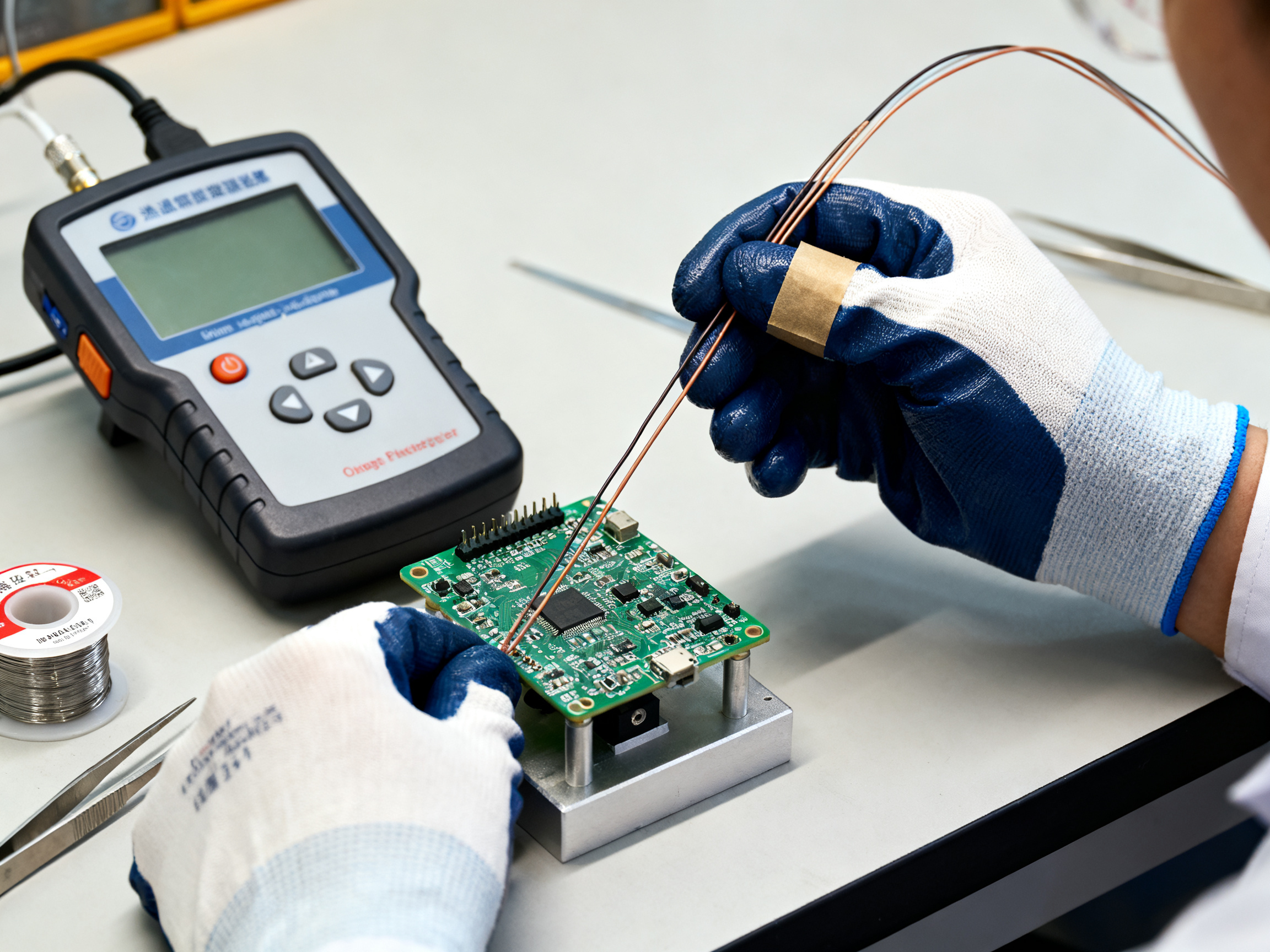
- Calibrate the profiler first. A profile from an uncalibrated instrument is a guess with a chart attached. Log the calibration date and use a contact thermocouple or infrared camera that covers your temperature range, which for lead-free SAC305 work sits well above 250 °C.
- Choose the right boards. One representative board plus one worst-case board. Worst case means the heaviest assembly, the densest BGA array, or the board with the most heat-sensitive parts, whichever worries you most.
- Attach thermocouples properly. Use the smallest sensible bead, secure it with high-temperature adhesive, and place it on a real component or a location that represents the joint you care about. Tape a bead to a corner of bare laminate and you measured the corner of the laminate, not the solder joint.
- Measure at multiple locations. At least one on a large thermal mass component, one on a small joint, one on a lead-free-sensitive part, and one at the board center. Single-point profiling is the most common reason people think their oven is better than it is.
- Run it loaded and unloaded. An empty oven profile is a laboratory result. Load the oven with representative boards and re-profile.
- Run it repeatedly. Same recipe, same boards, at least three runs. Then run a hot start after a full production shift, and a cold start on a Monday. Thermal recovery is where recipes fail.
- Hold worst-case locations. The point of the profile is the slowest and fastest point on the board, not the average.
| Profile parameter | What it controls | Symptom when wrong | Corrective action direction |
|—|—|—|—|
| Ramp-up rate | Flux activation, solder melting | Skinned paste, solder balls | Slow the ramp, check oven zone balance |
| Soak time and temperature | Flux burnout, solder paste wetting | Dry-out, weak joints, residue | Adjust soak zone dwell |
| Time above liquidus | Joint formation | Cold joints, non-wet opens | Extend TAL, raise peak slightly |
| Peak temperature | Joint formation, component stress | Damage to parts, lifted pads | Lower peak, check placement |
| Cooling rate | Intermetallic growth, stress | Cracked BGA joints, warpage | Adjust cooling blower or add cool-down |
| Edge-to-center delta | Uniformity on heavy boards | Cold joints at board edge | Improve airflow, extend soak |
Connect the profile to the defects you actually see
Profiles exist to prevent specific failures. Here is the mapping most lines need.
| Defect | Usual suspects | Where to check first |
|—|—|—|
| Voiding in BGA | Low soak, insufficient flux, wetting issue | Soak zone dwell, nitrogen O₂ level |
| Head-in-pillow | Component lift during reflow, low peak | Peak temperature, pad design, paste volume |
| Non-wet opens | Low TAL, low peak, poor paste print | Time above liquidus, peak temperature |
| Tombstoning | Uneven heating, part too light, pad mismatch | Top and bottom heat balance, ramp rate |
| Solder balls | Flux displacement, violent heating | Ramp rate, exhaust, flux deposition |
| Component damage | Peak too high, soak too long | Peak temperature, package MSL rating per J-STD-020 |
| Board warpage | Uneven thermal mass, fast cooling | Cooling profile, heavy copper balance |
| Excessive intermetallic growth | Long dwell above liquidus, slow cooling | TAL, cooling rate |
Head-in-pillow and tombstoning often get blamed on the oven when the real cause sits upstream in the printing and placement steps. Keep that in mind during root cause work. A 2025 production study at Atma Jaya Catholic University reviewed 2,664 boards and rejected 69, a 94.51% yield, with failures traced largely to solder insufficiency on warped boards (Atma Jaya research article). Warpage plus a weak thermal profile is exactly the pair that a careless oven choice creates.
From Our Experience: On a representative high-mass board profile trial, the thermocouple on the large heat spreader told a completely different story from the one taped to the connector near the board edge. The edge joint reached liquidus early and cooled fast, while the heat spreader lagged by more than 40 °C at peak. No oven specification had revealed that, because the spec sheet describes air temperature, not component temperature. Move the thermocouple to the joint you actually care about before you accept any vendor claim.
Two honest caveats. First, publicly available evidence on reflow-caused defects and first-pass yield loss is thin. A 2025 peer-reviewed study in Soldering & Surface Mount Technology reported roughly 10% better component self-alignment after profile optimization, which is a process-performance metric rather than a proven 10% drop in defect rate (study record). Second, vendor-published figures exist but carry no independent validation, so treat them as claims until you reproduce them.
Finally, tie the profile to your acceptance rules. J-STD-001 does not hand you a universal oven recipe. It asks you to build and verify a capable process using the materials supplier’s recommendations plus IPC-7530 profiling, and it does not by itself tell you whether a given joint passes. That call belongs to your product classification and your customer.
Next section: total cost of ownership, and the supplier questions that actually tell you how a supplier will behave after the invoice clears.
5. Plan Oven Placement, Utilities, Automation, and Line Integration
Buying a reflow oven is the easy part. Making it work inside a real SMT production line is where schedules slip.
Where the oven actually goes
Standard SMT production process flow puts the oven after pick-and-place and before cooling and inspection. In practice you need to account for more than that arrow. Board transfer between the placement machine and the oven takes space, and so do the upstream and downstream buffers. If the oven cannot buffer a placement machine stop, every placement fault becomes a full line stop. You want enough accumulation to absorb a short upstream fault, but not so much that boards sit in the preheat zone and cook.
Reject handling sits on the other side. Decide where boards that fail AOI go, and how they get out of the line without an operator reaching across a hot zone. Operator access matters too. If someone has to stand on a platform to load a heavy panel, you have designed a problem you will pay for in ergonomics and lost time.
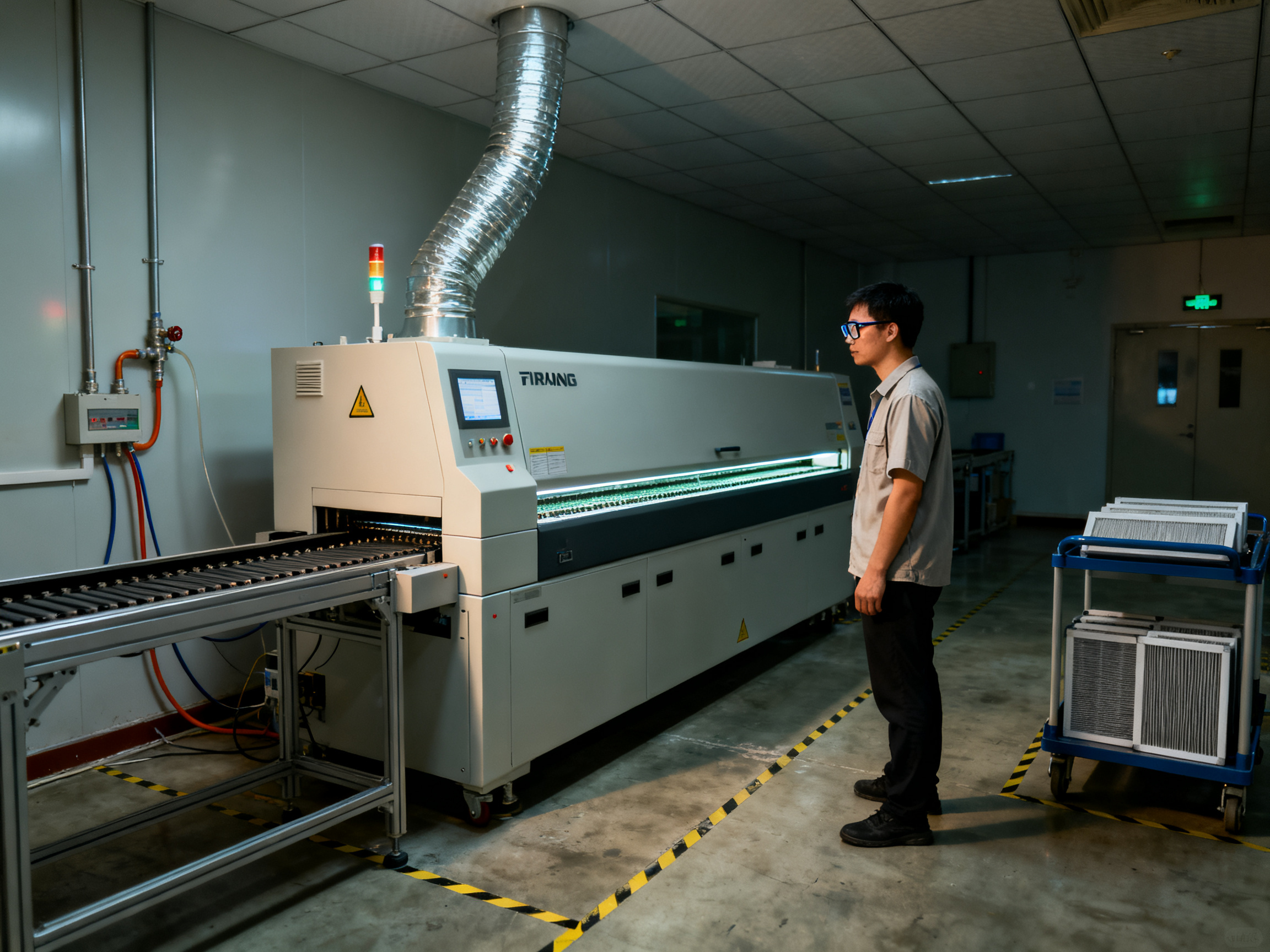
Here is the layout logic in one table.
| Position in the line | What it must connect to | Common layout mistake |
|—|—|—|
| Entry | Placement machine exit, board transfer unit | Oven too close, no room for the handler to swing |
| Inside the oven | Conveyor, buffers, unload | Conveyors at different heights, transfer clipping |
| Exit | Cooling tunnel, AOI or manual inspection | No reject chute, boards stack at the end |
| Alongside | Material flow, operator aisle, spares | Exhaust duct crossing a walkway |
SMT line oven placement gets decided by floor plan, but floor plans get decided by utilities. Do them together.
The interface checklist
Write an interface control document before the purchase order. It is a boring document, and boring is exactly what you want here.
- Mechanical. Conveyor height, board transfer direction, left-to-right or right-to-left flow, clearance for the manual in the equipment book, and the footprint including service access.
- Electrical. Supply voltage and phase, connected load, breaker sizing, and where the disconnect lives.
- Environmental. Exhaust volume and where it discharges, nitrogen purity and flow, compressed air at what pressure, heat rejection into the room.
- Safety and control. Fire controls, guard interlocks, emergency stops, SMEMA or Hermes style communication if your handlers need it, and the local EHS rules your plant follows.
Automation and product change
The oven has to know which board it is carrying. Barcode verification at the entry, tied to a locked recipe, prevents the single most expensive mistake in reflow: running a qualified profile on the wrong product. Connect the oven to your MES or factory data system so recipe history and board history come out without emailing the machine vendor.
Line balancing comes next. Measure the real cycle time of every station, including the ones upstream of the oven. Often the oven is not the bottleneck at all, and buying a faster oven just moves the queue one station left. Offline programming for the machines downstream helps too, so a changeover does not stop the whole line while someone reloads a profile.
After a stoppage, the recovery plan decides whether you lose the board in the oven or the line. Write down what happens to a partially processed board, what happens to the recipe state, and who clears the fault.
Pro Tip: Ask each supplier to complete the interface control document before delivery, not after. The suppliers who fill it in with real numbers are the ones who have installed machines in places like yours. The ones who leave it blank will leave the commissioning to you.
Once placement, utilities, and automation are settled, the final piece is money. The next section runs the total cost of ownership and the supplier questions that predict how support will behave after the invoice clears.
6. Check Compliance, Reliability, Safety, and Supplier Support
Here’s the distinction that catches out a lot of buyers: equipment conformity asks whether the oven is legally safe and suitable to place on the market or install. process compliance asks whether your controlled soldering process produces acceptable assemblies. A CE mark or NRTL listing does not prove your joints are good. And a clean process does not excuse missing technical documentation. You need both, and you need to separate them on paper.
CE marking is the manufacturer’s declaration of conformity with applicable EU legislation, including the machinery, Low Voltage, and EMC directives, plus RoHS where the oven itself is in scope. In the US, the path usually runs through NRTL certification, National Electrical Code installation rules, and your local authority having jurisdiction. OSHA’s own list of appropriate test standards does not name a dedicated reflow oven standard, so “UL compliant” means nothing unless the supplier names the certification body, the standard, and the covered model. The OSHA list of appropriate test standards and the European Commission RoHS pages are worth bookmarking before you sign anything.
For process-side compliance, work from the IPC listings. An IPC status entry shows J-STD-001K, while the IPC catalog listing shows J-STD-001J dated 2 April 2024 and IPC-7530B dated 13 March 2025. Verify the edition you are held to before writing it into a work instruction. J-STD-020 governs moisture sensitivity for nonhermetic components, and REACH duties for substances in articles flow through your supply chain via ECHA’s legislation collection.
| Criterion type | Example | Evidence you need |
|—|—|—|
| Mandatory | CE or NRTL conformity for the exact model | Declaration of conformity, test report, model-specific scope |
| Mandatory | Risk assessment and technical file | Available on request, matches the shipped configuration |
| Customer required | J-STD-001 edition named in the customer spec | Profile, work instruction, operator training records |
| Customer required | PPAP or first-article package | Capability data, traceable materials |
| Preferred | Local spare parts, regional technician | Contractual response time and parts list |
Reliability and maintainability
Ask what the oven looks like after year three. You want documented mean time between failures, a preventive maintenance schedule with real labor hours, diagnostics that tell a technician which heater or blower is drifting, and access to flux extraction, cleaning, and calibration points without dismantling the machine. Software matters too. How long does the control platform get updates, and who has the keys? Then check spare parts lead times for the heater, blower, thermocouple, and board, because those are the parts that stop your line.
Audit the supplier before you buy
Check installation and commissioning scope, training hours for operators and maintenance staff, technician coverage in your region, warranty exclusions, response time commitments, and references in comparable industries. Ask what acceptance testing they run, then score it.
| FAT/SAT item | Weight | Pass condition |
|—|—|—|
| Zone temperature sweep | 25% | Within ±3 °C of setpoint, all zones |
| Empty oven profile | 15% | Ramp, soak, TAL, peak within paste window |
| Loaded profile, worst-case board | 25% | Meets paste window, edge-to-center delta under 10 °C |
| Nitrogen O₂ at soak exit | 10% | Below 500 ppm on nitrogen recipes |
| Conveyor speed range | 10% | Holds profile at slowest and fastest recipe |
| Alarms and data export | 10% | Recipe lock, board log, MES or CSV export |
| Documentation handover | 5% | Manuals, conformity file, spare parts list |
Pro Insight: A supplier who fills this scorecard with real measured values before the order is placed will hand you a working line. A supplier who leaves the “pass condition” column blank and promises to sort it during commissioning is handing you your own problem with extra steps.
One more piece of evidence to chase: ask for uptime figures and mean time to repair from named reference customers in your sector, and check whether they will take the call. S&M Co. Ltd. builds lead-free reflow ovens and complete SMT production lines under the Shenzhen Chuxin Electronic Equipment brand, and our case studies document deployments such as the Foxconn Vietnam SMT equipment project, with commercial connections disclosed in line with our commercial disclosure policy.
Next section: total cost of ownership, and how to compare suppliers on the numbers nobody puts on the quotation.## 7. Calculate Total Cost of Ownership and Compare Suppliers
The quotation tells you what the machine costs. It tells you almost nothing about what it costs to own. Two ovens with the same price can differ by tens of thousands of dollars per year once you count the boring stuff.
So build the number properly. Start with what it takes to get running, then add what it takes to keep running, then price the downtime.
Capital and implementation costs
The machine price is line one, and it is rarely the largest line once implementation is counted.
| Cost item | Typical scope | Notes |
|—|—|—|
| Oven and options | Base machine, nitrogen kit, extra zones | Quote each option separately |
| Freight, duties, rigging | Door delivery to final position | Confirm who handles customs |
| Facility changes | Exhaust ducting, gas skid, power upgrade | Can exceed the oven |
| Integration | Handler, interfaces, MES connection | Often sold as a separate line item |
| Profiling tools | Contact thermocouples, calibration, board fixtures | Budget if you do not own them |
| Qualification | Profiling, DOE, first article, paperwork | Internal labor time |
| Training | Operators and maintenance | Include travel for foreign vendors |
| Ramp-up scrap | Boards run before the process is locked | Real money, easy to forget |
Recurring cost per production hour
Energy, nitrogen, exhaust, consumables, calibration, maintenance, labor, and spare parts all recur. Here is a rough illustration in US dollars for a single inline nitrogen oven running two shifts at 70% utilization. Treat every number as an assumption to replace with your own quotes.
| Cost per year | Assumption | Estimate |
|—|—|—|
| Electricity | 35 kW average, 3,000 running hours | $18,000 |
| Nitrogen | 25 Nm³ per hour, $0.35 per Nm³ | $26,000 |
| Exhaust and HVAC | Fume extraction plus cooling load | $9,000 |
| Consumables and cleaning | Flux residue, filters | $4,000 |
| Calibration and PM | Two PM visits, profiler calibration | $5,500 |
| Spare parts | Heater, blower, thermocouple, board | $7,000 |
| Operator and technician labor | 0.4 FTE | $12,000 |
| Unplanned downtime | 3% of scheduled hours | $14,000 |
That is about $95,500 per year. The nitrogen line is the one that surprises people, and it grows as your mix moves toward fine pitch.
Pro Insight: Most buyers compare a nitrogen oven against a plain convection oven on price alone. Run the seven-year number first, then price the scenarios. When utilization drops and the line idles, the nitrogen oven still burns gas and draws HVAC; the plain oven does not. A capital saving of $12,000 can turn into a $60,000 operating loss in a scenario where volume arrives late.
Keep technical gates outside the commercial score
Do not let price outvote process capability. Run technical criteria as pass or fail first: can it hold the profile window on your worst-case board, can it hold oxygen below target, can it export data to your system. Any oven that fails a gate is out, whatever it costs.
Only among survivors do you score commercially.
| Criterion | Weight | Source of the number |
|—|—|—|
| Capital and installation cost | 25% | Quotation and rigging quote |
| Five-year operating cost | 25% | Utility tariffs and supplier data |
| Local service coverage | 20% | Named technician and response time |
| Spare parts lead time | 15% | Parts list with region commitments |
| Training and documentation | 10% | Sample training plan and manuals |
| Payment terms and warranty | 5% | Contract terms |
Then run base, expected, and worst case for volume, energy price, nitrogen price, and utilization. State the ownership period, the currency, and every assumption. A number without assumptions is a sales pitch.
From Our Experience: When we priced a nitrogen oven for a 12-layer accelerator board line, the electricity estimate from the supplier was nearly half our measured figure, because the calculation ignored idle heat and the cooling tunnel running outside the recipe. We rebuilt the model from three months of utility bills. The oven still won on technical grounds, but the payback window moved by a year. That is the whole point of building the model from your own data.
Finally, check the supplier’s math against yours. If their operating estimate is 30% below what your own utility bills suggest, ask which assumption they changed. Usually you will find it.
Next, we pull everything together into a checklist you can take into the supplier meeting.## 8. Use a Final Reflow Oven Selection and Acceptance Checklist
You have the numbers now. Time to turn them into a decision you can defend to your boss, your quality manager, and your next auditor.
The go/no-go gates
Run these in order. A “no” on any gate ends the evaluation, whatever the price says.
| Gate | Pass condition |
|—|—|
| Product | Holds the paste supplier’s window on your heaviest board, loaded |
| Capacity | Meets takt at your fastest recipe with a handler interval buffer |
| Footprint | Fits the bay with the service access the manual requires |
| Utilities | Power, nitrogen, and exhaust confirmed with the facility team |
| Protocol | Conveys with your handlers and reports to your MES or data system |
| Safety | Conformity evidence names the exact model and certification body |
| Compliance | Documentation package matches the shipped configuration |
Then run sample boards under representative loaded conditions, and ask for documentary evidence plus contractual acceptance criteria on profile capability, throughput, utilities, traceability, training, warranty, service response, software updates, and spare parts lead time.
Quick comparison summary
| Option | Best fit | Watch for |
|—|—|—|
| Batch convection | Prototype and pilot work | One profile per load |
| Inline convection | High mix, high volume | Ventilation and energy load |
| Inline nitrogen | Fine pitch, BGA, QFN | Gas contract and running cost |
| Vapor phase | Very uniform heating | Fluid, maintenance, cost |
| Vacuum assisted | Voiding critical | Narrow application |
Make the final call on the mix you have today, the demand you expect, your quality risk, and the support you can actually reach.
Pro Tip: Print the gate table and the comparison summary, bring both into the supplier meeting, and leave the meeting with either a signed go or a written list of what is still open. If a supplier will not put acceptance criteria in the contract, that is your answer.
Need the one-page version? Our SMT production resources include the requirements worksheet and checklist templates, and our team at S&M Co. Ltd. builds lead-free reflow ovens and complete SMT production lines under the Shenzhen Chuxin Electronic Equipment brand. We are a vendor, so treat our figures as claims to verify, just like everyone else’s.### Conclusion: Choose on Verified Process Capability and Lifecycle Value
The decision hierarchy is simple once you stop reading brochures top to bottom. Product and process window come first. Demonstrated capacity and line integration come second. Lifecycle economics and supplier support come third.
If you run high-volume mixed-product lines with fine-pitch BGA and QFN work, our recommendation is an inline forced-convection oven with nitrogen capability and zone-level control, sized so your heaviest board fits the process window at your fastest recipe. That assumes steady utilization, a gas contract you can hold, and a technician on site who can maintain blowers and heaters. If your volume is lower, or only one product family dominates, plain inline convection usually wins on running cost.
Five moves from here: complete the requirements sheet, profile representative and worst-case boards, audit utilities and interfaces, build the five-year cost model, and contract measurable FAT/SAT criteria before the purchase order.
Source note: standards references point to the IPC status listing, the IPC catalog, ECHA legislation, and the OSHA test standards list. Verify current editions before writing any of them into a work instruction.