
Published: November 16, 2026
Last updated: November 16, 2026
Reading Time: 16 minutes
Reviewer: [Reviewer Name], [Credentials], to be assigned by the S&M Co. Ltd. technical team
Topic tag: SMT Equipment | Category: Electronics Manufacturing Process
Publication note: The reviewer name, credentials, and author byline above are placeholders. They are not published claims and will be replaced with named personnel and verifiable qualifications before this article goes live.
—## How a Curing Oven Works
A curing oven does more than heat a part. It executes a controlled thermal process designed to give a specific material enough time and energy to complete its intended reaction. The useful variables are the temperature of the workpiece, the duration of each temperature step, the rate at which the environment changes, and the atmosphere around the part.
The process begins with a controlled heat-up. Once the chamber or conveyor reaches the material’s specified temperature, the oven holds the load at that temperature long enough for the cure reaction to progress. It may then cool the assembly before unloading. This sequence is commonly represented as a thermal profile: temperature versus time.
For a simple profile, the ramp rate brings the oven to the cure temperature, the soak or dwell period maintains the required temperature, and the cool-down removes residual heat safely. More demanding materials may require a preheat, multiple temperature stages, or a longer hold at a lower temperature. The correct profile must come from the coating, adhesive, or epoxy supplier’s technical data sheet and, where applicable, the customer’s qualification requirements.
The temperature shown by the oven is not necessarily the temperature experienced by the component. A densely populated board can heat more slowly than an empty shelf because its thermal mass is greater. Large metal fixtures can act as heat sinks, while stacked boards may create airflow restrictions. A qualified process therefore accounts for actual part temperature and heating uniformity, not just the oven’s setpoint display.
Why the Difference Between Drying and Curing Matters
Drying and curing are often treated as interchangeable in production language, but they serve different purposes. Drying primarily removes moisture, solvent, or other volatile material. Curing allows a polymer system to develop its final crosslinked structure and mechanical properties.
A material can appear dry while remaining chemically undercured. Solvents may have evaporated from a coating, yet the coating may still be soft, weak, or vulnerable to chemical attack. Conversely, excessive heat can complete a reaction but damage the substrate, discolor a coating, accelerate undesirable chemistry, or embrittle an assembly. This is why a general oven recipe cannot replace a material-specific cure schedule.
The Four-Stage Thermal Profile
Many electronics curing ovens are described as having a four-stage or four-zone thermal profile. The stage names vary by manufacturer, but the underlying sequence is usually consistent.
1. Preheat
The preheat stage brings the workpiece gradually toward the process temperature. Its purpose is to reduce thermal shock, distribute heat more evenly, and give the material time to flow or wet the intended surfaces before the main cure reaction accelerates.
A controlled ramp is especially important for encapsulated assemblies, large thermal masses, and components with different coefficients of thermal expansion. Heating a sealed package too quickly can create internal pressure or drive moisture into a location where it cannot escape. Heating a conformal coating too quickly can increase trapped solvent, bubbles, or a skin over the material before the interior has leveled.
2. Cure or Soak
The soak stage holds the part at the temperature and duration specified for the material. This is the most important part of the profile for cure completion. The nominal temperature must be maintained throughout the qualified load, and the exposure time must reflect both the oven dwell and the time required for the core of the part to reach temperature.
Manufacturers should define whether their stated cure time begins when the chamber reaches setpoint or when the product has reached its qualified temperature. Those are not equivalent. A thick assembly placed into a preheated chamber may reach its soak temperature much later than a thin board.
3. Controlled Cooling
Controlled cooling removes heat without creating condensation or damaging components. The rate should be compatible with the package, solder joints, adhesive, and coating. Rapid cooling may create thermal gradients in large assemblies or generate stresses in bonded interfaces.
Cooling also affects the handling state. A coating may need enough time to stabilize before inspection, rework, or packaging. Some processes use a controlled cool-down within the oven; others move the load to a separate cooling area after the required hold.
4. Exit or Unload
The final stage is the transition from the controlled environment back to production. Fixtures, spacing, load orientation, and maximum capacity affect heat distribution and should be standardized. Unloading parts immediately after a high-temperature soak can expose thermally sensitive components or coating surfaces to uncontrolled cooling.
Not every material requires all four stages. A single-stage batch oven can perform a simple soak-and-cool cycle if the load has been qualified for it. Conversely, some advanced ovens use programmable ramps, multiple holds, forced airflow, or independently controlled zones. “Four-zone” should therefore be treated as a process description, not proof that every part receives four identical temperatures.
Common Types of Curing Ovens in Electronics Manufacturing
Batch Curing Ovens
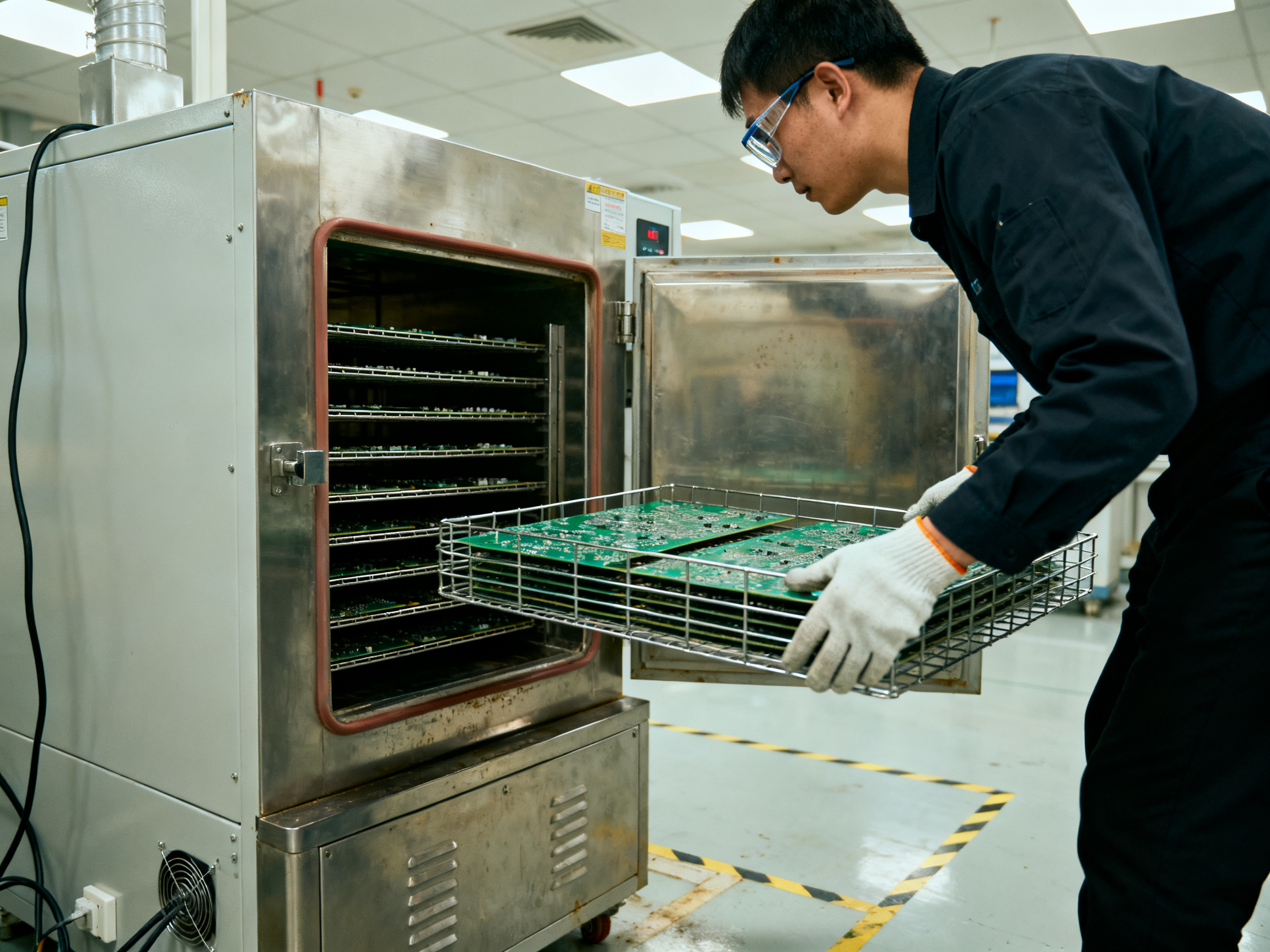
Batch ovens process a limited number of parts or fixtures in an insulated chamber. They are practical for prototype work, low-volume production, and materials with predictable, short schedules. Batch curing offers flexibility because different recipes can be run from one oven.
The main challenge is load-to-load consistency. The placement of boards, the amount of mass, the choice of shelves, and the distance from the airflow or heating elements can all influence heat-up time. Qualification must therefore include representative worst-case loads rather than only a lightly loaded chamber.
Conveyorized Curing Ovens
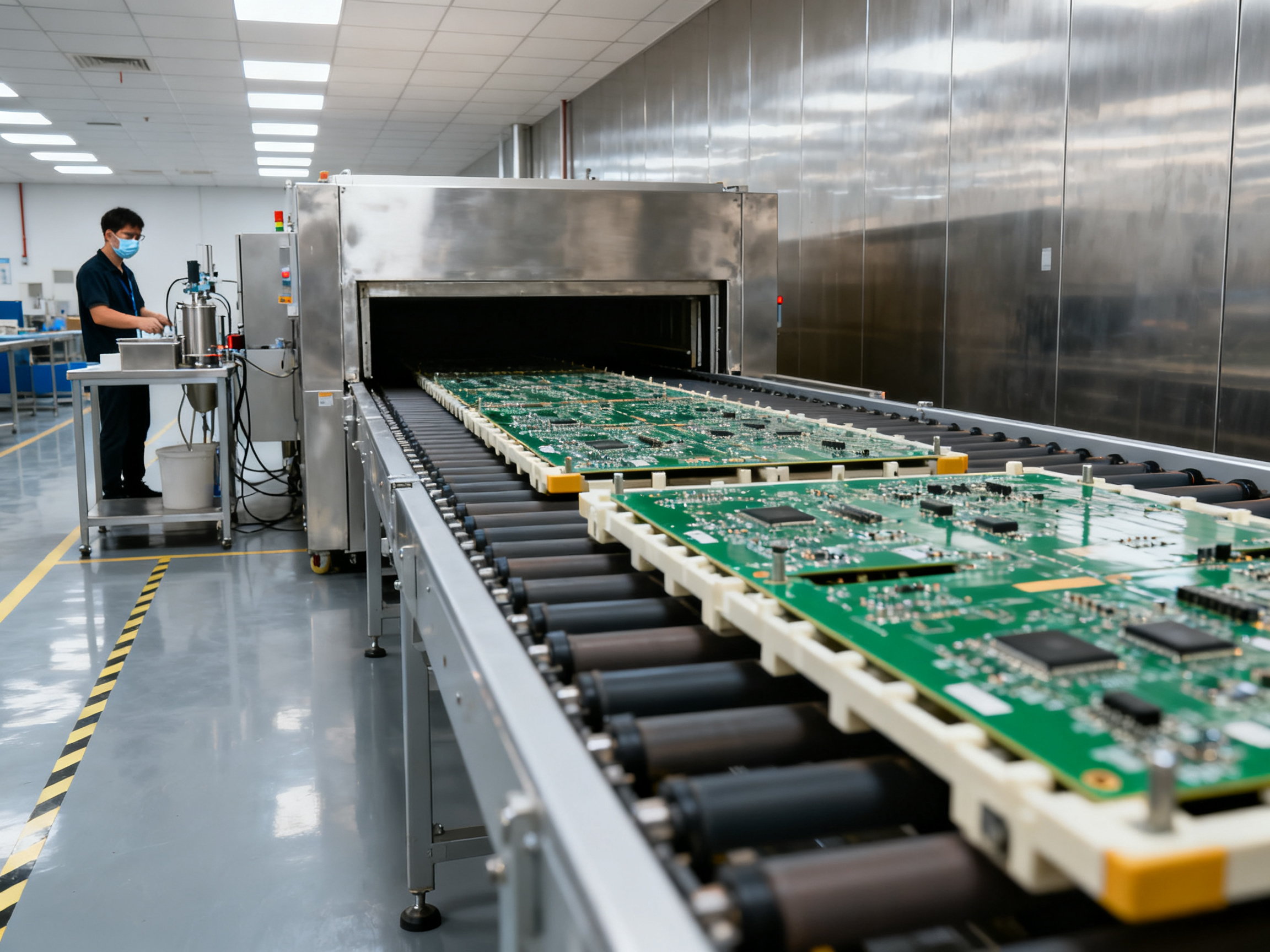
Conveyor ovens move parts continuously through one or more heated zones. They suit high-volume workflows where cycle time and repeatability are critical. Uniformity is maintained through controlled airflow, appropriate conveyor speed, zone partitioning, and defined fixture spacing.
Conveyor systems can reduce manual handling, but they also impose constraints on part size and orientation. Overlapping parts may block airflow, and heavy assemblies may not remain stable on the chosen fixture. Recipe development must account for these effects.
Forced-Air Drying and Curing Cabinets
These cabinets use filtered, temperature-controlled air to heat and dry loads. Many can serve as curing systems when their airflow, temperature uniformity, and environmental controls satisfy the material’s process requirements. They are common for coatings and adhesives that benefit from air exposure around all surfaces.
A drying cabinet should not automatically be considered a curing oven. Its airflow pattern, humidity control, filtration, temperature recovery, and ability to maintain a qualified soak may differ from those required for a chemical cure.
Hybrid Cure-and-Dry Systems
Some production environments use systems that combine moisture removal with cure heating. These are useful where a coating contains solvent that must evaporate before crosslinking, or where a product specification requires controlled drying followed by a thermal cure. The sequence must be defined by the supplier because simultaneous drying and cure can produce different results from sequential stages.
Controlled-Environment or Atmosphere Ovens
Where oxygen level, humidity, contamination, or flammability matters, an atmosphere-controlled oven may be appropriate. These systems are less common in general electronics assembly than in specialized coating, optical, or advanced-material processes. The enclosure must prevent hazardous interactions and should include suitable monitoring and safety controls.
Principal Applications in Electronics Manufacturing
Conformal Coating Curing
Conformal coatings protect PCB assemblies from dust, moisture, chemicals, and electrical contamination. UV-curable coatings may receive a final thermal post-cure, while solvent- or water-based coatings often require an extended thermal drying and cure cycle.
For a coating process, oven parameters affect more than the material’s hardness. Temperature, dwell, and ramp rate influence bubbles, flow, adhesion, reworkability, color, and chemical resistance. Fixtures should support coated areas without creating marks, and boards should be spaced so that airflow can remove volatile material. Coating thickness, coverage, and formulation must remain consistent because cure requirements can change with deposited mass.
Epoxy Underfill and Board-Level Adhesive Curing
Epoxy underfill is placed beneath selected components, particularly flip-chip devices, to improve mechanical reliability, redistribute stress, and protect the assembly. The epoxy is commonly dispensed before or after placement and then thermally cured.
Underfill cure profiles are constrained by the component and substrate. Excessive temperature can damage the device, moisture-sensitive package, or board. Insufficient cure can leave the device vulnerable to motion during subsequent handling or testing. Gap fill, dispensed volume, cure shrinkage, and cure-cycle repeatability should be monitored as part of the process.
Structural and Bonding Adhesives
Heat-cure epoxies, acrylics, silicones, and other adhesives are used for component bonding, lid attachment, heat-sink installation, and mechanical reinforcement. These applications may involve mixed materials with different thermal expansion behavior, making controlled ramp and cool-down particularly important.
The adhesive’s cure schedule must coexist with the soldering and component-handling requirements. For example, an assembly may be electrically tested before cure but should not receive mechanical loads until the adhesive has reached a defined handling strength.
Selector and Die-Attach Processes
In power modules, die attach, substrate attach, and other high-reliability bonding operations may use dedicated cure ovens or controlled heating systems. These processes often require tighter temperature control and traceability than a general-purpose coating cure.
Solder Mask and Other Printed Film Processes
Solder mask is normally cured during the reflow process rather than in a separate downstream curing oven. Some non-reflow applications, specialty inks, or printed dielectric films do require separate thermal processing, but the distinction should be verified with the material supplier.
Moisture-Sensitive Device Baking
Pre-baking moisture-sensitive devices, or MSDs, before soldering is a drying operation rather than a curing operation. Its purpose is to control moisture absorbed by the package. A drying oven used for this purpose should not be confused with a chemical curing oven, although the same heated chamber can sometimes perform both functions when configured and qualified appropriately.
Integrating a Curing Oven into an SMT Line
A curing oven is usually downstream of coating, dispensing, bonding, or placement. If the oven is part of a conveyor line, its cycle time must be coordinated with the upstream process and the downstream inspection, testing, or packaging stations. A faster oven is not automatically more efficient if it introduces a queue, obstructs operators, or prevents parts from reaching a safe handling state.
Integration should address the following questions:
- What is the process sequence? Identify whether the oven performs drying, cure, post-cure, or a combined cycle.
- What constitutes a complete load? Define maximum dimensions, weight, fixture type, number of boards, and allowable spacing.
- How is the recipe controlled? Determine whether operators select recipes manually or the oven receives them from production software.
- How are records retained? The system should log the recipe, date, operator, lot, oven status, and relevant alarms.
- How are deviations handled? An out-of-tolerance temperature, door event, fan failure, or power interruption needs a defined disposition.
- Can material be loaded safely? Parts and fixtures must remain stable at the maximum process temperature.
- How does the line respond to a stoppage? Plans should account for interrupted cycles, rework, and material exposed beyond its qualified total thermal history.
The floor around the oven matters as well. The equipment needs enough space for loading, unloading, fixture access, and maintenance. Exhaust or ventilation must satisfy the safety requirements of the selected coating or adhesive. Good process control includes protecting the oven from dust, conductive debris, and accidental impact.
How to Select a Curing Oven
The first selection criterion is the qualified process, not chamber volume. Begin with the coating, epoxy, or adhesive data sheet and identify every thermal requirement the oven must meet.
Temperature Range and Stability
The oven should cover the required process temperature with margin for control accuracy and measurement uncertainty. Temperature stability must be evaluated across the usable chamber volume under actual load conditions. A wide operating range is useful when several materials share the oven, but broad specifications do not replace qualification for each recipe.
Airflow and Temperature Uniformity
Uniformity is critical when every part in a load must receive equivalent treatment. Evaluate the oven’s airflow pattern, fan arrangement, baffles, and heating strategy. Parts that block airflow should be prohibited from the qualified load configuration.
Ramp Rate and Soak Control
Some profiles require slow heating or multiple holds. The oven should be able to follow the specified sequence, recover after loading, and maintain the soak temperature without significant overshoot.
Load Capacity and Geometry
Capacity should be based on usable space rather than nominal chamber dimensions. Consider fixture clearance, airflow paths, load weight, thermal mass, and conveyor geometry.
Monitoring and Traceability
For qualified production, look for independent temperature monitoring, event logging, recipe control, alarm capability, and access to process records. Dual-thermocouple or other product-temperature verification may be necessary during qualification even if every production oven does not require a sensor on every part.
Safety and Compliance
The installation should meet local electrical, ventilation, occupational, and fire-protection requirements. The oven should have appropriate overtemperature protection, door interlocks, and controls for the materials processed in it. Materials should also be assessed for compatibility with the chamber, racks, fixtures, and any cleaning agents.
Total Cost of Ownership
Compare energy consumption, installation, consumables, maintenance, calibration, spare parts, and operator time. A lower purchase price can be offset by poor uniformity, long recovery times, unreliable controls, or difficult maintenance access.
Qualifying and Maintaining the Process
A curing oven should be treated as a controlled process tool rather than as general-purpose equipment. A sound qualification program normally includes the following steps.
Establish the Material Recipe
Start with the manufacturer’s cure data, then confirm that the recipe is compatible with the actual assembly, coating thickness, dispensing volume, fixture, and production load. If the data sheet provides ranges, select a defined operating point that demonstrates compliance with the finished-product requirements.
Perform an Empty-Chamber Survey
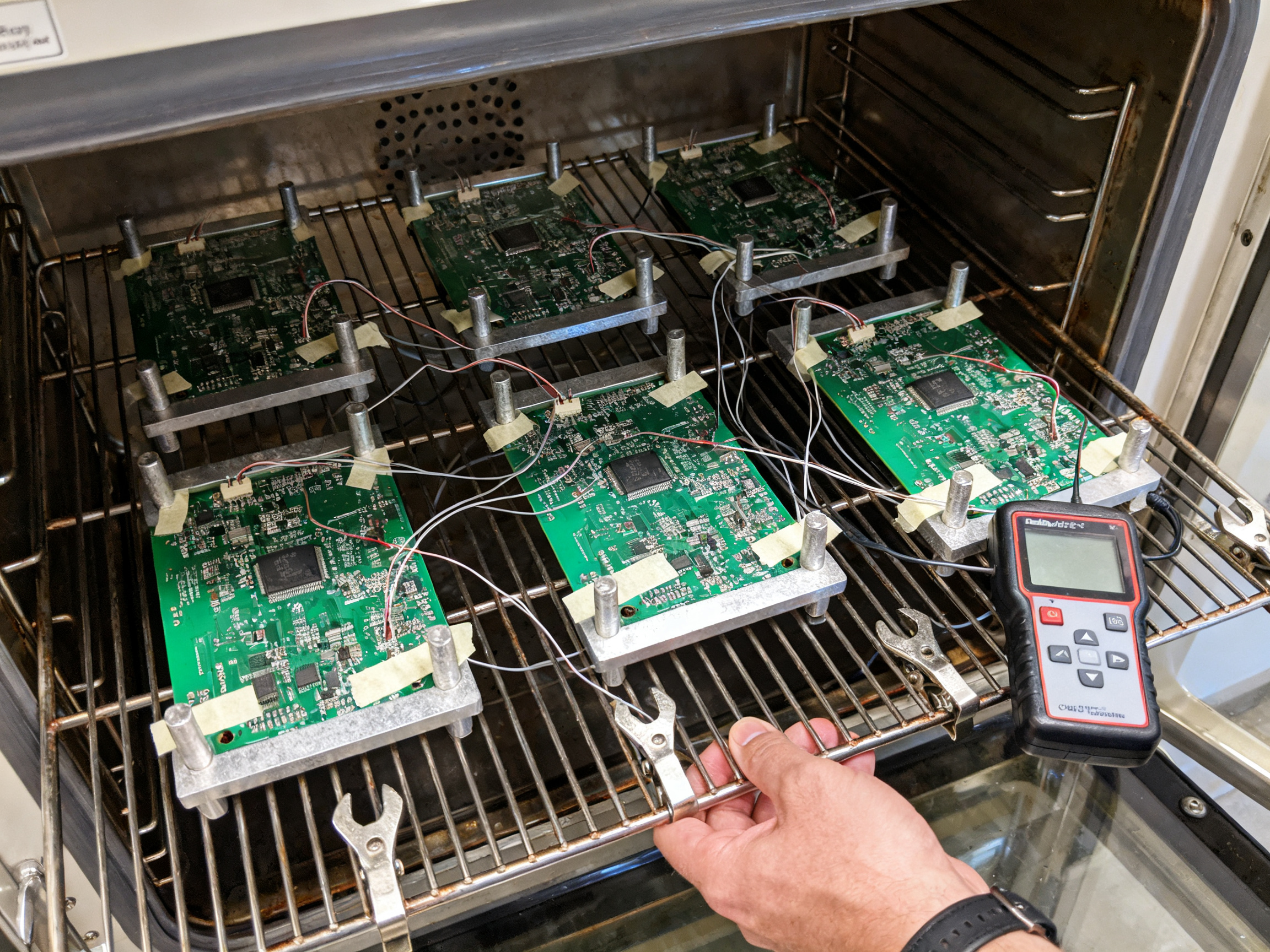
Map chamber temperature at multiple locations using calibrated equipment. Evaluate the usable volume rather than only the center point. Include expected operating temperatures and repeat the survey after maintenance, sensor replacement, or a significant equipment change.
Perform a Loaded Thermal Mapping Study
Instrument representative assemblies with product-level thermocouples and run worst-case loads. Measure heat-up, soak, temperature variation, and cool-down. This study confirms whether the center of a dense board actually receives the required thermal exposure.
Verify the Critical Process Outputs
Temperature and time are only two parts of the cure. Process validation may also need to demonstrate coating adhesion, hardness, chemical resistance, bond strength, underfill void control, reworkability, or other application-specific properties. The inspection method should be capable of distinguishing a qualified process from an undercured or thermally damaged one.
Control Routine Maintenance
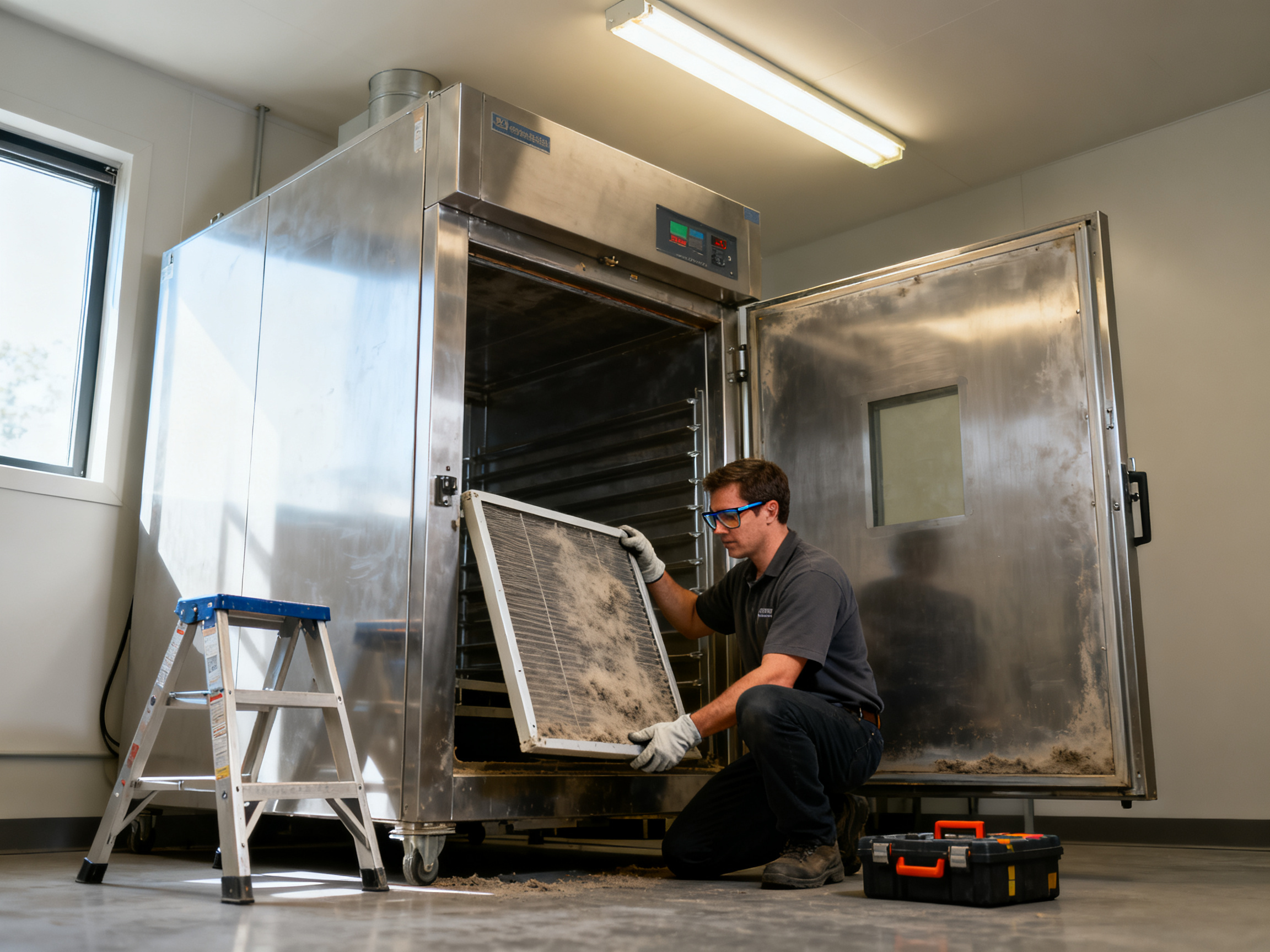
Maintenance schedules should cover filters, fans, heating elements, door seals, sensors, conveyor components, and electrical connections. A preventive-maintenance check can detect drift and airflow restrictions before they affect production.
Calibrate and Recalibrate
Calibration intervals should follow the equipment’s stability, usage, and quality-system requirements. Critical sensors should be traceable to suitable standards. Calibration should include verification, not just instrument adjustment, because an instrument that is adjusted incorrectly can conceal a chamber problem.
Manage Recipe Access and Change Control
Only approved recipes should be available to production personnel. A new coating, adhesive, fixture, load pattern, or oven configuration may require requalification. Temporary deviations should be documented and reviewed against the material’s maximum thermal exposure.
Common Failure Modes
Undercured Coating or Adhesive
Symptoms include soft surfaces, tackiness, poor adhesion, low chemical resistance, or epoxy that has not reached handling strength. Common causes are insufficient soak temperature, an inaccurate cure-time definition, an overloaded oven, a blocked airflow path, or an unverified recipe.
Bubbling or Blistering
Bubbles may result from trapped solvent, moisture, poor coating geometry, excessive heating rate, or inadequate drying before cure. Material compatibility and part preparation should also be reviewed.
Discoloration or Charring
These defects usually indicate excessive temperature, excessive exposure, an incompatible material, or contamination inside the chamber. The oven’s actual temperature survey and the product’s recorded cycle should be checked before blaming a single component.
Poor Adhesion
Possible causes include contamination, inadequate surface preparation, excessive cooling, a ramp that creates stress, an incorrect recipe, or a coating cured beyond its useful life before use. Adhesion testing should be correlated with the surface and material involved.
Inconsistent Results Between Ovens
Differences can arise from load configuration, airflow, calibration status, recovery time, maintenance history, or a recipe that was never transferable between equipment designs. Equivalent setpoints do not guarantee equivalent part temperatures.
Thermal Damage
Damage may appear as cracked packages, solder-joint stress, coating shrinkage, or degraded adhesives. It can result from an excessive profile, repeated unplanned cycles, an interrupted process followed by an incorrect restart, or a recipe used outside its qualified limits.
A Practical Qualification Checklist
Before releasing a cure process for production, confirm that:
- The oven model and configuration match the qualified design.
- The oven is installed in the intended production environment.
- Chamber and product temperatures have been mapped under representative loads.
- The cure schedule is traceable to the current material data sheet.
- Fixtures, spacing, load orientation, and maximum capacity are controlled.
- Production operators can select only approved recipes.
- Temperature records, alarms, and interruptions are traceable to each lot.
- Preventive maintenance and calibration are scheduled.
- The process has been shown to produce acceptable physical and chemical results.
- Changes to materials, parts, recipes, fixtures, or equipment have a defined requalification path.
Conclusion
A curing oven is the controlled thermal step that turns deposited coating, adhesive, or epoxy into a stable, qualified material. Its value is not measured by whether the chamber reaches a displayed temperature. The value is measured by whether every part receives the required heat history and the finished assembly meets its reliability and workmanship requirements.
That makes curing oven selection a process-engineering decision rather than an equipment-only decision. Define the material schedule, characterize the real workpiece, qualify the load, connect records to production, and maintain the equipment over time. Done correctly, the curing oven becomes more than a stainless steel box at the end of the line: it becomes a repeatable source of product quality.### About the Author
Author photo placeholder: [Author Name, Title/Role, S&M Co. Ltd.]
[Author Name] is a [Title/Role] at S&M Co. Ltd., which operates as Shenzhen Chuxin Electronic Equipment Co., Ltd., an SMT equipment manufacturer building lead-free reflow ovens, wave soldering machines, and complete SMT production lines.
The work is hands-on rather than purely commercial. [Author Name] supports consumer electronics, semiconductor, automotive, and military manufacturers across Asia and North America with specification, line integration, and validation of soldering and thermal-process equipment, including troubleshooting BGA and QFN defect rates, conformal coating workflows, and lead-free compliance upgrades.
That background shapes how this guide is written. Every process point here comes from equipment that has to hold up on a real line, not from a brochure.
Credential strip placeholder: S&M Co. Ltd. | Shenzhen Chuxin Electronic Equipment Co., Ltd. | SMT equipment, reflow ovens, wave soldering, full-line integration. Individual staff names, titles, and certifications will be added before publication.## What Is a Curing Oven? Definition and Core Purpose
Here is the short version. A curing oven is a sealed, temperature-controlled enclosure that applies controlled heat, and sometimes humidity, vacuum, or UV, for a defined dwell time so a material reaches its specified cure state. That single definition is where most buying decisions go wrong, because plenty of heated boxes sit on factory floors doing other jobs and get filed under “curing oven.”
The three jobs a curing oven actually does
1. Chemical crosslinking. Thermosets, epoxies, silicones, acrylics, and UV-curable chemistries finish their reaction inside a curing oven. The material goes from liquid or soft to a fully polymerized network with its final mechanical and chemical properties. This is the job most people picture when they hear the word.
2. Solvent and moisture removal. Volatiles have to leave the deposited film before or during crosslinking. Trapped solvent shows up later as bubbles, softness, or delamination. Many modern thermal curing ovens handle outgassing as part of the same cycle rather than as a separate step.
3. Post-apply heat treatment. A cure cycle can also relieve assembly stress, improve bond strength, and set a coating harder than its chemistry alone would allow.
What it is not
Buyers regularly mix up four adjacent pieces of equipment. The differences are real, and each one needs its own qualification data.
| | Curing oven | Reflow oven | Bake / drying oven | Environmental test chamber |
|—|—|—|—|—|
| Heater type | Forced convection, infrared, steam, or UV | Forced convection or infrared | Forced convection | Forced convection, with cooling |
| Typical range | Room temp to about 200 to 250°C | About 200 to 260°C for lead-free paste | About 100 to 150°C for bake-out | Broad, often minus 40 to plus 150°C |
| Purpose | Complete a chemical cure on a deposited material | Melt solder paste and form joints | Drive moisture out of moisture-sensitive packages | Stress-test products through cycling, humidity, and shock |
| Key spec | Soak accuracy plus part-temperature uniformity | Profile control and thermocouple tracking | Recovery and low humidity | Ramp rate, control resolution, chamber size |
| Output | Hardened coating, cured epoxy, bonded joint | Soldered PCB | Dry package, ready to solder | Test report, no production part |
A bake oven is a drying oven, and a moisture-sensitive device bake should never be run off a coating cure recipe. An environmental chamber stresses a finished product rather than processing one. And a reflow oven is a soldering tool, not a curing tool, even though both live in the same thermal family.
Vocabulary you will meet in every datasheet
- Cure schedule: the full recipe, temperature, time, ramp, and cooling for a specific material.
- Soak or dwell: the hold at a target temperature once the load has reached it.
- Ramp rate: how fast the chamber or part changes temperature.
- Setpoint: the temperature the controller is asked to hold.
- Working volume: the space that is actually qualified for processing.
- Thermal uniformity: how much temperature varies across that working volume.
- Cure state: how far the chemistry has progressed toward full crosslinking.
Get comfortable with those seven terms before you compare quotes. It is much easier to spot an oven that looks good on paper but has no useful working volume once you know what the words mean.
How Does a Curing Oven Work? Core Working Principles and the Four-Zone Thermal Profile
Ask most people how a curing oven works and they will point at the temperature dial. That is the display, not the mechanism. The real answer is a closed chain of six parts, and if any one of them is weak, the whole cure suffers.
The heat path, from element to PCB
- Heater element. Most electronics ovens use electric resistance elements. Industrial ovens at scale often use gas-fired infrared, and a small number use steam. The energy source sets the ramp speed and the control resolution you get.
- Heat exchanger and recirculating fan. The fan pulls chamber air across the elements and pushes it back. This is the single biggest influence on uniformity.
- Plenum and baffles. Baffles distribute the recirculated air so it does not short-circuit straight back to the fan inlet.
- Air distribution over the load. Racks, fixtures, and panel spacing shape the flow. A dense board sitting in a dead zone gets a different history than an empty shelf.
- Sensor feedback. A thermocouple or RTD probe in the chamber closes the loop.
- PID control. The controller uses that feedback to manage ramp, soak, and cool on its own.
Here is the practical bit. The chamber probe reads chamber air. Your PCB sits in that air, but a board with a lot of copper, a heavy aluminum fixture, or a stack of panels will not sit at the same temperature as the air. Sensor placement and qualified load mapping are how you close that gap.
The four-zone profile
| Zone | What happens | Why it exists |
|—|—|—|
| Ramp / preheat | Chamber climbs to process temperature at a controlled rate | Even heat-up, less thermal shock, lets coating wet out |
| Soak / flash-off | Hold at target while volatiles leave and temperature equalizes | Removes solvent or moisture before crosslinking hardens the film |
| Cure / hold | Dwell at setpoint for the material-specified time | This is where the chemistry actually completes |
| Controlled cool-down | Heat is removed at a controlled rate | Avoids condensation, thermal gradients, and handling damage |
The cool-down is a process step, not an afterthought. Pulling a coated board out at 180°C into a 24°C aisle can put condensation on the surface you just paid to protect. Fast cooling also stresses solder joints and shrinks curing coatings, which is where edge cracking comes from.
Energy sources change what you can control
Electric forced air is the default in SMT because it is cheap, clean, and easy to control to a fraction of a degree. Infrared and convection hybrids ramp faster, which helps UV-hybrid coatings that need a thermal tail after a UV pass. Gas-fired suits very high volume industrial work where fuel cost beats electricity, but the burner is a slower thing to modulate, so you trade resolution for throughput.
The three parameters that decide whether a loaded batch cures evenly
Uniformity is the temperature spread across the working volume. Recovery is how fast the chamber returns to setpoint after a cold load is inserted. Overshoot is how far past setpoint it swings while hunting. All three are measured with a load in the chamber, not empty.
Humidity-sensitive coatings add a dew-point control loop on top, so the chamber can hold moisture in check while still delivering heat.
Instrumentation and records
Qualified production runs need independent temperature recorders, alarm history, recipe change logs, and event stamps tied to a lot number. That matters most in military and aerospace work, where an auditor may ask for the thermal history of a specific serial number months later.
Pro Insight: Most line stoppage tied to curing is not about chamber temperature. It is soak time at the wrong point in the profile. We tune dwell zones to the specific coating data sheet rather than running a generic bake cycle, and we recommend validating the profile with an oven recorder on every new coating changeover.
In our line audits, the same oven can pass a setpoint check and still deliver a 10 to 15°C gradient across the working volume once a real load is in place. That gap is where uneven cure, soft spots, and failed adhesion come from.
Want to see how this profile translates into a full production flow? S&M Co. Ltd. builds lead-free reflow ovens, wave soldering machines, and complete SMT lines, so curing can be planned as one station in a sequence rather than an afterthought bolted onto the end.## Types of Curing Ovens Used in Electronics Manufacturing
“Which curing oven do we need?” is a fair question, because the honest answer depends on four separate choices: how the load enters and leaves, how heat reaches it, what the load looks like, and how much control you want. Get one of those wrong and you end up with a shiny new oven that cannot qualify a single recipe.
By configuration: how the work moves through the oven
Batch cabinet ovens hold a limited number of racks, shelves, or a trolley inside an insulated chamber. They are the flexible choice for prototypes, low-volume batches, and lines running several different coating chemistries. The trade-off is load-to-load consistency, since where you place the boards and how much mass you stack changes the heat-up time.
Conveyorized ovens carry fixtures continuously through one or more heated zones. Repeatability and cycle time are the reasons to buy one, and manual handling drops away. What you inherit is rigidity: part size, orientation, and spacing all become fixed by the fixture and conveyor geometry.
Inline tunnel ovens sit directly downstream of coating, dispensing, or assembly equipment and share the line flow, so parts never have to be staged by hand. They work well in a high-volume cell, but they commit you to a fixed line length and a fixed upstream speed.
By heating method
| Heating method | How it works | Typical fit in electronics | Watch out for |
|—|—|—|—|
| Electric forced air | Resistance elements plus recirculation fan and baffles | The default choice for SMT coating and adhesive cure | Duct or fan blockage shows up as uneven cure |
| Infrared | Emitters heat the part directly | Fast ramp, good for UV-thermal hybrid coatings | Surface-driven, so color and geometry matter |
| Steam or humidity-controlled | Heated steam sets both temperature and moisture | Coatings sensitive to humidity, controlled environments | Needs pressure and utility infrastructure |
| UV and UV-thermal hybrid | UV flash plus a controlled thermal tail | Fast cure on shadowed or mixed-access assemblies | Cure depth depends on light access |
| Vacuum-assisted | Reduced pressure lowers boiling point | Low-volatility or hermetically sealed work | Longer cycles, higher equipment complexity |
Electric forced air dominates in electronics manufacturing because it is cheap, clean, and easy to hold to a fraction of a degree, which is usually what a coating data sheet asks for.
By workload and control level
Open-tray and shelf ovens handle discrete parts, cable harnesses, and small assemblies. Panel and rack ovens handle PCB batches, so you think in terms of panels per load. Large-chamber industrial ovens handle oversized assemblies such as power modules or potted units.
On the control side, the range runs from a simple timer with one setpoint, through multi-zone PID with programmable recipes, to networked ovens that log to MES or IoT platforms and pull recipes by work order. That last level is where traceability lives, and traceability matters most in defense and automotive work where an auditor may ask for the thermal history of one serial number months later.
Special variants exist too: cleanroom-compatible ovens for medical and defense cleanlines, nitrogen-purge ovens for moisture-sensitive device work, and explosion-proof or ATEX-rated chambers for solvent-heavy processes.
Typical ranges and cycle times
| Oven type | Usual temperature band | Typical cycle | Best use |
|—|—|—|—|
| Batch cabinet | Roughly 50 to 250°C | 30 minutes to several hours | Coating, epoxy, prototypes |
| Conveyorized | Roughly 60 to 200°C | Minutes, tied to line speed | High-volume coating and bonding |
| Inline tunnel | Roughly 60 to 180°C | Minutes, continuous | Cells with no manual handling |
| Large-chamber industrial | Often above 200°C for some cycles | Hours | Oversized or heavy assemblies |
Treat those bands as starting points for a conversation with the supplier, not as published specifications. Your own data sheet sets the real numbers.
Expert Tip: Match oven configuration to throughput, not to board size. A batch cabinet oven handling two racks of panels often beats a conveyor oven on a low-volume line, and it costs a fraction of the floor space. On the other hand, a line running more than 2,000 PCBs a day can justify a conveyorized or batch-in-chamber oven, because labor and rework cost more than the oven does.
That last point is worth repeating. On high-volume lines the oven is rarely the expensive part. Rework, scrapped panels, and an operator waiting on a slow cycle are the expensive part, and they scale with throughput while the oven does not.
One more variant worth naming: the epoxy curing oven. The name sounds like it refers to a special machine, but it usually just means a batch oven configured for a specific epoxy’s schedule. Same hardware, different recipe, different load pattern, and a qualification file of its own.## Applications: What a Curing Oven Is Actually Used For in Electronics Manufacturing
Now that you know how the machine works, the useful question is what it does all day. The short answer is that an industrial curing oven supports far more than conformal coating, even though coating is where most people first encounter one.
Conformal coating curing
This is the headline application. Silicone-modified epoxy, polyurethane, and acrylic coatings get applied to PCBs in consumer electronics, automotive ECUs, and military avionics, then baked so the film crosslinks into a hard, chemically resistant shell. Coating classifications such as those described in IPC-CC-830 and IEC 61086-2-1 work hand in hand with the oven, because the classification you claim depends on the film actually being fully cured. Thickness and coverage matter as much as the schedule; a thicker deposit holds more solvent and needs a longer tail.
Adhesive, underfill, and potting curing
Board-level adhesive and epoxy underfill go under flip-chip devices in smartphone and semiconductor packaging, and they cure thermally. Die attach in power modules and reworkable chip bonding work the same way, with tighter control. Potting compound cures in a closed or filled geometry, so outgassing matters more here than anywhere else.
Solder mask and post-solder stabilization
Solder mask normally cures inside the reflow profile, not in a separate downstream oven. But stress-relief cures for specialty solder resists, and stabilization steps for flux residue after wave soldering or selective soldering, do use standalone heating.
Uses outside the SMT line
Cable harness potting, transformer and coil encapsulation, gaskets, and composite prepreg curing all borrow the same oven class. These are bigger loads with different geometry, but the physics of heat-up, soak, and controlled cool-down stays the same.
Compliance changes the recipe
Lead-free and RoHS-aligned processes, VOC-controlled coating chemistries, and halogen-free requirements narrow the acceptable cure windows. Halogen-free chemistry can behave differently during thermal exposure, and VOC limits push you toward different solvent systems with different flash-off needs. Compliance itself does not prescribe a schedule, but it changes which schedules you are allowed to use.
The adjacent use: dry bake
Moisture-sensitive device bake-out is a drying job, not a curing job. Same heated chamber can often do both, but only with a separate qualification and a separate recipe.
| Application | Material | Typical cure profile | Governing reference |
|—|—|—|—|
| Conformal coating | Silicone-modified epoxy, polyurethane, acrylic | Ramp, soak at material-specified temperature, controlled cool | Coating supplier data sheet; IPC-CC-830 and IEC 61086-2-1 for classification |
| Underfill and board adhesive | Epoxy, acrylic | Multi-stage ramp, extended hold, slow cool to protect the device | Supplier data sheet plus customer qualification |
| Die attach and potting | Epoxy, silicone, filled resin | Controlled ramp to limit void formation, hold, staged cool | Supplier data sheet; thermal cycle verification |
| Solder resist and stress relief | Ink or resist film | Short elevated bake after print | Ink supplier data sheet |
| Cable and coil encapsulation | Epoxy, polyurethane, silicone | Long soak, heat-sink-aware cool | Compound data sheet |
| MSD dry bake | None (moisture drive-out) | Low-temperature drying with recovery control | Internal handling specification |
From Our Experience: In line audits we have seen ovens sold on peak wattage and temperature range that were undersized on airflow. The chamber reached setpoint, yet a loaded shelf showed a 10 to 15°C gradient, and that gradient is the real cause of uneven cure and out-of-spec adhesion. Always ask for the qualified working volume and an airflow figure, and request a load-mapping report.
And here is the flow that ties it together. Coating dispensing, then the curing oven, then UV inspection, adhesion testing, and thickness measurement, then electrical test. The oven is not the end of the line; it sits in the middle of a chain that either proves the coating is good or sends the board back for rework. If you are planning that chain from scratch, S&M Co. Ltd. builds lead-free reflow ovens, wave soldering machines, and complete SMT lines, so the cure station can be designed around the flow rather than dropped into it later.
Ready to size an oven for your own line? The next section covers the specifications that actually change your results.## Industrial Curing Oven vs. Electronics Curing Oven: What Actually Differs
People ask us this one a lot, usually after they realize their powder coating oven is not a drop-in replacement for a coating cure station. Same basic idea, very different machine.
An industrial curing oven handles bulk work: coil enameling, composite prepreg, powder coating, large castings. The chamber can be enormous, the heater is built for volume, and the job is throughput on commodity material.
An electronics curing oven does a much tighter job on a much smaller load. The chamber holds PCBs, panels, or small fixtures. The heat has to be even across a load that is full of mixed materials, and the recipe has to hit a datasheet, not a general work order.
The differences that actually change results
Scale and structure. Industrial ovens are built around chamber volume and watt density. Electronics ovens trade chamber size for footprint density and uniformity at lower setpoints. A bigger oven does not give you a better cure on a dense board.
Precision. Electronics work usually calls for tight uniformity in the 60 to 200°C range plus fast recovery after the door opens. Industrial ovens often run hotter and tolerate a wider band because the end product is steel, not a populated PCB.
Cleanliness and traceability. ESD-safe interiors, low-particulate design, and logging that ties each cycle to a lot or serial number are routine asks in electronics. A general industrial oven spec sheet often stops at temperature range and wattage.
Economics. An industrial oven amortizes across commodity volume. An electronics oven has to earn its keep per cured board, so footprint, energy per cycle, and cycle time carry more weight in the purchase decision.
| Specification | Industrial curing oven | Electronics curing oven |
|—|—|—|
| Chamber volume | Large, built around bulk loads | Compact, sized to panels and fixtures |
| Temperature range | Often high, above 200°C | Typically 50 to 250°C |
| Uniformity target | Wider band acceptable | Tight uniformity across the load |
| Heating method | Gas, infrared, large electric elements | Electric forced air with baffles and recirculation |
| Footprint | Floor and utility space | Bench or cell footprint, fits an SMT line |
| Connectivity | Basic or none | Recipe logging, MES or work-order integration |
| Best fit | Coil, composite, powder coat, castings | Conformal coating, underfill, adhesive cure |
One practical note from our line audits: when a customer swaps a general industrial oven into a coating cell, the failure almost never comes from the heater. It comes from airflow and load mapping. Ask for the qualified working volume and a loaded temperature survey before anything else.
Want the rest of the flow mapped out? S&M Co. Ltd. builds lead-free reflow ovens, wave soldering machines, and complete SMT lines, so the cure station can be planned as one station in a working sequence instead of a box dropped in at the end.## Selecting the Right Curing Oven: Specifications That Actually Matter
Buying a curing oven for electronics manufacturing is easy to get wrong, because the spec sheet flatters the machine. Wattage looks impressive, temperature range looks generous, and the price is competitive. Then the first qualified recipe fails to hold setpoint under load.
Start from the material data sheet instead of the equipment catalogue. Every specification below only matters once you know the thermal schedule your coating, epoxy, or adhesive actually requires.
Working volume and load geometry
Usable working volume is not the same number as chamber size. You need to know the qualified volume, the shelf and rack spacing, and the clearance around a fixture once a loaded panel is sitting in it. Airflow paths matter more than cubic metres. A panel that blocks the recirculation path will not receive the same cure as one that sits in a clear lane.
Thermal performance
Ask four questions: what is the uniformity across the working volume with a load in place, how long does the chamber take to recover after the door opens, what is the maximum ramp rate, and does the temperature range hold with and without a load? A chamber that reaches setpoint empty and stalls for 20 minutes with a real load is a common and expensive surprise.
Profile control
Look for multi-zone or multi-step programmability, recipe storage with operator lockout, and a data logging interval fine enough to reconstruct an event. Records must be exportable in a format your quality system can read, because an auditor asking about one serial number should not mean a week of manual chart hunting.
Total cost of ownership
Energy per cycle, heater and fan service life, spare parts lead time, consumables, and calibration intervals all belong in the comparison. The cheapest oven on the invoice is rarely the cheapest oven per cured board.
Integration readiness
Confirm the connectivity your line actually needs: Profinet, EtherNet/IP, Modbus, SECS/GEM, or IPC-CFX for MES hand-off. Also check fume extraction interfaces, door swing clearance, and whether an operator can load a full rack without twisting or two people.
Service and support
Ask whether the supplier performs on-site uniformity mapping and profile qualification, and get a written response time for on-site calls in your region. A supplier who will not map your load is telling you something useful.
| Specification | Why it matters | What to look for | Red flag |
|—|—|—|—|
| Qualified working volume | Determines whether your actual load fits the process | Qualified volume stated with a mapped load | Only nominal chamber dimensions quoted |
| Airflow figure (CFM per shelf) | Drives uniformity and recovery | Supplier-provided airflow plus loaded mapping report | Sold on peak wattage alone |
| Uniformity under load | The real driver of even cure | Survey report with a representative load | Survey shown empty only |
| Recovery time | Sets cycle time between batches | Measured recovery with the door opened | No recovery figure offered |
| Recipe programmability | Protects the process from operator error | Multi-step ramps, holds, cool-down, locked recipes | Single setpoint with a manual timer |
| Logging and export | Audit and traceability | Per-lot records, exportable format | Records only on a local panel |
| Connectivity | MES and work-order hand-off | Named protocol support | “Can be integrated” with no protocol |
| Ventilation interface | Solvent-bearing coating work | Extraction connection specified | No mention of exhaust |
| Service and mapping support | Long-term process stability | On-site mapping and written response time | Remote support only |
From Our Experience: In line audits we have seen ovens sold on peak wattage and temperature range that were undersized on airflow. The chamber reached setpoint, yet a loaded shelf showed a 10 to 15°C gradient, and that gradient is the real cause of uneven cure and out-of-spec adhesion. Always ask for the qualified working volume and an airflow figure, and request a load-mapping report.
S&M configuration comparison
| Configuration | Best fit | Capacity per cycle | Control level |
|—|—|—|—|
| Batch cabinet oven | Prototypes and low-volume lines | 2 to 4 racks of panels | Multi-step recipe with logging |
| Conveyorized curing oven | Continuous high-volume cells | Continuous, tied to line speed | Zone-based PID, MES hand-off |
| Inline tunnel oven | Cells with no manual handling | Continuous, no staging | Zone-based PID, networked recipes |
Product data to be confirmed by the S&M Co. Ltd. technical team before publication.
If you are planning the whole cell rather than a single box, S&M Co. Ltd. builds lead-free reflow ovens, wave soldering machines, and complete SMT production lines, so the curing station can be specified as one step in a working sequence instead of an add-on at the end.## Integrating the Curing Oven Into an SMT Production Line
A curing oven that sits alone at the end of the line, waiting for someone to carry panels to it, is a bottleneck dressed up as a process step. Integration is where the oven either becomes part of the flow or quietly caps your throughput.
Where it belongs in the sequence
The curing station normally sits after coating or dispensing and before inspection. UV inspection, coating thickness measurement, adhesion testing, and final electrical test all depend on the coating being cured. Put the oven downstream of those checks and you are inspecting a film that has not hardened yet.
Dispense / Coat  >  Staging  >  Curing Oven  >  Cooling  >  UV Inspect
                                                      >  Thickness
                                                      >  Adhesion
                                                      >  Final Test
That staging buffer matters. Without one, the oven dictates the speed of the coating machine and the operator runs back and forth instead of watching the line.
Workflow and takt time
Batch loading is ergonomic or it is a strain injury waiting to happen. Two operators lifting a full rack at 150°C is bad, and one operator doing it alone is worse. Check whether the rack loads from waist height, whether the door swing clears the conveyor, and whether a full load can be moved without twisting.
Takt time is the number that matters. A 90-minute cure cycle feeding a 40-minute coating cycle means the coating machine waits. The cure cycle must be shorter than, or equal to, the upstream and downstream takt, or you need buffers on both sides.
Recipe changeover is where losses hide. If you run silicone-modified epoxy on the day shift and polyurethane on nights, the oven has to be cleaned, purged, and re-qualified for each switch, and those changeover minutes are pure scrap risk if the purge is short.
Quality control integration
Qualify the first article of every new recipe. Run an independent recorder, not just the oven display, and attach the profile to the lot. Then treat the cure records as process data: chart soak temperature and time against the control limits so drift shows up as a trend rather than a surprise failure.
From Our Experience: The ovens that cause trouble on a line are almost never the ones with bad heaters. They are the ones nobody mapped under load, so every board in the cell has a slightly different cure history. Get a qualified working volume, an airflow figure, and a loaded temperature survey before you sign the purchase order.
Environment and safety
Solvent-bearing coatings need extraction at the chamber, not a general room fan. The oven also dumps real heat into a cleanroom, which shifts the balance for the coating booth and the reflow oven downstream. Electrical and thermal protection should be checked against local requirements, and material safety data sheets should drive the ventilation design rather than a rule of thumb.
Commissioning checklist (IQ/OQ)
- IQ: Oven installed in the intended location, utilities connected, extraction proven, interlocks and alarms functional.
- OQ: Empty-chamber survey completed, then loaded mapping at worst-case load, independent recorder used, cure results confirmed on finished assemblies, records exportable to the quality system, recipes locked to approved lists.
One practical note. A curing oven, a lead-free reflow oven, and a wave soldering system share utilities, operators, and cycle planning. S&M Co. Ltd. builds reflow ovens, wave soldering machines, and complete SMT production lines, so the cure station can be specified as one station in a working sequence rather than a box dropped in at the end.## Maintenance, Calibration, Safety, and Common Mistakes
An oven that was qualified in January can drift by July, and the drift will not announce itself. Most cure problems we investigate were never a bad recipe. They were a dirty filter, a loose baffle, or a sensor that had slowly moved off its value.
Preventive maintenance
- Heater elements: inspect for element breakdown, uneven glow, and terminal oxidation. Elements do not fail loudly, they just heat less.
- Fans and bearings: listen for rumble and check blade buildup. A failing fan reduces airflow, and airflow is what uniform cure actually depends on.
- Filters and baffles: clean on a fixed interval. A restricted recirculation path shows up as a 10 to 15°C gradient across the load.
- Door seals: replace when the seal hardens or tears, otherwise hot air leaks and recovery slows.
- Probes and recorders: calibrate on a schedule tied to usage and stability, and verify accuracy as well as adjustment. An instrument adjusted incorrectly can hide a chamber fault rather than reveal it.
| Interval | Task |
|—|—|
| Weekly | Clean filters, check door seal, confirm fan noise level |
| Monthly | Inspect elements and terminals, clean baffles, check recipe logs |
| Quarterly | Calibrate chamber probes and independent recorders, verify recovery and loaded uniformity |
| Annual | Full service of fans and bearings, re-run chamber survey, review recipe history |
Troubleshooting by symptom
| Symptom | Likely cause | Corrective action |
|—|—|—|
| Temperature overshoot after setpoint | Oversized heaters, weak control tuning, dirty filters | Balance airflow, restore filter condition, retune PID |
| Slow recovery after loading | Undersized airflow for load mass | Re-map load, adjust spacing, review qualified volume |
| Hot and cold spots across shelves | Blocked recirculation path | Clear baffles, reposition racks, requalify load pattern |
| Condensation on cool parts | Excessively fast cool-down, no staging area | Extend cool-down, add controlled cooling or dwell |
| Persistent odor | Incomplete solvent flash-off | Lengthen flash-off stage, verify ventilation performance |
Common mistakes
Overloading racks and blocking the recirculation path. Running a generic bake profile instead of the coating data sheet. Opening the door during soak and pretending the cycle still counts. Skipping cool-down because parts look fine hot. And mixing cure chemistries inside one recipe, which nobody can qualify or troubleshoot later.
Safety and documentation
Burn and hot-surface risk comes first, so gloves and a defined loading method matter more than most spec sheets admit. Solvent vapor needs extraction at the chamber, sized from the material safety data sheet rather than a rule of thumb. Electrical service requires lockout. Coated parts should be handled as hot and uncured until the cycle completes.
For military, aerospace, and medical customers, retain cure logs. Recipe, date, operator, lot, alarms, and interruptions should be exportable to your quality system, because an auditor asking about one serial number should not mean a week of chart hunting.
Want the whole station planned rather than a single box? S&M Co. Ltd. builds lead-free reflow ovens, wave soldering machines, and complete SMT production lines, so curing can be specified as one step in a working sequence.## Conclusion: Practical Recommendations From the Line Floor
So, what is a curing oven? It is a controlled chamber that gives a deposited coating, adhesive, or epoxy the heat and time it needs to reach its specified cure state. But it is not a heat source, and that distinction matters. Cure quality is set by the profile and by the part temperature inside the load, not by the setpoint glowing on the display.
Recap: five things worth remembering
- A curing oven is a process-control tool, not a heater. Temperature, dwell time, ramp rate, and cool-down together define the cure.
- Chamber temperature is not part temperature. A loaded shelf can sit 10 to 15°C off the probe, and that gap causes soft spots and failed adhesion.
- Match the oven to throughput and chemistry first. Batch cabinet, conveyorized, and inline tunnel each win on different lines.
- Drying and curing are different jobs. A bake oven is not a curing oven until it has been qualified as one.
- Records are part of the product. In 2026, a cure cycle with no traceable log is a cycle you cannot defend.
Here is how we rank the decisions. Match oven type to your volume and your coating chemistry first. Then optimize uniformity and data capture. Only then compare price. An oven that is cheap and uneven will cost more than it saves.
Next steps you can take this week
- Run a load-mapping survey on the oven you already own. Put a qualified thermocouple in the corners of a real load, not an empty chamber, and document the spread.
- Pull cure records for the last 50 batches. Compare each recipe against the current coating data sheet. Watch for recipes that drifted from the supplier schedule.
- Define one qualified recipe before you scale volume. A single documented profile, with its load pattern, fixture spacing, and inspection method, beats five undocumented ones every time.
The reason curing matters more in 2026 than it did a decade ago is simple. Boards got denser, packages got smaller, and lead-free, automotive, and military qualification got stricter. What used to be a timer and a thermostat is now a measured, audited process step with a paper trail.
If you want a second set of eyes on your cure station, the S&M Co. Ltd. technical team can help scope a line audit or a profile qualification alongside your reflow and wave soldering setup. Reach out and we will walk the process with you.